
Reviewed · ROME
Julius Caesar and the Emperors’ Nighttime Stories
Rome’s ancient rulers come alive on this evening walk, not as a string of dates but as flawed people caught in murder, family conflict, ambition, and forbidden love. Guide Massimo links each story to a real Roman site, from Caesar’s assassination place at Largo Argentina to Nero’s former burial ground in Piazza del Popolo.
I like the cooler evening timing, which helps you avoid the worst daytime heat and crowds. I also like the human focus, especially the story of Julia, Augustus’ only child, which gives the tour an emotional center. The main drawback is that this is an outdoor walking tour, so poor weather can cancel it and cold evenings call for warm clothes.
In This Review
- Key points to know
- Rome after dark, with emperors at the center
- Largo Argentina and the death of Julius Caesar
- The Pantheon and Marcus Agrippa’s climb to power
- Piazza di Pietra and the complicated reign of Hadrian
- Piazza Colonna and the spiral of Marcus Aurelius
- Augustus’ mausoleum and Julia’s heartbreaking story
- Piazza del Popolo and the troubled Nero
- Why the evening timing works
- What the $47.06 price gets you
- Who should book this Rome walking tour
- Practical details before you reserve
- Should you book it?
- FAQ
- How long does Julius Caesar and the Emperors’ Nighttime Stories last?
- What language is the tour offered in?
- How much does the tour cost?
- Where does the tour begin?
- Where does the tour end?
- Which places do you see during the walk?
- Is admission to the sites included?
- Can I cancel for a full refund?
Key points to know
- Caesar’s murder begins the story: Start at Largo Argentina, the ancient square tied to the Ides of March.
- Massimo is the main attraction: His lively delivery, humor, and careful pacing turn political history into personal drama.
- Six major Roman settings shape the route: See the Pantheon, Piazza di Pietra, Piazza Colonna, Augustus’ mausoleum, and Piazza del Popolo.
- The tour is best after the heat fades: Departures run in the late afternoon or evening, when Rome’s streets feel more comfortable.
- The route ends well for dinner: Finish at Piazza del Popolo, close to the Flaminio Metro station and a taxi stand.
- Small groups keep the storytelling personal: The maximum group size is 20 people.
Rome after dark, with emperors at the center
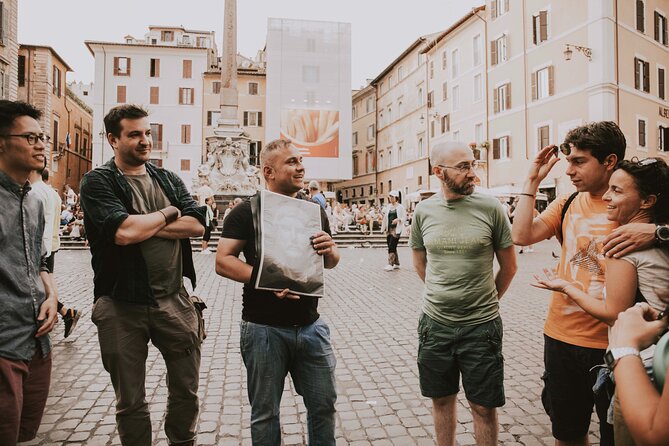
This is a walking tour about power, but it is not mainly a tour of military victories or building dates. Its real subject is character. You hear about the people who wanted power, the families damaged by it, and the rulers who could not separate public life from private desire.
The route takes about 2 to 3 hours and covers six stops. Admission to the sites is free because you view the monuments and ruins from public spaces rather than entering paid attractions. That keeps the price at $47.06 per person, a fair sum for a small-group guided walk lasting most of an evening.
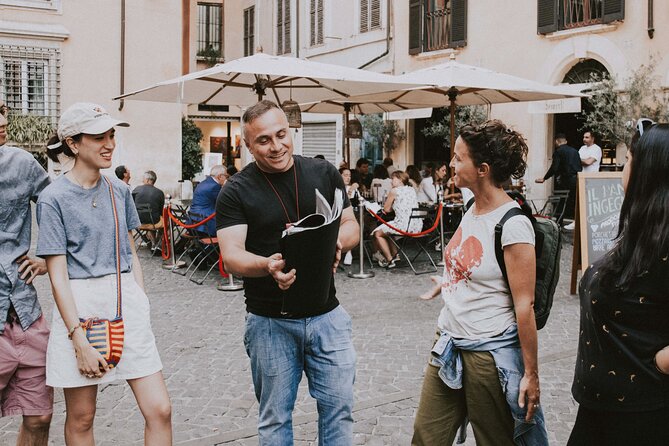
Massimo’s style matters here. The strongest praise for this experience centers on his energy, humor, and storytelling skill. He also contacts participants before the walk with practical advice, including a warning to keep warm at night. That small touch is useful in Rome, where a mild afternoon can turn chilly after sunset.
The route is offered in English. The group can reach up to 20 people, though one account describes the guide conducting the walk for only two people. You should not count on a private tour, but the format can sometimes feel close to one.
Tours travellers often pair with this one in Rome:
- Vatican: Museums & Sistine Chapel Entrance Ticket
★ 4.5 · 144,003 reviews - Vatican Museums & Sistine Chapel Tour with Optional Basilica
★ 4.3 · 67,413 reviews - Vatican Museums, Sistine Chapel & St Peter’s Basilica Guided Tour
★ 4.5 · 39,149 reviews
Largo Argentina and the death of Julius Caesar
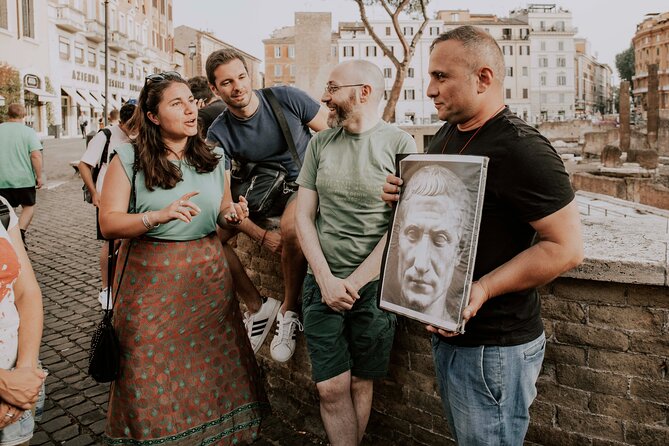
The tour starts at Via Florida, 14, near Area Sacra di Largo Argentina. This is an easy place to begin a story about Roman power because the ruins are tied to one of the most famous political murders in history.
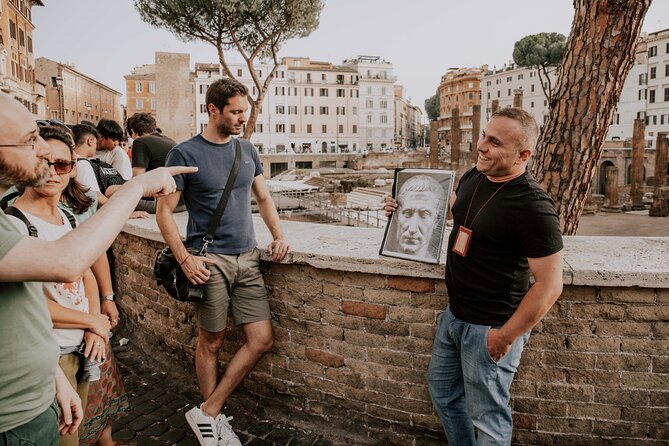
At Largo Argentina, you see the square associated with Julius Caesar’s assassination. The surrounding ruins belong to ancient temples, and the open archaeological area gives the first stop a strong sense of place even though you do not enter a museum or monument.
The guide uses Caesar’s death as a doorway into the larger story of the Roman Empire. This is a good opening because it immediately raises questions about loyalty, betrayal, and the price of political ambition. You are not simply told where Caesar died. You are asked to consider the people around him and the motives that pushed them toward violence.
You spend about 30 minutes here, including the first storytelling. Since the stop is outdoors, your experience depends partly on the light, temperature, and noise of the city. The evening setting helps, but you still need comfortable shoes and enough attention for a walk rather than a seated lecture.
The Pantheon and Marcus Agrippa’s climb to power
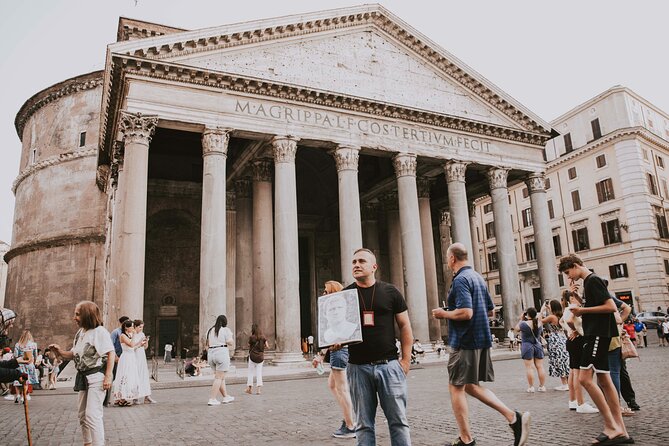
The route continues to the Pantheon, one of Rome’s most memorable ancient buildings. You view it from outside at night and hear about Marcus Agrippa, the powerful Roman who rose to become the second most powerful man in the world during the first century BC.
This stop adds useful contrast to Caesar’s story. Caesar is remembered as a dictator whose murder changed Rome. Agrippa’s story shows a different path to influence, built through service, political skill, and close ties to the ruling family.
The Pantheon itself is not entered on this tour, so book this walk for the story and the nighttime view, not for an interior visit. If you want to study the dome, the inscriptions, or the famous opening in the roof at length, plan a separate daytime visit.
The stop lasts about 20 minutes. That short format works well for a walking tour. You get a focused story without spending too long in one place, then move on while the city remains part of the experience.
Piazza di Pietra and the complicated reign of Hadrian
At Piazza di Pietra, tall ancient columns create one of the most atmospheric settings on the route. These are second-century ruins, and the guide connects them with Emperor Hadrian, one of Rome’s most capable rulers.
Hadrian is a useful choice for this location because his reign brings a different mood to the tour. The story moves away from the raw shock of assassination and toward the question of what makes a ruler effective. You hear about a leader whose place in Roman history is tied to administration, empire, and personal interests.
You spend around 20 minutes in the square. The columns are best appreciated from street level, where you can see how ancient remains fit into modern Rome. This is one of the tour’s strongest features: you do not move from one sealed attraction to another. You walk through ordinary streets and suddenly find a large piece of the ancient city integrated into the present one.
That said, street-based sightseeing has limits. You will not receive the same close examination of carvings or building details that you might get on an archaeological tour. The reward is a broader sense of Rome as a city where different periods occupy the same space.
A completely different way to spend the day in Rome:
- Rome: Colosseum, Palatine Hill and Roman Forum Guided Tour
★ 4.8 · 32,814 reviews - Rome: Guided Tour of Colosseum, Roman Forum & Palatine Hill
★ 4.7 · 27,897 reviews - Rome: Colosseum & Forum with Audio Guide App -Optional Arena
★ 4.2 · 24,770 reviews - Rome: Colosseum, Roman Forum and Palatine Hill Guided Tour
★ 4.5 · 23,903 reviews
Piazza Colonna and the spiral of Marcus Aurelius
The next stop is Piazza Colonna, home to the Column of Marcus Aurelius. This second-century monument carries a spiral relief carved from bottom to top, showing key moments from the emperor’s life and campaigns.
A column like this can be easy to overlook if you are walking through central Rome on your own. The relief sits high above street level, and the details are difficult to study without guidance. Massimo gives the monument a purpose by explaining how the spiral works and what it was meant to show.
This stop also brings the story back to the public image of an emperor. The column is not just decoration. It presents a carefully shaped account of authority, military success, and the ruler’s place in the Roman world.
The visit lasts about 20 minutes. You should expect a spoken explanation rather than a long visual study of every section of the relief. If you have binoculars or a strong zoom camera, you might find them useful, but no special equipment is required.
Augustus’ mausoleum and Julia’s heartbreaking story
Piazza Augusto Imperatore gives the tour its emotional high point. Here you see the Mausoleum of Augustus, a first-century burial site built for the emperor who helped reshape Rome after years of civil conflict.
The guide turns from Augustus himself to his only child, Julia. Her story focuses on her strong personality and independence in a period when women of her position had little freedom to define their own lives. That makes this stop more than a monument talk. It becomes a close look at family control, expectation, and the personal cost of imperial politics.
I find this part especially valuable because it widens the tour beyond famous men. Julia is connected to the central political family, yet the story asks you to think about what power looked like from inside the household. The account is described as heartbreaking, and it provides the emotional weight that makes the earlier political stories matter.
You spend about 25 minutes here. The mausoleum is seen from the square, so do not expect an interior visit. The site has also been part of Rome’s changing urban setting, which can make the contrast between the ancient burial place and the modern city particularly striking.
Piazza del Popolo and the troubled Nero
The route ends at Piazza del Popolo, roughly two millennia ago associated with the burial site of Emperor Nero. Today it is one of Rome’s major public squares, with the Basilica of Santa Maria del Popolo at the meeting point.
Nero’s story closes the walk with a psychological portrait. Massimo discusses Nero’s relationship with his mother, Agrippina, and the emperor’s fierce wish to become an artist. That desire placed him at the center of public attention and helps explain why his rule remains so memorable.
This is not a simple villain story. The emphasis on Nero’s family and artistic ambition gives you a more personal way to think about his conduct. You hear about a ruler who wanted recognition not only as emperor, but also as a performer.
The final storytelling lasts about 20 minutes. Ending here is practical. Piazza del Popolo has a taxi stand, and Flaminio Metro station on Line A is nearby. You can also continue into the square’s restaurants for dinner, making the tour easy to fit into an evening plan.
Why the evening timing works
Rome’s famous sites can be tiring in the middle of the day. The late-afternoon or nighttime departure avoids much of the strong sun and gives the walk a more dramatic setting. The monuments are not illuminated in a way that guarantees perfect viewing, but the cooler air and changing light suit stories about emperors, scandals, and murder.
You should dress for the actual season rather than assume Rome will stay warm. Massimo specifically advises participants to keep warm at night, and that is sound advice. Wear shoes you can walk in for several hours, and bring a layer even if the afternoon feels comfortable.
A break is optional. The supplied details do not promise a scheduled stop, so you should eat beforehand or be prepared to continue unless the group pauses. This matters if you are traveling with children or anyone who needs regular rest.
What the $47.06 price gets you
At $47.06 per person, the cost is reasonable if you want an expert-led evening in central Rome rather than a simple self-guided walk. The sites themselves do not require admission on this route, so most of the value comes from the guide’s preparation, pacing, and ability to connect each location to a strong story.
You are paying for interpretation, not entry tickets. That is important. If you prefer to spend an evening inside major monuments, this is not the right purchase. If you have already seen Rome’s headline attractions and want the people behind the monuments, the price compares well with other guided activities.
The group limit of 20 helps protect the experience from becoming a moving crowd. A smaller group makes it easier to hear the guide and ask questions, though the actual size can vary. The high rating of 5 from 71 published ratings, with 100 percent recommending the experience, reflects how strongly the storytelling has connected with people who booked it.
The route also offers good location value. You start near Largo Argentina and finish near public transport, restaurants, and taxis. You do not have to return to the starting point, which saves time if you plan dinner or another activity near Piazza del Popolo.
Who should book this Rome walking tour
I would choose this tour for you if you want Rome’s ancient past presented through human drama rather than a formal academic lecture. It suits first-time visitors who need a clear story connecting several central sites, as well as repeat visitors who have already seen the major monuments and want fresh context.
It should work well for families with older children and teenagers, especially if they enjoy stories about betrayal, ambition, and unusual personalities. One family account describes a son becoming fully engaged after the first 15 minutes, which fits the tour’s quick move into character-driven storytelling.
History fans should also find plenty to enjoy, but you need to accept that this is not a specialist archaeology course. The emphasis is on memorable people and dramatic connections. You will not receive a technical study of every ruin, inscription, or architectural phase.
The tour is also a good match for anyone who wants a low-cost evening activity with a central finish. It is less suited to people who dislike outdoor walking, need frequent scheduled breaks, or want to enter the Pantheon and other monuments.
Practical details before you reserve
Confirmation arrives at booking time. The tour is offered in English, includes a mobile ticket, and allows service animals. It is near public transport, and most people can take part.
The meeting point is Via Florida, 14, in Rome’s 00186 postal area. Allow enough time to find it, since a late arrival can be stressful at the start of a walking experience. Massimo has sent participants directions and a photo of the meeting place, which can help you get oriented.
The walk ends at Basilica Parrocchiale di Santa Maria del Popolo, Piazza del Popolo, 12. From there, Flaminio Metro station is on Line A, and taxis are available. Piazza del Popolo also has restaurants, so you can plan dinner without crossing the city.
Free cancellation is available up to 24 hours before the start time for a full refund. Changes or cancellations within 24 hours are not accepted for a refund. Since the tour requires good weather, a cancellation caused by poor conditions brings the choice of another date or a full refund.
Should you book it?
Book this tour if you want Massimo’s lively storytelling, a manageable route through central Rome, and a personal look at emperors and their families. The stories of Caesar, Agrippa, Hadrian, Marcus Aurelius, Augustus, Julia, and Nero give the walk a clear shape, while the evening timing makes it easier to fit into a busy Rome schedule.
Skip it if your priority is entering monuments, examining ruins in technical detail, or taking a short sightseeing stroll. You will spend up to three hours outdoors, and the optional break is not guaranteed.
For the price, this is a strong choice for an evening when you want Rome to feel less like a list of famous buildings and more like a city shaped by difficult, ambitious, and often troubled people.
FAQ
How long does Julius Caesar and the Emperors’ Nighttime Stories last?
The walking tour lasts approximately 2 to 3 hours.
What language is the tour offered in?
The tour is offered in English.
How much does the tour cost?
The listed price is $47.06 per person.
Where does the tour begin?
The meeting point is Via Florida, 14, 00186 Roma RM, Italy.
Where does the tour end?
The tour ends at Basilica Parrocchiale di Santa Maria del Popolo in Piazza del Popolo, 12, 00187 Roma RM, Italy.
Which places do you see during the walk?
The route includes Largo Argentina, the Pantheon, Piazza di Pietra, Piazza Colonna, Piazza Augusto Imperatore, and Piazza del Popolo.
Is admission to the sites included?
The storytelling walk takes place among Rome’s outdoor highlights, and admission tickets are listed as free. The tour does not include entry into the Pantheon or other paid interior attractions.
Can I cancel for a full refund?
Yes. You can cancel at least 24 hours before the experience start time for a full refund. If bad weather causes the tour to be canceled, you will be offered another date or a full refund.
Newest reviews from Rome
- Rome: Explore the Colosseum and Roman Forum, Half-Day Tour★ 3.9 · 22 reviews
- Palazzo Barberini (Caravaggio Exhibition Is Not Included)★ 3.9 · 22 reviews
- Colosseum, Roman Forum and Palatine Hill- Private Tour★ 5.0 · 22 reviews
- Rome Tuk-tuk Tour with Hotel Pickup and Prosecco★ 5.0 · 22 reviews
- Trastevere and Jewish Ghetto Semi Private Tour MAX 6 PEOPLE GUARANTEED★ 5.0 · 22 reviews
- Colosseum & Roman Forum Semi-Private Tour★ 4.5 · 22 reviews
- Rome: Vespa Tour with Professional Photoshoot as Passenger★ 5.0 · 22 reviews
- Daytrip from Rome to Pompeii and Amalfi Coast★ 5.0 · 22 reviews