
Reviewed · BORGHESE GALLERY TOURS
Borghese Gallery Guided Tour with priority entrance
The Borghese Gallery is one of Rome’s best places to see great art without getting lost in a huge museum. In two tightly planned hours, you move from Bernini’s twisting marble figures to Caravaggio’s sharp, human paintings, with a guide explaining what to notice and why it matters. The art is close enough to inspect, and the rooms themselves are part of the show.
I like the small group of no more than 15 because you can hear the guide and ask questions without shouting across a crowd. I also like the headsets, which help the guide speak clearly while you stand near busy masterpieces. The main drawback is time: the collection is large, and a two-hour highlights tour cannot cover every room in detail. Some galleries may also close for restoration without advance notice.
In This Review
- Key points at a glance
- Why the Borghese Gallery works so well with a guide
- Meeting outside the gallery
- Ground floor: Bernini’s marble in motion
- First floor: Caravaggio’s people and Raphael’s grace
- The palace rooms are part of the collection
- How the 15-person format changes the visit
- Is $73 a fair price?
- Practical preparation before you go
- Who should book this Borghese Gallery tour?
- FAQ
- How long does the Borghese Gallery guided tour last?
- What artworks are included?
- How large is the group?
- Is admission included?
- Where do I meet the guide?
- What languages are offered?
- Should you book it?
Key points at a glance
- Bernini takes center stage: See Rape of Proserpina, Apollo and Daphne, and David on the ground floor.
- Caravaggio and Raphael follow upstairs: The first-floor route includes Young Sick Bacchus and Boy with a Basket of Fruit.
- A 15-person limit matters: The group stays small enough for clear explanations and questions.
- Priority entry saves effort: Meet outside, receive headsets, and enter with skip-the-ticket-line admission.
- Guide quality is central: Agnese, Irene, Silvia, Dimitri, Francesca, and others have been praised for clear stories, humor, and strong art knowledge.
- Plan for a focused visit: Wear comfortable shoes, arrive 20 minutes early, and leave large bags, food, and drinks behind.
Why the Borghese Gallery works so well with a guide
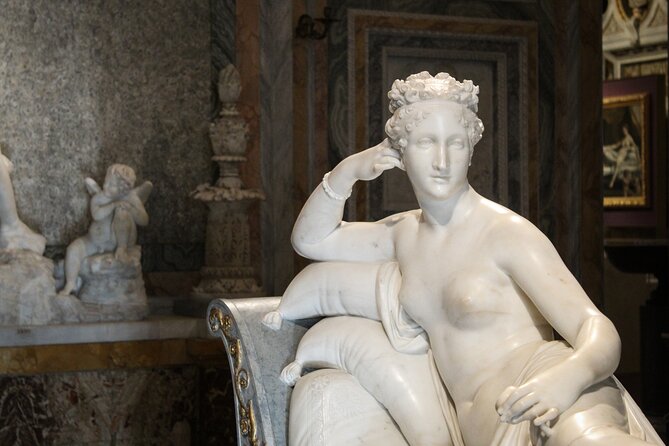
The Borghese Gallery is not simply a building filled with paintings. It was created as a grand setting for the Borghese family collection, and the decoration can compete with the art on display. Gold crown moldings, painted ceilings, and ornate rooms give the sculptures and paintings a theatrical home.
That setting can also make an unguided visit feel scattered. You may see a famous statue, read a short label, and move on without noticing the small choices that make the work special. A good guide gives you a route and a story, so the visit feels less like checking names off a list.
This tour is built around that idea. Instead of trying to discuss every object, the guide focuses on major works by Bernini, Caravaggio, and Raphael, then answers questions about other pieces along the way. That is a sensible choice in a museum where the collection is too large for a full reading in two hours.
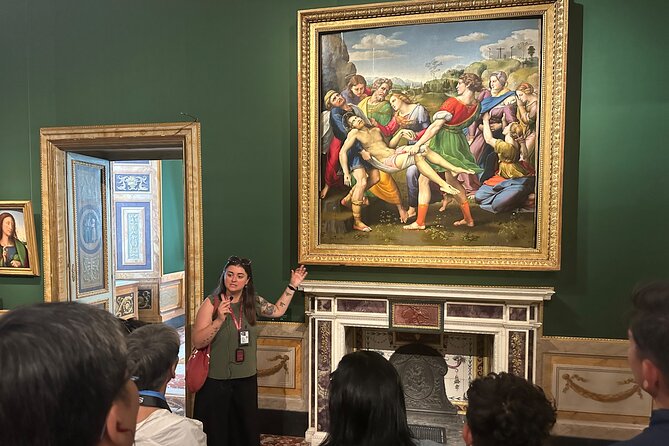
The guide quality will shape your experience. Names praised for warmth, humor, and clear explanations include Agnese, also called Agnes in some bookings, Irene, Silvia, Dimitri, Francesca, Susanna, Lucia, Federico, and Virginia, or Ginia. The provider is Inside Out Italy, and the tour is offered in Italian, English, French, or Spanish.
More Borghese Gallery entries:
- Rome: Borghese Gallery Guided Tour with Skip-the-Line Entry
★ 4.8 · 2,649 reviews - Rome: Borghese Gallery Skip-the-Line Tickets with Audioguide
★ 4.6 · 2,562 reviews - Rome: Borghese Gallery Entry Ticket & Optional Guided Tour
★ 4.5 · 2,237 reviews
Meeting outside the gallery
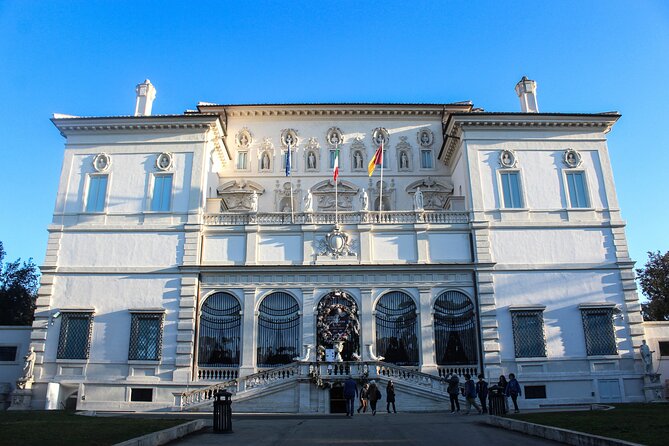
You meet your guide in front of the main entrance to the Borghese Gallery. Look for the sign reading INSIDE OUT ITALY, and check in 20 minutes before the scheduled start.
That early arrival is worth taking seriously. A busy Roman attraction is not the place to stroll up at the last minute while searching for a guide. Give yourself time to locate the meeting point, confirm your group, and collect the headset before the timed visit begins.
The tour includes priority entrance tickets, so you do not need to wait in the standard ticket line. This does not turn the museum into a private room, and entry procedures can still take time, but it removes one of the most annoying parts of visiting a popular Roman sight.
You do not get hotel pickup or drop-off. Plan your own way to the gallery and allow extra time to reach the meeting point. The supplied information does not give a transport service or a detailed arrival route, so check your map and booking confirmation before leaving.
Ground floor: Bernini’s marble in motion
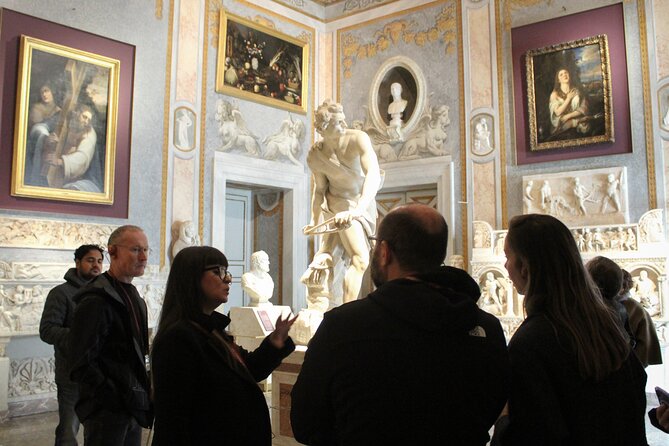
The tour starts on the ground floor, where Bernini’s sculptures provide the first major focus. This is an excellent opening because the works demand close attention. Marble seems to bend, stretch, and react, even though the material is hard and still.
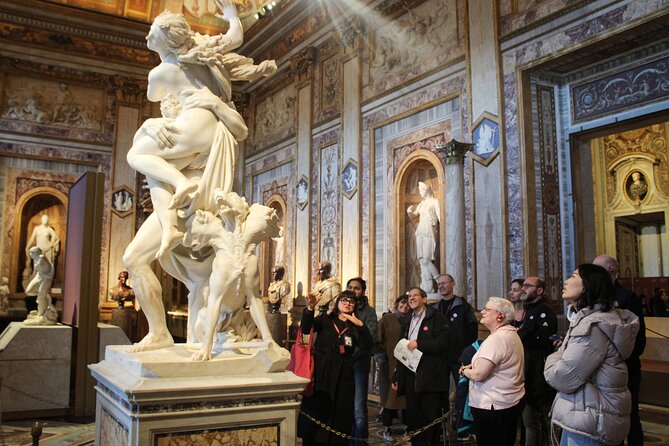
The guide begins with Rape of Proserpina, a sculpture based on a Latin myth. The subject shows Pluto carrying Proserpina away, and the drama is written into the figures’ bodies. Look closely at the details of touch and resistance. Bernini makes the viewer think about the difference between stone and living flesh.
The title uses an older translation of the myth. The scene is not a gentle romance, and a thoughtful guide can help place the work in its mythological and artistic setting without turning the stop into a dry lecture. This is one reason a guided visit helps: the story gives you a way into the sculpture, while the marble details keep you looking.
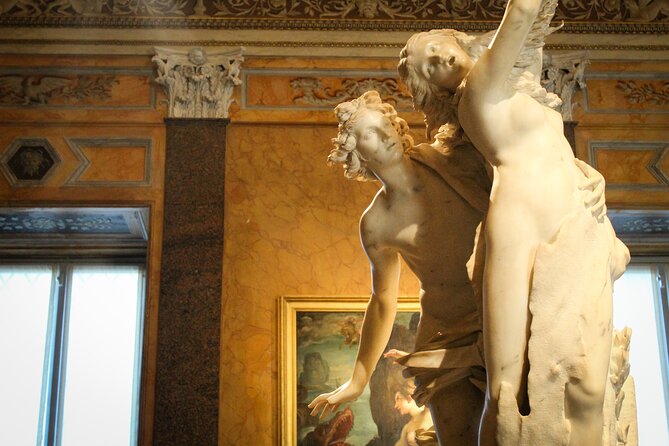
Next comes Apollo and Daphne, another work that rewards a slow look. The story describes Daphne changing into a laurel tree as Apollo pursues her. Bernini captures the instant of transformation, with branches and leaves emerging from the figure.
You will likely notice movement first. Apollo reaches forward, Daphne turns away, and the sculpture seems to unfold as you walk around it. The guide can point out how the composition tells the story from several angles. In a short visit, this kind of explanation is useful because you might otherwise spend your time trying to find the best viewing position.
David brings a different kind of energy. Rather than showing the hero resting after victory, Bernini presents him in action, twisting as he prepares to throw the stone. The body turns through space, and the viewer becomes part of the scene.
This is a strong sequence for the tour. Rape of Proserpina shows emotional and physical tension, Apollo and Daphne freezes transformation, and David turns a biblical story into an active moment. You get three different ways Bernini makes marble feel alive.
The drawback is that these stops can become crowded, especially around the most famous sculptures. The small group and headsets help, but you should not expect unlimited time alone with each work. If you want to study every detail at your own pace, plan to return independently only if the ticketing rules and opening arrangements allow it.
First floor: Caravaggio’s people and Raphael’s grace
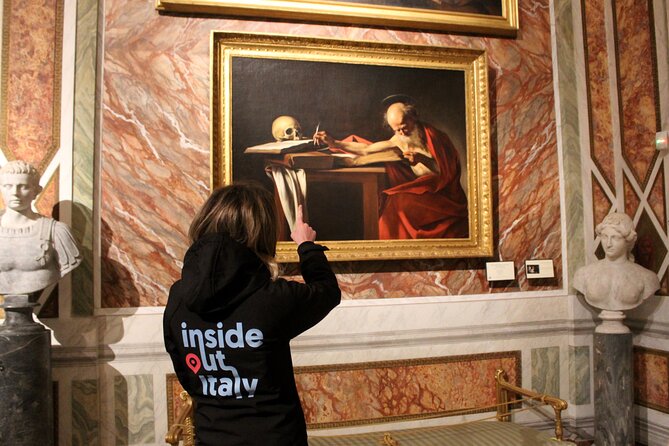
The route continues to the first floor, where the mood shifts from sculptural action to painted faces, bodies, and gestures. The tour highlights works by Caravaggio and Raphael, two artists whose approaches are very different.
Caravaggio’s Young Sick Bacchus gives you a direct, memorable image. The figure looks less like an untouchable ancient god and more like a real person sitting before you. The painting’s physical presence is part of its appeal, but the guide’s role is to connect the figure to Caravaggio’s artistic choices and the wider collection.
The tour also includes Boy with a Basket of Fruit. Caravaggio gives the basket and fruit a vivid presence, while the boy’s expression makes the picture feel personal rather than merely decorative. A guide can help you look at the relationship between the still-life details and the human figure, rather than treating the fruit as background decoration.
One of the useful features of this visit is that the guide can take questions about works outside the main route. You should not assume every painting will receive a full explanation, but the guides described for this experience are prepared to discuss other objects when asked. That flexibility adds value in a museum with such a wide collection.
Raphael brings another tone to the first-floor section. His work can seem calm beside Caravaggio’s raw immediacy and Bernini’s physical drama. The guide helps you see how painting, pose, color, and expression create a different kind of power.
The information provided does not promise a fixed stop-by-stop script beyond the main works named. That is worth knowing. The exact order or amount of time spent at each piece may depend on room access, crowd levels, the guide, and restoration work. The advantage is a human visit rather than an audio recording. The tradeoff is that the experience can vary slightly from one departure to another.
More museums and galleries in Rome:
- Vatican: Museums & Sistine Chapel Entrance Ticket
★ 4.5 · 144,003 reviews - Vatican Museums & Sistine Chapel Tour with Optional Basilica
★ 4.3 · 67,413 reviews - Vatican Museums, Sistine Chapel & St Peter’s Basilica Guided Tour
★ 4.5 · 39,149 reviews - Rome: Vatican Museums, Sistine Chapel & Basilica Tour
★ 4.3 · 13,872 reviews
The palace rooms are part of the collection
Do not keep your eyes only at painting height. The Borghese Gallery’s ceilings and moldings are a major part of the visit, with frescoes covering the ceilings and gold crown moldings framing the rooms.
These details explain why the gallery feels different from a modern white-walled museum. The art was meant to be seen in an ornamental setting, surrounded by decoration and signs of wealth. That does not make the paintings or sculptures less important. It shows how the collection was designed to impress visitors through the whole room.
A guide can help you connect the objects to the Borghese family and to the building itself. Several guides have been praised for adding family history and palace context without allowing it to overwhelm the art. That balance matters. You want enough background to understand the setting, not a long history lesson when Bernini is waiting nearby.
How the 15-person format changes the visit
A maximum of 15 participants is small enough to feel manageable but not intimate in the same way as a private tour. You may still be sharing the room with other museum visitors, and you may need to gather around a sculpture before moving on.
The headsets are an important practical detail. Instead of standing shoulder to shoulder with the guide to catch every word, you can keep a better viewing position while listening. Clear audio is especially useful when the gallery is busy or when the guide is explaining a detail from across the room.
The format also suits families and mixed-interest groups. One highly praised guide, Agnese, was able to keep children and adults engaged by using relatable context instead of speaking like a textbook. That is encouraging if someone in your group tends to lose interest in large art museums.
Still, a group tour has limits. You cannot choose every stop, set your own pace, or linger indefinitely. If you already know the collection well, a private option may suit you better. If you are new to Renaissance and Baroque art, the standard small group should give you a clear foundation.
Is $73 a fair price?
At $73 per person, this is not the cheapest way to enter the gallery. You are paying for more than admission, though. The price includes the priority ticket, a live guide, the small-group limit, and the headset.
I see the strongest value in the planning. You do not have to build your own route through the gallery or spend your limited Roman holiday time deciding which works deserve attention. A strong guide can show you the major Bernini sculptures, explain the Caravaggio paintings, add Raphael, and provide enough palace context to make the rooms more meaningful.
The value depends heavily on how you use the two hours. If you want a quick, structured introduction, $73 is reasonable for a famous museum where the best-known works can be hard to place in context. If you prefer to read every label and spend ten minutes with one painting, the fixed route may feel restrictive.
The consistently high rating of 4.8 from 546 bookings supports the idea that the tour delivers a reliable experience, especially in guide quality. The praise centers on expressive storytelling, clear English, humor, art knowledge, and the ability to make the museum feel less intimidating. That is the part of the price I would care about most.
Practical preparation before you go
Wear comfortable shoes. The visit lasts two hours, and you will spend much of it standing and walking through ornate rooms.
Do not bring food or drinks into the gallery. Large bags and luggage are not allowed, so pack light and make other arrangements for anything bulky before you arrive. The tour is listed as unsuitable for people with mobility impairments, so consider that restriction carefully when booking.
Arrive 20 minutes early at the main entrance. Have the booking details ready, look for the Inside Out Italy sign, and avoid assuming that the guide will be easy to spot from a nearby street.
Room closures are possible because restoration work may continue without advance notice. If part of the gallery is closed, the guide will need to adjust the route. You should see the principal artists listed for the experience, but no museum visit can promise access to every room on a particular day.
Cancellation is free up to 24 hours before the start time, and you can reserve now while paying later. Those terms are useful if your Rome plans are still shifting, but the key decision is still the schedule. Choose a start time that leaves enough room to reach the gallery without rushing.
Who should book this Borghese Gallery tour?
I would choose this tour for a first visit to the Borghese Gallery, especially if Bernini and Caravaggio are high on your Rome list. It also makes sense if you have limited time and want a clear route through the most important works.
Families may appreciate the stories and the shorter format. People who usually feel lost in art museums should benefit from the guide’s explanations and the focus on a manageable set of masterpieces. The range of guide languages also makes the tour practical for many international visitors.
Art specialists or repeat visitors may prefer more freedom. You will not see every work thoroughly in two hours, and the route is built around highlights rather than a full scholarly survey. Restoration closures can also change what is available.
FAQ
How long does the Borghese Gallery guided tour last?
The tour lasts two hours. Starting times vary, so check availability when choosing your booking.
What artworks are included?
The main works named for the visit include Bernini’s Rape of Proserpina, Apollo and Daphne, and David, along with Caravaggio’s Young Sick Bacchus and Boy with a Basket of Fruit. Raphael works are also included.
How large is the group?
The small group is limited to a maximum of 15 participants. Private and other small-group options are also available.
Is admission included?
Yes. Skip-the-ticket-line entrance tickets are included, along with the live guide and headsets for listening clearly.
Where do I meet the guide?
Meet outside the main entrance of the Borghese Gallery. The guide will hold a sign reading Inside Out Italy. Check in 20 minutes before the start time.
What languages are offered?
The tour is offered in Italian, English, French, and Spanish. You can check the available language when selecting a time.
Should you book it?
Book this tour if you want the Borghese Gallery’s greatest hits explained by a lively art guide rather than experienced as a fast walk through unfamiliar rooms. The small group, priority entrance, and headset make the visit easier, while the Bernini, Caravaggio, and Raphael focus gives you a solid two-hour plan.
Skip it if you want to explore every gallery at your own speed or if standing and walking for two hours will be difficult. For most first-time visitors who want art to feel understandable and memorable, the $73 cost is justified by the structure and the guide’s role. Arrive early, pack light, and let the marble figures and painted faces do the rest.
Newest reviews from Rome
- Rome: Vatican Museums & Sistine Chapel Skip-the-Line Ticket★ 4.4 · 148 reviews
- Shared Shuttle Transfer from Rome to Civitavecchia Port★ 5.0 · 148 reviews
- Rome: Crypts & Catacombs After Hours Tour with Bone Chapel★ 4.6 · 149 reviews
- Ghosts Legends and Mysteries of Rome Walking Tour★ 5.0 · 149 reviews
- Skip the Line: Vatican and Sistine Chapel with Guided Tour★ 4.0 · 149 reviews
- Pizza and Tiramisu Cooking Class in Rome, Piazza Navona★ 5.0 · 150 reviews
- Tivoli: Villa Gregoriana Entrance Ticket★ 4.7 · 150 reviews
- Rome: Borghese Gallery Skip-the-Line Entry and Guided Tour★ 4.7 · 150 reviews
Borghese Gallery Tours, compared.
Borghese Gallery Guided Tour with Skip-the-Line Entry
Read our review →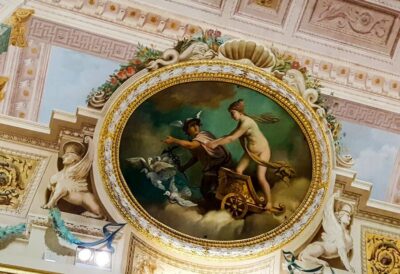
Borghese Gallery Skip-the-Line Tickets with Audioguide
Read our review →
Borghese Gallery Entry Ticket & Optional Guided Tour
Read our review →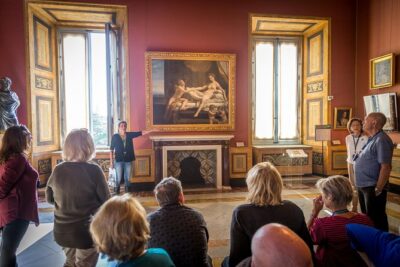
Borghese Gallery & Gardens Small Group Guided Tour
Read our review →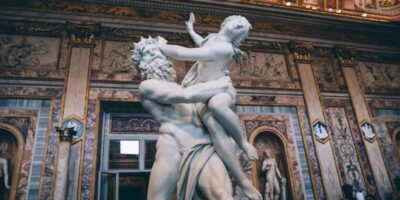
Borghese Gallery, Canova’s Masterpieces Skip-the-Line Guided Tour
Read our review →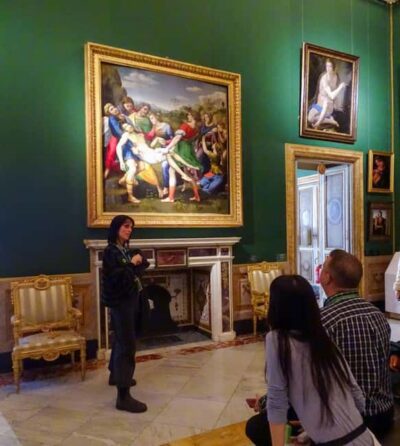
Borghese Gallery Guided Tour with Skip-the-Line Entry
Read our review →Browse the lists this tour appears in