
Reviewed · BORGHESE GALLERY TOURS
Borghese Gallery Guided Tour with Skip-the-Line Entry
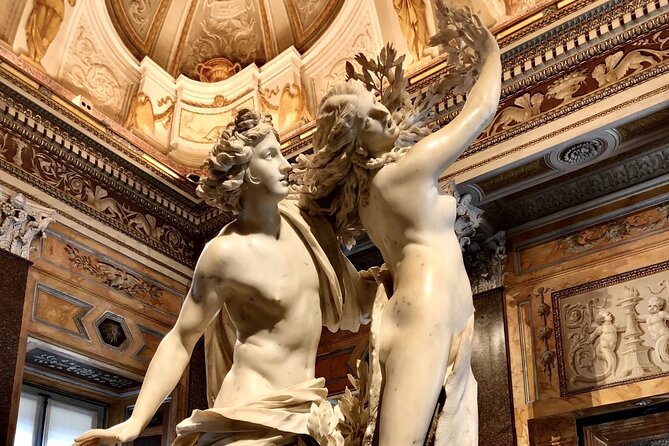
The great prize here is Bernini’s Apollo and Daphne, where marble seems to turn into bark, hair, and trembling fingers. A guide helps you notice the clever details rather than simply walking past another famous statue. I especially like the small group, capped at 15, and the skip-the-line entry, which matters at a museum with tightly controlled admission.
I also like the focused two-hour route through the gallery’s 20 rooms, with headsets available when the room gets noisy. Guides such as Martina, Francesca, Stephanie, Lorenzo, and Serena have been praised for clear explanations and lively teaching. The main caution is timing: late arrivals are not admitted or refunded, and one extended visit ran well beyond two hours.
In This Review
- Key points to know before booking
- Why the Borghese Gallery deserves a guided visit
- Entering at Piazzale Scipione Borghese
- Apollo and Daphne: the 20-minute showstopper
- Pauline Bonaparte as Venus Victorious
- The two busts of Cardinal Scipione Borghese
- Truth Unveiled by Time and the unfinished idea
- Bernini’s David in seven months
- The rest of the 20-room collection
- What the guides add to the visit
- Is $91.95 a fair price?
- Timing, pace, and the two-hour promise
- Who should book this experience?
- Booking, cancellation, and practical cautions
- FAQ
- How long does the Borghese Gallery guided tour last?
- What is the price of the tour?
- Is the tour offered in English?
- How large is the group?
- Is gallery admission included?
- Are headsets provided?
- Where does the tour begin and end?
- What happens if I arrive late?
- Should you book the Borghese Gallery guided tour?
Key points to know before booking
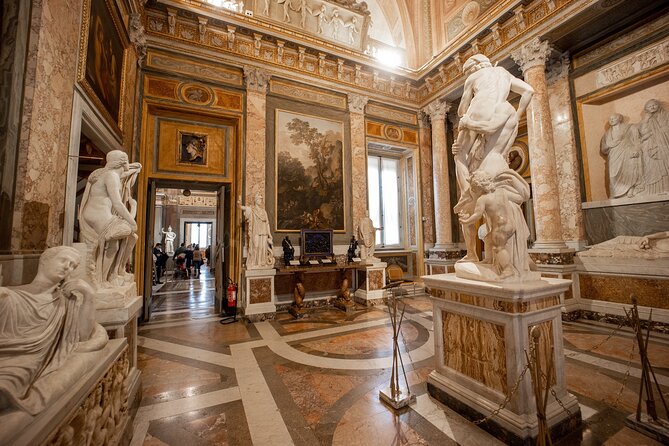
- Bernini takes center stage: Apollo and Daphne, David, the two Borghese cardinal busts, and Truth Unveiled by Time form the core of the visit.
- Small group, not private: The maximum is 15 people, a useful middle ground between a large crowd and a costly one-on-one guide.
- Skip-the-line entry saves time: The group enters with prearranged admission, so you do not spend your short museum visit waiting outside.
- English commentary with headsets: Headsets are available if you need help hearing the guide clearly.
- Arrive 15 minutes early: The museum requires the group to enter together, and late arrivals cannot be accommodated.
- The price is $91.95 per person: That is a premium over admission alone, but it pays for guided interpretation and a more efficient visit.
Why the Borghese Gallery deserves a guided visit
The Borghese Gallery is not a giant museum where you need three days and a color-coded map. Its manageable size is part of the pleasure. You can see major works by Bernini, Caravaggio, Canova, and other artists without wearing yourself out before lunch.
The catch is that a short visit can also become a fast march from masterpiece to masterpiece. This is where the guide earns the fee. You get the visual facts, but also the setting, symbolism, rivalries, and stories that help each work make sense.
The museum’s collection was shaped around the taste and ambition of Cardinal Scipione Borghese. That makes the route especially strong for understanding Baroque art, where movement, theatrical effect, emotion, and technical skill all matter. Instead of seeing a statue as a silent object, you begin to notice the exact moment the artist chose to show.
The experience is offered in English and uses a semi-private group of no more than 15 people. That size is large enough to keep the price below a private tour, yet small enough for a guide to speak to the group without shouting across a room.
More Borghese Gallery entries:
- Rome: Borghese Gallery Guided Tour with Skip-the-Line Entry
★ 4.8 · 2,649 reviews - Rome: Borghese Gallery Skip-the-Line Tickets with Audioguide
★ 4.6 · 2,562 reviews - Rome: Borghese Gallery Entry Ticket & Optional Guided Tour
★ 4.5 · 2,237 reviews
Entering at Piazzale Scipione Borghese
The meeting point is Piazzale Scipione Borghese, 5, in the Villa Borghese area of Rome. Public transportation is nearby, but your booking information should be checked for the exact departure instructions and any route changes.
Build in more time than you think you need. The operator requires you to arrive at least 15 minutes before departure, and the late arrival rule is strict. This is not the sort of museum visit where you can slip through the door and catch up with the group inside.
The reason is practical. Admission is regulated, and the group enters together with the guide. The tickets are arranged for the group rather than handed out for separate individual use. If traffic delays you, the guide cannot simply leave tickets at the entrance.
The tour ends back at the meeting point. Private transportation is not included, so plan your route to and from the gallery separately.
Apollo and Daphne: the 20-minute showstopper
The first featured work is Bernini’s Apollo and Daphne, completed between 1622 and 1625. It shows the climax of the story from Ovid’s Metamorphoses, as Daphne transforms while Apollo reaches for her.
This is the kind of sculpture that rewards a slow look. Focus on Daphne’s fingers becoming leaves, the roots forming at her feet, and the change moving through her body. Bernini worked in marble, yet the scene feels like it is still happening.
A guide can also help you read the work from several angles. The sculpture is not meant to be understood from one flat front view. As you move around it, the expressions and physical tension shift.
The 20-minute allocation is enough for a proper explanation, but it also signals how much ground the tour covers. If this is the work you most want to study, you may wish to return to it after the guided route, if museum rules and remaining time allow.
Pauline Bonaparte as Venus Victorious
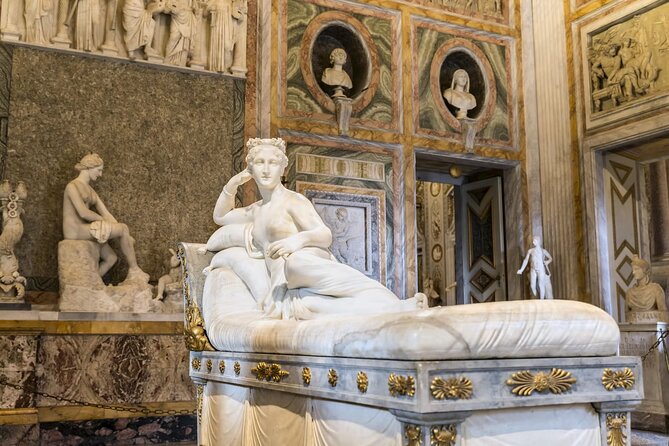
Antonio Canova’s Pauline Bonaparte as Venus Victorious offers a different kind of spectacle. The life-size neo-Classical sculpture presents Napoleon’s sister as Venus, reclining with an apple in her hand.
The work was commissioned by her husband, Camillo Borghese, and made in Rome between 1805 and 1808. It later moved to Turin and Genoa before reaching the Borghese Gallery around 1838.
This stop gives the tour a useful contrast. Bernini’s figures twist with sudden Baroque energy, while Canova’s style is smoother, calmer, and tied to the ideals of classical beauty. A guide can point out that the sculpture is both an idealized mythological figure and a portrait of a real woman.
You get about 20 minutes here. That is enough time to take in the pose, surface, and historical setting without allowing one work to swallow the whole visit.
More museums and galleries in Rome:
- Vatican: Museums & Sistine Chapel Entrance Ticket
★ 4.5 · 144,003 reviews - Vatican Museums & Sistine Chapel Tour with Optional Basilica
★ 4.3 · 67,413 reviews - Vatican Museums, Sistine Chapel & St Peter’s Basilica Guided Tour
★ 4.5 · 39,149 reviews - Rome: Vatican Museums, Sistine Chapel & Basilica Tour
★ 4.3 · 13,872 reviews
The two busts of Cardinal Scipione Borghese
The gallery has two marble busts of Cardinal Scipione Borghese, both created by Bernini in 1632. They are among the most revealing portraits in the collection.
At first glance, two versions of the same sitter might seem excessive. Look closer and the point becomes clear. Bernini captured a lively face rather than a stiff official likeness. The cardinal seems alert, expressive, and ready to speak.
The pair also shows the importance of speed and workshop practice in this period. One bust was made after a flaw appeared in the marble of the first version, giving Bernini a chance to produce another portrait of his patron.
The planned stop lasts 15 minutes. That is a sensible amount of time for comparing the two faces and listening to the guide explain the circumstances behind them.
Truth Unveiled by Time and the unfinished idea
Truth Unveiled by Time is another Bernini work, made between 1646 and 1652. It presents Truth as a nude young woman, intended to be revealed by a figure of Time above her.
The Time figure was not completed as originally planned. Bernini later added it in 1665, but the story remains one of an unfinished or altered concept. That makes the sculpture useful for discussing an artist’s intentions, changes, and practical limits.
This stop can be especially helpful if you like the less polished side of art history. Not every important work is a perfectly finished package. The missing or delayed elements can tell you how commissions developed and how artists revised their plans.
The visit allows about 15 minutes here. The guide’s explanation matters because the allegory may not be obvious if you only glance at the figures.
Bernini’s David in seven months
Bernini completed David between 1623 and 1624, reportedly finishing the life-size marble sculpture in seven months. Cardinal Scipione Borghese commissioned it for the collection.
The familiar biblical subject appears at a dramatic instant. David is not resting after victory or posing with Goliath’s head. He is twisting into the act of throwing the stone that will bring Goliath down.
That choice is pure Bernini. The body is caught in motion, and the viewer becomes part of the scene. David’s concentration is aimed outward, which encourages you to imagine the target beyond the sculpture.
The 20-minute stop gives the guide time to explain the pose, the biblical story, and the way Bernini created movement from a single block of marble. If you enjoy comparing artists, this is also a good point to think about how sculpture can suggest action without actually moving.
The rest of the 20-room collection
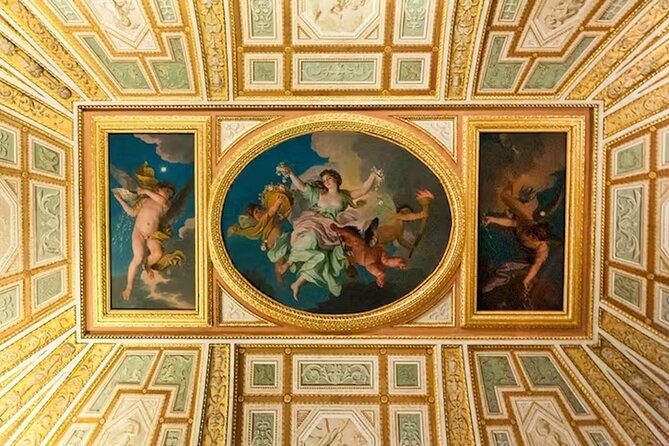
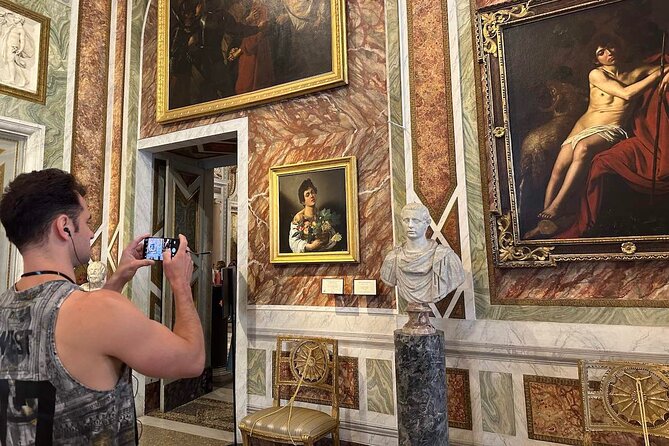
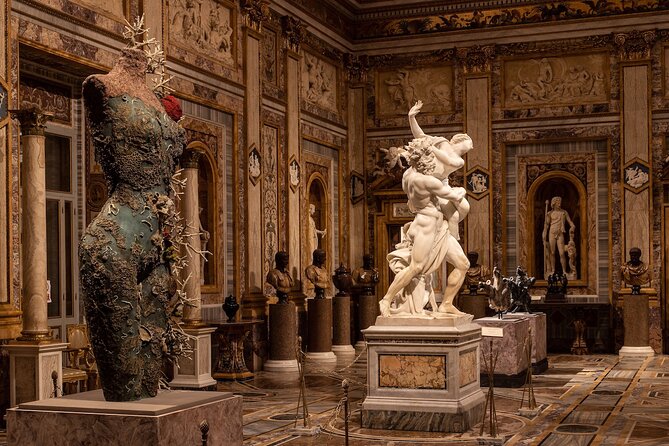
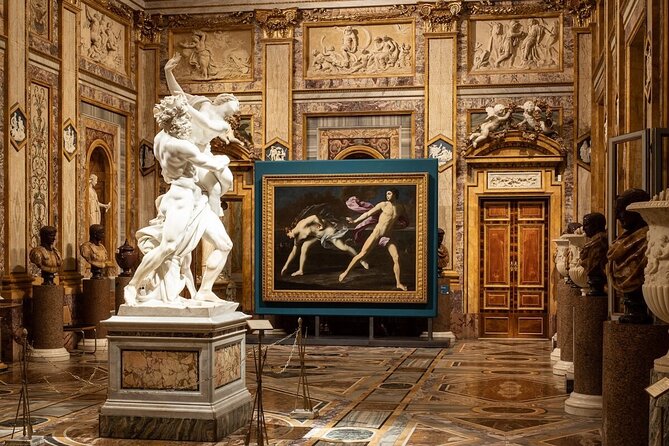
The listed works are the main stops, but the gallery contains more than these five pieces. You may also see major paintings and sculptures by other artists, including Caravaggio, whose work is often singled out as another reason to visit.
The guide’s job is to help you avoid missing the key works among the gallery’s 20 rooms. That does not mean every object receives equal attention. A two-hour tour has to make choices, and the strongest explanations will focus on the pieces that best show the collection’s character.
This is where your own priorities matter. If you want a broad introduction to the gallery, the guided route is efficient. If you already know the collection well, you may prefer more independent time to study lesser-known works.
One useful approach is to treat the tour as your orientation. Take mental notes of rooms and works you want to revisit, then ask whether you can remain afterward for personal viewing. The exact amount of extra time depends on museum rules and the day’s schedule, so do not assume it is guaranteed.
What the guides add to the visit
The strongest praise for this experience centers on the guides’ art knowledge and enthusiasm. Martina is repeatedly singled out for being articulate, pleasant, entertaining, and skilled at setting the scene for each work. Other praised guides include Francesca, Stephanie, Lorenzo, Serena, and a guide identified as Sabrina or Sophia in one account.
You should not book expecting one particular guide unless the booking specifically guarantees that person. Still, the pattern is useful: the experience depends heavily on a guide who can explain art without turning the visit into a lecture.
A good guide will help you see details you might miss, such as Daphne’s transformation, David’s physical tension, or the difference between Canova’s polished Neo-Classical surface and Bernini’s active Baroque forms.
The commentary has also been described as well paced and accessible. One guide used dramatic gestures and reenactments to explain Bernini and Caravaggio. That style will suit you if you like stories and movement in your art lessons. If you prefer quiet, extended looking, remember that the group follows a set route and schedule.
Headsets are available if needed. In a museum with hard floors, high ceilings, and several groups nearby, that small feature can make a real difference.
Is $91.95 a fair price?
At $91.95 per person, this is not a bargain museum entrance. You are paying for more than the ticket: skip-the-line access, an English-speaking guide, headsets if needed, and a small-group format.
I see the value most clearly when your time in Rome is limited. The Borghese Gallery uses controlled entry, and waiting around can cost a large part of a two-hour visit. A guide also helps you get more from the art immediately, especially if you do not already know Bernini, Canova, or Caravaggio well.
The value is less certain if you are an experienced art student who wants to set your own pace. You may find the fixed route too selective, and one person specifically wished for more time with works the guide did not discuss.
The best comparison is with a private guide. This tour does not offer that level of personal attention, but the maximum group size of 15 keeps it more practical for many budgets. You get expert explanation without paying the full cost of a private visit.
Timing, pace, and the two-hour promise
The advertised duration is about two hours. The itinerary assigns 20 minutes to Apollo and Daphne, 20 minutes to Pauline Bonaparte, 15 minutes to the two cardinal busts, 15 minutes to Truth Unveiled by Time, and 20 minutes to David.
That adds up to 90 minutes of named stops, leaving time for movement between rooms, other highlighted works, and entry procedures. In practice, the exact length can vary. One guide continued for more than two hours because of the amount of material and the group’s agreement to continue.
That can be a gift if you want a fuller art lesson. It can also be tiring. Much of the visit involves standing, and one account found the extended schedule difficult. If your energy drops quickly, two hours is already a serious museum session.
I would plan the rest of your day with some flexibility. Do not schedule a tightly timed meal or attraction immediately afterward, especially if the guide is still explaining a major work.
Who should book this experience?
I would choose this tour if you want the major Borghese highlights explained in clear English and you have limited time in Rome. It is especially suited to first-time visitors, couples, families with older children, and anyone who wants context instead of a silent walk through beautiful rooms.
It also works well for people who find art museums intimidating. Bernini’s work can look impressive but confusing if you do not know what to watch for. A strong guide gives you a way into the sculpture, then sends you on to the next room with better eyes.
You may want another option if you dislike group schedules, need long periods of quiet viewing, or want to examine every room equally. The guide chooses the focus, and the two-hour structure leaves limited time for wandering.
The tour is generally suitable for most people, but the supplied details do not promise a specific accessibility setup. If you have mobility or hearing needs, confirm arrangements before booking.
Booking, cancellation, and practical cautions
Confirmation is provided at booking, and the experience is commonly reserved about nine days ahead. That is a useful planning window for a Rome itinerary, particularly if your dates are fixed.
Free cancellation is available up to 24 hours before the local start time. Cancellations or changes inside that window are not refunded or accepted.
The experience may be canceled if poor weather affects operation or if the minimum number of participants is not reached. In those cases, you are offered another date or experience, or a full refund.
Some rooms may be closed because of refurbishment. Due to the Jubilee, restoration work and changing access routes may also affect your visit. Check messages before leaving for the meeting point.
FAQ
How long does the Borghese Gallery guided tour last?
The stated duration is approximately two hours. The actual visit can run longer if the guide and group agree to continue.
What is the price of the tour?
The listed price is $91.95 per person.
Is the tour offered in English?
Yes. The tour is offered in English.
How large is the group?
The semi-private group has a maximum of 15 people.
Is gallery admission included?
Yes. Entrance fees and the Borghese Gallery guided tour with skip-the-line entry are included.
Are headsets provided?
Headsets are available if needed so you can hear the guide’s commentary more clearly.
Where does the tour begin and end?
The meeting point is Piazzale Scipione Borghese, 5, 00197 Roma RM, Italy. The activity ends back at the meeting point.
What happens if I arrive late?
You must arrive at least 15 minutes before the scheduled departure. Late arrivals cannot be accommodated or refunded because the group must enter the gallery together.
Should you book the Borghese Gallery guided tour?
Book it if you want an efficient, art-focused introduction to one of Rome’s finest museums. The combination of controlled entry, a maximum group of 15, and strong guide-led explanations makes the $91.95 price reasonable for a short Rome visit.
I would be especially inclined to book if Bernini’s Apollo and Daphne or David is high on your list, or if you want help understanding the collection rather than simply photographing it. Just arrive early, allow some schedule flexibility, and accept that the guide will choose the highlights.
Skip it if you already know the gallery well and want unrestricted time with every work. For most first-time visitors, though, this is a practical way to make two hours count.
More Skip the Line in Rome
- Vatican Museums & Sistine Chapel Skip-the-Line Entry Ticket
★ 4.4 · 13,838 reviews - Skip-the-Line Group Tour of the Vatican, Sistine Chapel & St. Peter’s Basilica
★ 4.5 · 12,779 reviews - Rome: Vatican Museums & Sistine Chapel Skip-The-Line Ticket
★ 4.2 · 11,708 reviews - Vatican, Sistine Chapel & St. Peter’s Skip-the-Line Tour
★ 4.5 · 7,770 reviews
Newest reviews from Rome
- Rome: Vatican Museums & Sistine Chapel Skip-the-Line Ticket★ 4.4 · 148 reviews
- Shared Shuttle Transfer from Rome to Civitavecchia Port★ 5.0 · 148 reviews
- Rome: Crypts & Catacombs After Hours Tour with Bone Chapel★ 4.6 · 149 reviews
- Ghosts Legends and Mysteries of Rome Walking Tour★ 5.0 · 149 reviews
- Skip the Line: Vatican and Sistine Chapel with Guided Tour★ 4.0 · 149 reviews
- Tivoli: Villa Gregoriana Entrance Ticket★ 4.7 · 150 reviews
- Pizza and Tiramisu Cooking Class in Rome, Piazza Navona★ 5.0 · 150 reviews
- Rome: Borghese Gallery Skip-the-Line Entry and Guided Tour★ 4.7 · 150 reviews
Borghese Gallery Tours, compared.
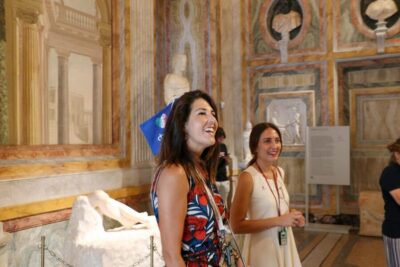
Borghese Gallery Guided Tour with Skip-the-Line Entry
Read our review →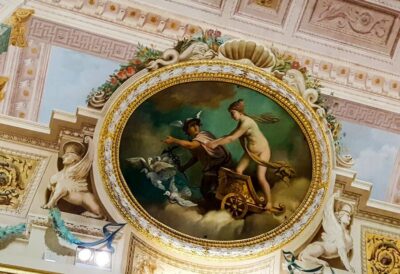
Borghese Gallery Skip-the-Line Tickets with Audioguide
Read our review →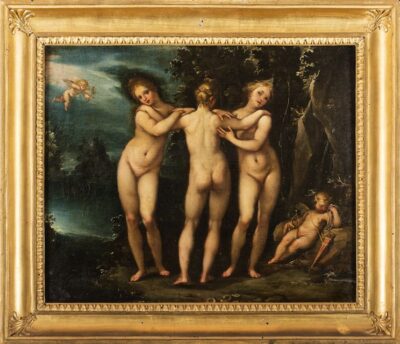
Borghese Gallery Entry Ticket & Optional Guided Tour
Read our review →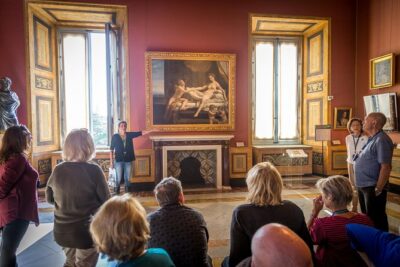
Borghese Gallery & Gardens Small Group Guided Tour
Read our review →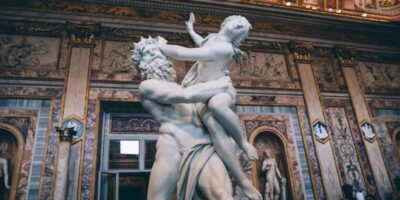
Borghese Gallery, Canova’s Masterpieces Skip-the-Line Guided Tour
Read our review →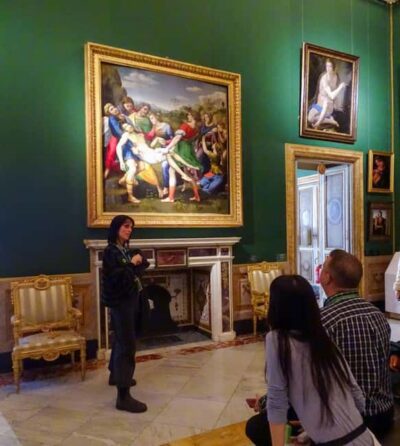
Borghese Gallery Guided Tour with Skip-the-Line Entry
Read our review →Browse the lists this tour appears in