
Reviewed · ROME
Caprarola: Villa Farnese, masterpiece of Renaissance architecture
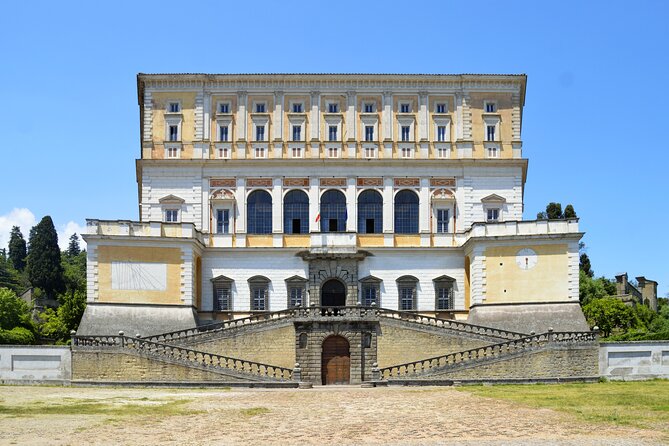
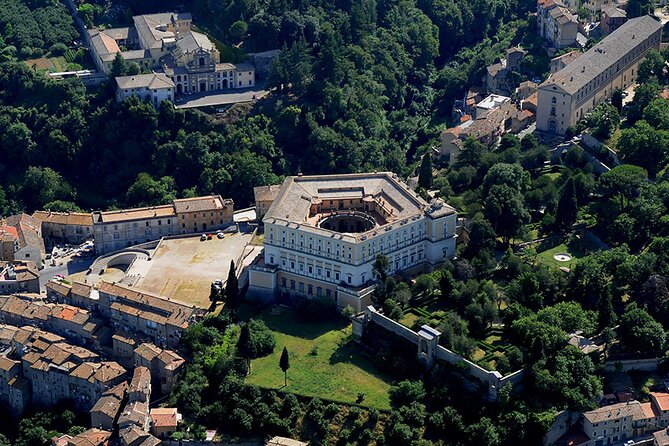
Palazzo Farnese is not a polite little country house. It is a pentagonal palace-fortress planted above Caprarola, with a grand staircase, frescoes on nearly every available surface, and gardens climbing behind it. The scale is the surprise: from outside it looks stern, then the interior opens into a theatrical world of painted ceilings, mythological scenes, religious subjects, maps, and carefully staged rooms.
I like two things especially. First, an English-speaking private guide can explain why the paintings matter instead of leaving you to puzzle over a wall of figures. Serena, named by several visitors as a particularly strong guide, is praised for making the art and politics understandable. Second, the visit includes both the palace and its gardens, so you get architecture, painting, views, fountains, statues, chestnut woods, and cypress trees in one compact outing.
The main caution is location. Caprarola is near Viterbo, about 60 kilometers from Rome, not in the city of Rome. The meeting point is at Via Filippo Nicolai 1, Caprarola, and the town has narrow streets. Check your route carefully before booking.
In This Review
- Key points to know before booking
- Why Palazzo Farnese feels so different
- Meeting an English-speaking guide in Caprarola
- The Scala Regia and the palace entrance
- Frescoes in the state rooms and reception hall
- The Hall of the Angels and the Room of Maps
- The gardens, fountains, and upper villa
- Is $138.16 a fair price?
- Who should choose this Caprarola visit?
- Cancellation and practical planning
- Should you book Palazzo Farnese in Caprarola?
- FAQ
- Where is Palazzo Farnese located?
- How long does the experience last?
- Is the tour offered in English?
- Is this a private tour?
- What is included in the price?
- Where does the tour end?
- Can most people participate?
- Can I cancel for a full refund?
Key points to know before booking
- A pentagonal palace unlike the usual Italian villa: Palazzo Farnese began with the look of a fortress and became a grand Renaissance residence.
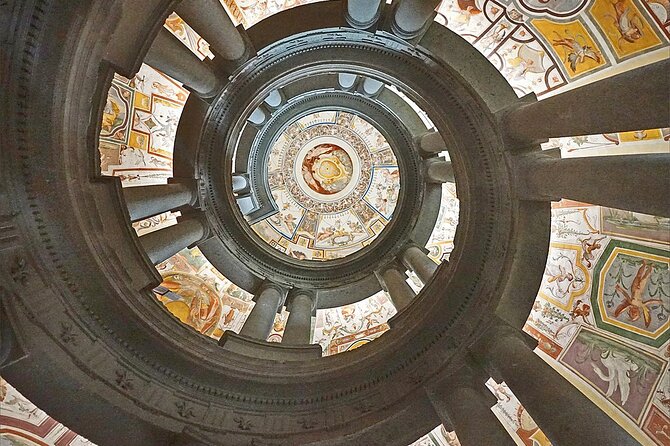
- Vignola’s Scala Regia: The sweeping ceremonial staircase was designed for Cardinal Alessandro Farnese and is one of the visit’s great visual moments.
- Frescoes replace most furnishings: Rooms are largely bare, but walls and ceilings carry the decoration.
- The Hall of the Angels has a memorable acoustic trick: Your voice can echo in this unusual room.
- The Room of Maps rewards a slow look: Its 16th-century geography offers a glimpse of how the papal world understood the globe.
- The tour ends in the gardens: Allow time for the fountains, statues, upper garden, woods, and views.
Why Palazzo Farnese feels so different
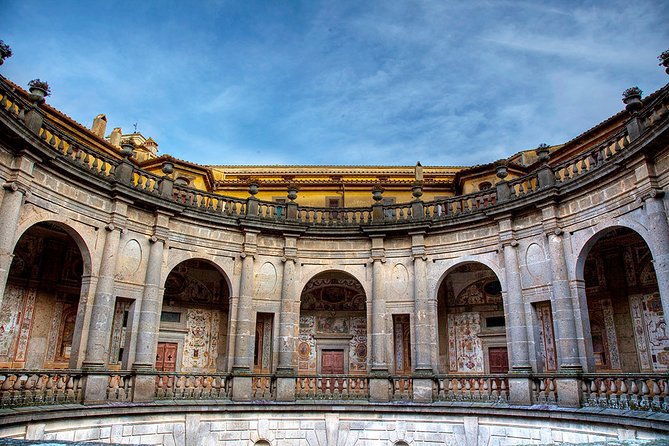
Caprarola’s Palazzo Farnese is one of Italy’s finest late Renaissance residences, but it does not begin like a typical villa. Its five-sided plan gives the building a defensive, almost military character. That shape reflects an earlier fortress project, later reshaped into a residence fit for the Farnese family and Cardinal Alessandro Farnese.
This contrast is the key to the visit. Outside, you see heavy walls and a strong geometric form. Inside, the building becomes ceremonial and almost dreamlike. The Farnese family used architecture and art to display power, education, faith, and political reach. The palace was not simply a comfortable home. It was a stage set for a cardinal whose family had risen to the highest levels of church and Italian politics.
I find that context useful because the paintings can otherwise feel like decoration without a clear purpose. Here, rooms tell stories about classical culture, religion, geography, and the Farnese family’s place in the world. The palace is best understood as a carefully planned statement of authority.
Tours travellers often pair with this one in Rome:
- Vatican: Museums & Sistine Chapel Entrance Ticket
★ 4.5 · 144,003 reviews - Vatican Museums & Sistine Chapel Tour with Optional Basilica
★ 4.3 · 67,413 reviews - Vatican Museums, Sistine Chapel & St Peter’s Basilica Guided Tour
★ 4.5 · 39,149 reviews
Meeting an English-speaking guide in Caprarola
The experience begins at Via Filippo Nicolai 1, 01032 Caprarola, in the province of Viterbo. The activity ends at the same meeting point. It is a private tour, so only your group participates, a useful arrangement if you want to ask questions or set the pace around the most important rooms.
The advertised length is about 1 hour and 30 minutes. That is enough for a focused visit to the palace and a look at the gardens, but you should not expect a leisurely half-day exploration of every corner. Some visits have lasted more than two hours, especially when the guide spends extra time on the paintings and architectural details.
The tour is offered in English. Serena is the guide specifically named in the available feedback, and the strongest praise focuses on her ability to explain historical context in clear terms. A good guide matters here because the palace gives you a great deal to look at, but not every scene explains itself.
The directions deserve serious attention. The palace is in Caprarola, not Rome, and the meeting address is clearly within the town. One failed visit resulted from going to the wrong city. Caprarola is described as easiest to reach by car, with narrow streets that may make arrival less relaxed than a visit in a large city. Build in extra time for the approach and confirm the address before departure.
The Scala Regia and the palace entrance
Your first major architectural moment is Vignola’s Scala Regia, the grand staircase leading toward the main apartments. This was not designed as a merely practical stairway. It was a formal route for Cardinal Alessandro Farnese, turning the act of walking upstairs into a display of rank.
The staircase is decorated with frescoes and architectural details that reward a slow ascent. Look up as you climb. The important view is not just the steps beneath your feet, but the way the space rises around you and frames the journey toward the reception rooms.
This is also where a guide can add real value. Without explanation, you can appreciate the shape and decoration. With context, you can better understand how the staircase controlled movement and created a sense of ceremony. The building continually directs your attention, making you feel the status of the person who commissioned it.
The palace has very little furniture. That can disappoint you if you expect rooms filled with beds, tables, and personal objects. I see it differently, as long as you know in advance: the empty rooms give the frescoes room to take over. Walls and ceilings become the main exhibits.
Frescoes in the state rooms and reception hall
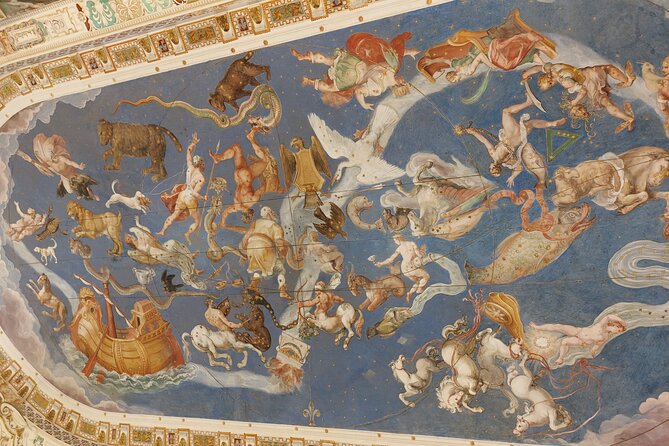
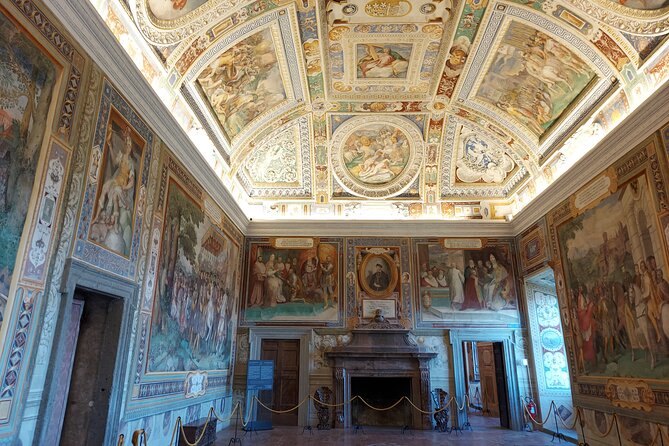
The state rooms and reception hall carry the visual weight of Palazzo Farnese. The paintings cover walls and ceilings in scenes drawn from classical stories, Christian subjects, allegory, and family history. Colors remain strong in many rooms, and the sheer amount of painted surface can be overwhelming at first.
Take your time before trying to identify every figure. First notice how each room has its own mood and subject. Then look for repeated symbols, coats of arms, maps, and references to ancient culture. These paintings were made for an educated elite, so they assume that viewers understood a large store of classical and religious stories.
A guided visit helps you sort the material into a story. Serena is praised for explaining both the obvious subjects and the smaller details that a first-time visitor could easily miss. That is particularly useful for anyone without a background in Renaissance art. You do not need to arrive as an expert, but you will get more from the tour if you are ready to look closely and ask questions.
The tradeoff is that there are few furnishings to ground the rooms in everyday life. You will learn more about the palace as a political and artistic project than about ordinary domestic routines. If your interest is painting, architecture, and power, that is a strong exchange. If you prefer furnished historic houses, adjust your expectations.
A completely different way to spend the day in Rome:
- Rome: Colosseum, Palatine Hill and Roman Forum Guided Tour
★ 4.8 · 32,814 reviews - Rome: Guided Tour of Colosseum, Roman Forum & Palatine Hill
★ 4.7 · 27,897 reviews - Rome: Colosseum & Forum with Audio Guide App -Optional Arena
★ 4.2 · 24,770 reviews - Rome: Colosseum, Roman Forum and Palatine Hill Guided Tour
★ 4.5 · 23,903 reviews
The Hall of the Angels and the Room of Maps
Two rooms deserve extra attention: the Hall of the Angels and the Room of Maps.
The Hall of the Angels is known for its echo. A small sound can resound in the room, giving it an unusual physical presence. It is a welcome change from simply looking at painted walls. You can experience the room with your ears as well as your eyes, and a guide can point out how the space was designed to produce that effect.
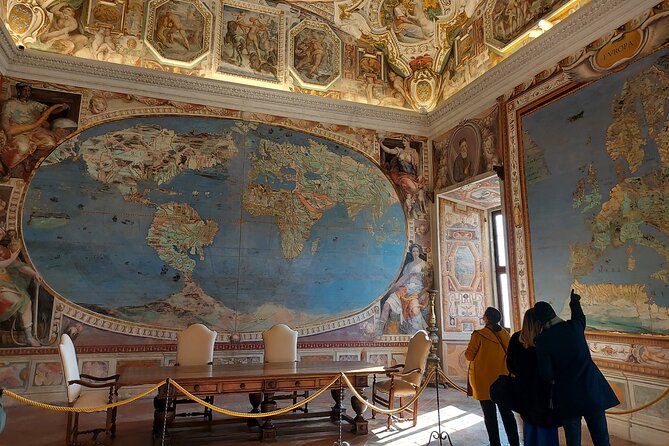
The Room of Maps offers a different kind of wonder. Its paintings show the geographical understanding of the period, including continents and regions as they were known in the 16th century. The maps are not modern reference material, of course, but that is precisely their appeal. They reveal how much information could be gathered, organized, and displayed in a palace built around 1573.
I would slow down here even if the rest of the group is ready to move on. The room connects art, science, religion, and political power. A map in a cardinal’s palace was not just decoration. It suggested reach, order, and command over a world that was becoming more connected and more fully charted.
The gardens, fountains, and upper villa
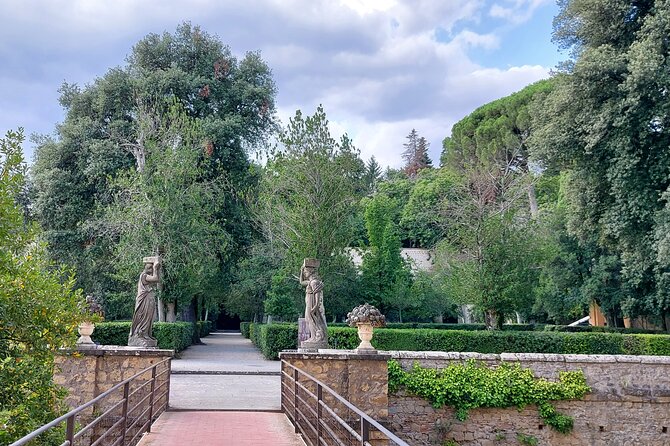
The tour ends outdoors in the Renaissance gardens. The grounds add an important second act because the palace can feel formal and enclosed. Paths lead through an Italian garden with statues, fountains, chestnut woods, and cypress trees. From the terraces, you can also look back toward Caprarola and across the surrounding countryside.
The garden design continues the palace’s message of control. Geometric planting, water, sculpture, and elevated paths turn nature into an organized extension of the residence. The upper section includes a smaller villa or hunting lodge, and reaching it requires a climb. The effort is considered worthwhile for the building, gardens, and views.
Conditions may vary. Parts of the upper gardens have been closed for restoration, and fountains or water features may not always be operating. Maintenance of statues and garden details has also drawn criticism. These limits do not erase the pleasure of the setting, but they matter if the gardens are your main reason for coming.
The outdoor visit is less tightly explained than the interior in some departures. You may explore parts of the gardens independently after the palace tour. That gives you freedom to take photographs and pause at the views, but it also means you should ask your guide about the garden route before the tour ends.
Is $138.16 a fair price?
At $138.16 per person, this is not a bargain admission ticket. The cost covers entry to Palazzo Farnese and a private English-language experience, rather than transportation from Rome, meals, or a full-day excursion. The value depends largely on how much you want interpretation and personal attention.
A regular entrance ticket can be far cheaper, and independent visitors can see the palace without paying for a private guide. But the palace is packed with subjects that are difficult to read quickly. If you are making a special trip to Caprarola, a guide who explains the Farnese family, Vignola, the staircase, the map room, and the symbolism in the frescoes can make the visit feel far more complete.
The price makes the most sense for a small group that can share the private-tour cost, especially if several people care about art or architecture. Group discounts may also be available. If you already know Renaissance painting well and are comfortable studying signs on your own, you may prefer a standard admission instead.
The experience is booked an average of 102 days ahead, which suggests that planning early is wise, particularly if your dates are fixed. Confirmation is normally sent at booking. Reservations made within two days of the visit may receive confirmation within 48 hours, subject to availability.
Who should choose this Caprarola visit?
I would recommend it most strongly to you if you enjoy Renaissance art, grand architecture, political history, or places outside the standard Rome and Florence route. The palace offers a serious cultural stop without the crowds and scale of Italy’s most famous city museums.
It also suits families and mixed-interest groups because the experience changes from room to room. One person can focus on painting, another on the fortress-like design, another on the gardens and views. The echo in the Hall of the Angels adds a simple sensory moment that younger visitors may remember.
You should think twice if you have only a few hours in Rome. Caprarola is not a quick side trip from the city, and the tour does not include transport. You should also be comfortable with a climb to parts of the gardens and with a visit where the artwork matters more than furniture.
Most people can participate, according to the supplied activity information, but no detailed accessibility description is provided. If stairs or uneven outdoor paths are a concern, ask for current details before booking.
Cancellation and practical planning
Free cancellation is available up to 24 hours before the start time for a full refund. Changes or cancellations made less than 24 hours before the experience are not accepted for a refund, and the cut-off follows local time.
Before you pay, check three things: the date, the English-language option, and the exact Caprarola meeting point. Do not assume that a tour connected with Rome takes place in Rome. The address is in Caprarola, near Viterbo, and the activity returns there at the end.
Wear shoes suitable for stairs and garden paths. The supplied details do not promise that every fountain will be working or that every garden section will be open, so treat the grounds as an important bonus rather than a guaranteed full tour of every feature.
Should you book Palazzo Farnese in Caprarola?
Book it if you want to see one of Italy’s great Renaissance residences in a quieter setting and you value an English-speaking guide who can make the frescoes readable. The staircase, the Hall of the Angels, the Room of Maps, and the gardens give the visit a strong sequence, even though the palace has little furniture and parts of the garden may be under restoration.
Skip this private option if you are looking only for the lowest admission cost or if reaching Caprarola would take too much time from your Rome plans. For a small group with a car, an interest in Renaissance culture, and a willingness to look beyond Italy’s headline sights, the price can be justified. Just put Caprarola, not Rome, into your route plan.
FAQ
Where is Palazzo Farnese located?
Palazzo Farnese is at Via Filippo Nicolai 1 in Caprarola, in the province of Viterbo, Italy. It is not in Rome.
How long does the experience last?
The advertised duration is approximately 1 hour and 30 minutes. Some visits may take longer when extra time is spent in the palace or gardens.
Is the tour offered in English?
Yes. The experience is offered in English.
Is this a private tour?
Yes. Only your group participates in the private activity.
What is included in the price?
Entry tickets to Palazzo Farnese in Caprarola are included. Transportation and meals are not listed as included.
Where does the tour end?
The activity ends back at the meeting point in Caprarola.
Can most people participate?
The activity information says most travelers can participate. No detailed accessibility information is provided.
Can I cancel for a full refund?
Yes, if you cancel at least 24 hours before the experience start time. Cancellations or changes made less than 24 hours before the start time are not refunded.
Newest reviews from Rome
- Off the Beaten Track in Rome: Rione VI Parione Private Tour★ 5.0 · 24 reviews
- ROME:Colosseum & Ancient Rome – private/small group TOUR★ 5.0 · 24 reviews
- Cinematic Photoshoot in Rome★ 5.0 · 24 reviews
- Rome: Best of Colosseum and Roman Forum Small Group Guided Tour★ 4.5 · 24 reviews
- The Labyrinth of Rome between catacombs and ancient quarries★ 4.5 · 24 reviews
- Vatican and Trionfale Market Tour with Wine and Food Tasting★ 5.0 · 24 reviews
- private tour: Vatican Museums, Sistine Chapel, St. Peter’s Basilica★ 4.5 · 24 reviews
- Colosseum guided tour with Virtual Reality★ 5.0 · 24 reviews