
Reviewed · BORGHESE GALLERY TOURS
Exclusive Borghese Gallery Tour with Skip-the-Line Access
The real prize here is not simply getting into the Borghese Gallery. It is having someone explain why Bernini’s marble seems to move, how Caravaggio uses light, and what the grand rooms were built to display. The collection is compact but remarkably strong, so two hours can cover its finest works without museum fatigue taking over.
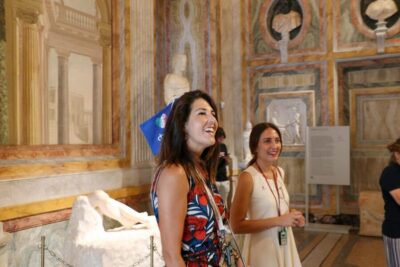
I like the small group limit of 15 and the radios and headsets, which let you hear the guide without standing shoulder to shoulder. I also like the art-history focus: guides such as Victoria, Francesca, Federico, and Gaga have been singled out for clear, engaging explanations. The main consideration is simple: confirm that you are booking the live guided version, not an audio-guide option. The latter has disappointed people who expected a person speaking beside them.
In This Review
- Key points to know before you book
- Why the Borghese Gallery deserves two hours
- Entering the villa and its lavish first rooms
- Classical antiquities and the Roman mosaic
- Bernini’s marble figures and the art of movement
- Caravaggio, Raphael, Leonardo, and the paintings
- The value of a small group and live commentary
- Skip-the-line access and the real value of $83.44
- Bags, timing, and the few drawbacks
- Who should book this Borghese Gallery tour?
- Should you book it?
- FAQ
- How long does the Borghese Gallery tour last?
- Is skip-the-line admission included?
- Is a live guide included?
- How large is the group?
- Where does the tour begin and end?
- What happens if I need to cancel?
Key points to know before you book
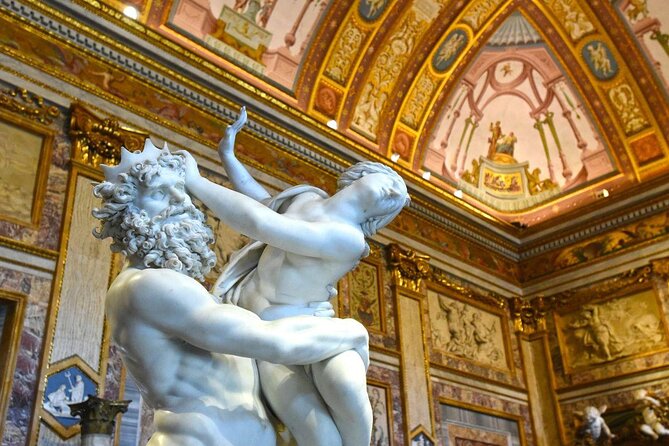
- Bernini takes center stage: Expect close attention to the sculptor’s technical tricks, emotional expressions, and dramatic movement.
- The two-hour visit is tightly focused: You will see the gallery’s major works, but not every object in the building.
- Headsets make a difference: Radios help you follow the guide in busy rooms and while looking closely at the art.
- The Borghese setting is part of the experience: Painted ceilings, classical antiquities, mosaics, and sculptures fill the villa.
- The group is capped at 15 people: This is more personal than a large museum procession, though the exact group size may vary.
- Arrive at least 15 minutes early: Late arrivals are not assured entry and do not qualify for a refund.
Why the Borghese Gallery deserves two hours
Rome has museums that can swallow half a day. The Borghese Gallery is different. Its collection is concentrated inside a lavish villa, giving you a chance to see major Renaissance, Baroque, and classical works without crossing a huge complex.
That compact scale makes a guided visit especially useful. You are not spending the first hour wandering past paintings and wondering which ones matter most. The guide takes you toward the key rooms and supplies the background that turns a beautiful object into an understandable one.
I find this particularly valuable at the Borghese because the building and its collection are closely linked. The rooms were designed to impress, and the art was chosen to support that effect. A sculpture is not isolated on a plain wall. It appears alongside painted decoration, antique pieces, and grand architectural details.
The tour lasts about two hours. That is enough time for a serious introduction, but not enough to inspect every painting, statue, and mosaic at length. If you want to study the collection in detail, you may leave wishing for more time. If you want the strongest introduction to the gallery’s main works, the limit keeps the visit manageable.
More Borghese Gallery entries:
- Rome: Borghese Gallery Guided Tour with Skip-the-Line Entry
★ 4.8 · 2,649 reviews - Rome: Borghese Gallery Skip-the-Line Tickets with Audioguide
★ 4.6 · 2,562 reviews - Rome: Borghese Gallery Entry Ticket & Optional Guided Tour
★ 4.5 · 2,237 reviews
Entering the villa and its lavish first rooms
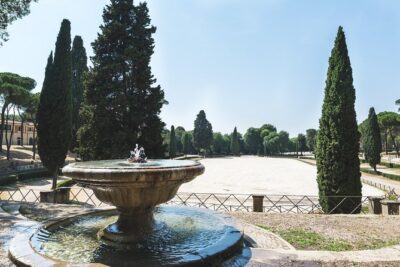
The meeting point is at Piazzale del Museo Borghese, with ticket redemption at Viale del Museo Borghese. You should arrive at least 15 minutes before the listed start time. This is not a place to test Rome’s traffic, confuse the park paths, or arrive at the final minute.
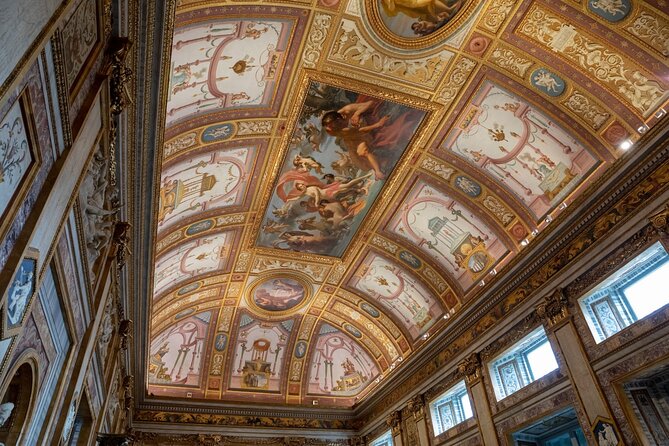
Once inside, take a moment to look up. The first room, or Salone, has a ceiling fresco by Sicilian artist Mariano Rossi. Its trompe l’oeil design uses foreshortening so convincingly that parts of the scene appear to project into the room.
That detail sets the tone for the visit. The Borghese is not merely a container for art. The villa itself is an elaborate visual performance. Paint, stone, ceiling decoration, and sculpture work together to create an atmosphere of power and wealth.
A live art historian can help you read those choices. Instead of seeing the ceiling as background decoration, you begin to understand how it shapes the way the collection is presented. This sort of explanation is difficult to get from a quick walk through the rooms with only a phone app.
Classical antiquities and the Roman mosaic
The main floor gives considerable space to classical antiquities and sculpture. Among the most unusual objects is a large gladiator mosaic dated to approximately 320 to 330 AD. It was found in 1834 on the Borghese estate at Torrenova, along the Via Casilina outside Rome.
A mosaic like this rewards an explanation of place and discovery. You are not looking at a decorative floor pattern alone. You are seeing a Roman-era work connected to the land and collecting interests behind the villa.
The antiquities also provide useful context for the later sculpture. Renaissance and Baroque artists studied ancient bodies, poses, and myths. A guide can point out how later artists borrowed from, competed with, or reworked classical models.
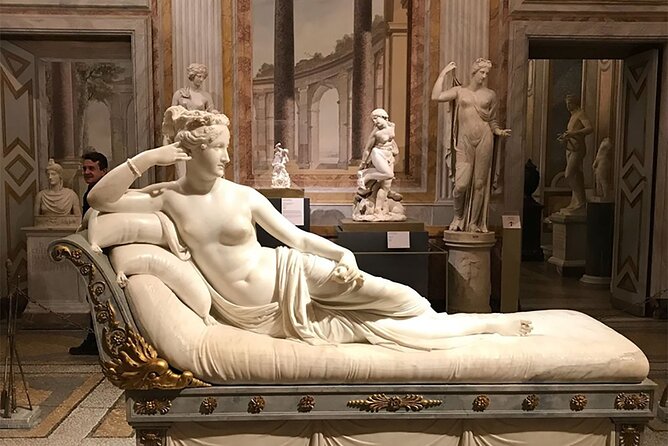
The famous Venus Victrix is another important stop. The sculpture presents Venus in a relaxed pose, yet the subject carries layers of mythology, beauty, and political symbolism. It is the kind of work that can look straightforward until someone gives you the visual clues to consider.
Because the villa contains works from different periods, the visit works best when you pay attention to connections. Ancient sculpture is not a separate topic from Bernini or the paintings upstairs. It helps explain the artistic language that later masters adopted and transformed.
Bernini’s marble figures and the art of movement
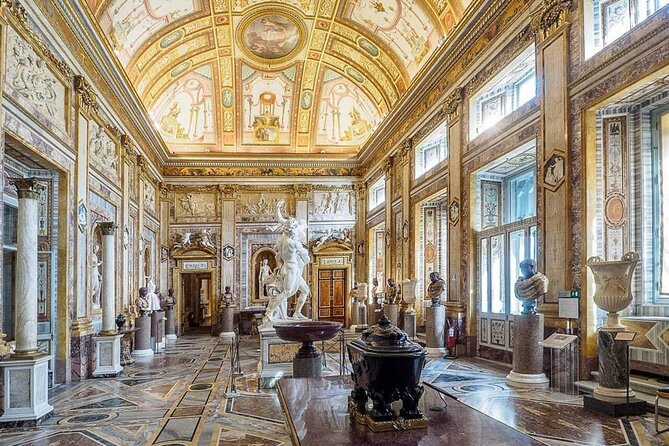
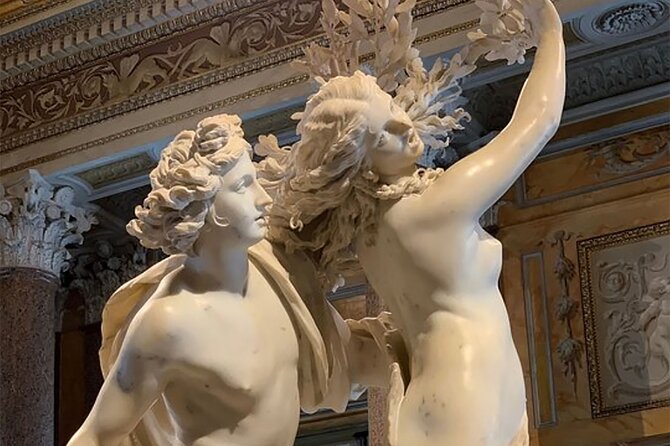
The gallery is especially rewarding for anyone interested in Gian Lorenzo Bernini. Several written evaluations of this tour praise the guides for explaining his innovations, and that emphasis makes sense. Bernini’s sculpture is built around movement, tension, and a precise moment in a story.
Look closely at the way a figure turns, reaches, twists, or reacts. The appeal is not just technical skill. Bernini makes hard stone suggest soft flesh, windblown fabric, flowing hair, and sudden action.
A good guide gives you a way to see those effects rather than merely naming the sculpture. You may be shown how a figure’s pose directs your eye, how the composition changes as you move around it, or how the facial expression adds a second layer to the scene.
This is where the headsets are useful. You can stand at a reasonable viewing distance, listen to the explanation, and keep your eyes on the sculpture rather than on a guide trying to project a voice across the room. The equipment is not glamorous, but it solves a real museum problem.
The tour’s pace is also worth considering. You will pause at major works, but you will not spend the entire morning with one statue. If Bernini is your main reason for coming, this guided introduction should give you a strong framework. You may still want to return later, if your admission arrangements allow it, for a slower look.
More museums and galleries in Rome:
- Vatican: Museums & Sistine Chapel Entrance Ticket
★ 4.5 · 144,003 reviews - Vatican Museums & Sistine Chapel Tour with Optional Basilica
★ 4.3 · 67,413 reviews - Vatican Museums, Sistine Chapel & St Peter’s Basilica Guided Tour
★ 4.5 · 39,149 reviews - Rome: Vatican Museums, Sistine Chapel & Basilica Tour
★ 4.3 · 13,872 reviews
Caravaggio, Raphael, Leonardo, and the paintings
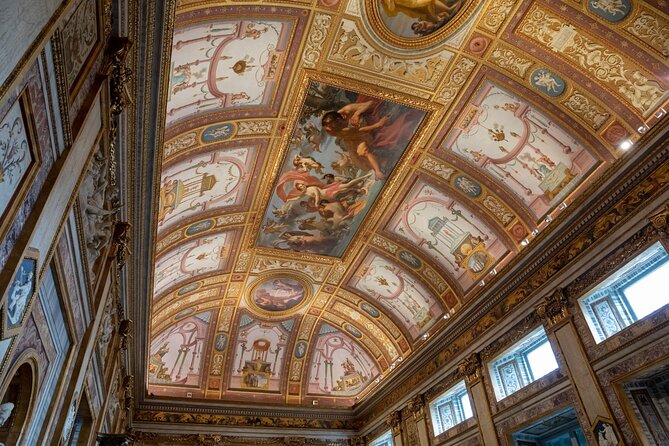
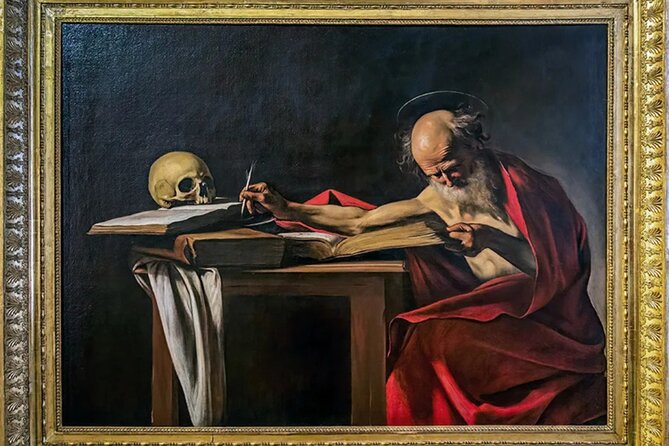
The Borghese is not only a sculpture museum. Its paintings include works associated with Caravaggio, Raphael, and Leonardo da Vinci, giving the guide room to compare different approaches to composition, light, and human expression.
Caravaggio’s paintings are often best understood through their lighting. His figures emerge from darkness with an immediacy that can make a religious or mythological scene feel close and physical. A guide can direct your attention to gestures, faces, and the way light controls the story.
Raphael offers a different kind of lesson. His work is useful for discussing balance, idealized figures, and the careful organization of a scene. Leonardo’s presence adds another layer, especially for anyone curious about the connection between observation, expression, and Renaissance painting.
You should not expect an exhaustive survey of each artist. The point is to understand the works on the walls in front of you. The guide selects important pieces and explains their period, subject, and visual choices.
This approach suits both art specialists and beginners. If you already know Renaissance and Baroque art, the historical comparisons can add useful detail. If you start with little background, the explanations give you enough structure to follow the tour without feeling lost.
One family described the experience as engaging even for a nine-year-old. That does not mean every child will enjoy a two-hour art tour, but it does suggest that a lively guide can make the material accessible. Families should still consider attention spans and the fact that the visit is built around listening and looking, not hands-on activity.
The value of a small group and live commentary
A maximum of 15 participants is a meaningful feature in a gallery of this size. A smaller group usually makes it easier to hear, ask questions, and stay with the guide as the tour moves from room to room.
It does not guarantee a private experience. Fifteen people can still gather around a popular sculpture, especially in a busy museum. But it is a far better setup for conversation than a large group spread across a grand room.
Several guides have been praised for different strengths. Victoria is noted for clear explanations and added detail. Francesca is described as friendly and well versed in fine arts. Federico has been praised for relating art to its period and wider historical setting. Gaga is recognized for making the context of major works understandable, even to a child.
The names do not guarantee who will lead your departure. They do show the kind of guiding style to expect: explanation rather than simple escorting, with room for questions and interpretation.
The radio system is another practical plus. One concern with guided museum tours is that the guide’s voice fades whenever you move a few steps away. Here, headsets are included so you can hear the commentary while viewing the art. Bring patience with the equipment, but use it. It is central to keeping the visit clear and organized.
Skip-the-line access and the real value of $83.44
The price is $83.44 per person. That is not bargain admission, especially if your main aim is simply to enter the building. The value depends on how much you want from the visit beyond access.
You are paying for skip-the-line entry, an art historian guide, a small group capped at 15, and headsets and radios. The strongest value comes when you want help choosing what to see and understanding why it matters. At the Borghese, that guidance can prevent you from giving equal time to every object and missing the collection’s most important works.
The skip-the-line feature also matters because admission to the gallery is controlled and advance planning is common. The experience is booked, on average, well ahead of the visit, about 39 days in advance. That is a useful warning for anyone building a Rome schedule at the last minute.
Still, compare the product carefully before paying. The live tour is the option described here. An audio-guide or app-based entry version may include admission and digital commentary but no person giving explanations in the rooms. If your goal is a real art lesson, check the wording and make sure the art historian guide is included.
Hotel pickup and drop-off are not included. You make your own way to the museum, and the activity ends back at the meeting point. The location is near public transportation, and the site has been described as reachable by taxi, but no private transfer is part of the price.
Bags, timing, and the few drawbacks
Only small bags and purses are allowed inside for security reasons. If you arrive with a larger bag, the gallery has a free cloakroom where you can store it. Even so, I would pack lightly and avoid bringing anything you do not need.
Late arrival is the biggest avoidable problem. You need to be at the meeting point at least 15 minutes early, and late arrivals are not guaranteed entry or a refund. Give yourself extra time to find the correct meeting point in the museum grounds.
The tour is offered in English. That makes it a good fit for English-speaking visitors, but it may not suit your group if you need another live language. One useful alternative mentioned in the experience details is an audio option, which can allow people who speak Portuguese, for example, to visit at the same time as relatives on an English guided tour.
The weather clause may seem odd for an indoor museum visit, but the activity requires good weather. If poor weather causes a cancellation, you are offered another date or a full refund. The same applies if the minimum number of participants is not reached.
You can cancel for a full refund up to 24 hours before the start time. Changes or cancellations inside that 24-hour window are not accepted and are not refunded.
Who should book this Borghese Gallery tour?
I would choose this tour if you want the gallery’s major works explained by a person rather than left to your own research. It is especially suitable if Bernini, Caravaggio, Renaissance painting, or classical sculpture are high on your Rome list.
It also suits first-time art museum visitors. The guides are expected to explain the period and story behind each selected work, not assume that you already know the vocabulary of art history.
Families may find it worthwhile if children can listen for two hours. The fact that a nine-year-old was captivated by the explanations is encouraging, but no guide can remove the need for patience in a quiet museum.
I would skip it if you prefer complete independence, want to linger at one painting for a long time, or are considering the tour only as a cheaper way to obtain admission. In that case, an independent visit may fit better. I would also avoid booking it without checking the difference between a live guide and an app-based audio product.
Should you book it?
Yes, if you want a focused introduction to one of Rome’s most rewarding art museums and value expert interpretation. The strongest reasons to book are the compact two-hour route, the small group, and the live commentary supported by headsets.
At $83.44, it costs more than basic entry, but the fee can make sense when you want to understand Bernini’s technical achievements, Caravaggio’s use of light, the villa’s painted rooms, and the links between ancient and later art.
Book early, arrive 15 minutes ahead, carry only a small bag, and verify that your reservation includes the English-speaking art historian. With those details handled, this is a practical and worthwhile way to make the Borghese Gallery’s concentrated collection mean more than a quick walk past beautiful objects.
FAQ
How long does the Borghese Gallery tour last?
The tour lasts approximately two hours.
Is skip-the-line admission included?
Yes. Skip-the-line entrance to the Borghese Gallery is included in the experience.
Is a live guide included?
Yes. This experience includes an English-speaking art historian guide. Check your booking carefully, since a separate audio-guide option does not include the same live commentary.
How large is the group?
The group has a maximum of 15 participants.
Where does the tour begin and end?
The meeting point is at Piazzale del Museo Borghese in Rome. The activity ends back at the meeting point, while ticket redemption is at Viale del Museo Borghese.
What happens if I need to cancel?
You can cancel up to 24 hours before the start time for a full refund. Cancellations or changes made less than 24 hours before the experience are not accepted or refunded.
More Skip the Line in Rome
- Vatican Museums & Sistine Chapel Skip-the-Line Entry Ticket
★ 4.4 · 13,838 reviews - Skip-the-Line Group Tour of the Vatican, Sistine Chapel & St. Peter’s Basilica
★ 4.5 · 12,779 reviews - Rome: Vatican Museums & Sistine Chapel Skip-The-Line Ticket
★ 4.2 · 11,708 reviews - Vatican, Sistine Chapel & St. Peter’s Skip-the-Line Tour
★ 4.5 · 7,770 reviews
Newest reviews from Rome
- Shared Shuttle Transfer from Rome to Civitavecchia Port★ 5.0 · 148 reviews
- Rome: Vatican Museums & Sistine Chapel Skip-the-Line Ticket★ 4.4 · 148 reviews
- Rome: Crypts & Catacombs After Hours Tour with Bone Chapel★ 4.6 · 149 reviews
- Ghosts Legends and Mysteries of Rome Walking Tour★ 5.0 · 149 reviews
- Skip the Line: Vatican and Sistine Chapel with Guided Tour★ 4.0 · 149 reviews
- Tivoli: Villa Gregoriana Entrance Ticket★ 4.7 · 150 reviews
- Pizza and Tiramisu Cooking Class in Rome, Piazza Navona★ 5.0 · 150 reviews
- Rome: Borghese Gallery Skip-the-Line Entry and Guided Tour★ 4.7 · 150 reviews
Borghese Gallery Tours, compared.
Borghese Gallery Guided Tour with Skip-the-Line Entry
Read our review →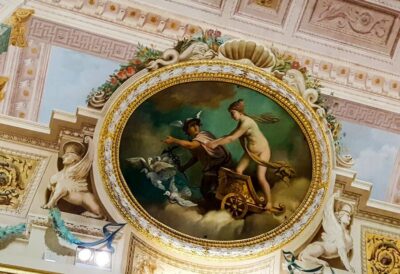
Borghese Gallery Skip-the-Line Tickets with Audioguide
Read our review →
Borghese Gallery Entry Ticket & Optional Guided Tour
Read our review →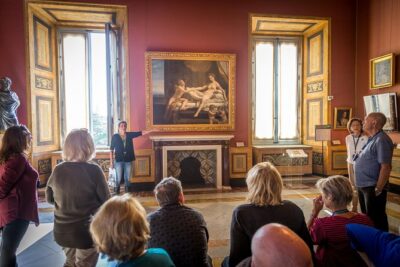
Borghese Gallery & Gardens Small Group Guided Tour
Read our review →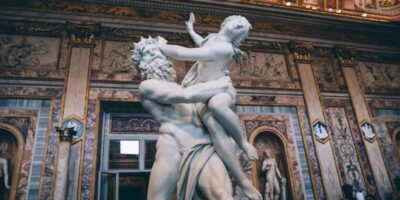
Borghese Gallery, Canova’s Masterpieces Skip-the-Line Guided Tour
Read our review →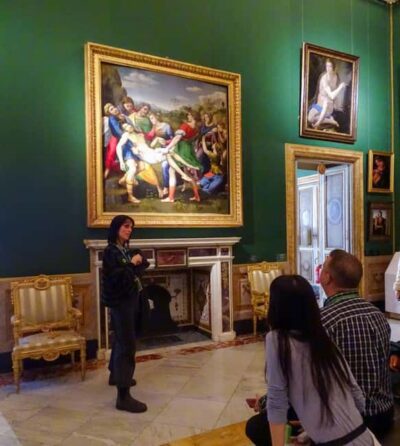
Borghese Gallery Guided Tour with Skip-the-Line Entry
Read our review →Browse the lists this tour appears in