
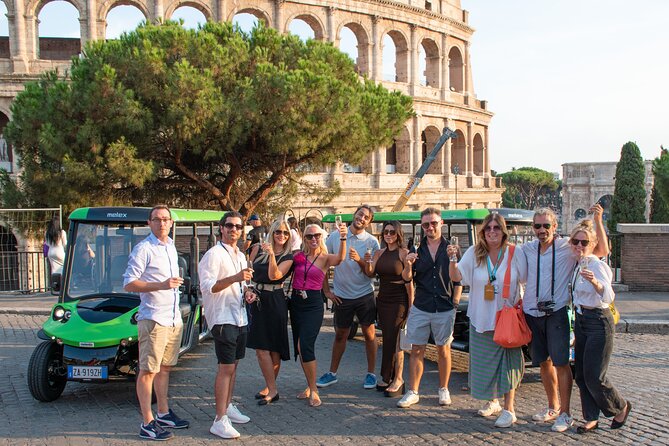
Reviewed · ROME GOLF CART TOURS
Golf Cart Tour Rome: Glide By Ancient Wonders & Hidden Gems
Rome is a city best understood from several angles, and this small golf cart tour gives you a fast look at its ancient ruins, grand squares, fountains, and hilltop views. You ride close to the sights, hop out for photos, and hear stories from guides who began their work at the Colosseum.
I like the maximum group size of seven, which makes it easier to ask questions and adjust the pace. I also like the practical route: you can see many major sights in 2.5 hours without spending the day on foot. The tradeoff is clear: this is an outside tour, so you will not enter the Colosseum, Pantheon, or other monuments.
In This Review
- Key points before you book
- Why a golf cart works so well in Rome
- Starting at the Colosseum
- Rome’s earliest hills and the Circus Maximus
- The ancient theater and its curious windows
- The Pantheon and the ancient roof trick
- Trevi Fountain and the art of the photograph
- Spanish Steps, people-watching, and Roman pop culture
- Piazza Navona and Bernini’s fountains
- The final panoramic garden
- What the 2.5-hour timing really means
- The guides make the difference
- Price, comfort, and who gets the best value
- Practical details before you go
- Should you book this Rome golf cart tour?
- FAQ
- How long is the golf cart tour?
- How many people can join the tour?
- Is the tour offered in English?
- Does the tour enter the Colosseum?
- Do you go inside the Pantheon?
- Where does the tour begin and end?
- Is cancellation free?
Key points before you book
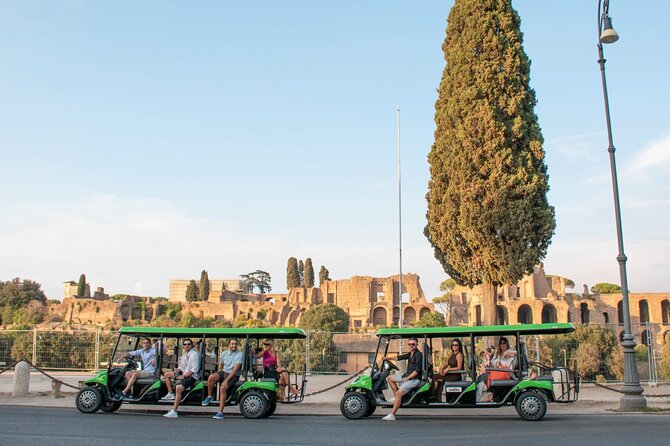
- Small group of seven: A more personal setup than a large coach tour, with room for questions and conversation.
- A leg-saving overview: You cover major parts of central Rome without long walks between each sight.
- Strong photo opportunities: The guide helps position you at the Colosseum, Trevi Fountain, Spanish Steps, and other landmarks.
- Guides with Colosseum experience: Guides such as Vladimir, Vitaly, Federico, and Antonio bring stories about Rome’s monuments and local life.
- Flexible departure times: Several start times help you fit the tour around meals, museum visits, or a first-day arrival.
- External visits only: You see the major sights from outside, with brief stops rather than admission into the monuments.
Why a golf cart works so well in Rome
Rome’s center is packed with famous places, but they are not all next door to one another. The Colosseum, Trevi Fountain, Spanish Steps, Pantheon, Piazza Navona, and Campo de’ Fiori form a broad circuit through the city.
On foot, that route takes energy, especially in summer or after an overnight flight. In a golf cart, you can watch the streets pass by, listen to the guide, and save your legs for the places you plan to enter later.
The open-sided cart gives you a better view than a closed vehicle. You can look left and right as you pass ruins, churches, fountains, and ordinary Roman streets. It also brings you closer to the action than a standard coach, though traffic can affect the exact timing of some stops.
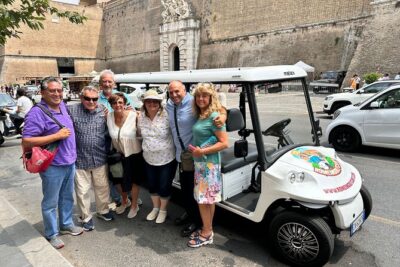
The group limit matters. With no more than seven people, the guide can speak in a conversational way rather than addressing a crowd. Several guides, including Vladimir and Vitaly, are praised for combining facts with humor and for adjusting the experience to the group’s interests and available time.
This is still a sightseeing overview, not a full archaeological tour. You will hear useful context and see many locations, but the short stops do not allow for long lectures or careful examination of every monument.
More golf cart tours of Rome:
- Rome by Golf Cart Private Tour: Beyond the Landmarks
★ 5.0 · 4,361 reviews - Rome on a Golf Cart Semi-Private Tour Max 6 with Private Option
★ 5.0 · 2,502 reviews - Rome Highlights by Golf Cart Private Tour
★ 5.0 · 2,379 reviews
Starting at the Colosseum
The meeting point is Largo Gaetana Agnesi, near the Colosseum. The tour begins with an outside look at Rome’s most famous ancient structure and a chance to take photographs.
The guide explains the arena’s role in Roman public life, including the gladiatorial contests that once filled its seats. The most useful part is the storytelling. Guides who began their careers at the Colosseum can explain the building and its spectacles in a more grounded way than a quick photograph alone.
Expect about 10 minutes here. That is enough for a strong introduction and a few pictures, but not enough for a detailed examination of the amphitheater. If you want to see the interior, underground passages, or exhibitions, you will need a separate timed ticket and another visit.
Starting here is smart for first-time visitors. The Colosseum gives you an immediate sense of Rome’s scale and age, while the rest of the ride helps place it within the wider city.
Rome’s earliest hills and the Circus Maximus
After the Colosseum, the cart passes near the area tied to Rome’s beginnings. You get wide views and hear about emperors’ palaces, the city’s earliest days, and corners that many quick city tours skip.
This part is less about checking off one famous monument and more about connecting Rome’s ruins to its setting. The guide points out details from the road and adds short stories that help you picture the ancient city beyond the Colosseum itself.
The next main stop is Circo Massimo, or Circus Maximus. The ancient track once hosted chariot races before huge crowds. From the cart, you can picture the long racing course and the noise of spectators gathered for a day of competition.
The stop lasts about 10 minutes. You will have time for photographs and a short explanation of where the finish line once stood. The guide may also show you how to use a fountain like a local Roman, a small practical touch that keeps the stop light and fun.
Do not expect a fully restored stadium. Much of the site is open ground, so the guide’s explanation is what gives the place meaning. If you want to study the ruins at length, you would need to return on foot.
The ancient theater and its curious windows
The route continues to a historic Roman theater, where you can stop near the arches and learn about its design and performances.
One especially appealing detail concerns the building’s windows. The guide explains why an ancient structure of this kind has them, turning what might seem like a simple photo stop into a small architectural lesson.
The tour does not present every stop as a formal entrance visit. Instead, it uses Rome itself as the classroom. You get the outside view, a few well-chosen facts, and time to take in the structure before moving through the city.
That format works best if you want orientation. You can decide later which places deserve a longer visit, rather than committing your whole day to one archaeological site.
A completely different way to spend the day in Rome:
- Vatican: Museums & Sistine Chapel Entrance Ticket
★ 4.5 · 144,003 reviews - Vatican Museums & Sistine Chapel Tour with Optional Basilica
★ 4.3 · 67,413 reviews - Vatican Museums, Sistine Chapel & St Peter’s Basilica Guided Tour
★ 4.5 · 39,149 reviews - Rome: Colosseum, Palatine Hill and Roman Forum Guided Tour
★ 4.8 · 32,814 reviews
The Pantheon and the ancient roof trick
The Pantheon is one of Rome’s best-preserved ancient buildings, and its exterior is impressive even when viewed quickly. You can see the great columns and rounded structure, photograph the façade, and hear about the famous opening at the top of its dome, known as the oculus.
You will not go inside during this tour. That is an important limitation, especially because the interior is the part that reveals the building’s full scale.
The guide instead shares a private video about why rain does not simply pour through the oculus and flood the floor. The explanation centers on a clever effect linked to the movement of warm air, along with the building’s drainage system. It is a good example of how a short story can make an architectural feature easier to understand.
Plan your own Pantheon visit separately if you want to see the dome from inside, the floor, and the tombs. The golf cart stop gives you context and a picture, not a complete visit.
Trevi Fountain and the art of the photograph
Trevi Fountain is one of the tour’s more lively stops. You have about 15 minutes to see the fountain, take pictures, and join the familiar coin-toss tradition.
The guide’s photo help is useful here. Trevi is often crowded, and a good angle can make the difference between a photograph filled with strangers and one that captures the fountain clearly. Guides are also alert to moments when traffic and access allow a better stop.
That last point matters. The visit to Trevi depends on road conditions and traffic, so the exact stop may be affected by what is happening in the area. Rome’s center is not a stage set with perfectly controlled timing.
The fountain itself tells a grand story through water, sculpture, and movement. You can admire the sea imagery and the central figure while the guide explains the tradition behind the coin toss. Bring a small coin if you want to take part, but the tour does not list coin tosses as an included item.
Spanish Steps, people-watching, and Roman pop culture
The Spanish Steps provide another 15-minute stop. You can climb a few steps, pause in the square, take a group photograph, and watch the steady flow of people around one of Rome’s most recognizable gathering places.
The guide adds stories from Roman history, local life, and films made in the city. That mix gives the staircase more personality than a quick photo alone. You also get advice on spots that make better photographs than the most obvious position.
The visit is brief, so do not expect a leisurely climb or time to explore every nearby street. Still, the stop works well because the Spanish Steps are as much about atmosphere and people-watching as they are about architecture.
Remember that the steps are not a place to sit for a long picnic or snack. Treat them as a monument, follow local rules, and keep the visit moving with the group.
Piazza Navona and Bernini’s fountains
Piazza Navona offers a change of mood. The long square follows the shape of an ancient Roman stadium, while Bernini’s fountains and the surrounding façades give it a grand Baroque character.
The guide points out the river gods in the central fountain and explains details you might miss while walking through on your own. Street performers add energy, though the square can be crowded and noisy at busy times.
This is also a useful food stop in planning terms. The guide can suggest a place for an Italian lunch or dinner in or near the square. I would still compare menus and prices before sitting down, since restaurants in major squares often charge for the location as much as the meal.
The route ends at Campo de’ Fiori, but the Piazza Navona stop helps connect the ancient city with Rome’s later artistic era. You see how the city kept building over its old foundations instead of replacing them completely.
The final panoramic garden
The last stop is a quiet garden with broad views over Rome. It gives you a pause after the traffic, fountains, and crowded squares, plus a final chance for photographs.
The exact garden is not named in the supplied details, so you should confirm the location with the operator if this view is especially important to you. The point of the stop is clear: you finish above the busy streets, looking across the city rather than standing inside another packed piazza.
This ending also makes the tour feel less rushed. After a route filled with famous monuments, a calm viewpoint gives you time to absorb the city and decide what you want to revisit.
What the 2.5-hour timing really means
The advertised duration is about 2 hours and 30 minutes. That is enough for a broad first look, but it is not enough for long visits at each sight.
You will spend some of the time riding between stops. That is not wasted time. The movement lets you see the relationships between Rome’s neighborhoods and monuments, which is one of the main reasons to choose this format.
The stops are short, often around 10 to 15 minutes. You should be ready to leave the cart promptly, listen while standing, and take photographs without turning every stop into a separate visit.
I would book this early in your stay, especially if Rome is new to you. It can help you understand where the major sights are and decide which ones deserve a longer return visit. It also works well on a first day when you want to see the city without exhausting yourself.
The tour is offered in English, and departure times give you some control over your day. A morning ride can orient you before museum visits. An afternoon or evening departure can show Rome in softer light, and nighttime rides may offer illuminated views.
The guides make the difference
The strongest part of this experience is the guide. Names that appear repeatedly in the available feedback include Vladimir, Vitaly, Federico, and Antonio.
Vladimir is described as funny, attentive, flexible, and strong on both Roman and world history. He has also adjusted meeting details during delays and tailored the ride to the group’s interests and schedule.
Vitaly is praised for giving detailed explanations while keeping the ride comfortable and efficient. Federico receives particular praise for evening tours, where a friendly manner and good timing can make the city feel especially inviting. Antonio is described as engaging and passionate about the city where he lives.
You cannot guarantee a particular guide unless the operator confirms one. What you can expect is a small group that allows the guide to answer questions and offer choices at some stops.
That personal contact is more valuable here than a scripted audio explanation. You are not simply being moved from one landmark to another. The guide’s stories, photo suggestions, restaurant advice, and ability to respond to the group shape the experience.
Price, comfort, and who gets the best value
The price is $163.33 per person. That is a significant cost for 2.5 hours, especially since monument admission is not included and the sights are viewed from outside.
The value improves if you are short on time, traveling with older relatives, managing tired legs, or visiting Rome during hot weather. A private taxi between sights could also become expensive, while a large coach may not reach the same central locations with equal ease.
The group limit of seven is the main reason to consider the price. You are paying for transport, a guide, a compact route, photo help, bottled water, and a more personal setting than a large city circuit.
It is less worthwhile if your main goal is to enter the Colosseum or Pantheon. In that case, spend your budget on timed admission and a focused interior tour. This golf cart ride is best viewed as a city overview, not a substitute for archaeological entry tickets.
Tips are not included. Plan to tip the guide separately if you feel the service earned it.
Practical details before you go
The tour begins at Largo Gaetana Agnesi, 00184 Roma, and ends at Piazza Campo de’ Fiori, 00186 Roma. Because the start and finish are in different parts of central Rome, allow time to reach the meeting point and plan your next move from Campo de’ Fiori.
Bottled water is included. Service animals are allowed, and the activity is near public transportation. Most people can participate, but the supplied details do not promise a fully step-free route or describe the exact cart setup, so ask the operator about mobility needs before booking.
Confirmation arrives at booking. Free cancellation is available until 24 hours before the start time. Changes or cancellations made inside that window are not accepted for a refund, and cut-off times follow Rome’s local time.
Wear comfortable shoes even though the cart saves your legs. You will still step out at the monuments and may stand on uneven stone surfaces. Keep your camera ready, listen for the guide’s instructions at traffic-sensitive stops, and do not assume every landmark will receive the same amount of time.
Should you book this Rome golf cart tour?
Book it if you want a comfortable first look at Rome, prefer a small group, and care more about seeing the city’s major sights than entering them all. It is especially useful for first-time visitors, families, older relatives, and anyone arriving with limited time or low energy.
Skip it if you already know central Rome well or want detailed interior visits. The price is not low, and the short outside stops cannot replace time inside the Colosseum or Pantheon.
For many people, the best plan is to take this ride early in a Rome visit, use the guide’s orientation and suggestions, then return to one or two monuments with admission tickets. That gives you both the broad view and the slower experience Rome deserves.
FAQ
How long is the golf cart tour?
The tour lasts approximately 2 hours and 30 minutes.
How many people can join the tour?
The maximum group size is seven travelers.
Is the tour offered in English?
Yes. The experience is offered in English.
Does the tour enter the Colosseum?
No. The Colosseum is visited from the outside, with time for photographs and stories. Admission is not included.
Do you go inside the Pantheon?
No. The tour does not have time to enter the Pantheon. The guide shares a private video about the oculus and the way rain is managed inside.
Where does the tour begin and end?
It begins at Largo Gaetana Agnesi, 00184 Roma, and ends at Piazza Campo de’ Fiori, 00186 Roma.
Is cancellation free?
Yes, you can cancel for a full refund up to 24 hours before the experience start time. Cancellations or changes made less than 24 hours in advance are not accepted for a refund.
Newest reviews from Rome
- Rome: Vatican Museums & Sistine Chapel Skip-the-Line Ticket★ 4.4 · 148 reviews
- Shared Shuttle Transfer from Rome to Civitavecchia Port★ 5.0 · 148 reviews
- Rome: Crypts & Catacombs After Hours Tour with Bone Chapel★ 4.6 · 149 reviews
- Ghosts Legends and Mysteries of Rome Walking Tour★ 5.0 · 149 reviews
- Skip the Line: Vatican and Sistine Chapel with Guided Tour★ 4.0 · 149 reviews
- Tivoli: Villa Gregoriana Entrance Ticket★ 4.7 · 150 reviews
- Pizza and Tiramisu Cooking Class in Rome, Piazza Navona★ 5.0 · 150 reviews
- Rome: Borghese Gallery Skip-the-Line Entry and Guided Tour★ 4.7 · 150 reviews
Rome Golf Cart Tours, compared.
Rome by Golf Cart Private Tour: Beyond the Landmarks
Read our review →
Rome on a Golf Cart Semi-Private Tour Max 6 with Private Option
Read our review →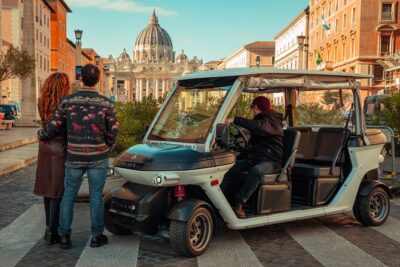
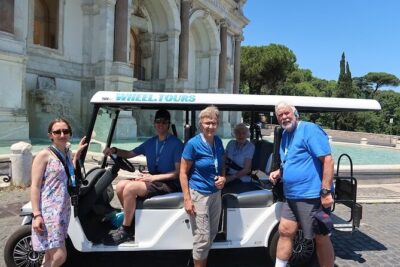
Rome Highlights City Tour by Golf Cart with Gelato
Read our review →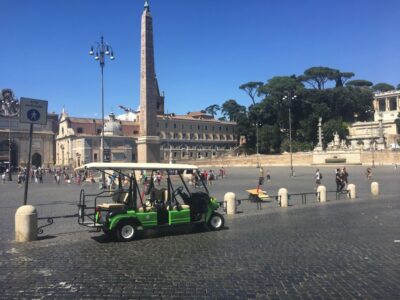
Imperial City Tour by Golf Cart with Optional Transfer
Read our review →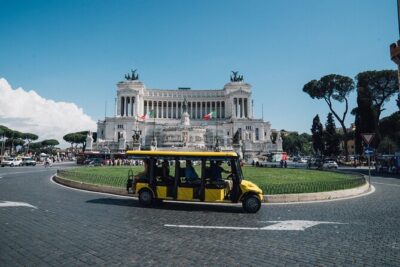
Golf Cart Small-Group Guided Tour: Rome City Highlights
Read our review →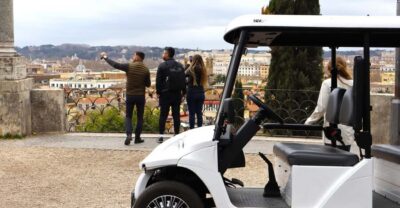
Private/Group 4 Hours Golf Cart SightseeingTour
Read our review →Browse the lists this tour appears in