
Reviewed · PRIVATE DRIVERS
Hidden Rome – Private Tour with Driver
Rome’s Appian Way and ancient aqueducts offer a welcome change from the Colosseum and Trevi Fountain crowds. This private six-hour outing takes you beyond central Rome by car, linking old roads, underground tombs, monumental ruins, neighborhood streets, and hilltop views.
I like the hotel pickup and drop-off, which saves you from working out Rome’s public transport before breakfast. I also like the private format: guides such as Stefano, Francesco, Pietro, Peter, and Michel have adjusted the day to match a group’s interests, and some have added churches or food stops when time allowed.
The main consideration is that the quality of guiding can vary. Some people received lively explanations at nearly every stop, while one experience included little guidance inside the Baths of Caracalla and no full visit to the top of Janiculum Hill. At $330.40 per person, this is best for a small group that values comfort, flexibility, and access to hard-to-reach places.
In This Review
- Key points to know before booking
- Why this private route works in Rome
- Walking the 312 BC Appian Way
- Going underground at San Sebastiano
- Standing beneath Rome’s aqueducts
- Seeing the Baths of Caracalla
- Following the Tiber toward Trastevere
- Visiting Santa Maria in Trastevere
- Finishing above Rome on Janiculum Hill
- What the $330.40 price buys you
- Who should book this day
- Practical details that affect the day
- Should you book Hidden Rome?
- FAQ
- What time does the tour start?
- How long does the experience last?
- Is hotel pickup and drop-off included?
- Is the San Sebastiano Catacombs admission included?
- Is admission to the Baths of Caracalla included?
- Is this a private tour?
Key points to know before booking
- Ancient Rome beyond the center: Walk the Appian Way and see the aqueducts without spending the day among the main crowds.
- A private vehicle matters: Hotel pickup, drop-off, and a dedicated car make the scattered sites much easier to connect.
- The catacombs are included: Admission to San Sebastiano Catacombs is part of the price.
- Your guide can shape the day: Stefano, Francesco, Pietro, Peter, and Michel have been praised for adapting stops and explanations to personal interests.
- Some admissions are extra: The Baths of Caracalla ticket is not included, and food and drinks are also your responsibility.
- Allow for walking: The tour requires a moderate level of fitness, especially on ancient paving, in parks, and around archaeological sites.
Why this private route works in Rome
Rome’s most famous sights are tightly packed in the historic center, but some of the city’s most atmospheric places are scattered well beyond it. The Appian Way, San Sebastiano Catacombs, and Parco degli Acquedotti are not difficult in themselves, but combining them by public transport can take patience and careful planning.
This tour solves that problem with a private vehicle and a driver-guide. You are not spending half the morning changing buses or finding a taxi after every stop. The route also gives you a look at Rome as a living city, with suburbs, local parks, churches, riverside views, and residential districts mixed in with ancient remains.
The day begins at 9:00 a.m. with hotel pickup. Since the experience is private, only your group participates. That makes the schedule less rigid than a large coach tour, though you should still confirm exactly how much time your guide plans to spend at each stop.
The tour has a 4.9 rating from 41 reviews, with 98 percent of customers recommending it. The strongest praise centers on the guides’ warmth, flexibility, and ability to make less familiar sites interesting. That praise is not universal, so I would treat the individual guide as an important part of the booking rather than assuming every day will feel identical.
More Rome tours worth comparing
- Rome Airport Transfer – Private Luxury Service with Driver
★ 4.5 · 231 reviews - Rome Private Tour with Driver: Colosseum and Vatican in a Day
★ 5.0 · 220 reviews - Private Shore Excursions to Rome from Civitavecchia Cruise Port with Driver
★ 5.0 · 118 reviews
Walking the 312 BC Appian Way
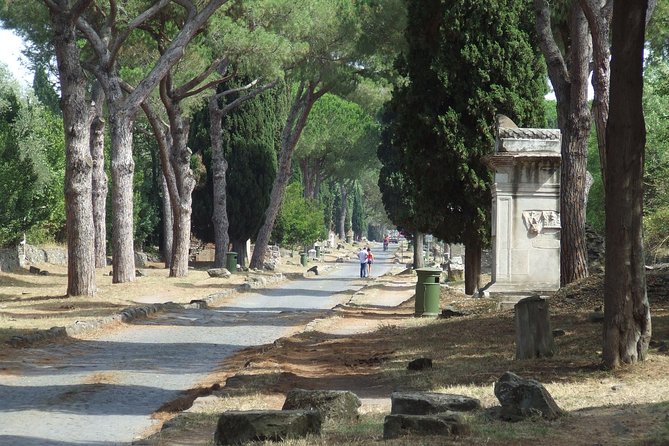
The Via Appia Antica is the historical backbone of this outing. Built in 312 BC under Appius Claudius Caecus, the road first linked Rome with Capua near Naples. In time, it reached Brindisi on the Adriatic coast, more than 300 miles away.
You walk on broad stone paving that has served Roman officials, soldiers, merchants, religious pilgrims, and ordinary foot traffic for more than two millennia. The stones are uneven, so comfortable shoes matter. This is not a polished pedestrian street, and that is part of its appeal.
The road is often called the Queen of Roads because of its importance to the Roman Empire. Your guide can help explain how the road connected Rome with distant settlements and why transport routes were central to Roman power.
The stop lasts about an hour and is free. That hour should give you time to walk, look closely at the paving, and take in the open setting. The appeal is not a long list of individual monuments. It is the feeling of moving through an ancient route away from the crush of central Rome.
One practical point: the amount of commentary may depend on your guide. Some guides have explained the Appian Way in detail, while one account praised only brief guidance there and at an Aurelian Wall stop. If the road is a major reason for booking, tell your guide at the start that you want historical context rather than only a photo stop.
Going underground at San Sebastiano
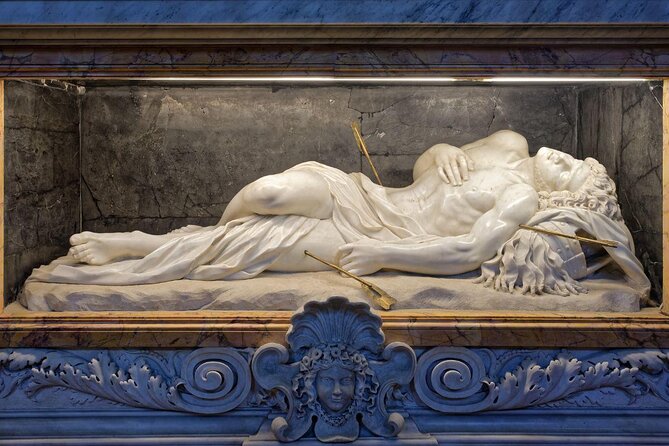
San Sebastiano Catacombs add a very different experience. The cemetery is named for St. Sebastian, who is buried there, and it was once known as ad catacumbas, generally explained as meaning near the hollows. The term later became a wider name for subterranean Christian cemeteries.
The site began with quarries and underground chambers. From the first century onward, the caves and tunnels were used for pagan and Christian burials, including wall tombs called loculi and smaller chambers for urns. Residential buildings once occupied the ground above, with painted interiors.
The catacomb admission is included, which is useful because it is the only clearly listed entrance fee covered by the tour. The visit lasts about an hour, giving this stop more weight than a quick look from the car.
Expect a darker, enclosed setting and a more focused historical visit than at the open-air sites. If underground spaces are uncomfortable for you, consider that before booking. The tour requires moderate physical fitness, and the catacombs are not simply a drive-by attraction.
This is also one of the places where a local guide can make a major difference. The material is easier to understand when someone explains the burial customs, the changing use of the quarries, and the connection between the site’s early Christian identity and later tradition.
Standing beneath Rome’s aqueducts
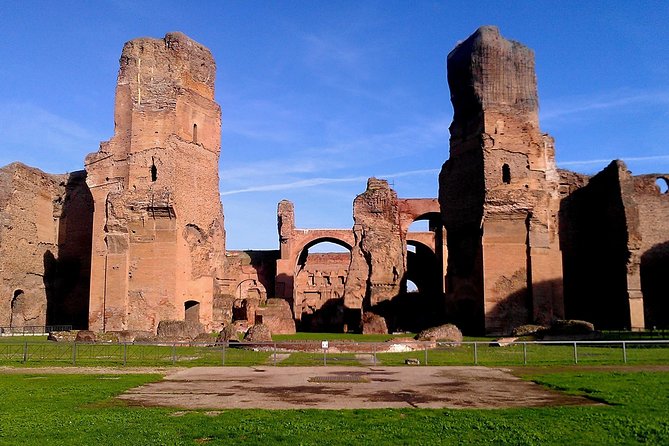
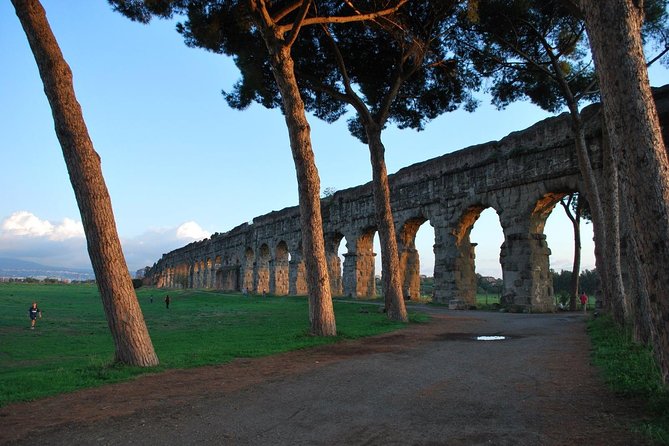
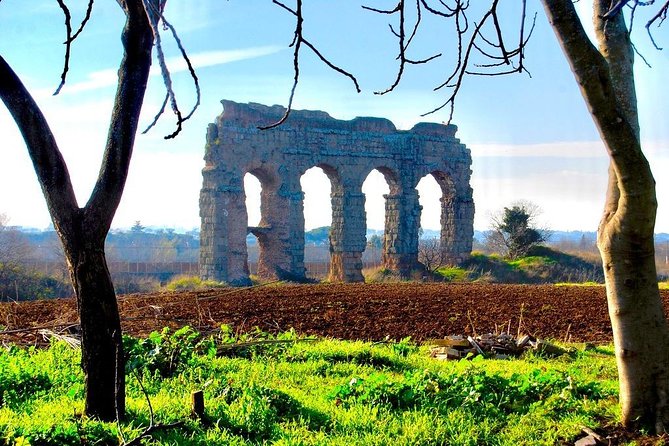
Parco degli Acquedotti is one of the most rewarding parts of the route for anyone who wants open space and ancient engineering without a ticket or a large crowd. The park contains long stretches of Aqua Felix and portions of Aqua Claudia, two aqueduct systems that once carried water from the countryside and mountains into Rome.
The scale is the point. Massive arches cross broad meadows, with umbrella pines and open skies around them. The setting feels far removed from the narrow lanes of the historic center, even though the park is only a few miles from central Rome.
You have about an hour here, and the best use of it is to stroll rather than rush between photo stops. Families picnic in the grassy areas on weekends, and bicycles can be rented in the park, though bike rental is not included in this experience. You should not assume there will be time for a long ride, since the tour continues to several other parts of Rome.
I especially like the contrast between this stop and the Appian Way. The road gives you close contact with ancient paving. The aqueduct park gives you distance and scale. Together, they show how Roman power depended not only on monuments and armies, but also on roads and water systems.
The park is free. If you want a quiet outdoor pause during a busy Rome visit, this may be the most pleasant hour of the day. If you prefer interiors, statues, and formal museums, it may feel less structured.
A completely different way to spend the day in Rome:
- Vatican: Museums & Sistine Chapel Entrance Ticket
★ 4.5 · 144,003 reviews - Vatican Museums & Sistine Chapel Tour with Optional Basilica
★ 4.3 · 67,413 reviews - Vatican Museums, Sistine Chapel & St Peter’s Basilica Guided Tour
★ 4.5 · 39,149 reviews - Rome: Colosseum, Palatine Hill and Roman Forum Guided Tour
★ 4.8 · 32,814 reviews
Seeing the Baths of Caracalla
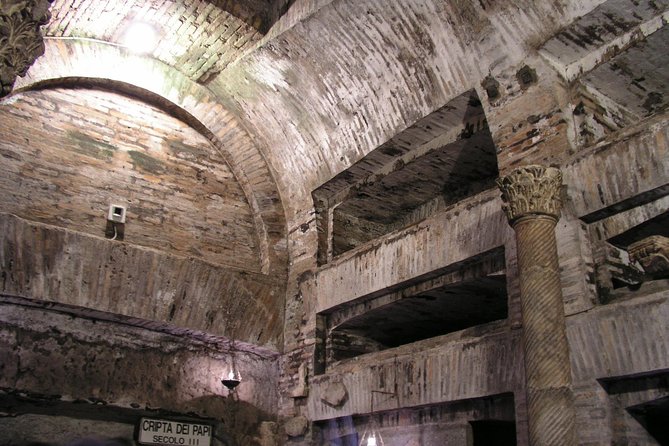
The Baths of Caracalla were built between 212 and 216 under Emperor Caracalla, whose official name was Marcus Aurelius Antoninus Augustus. They formed one of the grandest thermal complexes of the ancient world.
Today, the brick walls and collapsed vaults give only an outline of the original complex, but that outline is enormous. You can begin to understand the size and ambition of Roman public bathing by looking across the remaining structures.
The stop lasts about 30 minutes. Admission is not included, so plan for an additional ticket cost. The short visit makes this more of an introduction than a full archaeological exploration.
This is the clearest place to ask your guide for an explanation of how the baths worked and what the different spaces were used for. One account specifically found too little guidance here, with the group left to enter on its own. That is a useful warning: confirm whether your guide will accompany you inside or simply point out the entrance.
If the Baths of Caracalla matter greatly to you, you may want to ask about the available time before the tour begins. Thirty minutes can work for an overview, but it is not enough for a slow visit to every surviving section.
Following the Tiber toward Trastevere
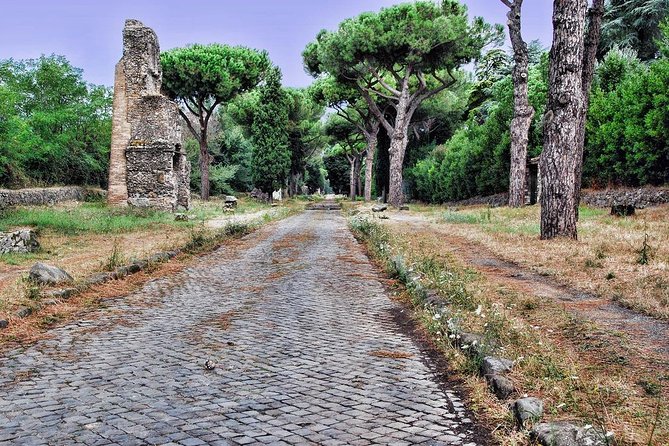
The route includes a look at the Tiber, Rome’s major river. It runs from the Apennines at Mount Fumaiolo through the city and onward to the Tyrrhenian Sea at Ostia. The river is about 250 miles long and varies from roughly 7 to 20 feet in depth.
The Tiber is not a formal sightseeing stop in the same way as the catacombs or aqueduct park. Its value is as a connector. It helps you understand Rome’s geography, including why so much of the historic city developed east of the river and how the river shaped neighborhoods on both sides.
The tour then moves into Trastevere, the district across the Tiber known for medieval lanes, cobbled alleyways, piazzas, cafés, and a strong local identity. You get about 30 minutes here, which is enough for a short walk and a sense of the neighborhood, but not enough for a full meal or an unhurried evening wander.
Piazza Trilussa is a natural place to pause, and ordering a coffee at a local bar is an easy way to join the daily rhythm. The experience does not include food or drinks, though one guide recommended a sandwich shop and lunch stop to a group. Such an addition should be treated as optional and dependent on the day’s timing.
Trastevere has become more commercial, but it still feels different from the main monument zone. I like this stop because it gives the tour a human scale after several hours of ancient ruins. The limitation is time. You will see the neighborhood, not fully explore it.
Visiting Santa Maria in Trastevere
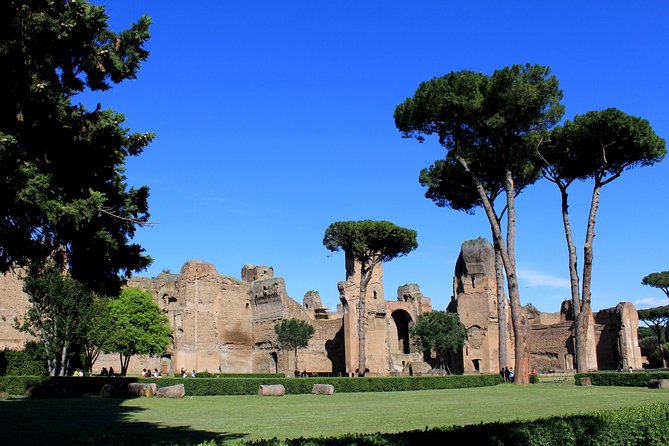
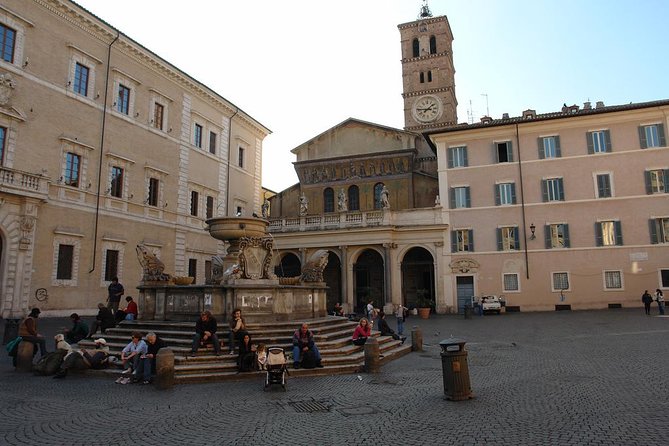
The Basilica di Santa Maria in Trastevere is one of Rome’s oldest churches and may have a claim to being the city’s first official Christian place of worship. The present church includes important medieval and later decoration.
Recent restoration has brought new life to the 12th-century mosaics and frescoes by Pietro Cavallini, including scenes from the life of the Virgin. The church also has a Baroque octagonal gold ceiling by Domenichino, which contains his painting of the Assumption of the Virgin from 1616 to 1617.
The visit lasts only about 10 minutes, so you should enter ready to look up and focus. Ten minutes is enough to see the ceiling, mosaics, and general interior, but not enough for a slow examination of every detail.
This stop also shows why a private guide can improve the route. A guide who knows your interests can point out the most important artwork quickly. Some guides have added other major churches, including St. Paul, St. John, and St. Mary, when circumstances and timing allowed. Those additions are not guaranteed, but they show the flexibility possible on a private day.
Finishing above Rome on Janiculum Hill
The Colle del Gianicolo, or Janiculum Hill, provides one of the best views toward central Rome. From above, domes and bell towers spread across the city, giving you a useful sense of Rome’s shape after seeing it from street level.
Other sights connected with the hill include San Pietro in Montorio, the Tempietto designed by Donato Bramante, and the Fontana dell’Acqua Paola, built under Pope Paul V in the late 17th century. The area also contains several foreign academies and universities, including the American Academy in Rome and the Spanish Academy.
The planned visit lasts about 10 minutes. That is enough for a quick panorama and a few photographs, but the duration is tight. One person specifically noted that the group was not taken to the top of Janiculum Hill, so I would confirm the exact viewpoint with your guide rather than assume every stop will be completed in full.
The hill is a fitting finish because it lets you look back across the city after seeing its roads, water systems, burial places, churches, and neighborhoods. It is not a substitute for a dedicated sunset viewpoint visit, but it adds a strong final image to the day.
What the $330.40 price buys you
At $330.40 per person, this is not a budget tour. Its value depends heavily on group size. For two people, the cost is substantial. For four or more, the price may compare more favorably with arranging several taxis, private transfers, and separate guiding.
You are paying for a private vehicle, hotel pickup and drop-off, a driver-guide, a local guide, and catacomb admission. The vehicle removes much of the logistical strain, especially because the route covers sites in different parts of Rome.
The price does not include the Baths of Caracalla admission, food, or drinks. It also does not guarantee extra churches, a lunch stop, or equal guiding time at every site. Ask about those details if they matter to your decision.
The strongest value comes from convenience and access. If you have already seen the Colosseum, Roman Forum, Pantheon, and Vatican, this tour can fill a day with less familiar places. If this is your first and only day in Rome, I would put the major sights first unless you strongly prefer quiet archaeological areas to famous landmarks.
Who should book this day
I would recommend the tour for:
- A small private group that wants hotel pickup and a comfortable vehicle.
- People who have already covered Rome’s main center.
- Anyone interested in roads, aqueducts, early Christian sites, and historic churches.
- Families or older adults who prefer not to manage several public transport connections.
- Repeat visitors who want a flexible route with room for personal interests.
I would be more cautious if you want a fully scripted walking tour with detailed explanations at every location. The experience seems to depend on the individual guide. Stefano, Francesco, Pietro, Peter, and Michel have all been praised for friendliness, historical detail, flexibility, or comfort, but one account describes very little guiding at several stops.
Tell your guide what matters most before leaving the hotel. You might prioritize a long Appian Way walk, a fuller catacomb visit, the aqueduct park, churches, or the Janiculum view. A clear request gives the private format a better chance to work in your favor.
Practical details that affect the day
The tour begins at 9:00 a.m. and lasts about six hours. Pickup and drop-off at your hotel are included, and confirmation is provided when you book.
Wear shoes suited to uneven ancient paving and outdoor walking. Bring water, since food and drinks are not included. A moderate level of physical fitness is expected.
Service animals are allowed. During the Jubilee, some monuments may be undergoing restoration, and the operator may send updates about changes. Free cancellation is available up to 24 hours before the start time. Cancellations or changes made later are not accepted for a refund.
Should you book Hidden Rome?
Book it if you want to trade the central Rome checklist for the Appian Way, underground San Sebastiano, sweeping aqueducts, Trastevere lanes, and a hilltop city view. The private car and flexible format make this collection of scattered sites practical, and the catacomb admission adds useful value.
Skip it if you want long visits at every monument, guaranteed extra churches, or a consistently scripted guide inside each site. Before booking, ask how the six hours will be divided and confirm that the Baths of Caracalla and Janiculum viewpoint will receive the attention you want.
For repeat visitors and small groups, this is a smart way to see a quieter, more spacious side of Rome. For first-time visitors with limited time, use it only after deciding that ancient roads and aqueducts appeal more than Rome’s headline sights.
FAQ
What time does the tour start?
The tour starts at 9:00 a.m.
How long does the experience last?
The tour lasts approximately six hours.
Is hotel pickup and drop-off included?
Yes. Hotel pickup and drop-off are included, along with transport in a private vehicle.
Is the San Sebastiano Catacombs admission included?
Yes. The catacomb admission fee is included in the tour price.
Is admission to the Baths of Caracalla included?
No. Admission to the Baths of Caracalla is not included.
Is this a private tour?
Yes. Only your group participates in this private tour or activity.
Newest reviews from Rome
- ROME:Colosseum & Ancient Rome – private/small group TOUR★ 5.0 · 24 reviews
- Off the Beaten Track in Rome: Rione VI Parione Private Tour★ 5.0 · 24 reviews
- Cinematic Photoshoot in Rome★ 5.0 · 24 reviews
- Rome: Best of Colosseum and Roman Forum Small Group Guided Tour★ 4.5 · 24 reviews
- Vatican and Trionfale Market Tour with Wine and Food Tasting★ 5.0 · 24 reviews
- private tour: Vatican Museums, Sistine Chapel, St. Peter’s Basilica★ 4.5 · 24 reviews
- The Labyrinth of Rome between catacombs and ancient quarries★ 4.5 · 24 reviews
- Colosseum guided tour with Virtual Reality★ 5.0 · 24 reviews
Private Drivers, compared.
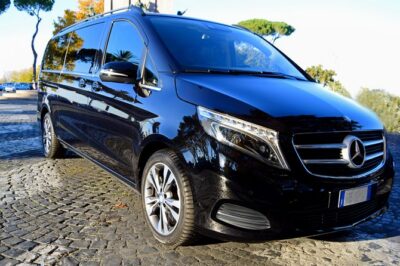
Rome Private Arrival Transfer: Fiumicino Airport to Hotel in Rome
Read our review →
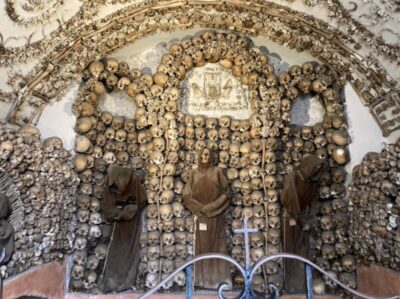
Catacombs and Capuchin Crypt Guided Tour with Transfer
Read our review →
Private Departure Transfer: Hotel to Rome Fiumicino Airport
Read our review →
Imperial City Tour by Golf Cart with Optional Transfer
Read our review →
Catacombs Tour with Transfer – Optional Capuchin Crypt or Trevi
Read our review →
Civitavecchia Private Transfer: Rome to Civitavecchia Cruise Port
Read our review →
Shared Transfer from Civitavecchia Pier to Rome Hotel or Airport
Read our review →Browse the lists this tour appears in