Reviewed · MUSEUMS
Leonardo da Vinci Museum: the Universal Genius and His Works
Leonardo da Vinci’s genius feels much less distant when you can touch and test working replicas of his ideas. This compact exhibition near Campo de’ Fiori brings his machines off the page, from bridges and ball bearings to flight, war machines, and submarine designs.
I especially like the hands-on design and the mix of wood-and-metal models with 3D holograms and videomapping. It works well for families, too. The main caution is size: you can see the exhibition in about 40 minutes, though a slower visit with the audio guide takes closer to an hour.
In This Review
- Key things to know before you go
- What this Leonardo museum actually offers
- Why the hands-on exhibits matter
- The modern layer: holograms and videomapping
- Aulo Hirzio’s tomb beneath Piazza della Cancelleria 1
- How long should you plan?
- Is the $10.81 admission good value?
- Finding the exhibition in central Rome
- Who will enjoy this most?
- What can make the visit feel rushed?
- Booking, tickets, and cancellation
- My practical plan for visiting
- Should you book the Leonardo da Vinci Museum?
- FAQ
- Where is the Leonardo da Vinci Museum in Rome?
- How long does the visit take?
- What is included in the admission price?
- Which languages are available for the audio guide?
- Is the exhibition suitable for children?
- Can I cancel for a full refund?
Key things to know before you go
- More than 65 full-scale replicas: Leonardo’s machine drawings become physical models you can inspect and, in many cases, operate.
- A rare hands-on museum: You are not limited to looking through glass. Several exhibits invite you to test how the mechanisms work.
- A surprise beneath the exhibition: The visit ends at an underground pond containing the tomb of Aulo Hirzio, dating from 43 B.C.
- Useful Rome location: Piazza della Cancelleria 1 is close to Campo de’ Fiori and within an easy walk of Piazza Navona.
- Allow at least 40 minutes: A quick visit can feel short, while the audio guide gives you more context and stretches the experience to roughly an hour.
- Good value at $10.81: The low admission price makes this a practical short stop, especially if you are already sightseeing in central Rome.
What this Leonardo museum actually offers
This is not a gallery filled with original Leonardo paintings. It is an exhibition about the artist as inventor, engineer, designer, and problem solver.
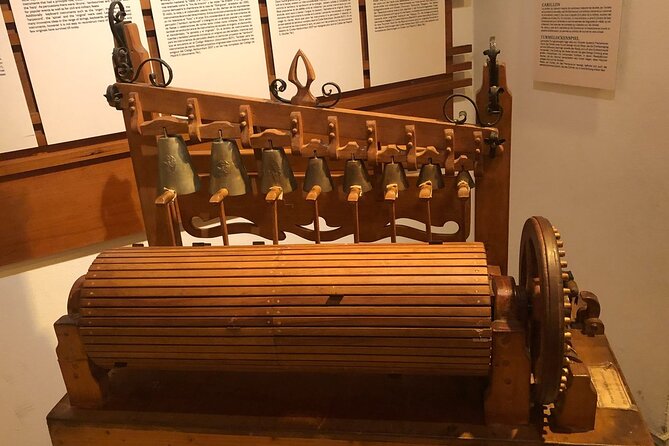
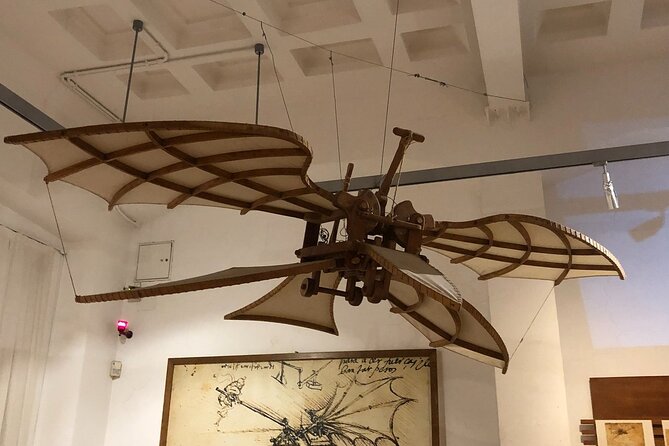
You move through rooms containing full-scale reproductions based on Leonardo’s drawings. The models show how his ideas might work in real life. That difference matters. A sketch of a flying machine can seem abstract on paper, but a physical model lets you examine the wings, supports, and moving parts from several angles.
The exhibition presents more than 65 reproductions. That is a strong number for a museum you can visit in under an hour, though the compact layout also explains why the experience is not an all-day attraction.
Many of the models are built at a size you can easily study. Some are designed for you to touch or try. One particularly useful activity is the Leonardo bridge, which helps show how a structure can hold together through its arrangement rather than through nails or mortar.
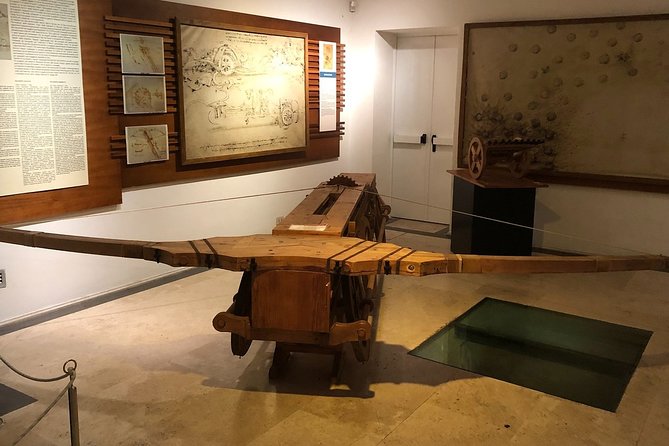
You may also see models connected with ball bearings, suspension bridges, flight, submarines, laminating, and military engineering. The war machines receive special attention in the displays, and they are among the more visually striking parts of the exhibition.
More museums and galleries in Rome:
- Vatican: Museums & Sistine Chapel Entrance Ticket
★ 4.5 · 144,003 reviews - Vatican Museums & Sistine Chapel Tour with Optional Basilica
★ 4.3 · 67,413 reviews - Vatican Museums, Sistine Chapel & St Peter’s Basilica Guided Tour
★ 4.5 · 39,149 reviews
Why the hands-on exhibits matter
Leonardo’s drawings are famous partly because they look modern. He studied movement, force, water, anatomy, and flight with a restless curiosity that crossed normal subject boundaries.
Here, you get a chance to understand that curiosity through action. A moving mechanism explains more than a wall label alone. When you turn, push, balance, or assemble something, you begin to see the practical question behind the drawing.
That makes the museum a good choice for children. Young visitors may not care about the date of a sketch, but they usually respond to a bridge they can build or a machine they can operate. Adults get something from it, too, especially if they enjoy engineering, design, or the story of how ideas develop.
The interactive quality is not perfect. Some displays may be unavailable when work is being done, and not every machine can be physically tested. Still, the chance to handle several models gives this exhibition a different feel from a standard art museum.
The modern layer: holograms and videomapping
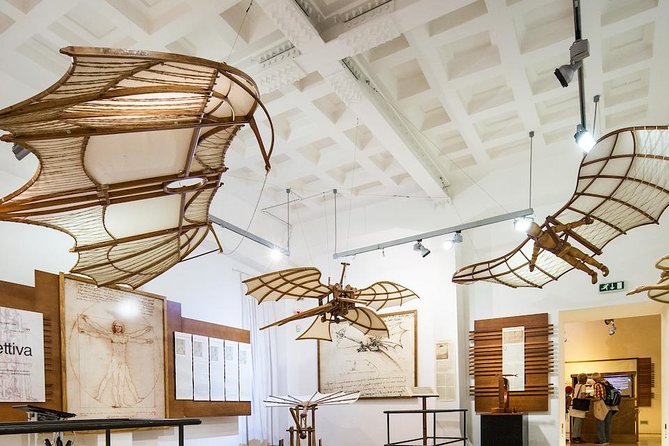
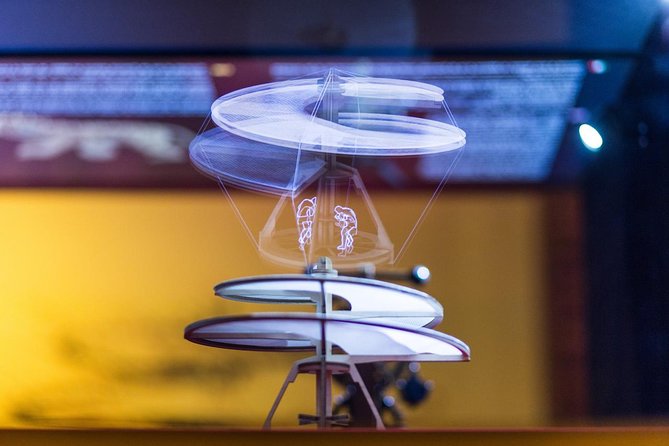
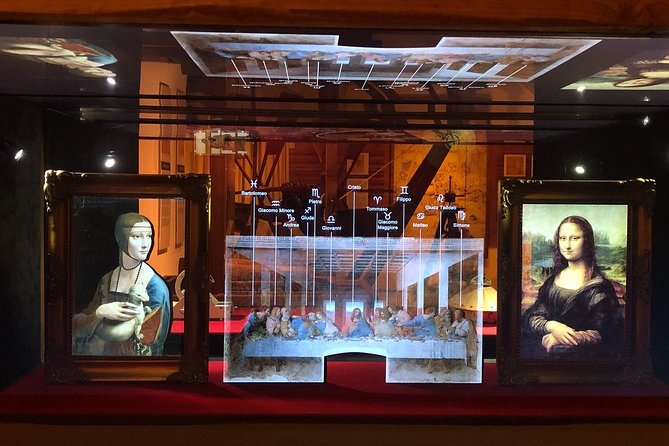
The museum does not rely only on wooden replicas. It also uses 3D holograms, projections, and videomapping to explain Leonardo’s designs in a more contemporary way.
These effects help connect the static model to the way it might move or function. If you have never studied Leonardo’s mechanical drawings, the animation can make the basic idea easier to follow.
I would not visit solely for the technology. The physical inventions are the heart of the experience. The digital material works best as support, giving you a clearer picture of how Leonardo’s concepts relate to movement and engineering.
The combination also helps the museum appeal to different ages. Children can watch the projections and test the models. Adults can take more time with the technical explanations and historical setting.
Aulo Hirzio’s tomb beneath Piazza della Cancelleria 1
The final part of the visit offers an unexpected change of pace. Beneath the exhibition is an underground pond containing the tomb of Aulo Hirzio, dating to 43 B.C.
This ancient feature gives the visit more depth than a simple collection of invention models. After seeing Renaissance-era interpretations of Leonardo’s work, you encounter a Roman archaeological remnant below the building.
The underground setting is part of the appeal. It is not just another object in a case. You look down into a space containing real flowing water and the tomb, adding a strong sense of place to the end of the visit.
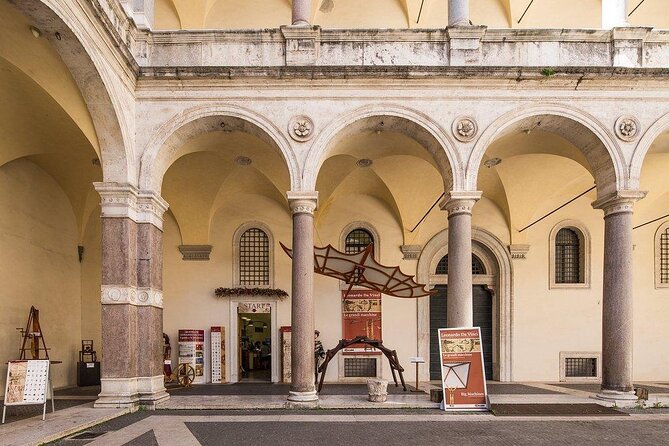
The building itself is also part of the experience. The exhibition is held at Piazza della Cancelleria 1, in a Renaissance building associated with the Vatican. Even if you have limited time, take a moment to notice the architecture around the entrance and courtyard area rather than treating the museum as an isolated indoor stop.
A completely different way to spend the day in Rome:
- Rome: Colosseum, Palatine Hill and Roman Forum Guided Tour
★ 4.8 · 32,814 reviews - Rome: Guided Tour of Colosseum, Roman Forum & Palatine Hill
★ 4.7 · 27,897 reviews - Rome: Colosseum & Forum with Audio Guide App -Optional Arena
★ 4.2 · 24,770 reviews - Rome: Colosseum, Roman Forum and Palatine Hill Guided Tour
★ 4.5 · 23,903 reviews
How long should you plan?
The stated minimum visit time is 40 minutes. That is realistic if you move steadily through the rooms and do not spend long with every machine.
For a better visit, plan on 45 minutes to one hour. That gives you time to read, operate the interactive models, watch the digital presentations, and see the underground tomb without rushing.
The audio guide can extend the visit. It costs €3 per person at the entrance and is available in Italian, Spanish, English, French, German, Portuguese, Russian, Dutch, Romanian, Polish, and Hebrew.
I would consider the audio guide a sensible extra if Leonardo is a main reason for your visit. Without it, you can move through the museum quickly because the exhibition is small. With it, you get more explanation about the machines and the ideas behind them.
There is one practical weakness in the audio arrangement. The guide can be confusing because the exhibit numbers and spoken information are not always easy to match. If you rent one, pause at each display and check the number before starting the next explanation.
Is the $10.81 admission good value?
At $10.81 per person, the basic admission is fairly priced for central Rome. You are not buying a full-day museum experience, but you are getting a focused attraction with many physical models, interactive sections, multimedia displays, and an archaeological feature.
The value is strongest when you combine it with nearby sightseeing. The location is close to Campo de’ Fiori and within easy walking distance of Piazza Navona. You can visit Leonardo’s exhibition between major sights without giving up half a day.
It is also a useful choice when you want a break from Rome’s larger, more crowded museums. The exhibition is small enough to fit into a busy schedule, and its subject gives you a different view of Renaissance culture than a painting-focused museum.
The value is weaker if you expect original Leonardo works or a large collection. This is primarily a reproduction museum. You come to understand the inventions and see them made into physical objects, not to examine Leonardo’s original manuscripts or paintings.
The extra €3 audio guide is worth considering, but it changes the total cost. If you are traveling with several people, you may prefer to read the displays and experiment with the models on your own.
Finding the exhibition in central Rome
The address is Piazza della Cancelleria 1. It is near public transportation and close to several major sights, including Campo de’ Fiori and Piazza Navona.
The location is easy to reach once you have the correct piazza. Rome has several Leonardo da Vinci exhibitions, so check the full address carefully. A museum near Piazza del Popolo and another near the Vatican on Via della Conciliazione are different attractions.
This mix-up is the biggest logistical warning. One person arrived at the wrong place and had to walk about 25 minutes to collect the correct tickets. If you book ahead, make sure your confirmation clearly matches Piazza della Cancelleria 1 and understand where admission is issued.
The exhibition is open Monday through Friday from 9:30 a.m. to 7 p.m., according to the provided schedule. It is closed on December 25. Since opening information can change, check your booking details before setting out.
Who will enjoy this most?
I would recommend this museum to families, curious adults, and anyone who wants a short activity near Rome’s historic center.
It is particularly good for children who need more than labels and paintings. The machines provide something to do with your hands, and the holograms add movement to the presentation. Children must be accompanied by an adult.
You will also get more from it if you enjoy the practical side of Leonardo’s work. The exhibition presents him as more than the painter of the Mona Lisa. You see a mind working across mechanics, construction, military design, water, and flight.
It suits a mixed-age group because you can choose your own level. One person can focus on the moving models while another listens to the audio guide or reads the explanations.
I would be less likely to recommend it to someone seeking original art or a major museum collection. It is compact, and some guests may feel the admission is high for a visit lasting only 30 minutes. The best approach is to treat it as a focused Rome stop, not as a replacement for the Vatican Museums or a major art gallery.
What can make the visit feel rushed?
The museum’s small size is both its strength and its limitation. You can fit it into an afternoon itinerary, but you can also finish before you feel you have learned much about Leonardo.
Without the audio guide, the route may take less than 45 minutes for a quick reader. If you want the full benefit, stop at the models and try the interactive parts instead of simply walking from room to room.
A few displays may be under construction or unavailable. That can reduce the hands-on element on the day you visit. The exhibition is still worthwhile for the number of models and the archaeological ending, but you should not assume every invention will be ready to operate.
The museum has air conditioning, which can be welcome during a hot Roman afternoon. It also has bathrooms, according to the information provided, though one published comment raised a concern about facilities. If this detail matters to you, ask staff on arrival rather than relying on outdated expectations.
Booking, tickets, and cancellation
A mobile ticket is provided, and confirmation is received at the time of booking. The experience is offered in English, while the optional audio guide covers a much wider range of languages.
The booking pattern suggests that many people reserve about 18 days ahead. You do not necessarily need to plan that early for a small museum, but advance admission can make sense if you want to place it at a specific time in a packed Rome schedule.
Free cancellation is available if you cancel at least 24 hours before the experience starts. Cancellations made less than 24 hours before the start time are not refunded, and changes inside that period are not accepted. The cut-off follows local Rome time.
My practical plan for visiting
I would place this museum after a morning near Piazza Navona or Campo de’ Fiori. Arrive with the address saved on your phone, confirm that you are at Piazza della Cancelleria 1, and allow an hour rather than trying to squeeze it into a 20-minute gap.
Start by looking at the physical models before listening to every explanation. Try the inventions that are available, then use the audio guide or multimedia displays to understand what you have seen.
Give yourself extra time for the war machines, bridge model, and any exhibits that demonstrate moving parts. Finish with the underground pond and Aulo Hirzio’s tomb, then continue on foot to nearby sights.
This plan keeps the visit relaxed without making it take over your day.
Should you book the Leonardo da Vinci Museum?
Book it if you want a compact, hands-on museum that shows Leonardo as an inventor and engineer. The price is reasonable, the central location is convenient, and the physical replicas make the subject easier to understand than drawings alone.
Families should find plenty to hold a child’s attention, while adults who like machines will appreciate the full-scale models and the chance to test several of them. The ancient tomb beneath the exhibition is an unusual bonus.
Skip it if you want original Leonardo art, a large museum, or a long guided tour. Also check the address carefully, since Rome has several Leonardo exhibitions. For most people, I would allow an hour, consider the €3 audio guide, and visit when you are already near Campo de’ Fiori or Piazza Navona.
FAQ
Where is the Leonardo da Vinci Museum in Rome?
The exhibition is at Piazza della Cancelleria 1 in central Rome, near Campo de’ Fiori and within an easy walk of Piazza Navona.
How long does the visit take?
You need at least 40 minutes. Most visitors should allow roughly 45 minutes to one hour, especially if they use the audio guide and spend time with the interactive models.
What is included in the admission price?
Admission to the Leonardo da Vinci exhibition is included. The optional audio guide is not included and costs €3 per person at the entrance.
Which languages are available for the audio guide?
Audio guides are available in Italian, Spanish, English, French, German, Portuguese, Russian, Dutch, Romanian, Polish, and Hebrew.
Is the exhibition suitable for children?
Yes. The exhibition is designed for visitors of all ages, and children can try many of the machine reproductions. Children must be accompanied by an adult.
Can I cancel for a full refund?
Yes, if you cancel at least 24 hours before the experience start time. Cancellations or changes made less than 24 hours in advance are not accepted for a refund.
Newest reviews from Rome
- Off the Beaten Track in Rome: Rione VI Parione Private Tour★ 5.0 · 24 reviews
- ROME:Colosseum & Ancient Rome – private/small group TOUR★ 5.0 · 24 reviews
- Cinematic Photoshoot in Rome★ 5.0 · 24 reviews
- Rome: Best of Colosseum and Roman Forum Small Group Guided Tour★ 4.5 · 24 reviews
- The Labyrinth of Rome between catacombs and ancient quarries★ 4.5 · 24 reviews
- Vatican and Trionfale Market Tour with Wine and Food Tasting★ 5.0 · 24 reviews
- private tour: Vatican Museums, Sistine Chapel, St. Peter’s Basilica★ 4.5 · 24 reviews
- Colosseum guided tour with Virtual Reality★ 5.0 · 24 reviews
Museums, compared.


Vatican Museums & Sistine Chapel Tour with Optional Basilica
Read our review →
Vatican Museums, Sistine Chapel & St Peter’s Basilica Guided Tour
Read our review →
Vatican Museums, Sistine Chapel & Basilica Tour
Read our review →
Vatican Museums & Sistine Chapel Skip-the-Line Entry Ticket
Read our review →Vatican Museums, Sistine Chapel & Basilica Tour
Read our review →
Vatican Museums & Sistine Chapel Guided Tour
Read our review →