
Reviewed · ROME GOLF CART TOURS
Nocturnal Rome Golf Cart Tour
Rome is at its most theatrical after sunset. Marble monuments glow, fountains sparkle, and the usual daytime crush often thins out. This three-hour golf cart tour gives you a broad look at central Rome without asking your feet to cross the whole city.
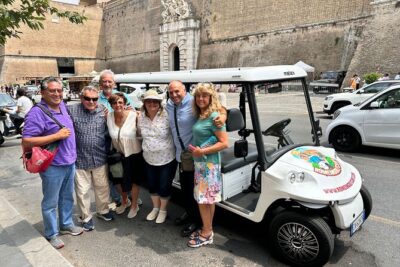
I like two things especially: the route mixes famous sights with less obvious Roman corners, and the provided headsets let you hear Eliphas’s stories while the cart moves. The covered golf cart also helps if a light shower rolls through, though you should still dress for the weather.
The main consideration is seating. The rear row faces backward, which can make sightseeing less comfortable for some people. Also, this is an overview tour, not an inside visit to the Colosseum or other monuments.
In This Review
- Key points at a glance
- Why Rome works so well after sunset
- Meeting at Piazza del Popolo
- The Pantheon and Rome’s engineering genius
- Trevi Fountain without the daytime crush
- The Colosseum from the outside
- Capitoline Hill and Michelangelo’s square
- Teatro di Marcello and the city’s layered past
- Piazza Venezia and the Baroque heart of Rome
- Pincio Terrace and the best broad view
- Piazza Navona over an ancient stadium
- The Spanish Steps and the end of the ride
- What the guide and headsets add
- Price, pace, and who gets good value
- Weather, seating, and practical advice
- Should you book the Nocturnal Rome Golf Cart Tour?
- FAQ
- How long is the Nocturnal Rome Golf Cart Tour?
- Where does the tour begin?
- Where does the tour end?
- Is the tour offered in English?
- Is admission to the Colosseum included?
- Are headsets provided?
- What is the maximum group size?
- Can I cancel for a full refund?
Key points at a glance
- Rome after dark: Illuminated fountains, churches, piazzas, and ancient ruins look very different at night.
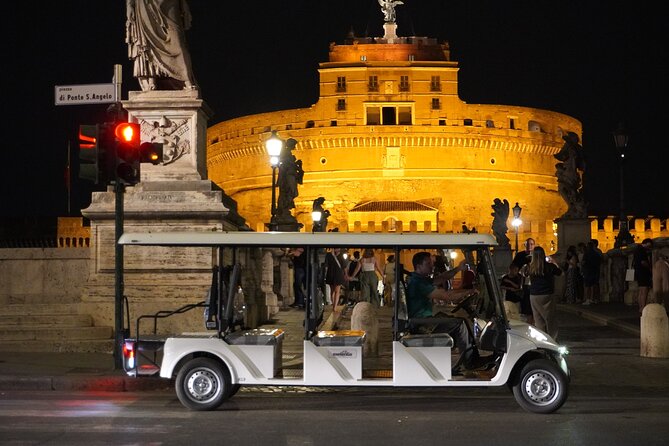
- A broad historic route: The cart connects the Pantheon, Trevi Fountain, Colosseum, Capitoline Hill, Piazza Navona, Spanish Steps, and more.
- Eliphas as your guide: Expect lively storytelling, Roman history, local details, and help with family photos.
- Little walking required: You ride between landmarks and pause for short visits and pictures.
- Clear commentary: Individual headsets make it easier to follow the guide beside busy streets.
- Best used early in your stay: The route helps you get oriented before spending later days inside museums and archaeological sites.
Why Rome works so well after sunset
Rome can be tiring in daylight. The streets are full, the stone reflects heat, and famous spots such as Trevi Fountain and the Spanish Steps can feel more like people-watching zones than ancient monuments.
At night, the mood changes. Lighting picks out columns, domes, fountains, and carved figures. You can often get closer to the main viewpoints, take cleaner family photographs, and hear the guide without competing with as much street noise.
This tour also makes practical sense for a first evening. In about three hours, you cover a large section of the historic center, from Piazza del Popolo to Piazza di Spagna. You will not master Rome in one night, but you will learn how its ancient, Renaissance, Baroque, and modern pieces fit together.
The cart is open-air, so you get a proper view rather than looking through a vehicle window. It is also easier to stop near central sights than it would be in a larger bus. The vehicle is covered, according to the tour details and guest experience, but bring a light jacket and prepare for rain or cool air.
More golf cart tours of Rome:
- Rome by Golf Cart Private Tour: Beyond the Landmarks
★ 5.0 · 4,361 reviews - Rome on a Golf Cart Semi-Private Tour Max 6 with Private Option
★ 5.0 · 2,502 reviews - Rome Highlights by Golf Cart Private Tour
★ 5.0 · 2,379 reviews
Meeting at Piazza del Popolo
The tour begins at Piazzale Flaminio 15, in front of the large McDonald’s beside the metro station and across from Piazza del Popolo. This is a handy central meeting point, but pay attention to the exact location.
A map pin can be confusing here. Use the McDonald’s next to the metro station rather than relying only on a general Google Maps result. Arriving a little early gives you time to cross over to Santa Maria del Popolo, a handsome church with works associated with Raphael and Caravaggio.
That small pre-tour visit is worth considering because it starts the evening with real art before the cart begins. The church may be closed depending on the hour, so treat it as an optional extra rather than part of the tour itself.
The end point is Piazza di Spagna, at the Spanish Steps. That is useful for an evening stroll or dinner, but plan your return before setting off if your hotel is outside the center.
The Pantheon and Rome’s engineering genius
The Pantheon is one of the tour’s strongest stops. After nearly 2,000 years, its massive concrete dome remains one of the great achievements of Roman construction. It is also the world’s largest unreinforced concrete dome.
You receive about ten minutes here, enough for an exterior look, photographs, and an explanation of how the building has survived. Admission is not included, but the scheduled stop itself is free.
The Pantheon appears again later in the route, likely as the cart passes through another angle of the old city. That repetition may look odd on paper, but Rome rewards repeated views. A building that first looks like an ordinary part of a street can reveal an ancient temple facade when you turn a corner.
Do not expect a full interior visit during this evening ride. If the Pantheon matters greatly to you, return in daylight and allow time for a separate entrance visit.
Trevi Fountain without the daytime crush
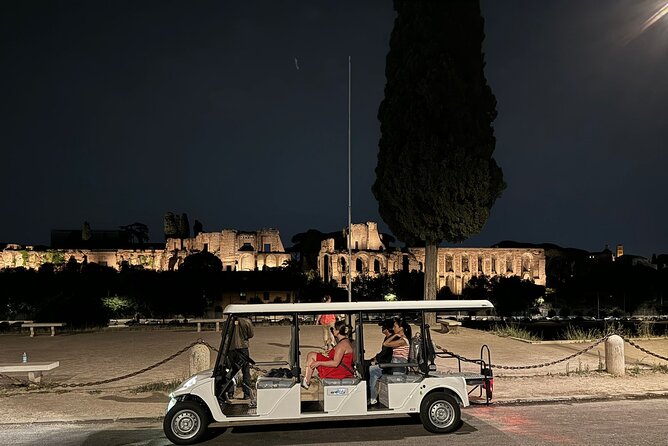
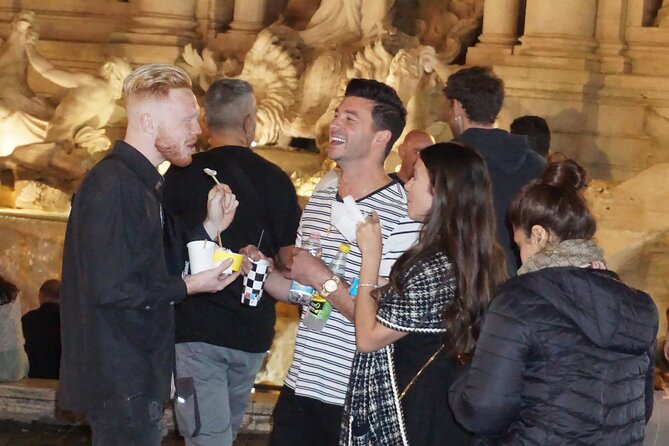
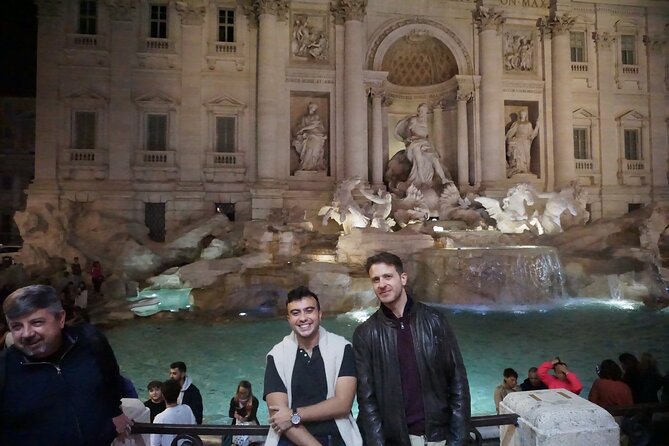
Trevi Fountain is usually the emotional high point. Its Baroque figures and falling water are especially striking under lights, and the nighttime setting can make the fountain feel less frantic than it does during the day.
The stop lasts about ten minutes. That gives you time to admire the sculpture and take photographs, but not to linger at length or wait for a perfect empty frame. The benefit is that you are brought close by cart rather than walking there after a long day of sightseeing.
The tour does not include admission because the fountain is an open public monument. You should expect other people to be present, but late evening generally offers a better chance of seeing the stonework clearly and taking photographs without the thick daytime crowd.
This is also a good place to listen closely. A strong guide can turn the fountain from a quick photo stop into a lesson in Baroque design and Roman water engineering. Eliphas is described as an engaging storyteller who answers questions and adds details beyond a memorized script.
A completely different way to spend the day in Rome:
- Vatican: Museums & Sistine Chapel Entrance Ticket
★ 4.5 · 144,003 reviews - Vatican Museums & Sistine Chapel Tour with Optional Basilica
★ 4.3 · 67,413 reviews - Vatican Museums, Sistine Chapel & St Peter’s Basilica Guided Tour
★ 4.5 · 39,149 reviews - Rome: Colosseum, Palatine Hill and Roman Forum Guided Tour
★ 4.8 · 32,814 reviews
The Colosseum from the outside
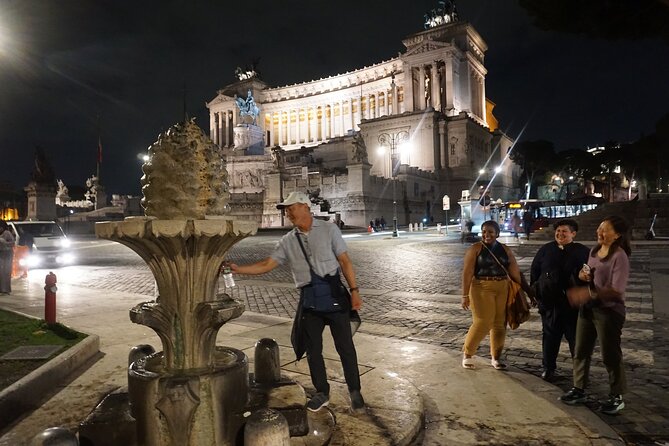
The Colosseum receives about ten minutes. That is enough for an exterior view and a short history lesson on the arena’s construction, engineering, gladiatorial contests, and public spectacles.
Admission is not included, and there is no interior exploration on this tour. That distinction matters. If you want the underground chambers, arena floor, or upper levels, you will need a separate timed ticket and a longer visit.
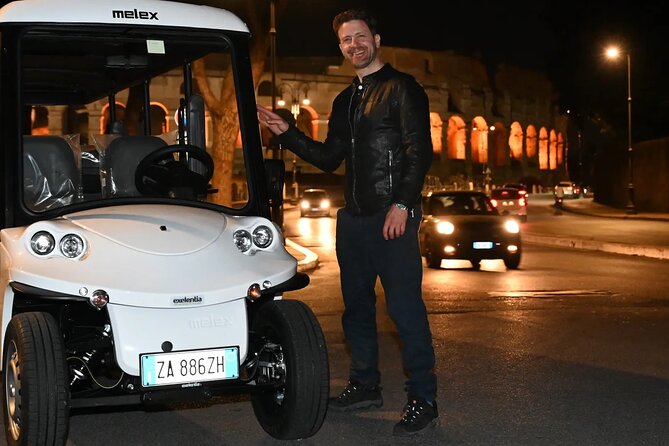
Still, seeing the Colosseum at night has real value. Its arches and enormous scale read clearly under the lighting, while the surrounding archaeological area can feel calmer than it does in the afternoon. The cart saves you a substantial walk from the Trevi area and keeps the evening moving.
This stop suits families especially well. A guide who can connect the building to public entertainment, Roman politics, and daily life gives children more to grasp than a quick photograph would. The tour’s broad format also helps restless young people because you keep changing locations.
Capitoline Hill and Michelangelo’s square
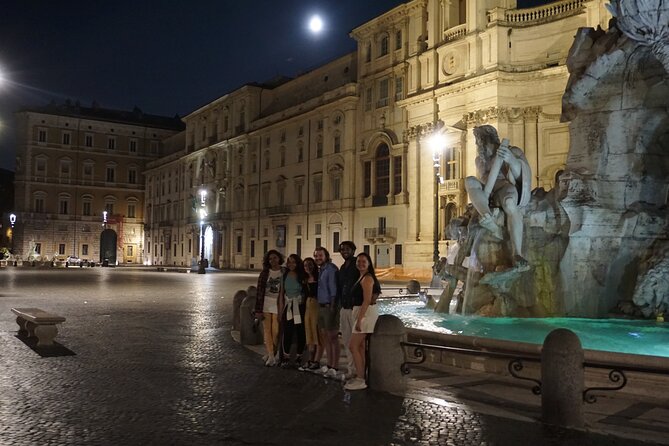
At Piazza del Campidoglio, the stop is shorter, around five minutes, but the setting deserves attention. Capitoline Hill was central to Roman political and religious life, and the ancient Tabularium, once a state archive, forms part of the hill’s story.
The present square comes from Michelangelo’s 16th-century redesign. Its geometry, stairway, surrounding buildings, and paving create one of Rome’s most elegant public spaces. At night, the lighting helps you notice the balance of the design without the glare of midday sun.
Five minutes is brief, so listen while the guide speaks and use the pause for a quick photograph. This is a place where a longer daytime visit would reward anyone interested in Renaissance architecture.
Teatro di Marcello and the city’s layered past
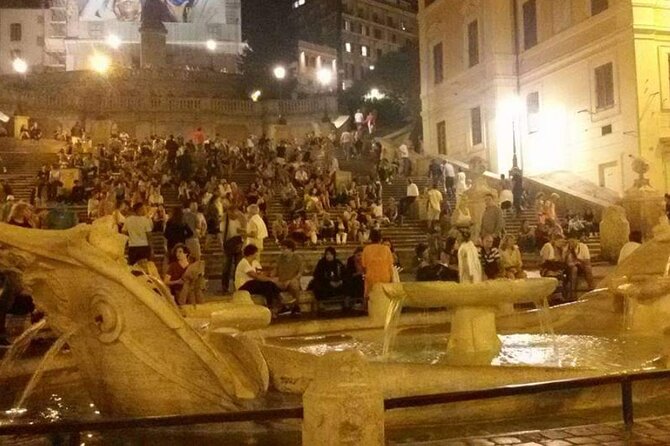
The route also passes Teatro di Marcello, an ancient open-air theater begun under Julius Caesar and completed under Augustus in the first century BC. It later helped inspire the form of the Colosseum.
This is one of the route’s useful surprises. Unlike the Colosseum, which everyone recognizes, Teatro di Marcello can appear as part of the ordinary city until you learn what you are looking at. The juxtaposition is pure Rome: modern streets, medieval additions, and ancient stone sharing one view.
The cart makes this kind of discovery easy. You do not need to plan a separate walk or study a map beforehand. You simply turn a corner and receive the context that makes the building meaningful.
Piazza Venezia and the Baroque heart of Rome
Piazza Venezia brings you to the huge white Altare della Patria, the monument honoring Victor Emmanuel II. The square also connects with Palazzo Venezia and several major roads through the historic center.
The monument can seem oversized at first. That is part of the point, and the guide’s explanation helps place it within modern Italian history rather than treating it as another ancient ruin.
The route then moves through several Baroque sights. You may pass the four fountains designed by Domenico Fontana, the church of San Carlo alle Quattro Fontane by Borromini, and a Baroque work by Bernini. The descriptions point to Rome’s love of curved forms, dramatic sculpture, and grand public space.
These passing views are an advantage and a limitation. You see more in one evening, but some stops are brief or viewed from the cart. If architecture is your main interest, note the locations and return later on foot.
Pincio Terrace and the best broad view
Terrazza del Pincio, above Piazza del Popolo in Villa Borghese, provides one of the tour’s clearest panoramic pauses. From here, Rome opens out across rooftops and domes, with the city lights giving the view a soft evening character.
The scheduled pause is about five minutes. That is enough for a quick photograph and orientation, but you will not have time for a long sunset sit or a walk through Villa Borghese.
The viewpoint is valuable because the rest of the tour puts you close to buildings. Here, you step back and see how the historic center fits together. It also makes a good early or late-trip reference point: after the tour, you may recognize domes and towers that were only names before.
Piazza Navona over an ancient stadium
Piazza Navona is the Baroque square par excellence, with major works linked to Bernini and Borromini. Its long oval shape follows the footprint of a 2,000-year-old stadium, a detail that changes how you read the entire piazza.
The stop lasts about five minutes. Look beyond the fountains and facades to the shape of the space itself. The square is not simply a pretty open area. It preserves the outline of an ancient venue beneath its Baroque surface.
This is an excellent example of why the tour works as an introduction. You receive a quick visual lesson in how Rome keeps building over its past. Later, when you walk the city on your own, you will have more clues to notice.
The Spanish Steps and the end of the ride
The final stop is the Spanish Steps, with about fifteen minutes to admire the staircase and take photographs. The steps are among Rome’s most famous sights, and nighttime lighting makes their curves and pale stone especially attractive.
The tour ends in Piazza di Spagna, so you are already in a central area with plenty of options for continuing your evening. The route’s finish is well chosen: after the cart ride, you can linger, meet friends, or head toward dinner.
Remember that the steps are a viewing stop, not a private experience. The square can still be active at night, and the fifteen minutes can pass quickly if you want photographs from several angles.
What the guide and headsets add
Eliphas is the named guide associated with this experience. His role matters because this route contains far more history than you can absorb from plaques. The best parts are the transitions: why a theater resembles the Colosseum, why a modern monument sits beside ancient streets, and how Michelangelo reshaped Capitoline Hill.
The commentary is offered in English only. No translation is available, so you should be comfortable following spoken English for most of three hours.
Headsets are provided. I consider them an important feature, not a small extra. They let you hear the guide while seated in the rear or while the cart is moving, and they reduce the need to lean forward or interrupt with repeated questions.
The tour can also feel personal. The maximum group size is 14, and the guide has helped with family photographs and adjusted the route for particular interests when possible. Do not assume every departure will receive a custom itinerary, but the format allows more flexibility than a large coach tour.
Price, pace, and who gets good value
The price is $93.12 per person. That is not a bargain city transfer, but the value is easier to see if you compare it with the cost of a private car, a separate guide, and the time needed to walk between all these sights.
You are paying for private transportation, an English-speaking guide, headsets, and a three-hour route through central Rome. You are not paying for entry to the Colosseum or the Pantheon, and the tour does not replace a full archaeological visit.
I think the price works best for:
- First-time visitors with only a few days in Rome
- Families who want to reduce walking
- Older adults who prefer seated sightseeing
- People who enjoy history but do not want a formal museum tour
- Anyone seeking strong nighttime photographs
- Couples looking for a relaxed evening introduction
It is less suitable if you want long visits inside monuments, a slow food-focused evening, or total control over every stop. The pace is designed to show you a lot, not to let you study one building for half an hour.
The tour is often booked well ahead, with an average booking lead time of 47 days. That suggests you should reserve early if your dates are fixed, especially during a busy Rome visit.
Weather, seating, and practical advice
This experience requires good weather. If poor weather cancels it, you are offered another date or a full refund. You can also cancel for a full refund up to 24 hours before the start time, while changes or cancellations inside that window are not accepted.
Wear layers. Even a covered cart does not make an evening ride warm, and a light rain can make the open sides feel chilly. Comfortable shoes still matter because every stop involves some standing and short walking, even though the cart removes most of the distance.
If you are assigned the rear-facing seat, know what to expect. Some people like the unobstructed backward view, while others find it awkward for sightseeing. If this matters to you, raise the issue politely at the start, though seat arrangements are not guaranteed.
The activity is near public transportation, service animals are allowed, and most people can participate. Confirmation arrives within 48 hours, subject to availability. The group limit is 14.
Should you book the Nocturnal Rome Golf Cart Tour?
I would book it early in a Rome stay, particularly if you want a broad introduction with less walking and fewer daytime crowds. The illuminated Trevi Fountain, Colosseum, Piazza Navona, and Spanish Steps provide the visual reward, while Eliphas’s storytelling gives the route its substance.
Book it if you value context, comfort, and variety. Skip it if your priority is entering monuments or spending extended time at each site.
For many people, the smartest plan is to use this as your orientation night, then return to the Pantheon, Colosseum, Capitoline Museums, or other places for longer daytime visits. At $93.12, it is a meaningful expense, but the combination of transportation, guide, history, and nighttime access can make it worthwhile for a short Rome visit.
FAQ
How long is the Nocturnal Rome Golf Cart Tour?
The tour lasts approximately three hours.
Where does the tour begin?
It begins at Piazzale Flaminio 15, in front of the McDonald’s beside the metro station and across from Piazza del Popolo.
Where does the tour end?
The tour ends at Piazza di Spagna, near the Spanish Steps.
Is the tour offered in English?
Yes. The tour is held in English only. No translations are available.
Is admission to the Colosseum included?
No. Admission to the Colosseum is not included, and the tour provides an exterior stop there.
Are headsets provided?
Yes. Headsets are included so you can hear the guide clearly during the ride.
What is the maximum group size?
The tour can have a maximum of 14 travelers.
Can I cancel for a full refund?
Yes. You can cancel at least 24 hours before the start time for a full refund. Cancellations or changes made less than 24 hours before the start are not accepted.
Newest reviews from Rome
- ROME:Colosseum & Ancient Rome – private/small group TOUR★ 5.0 · 24 reviews
- Off the Beaten Track in Rome: Rione VI Parione Private Tour★ 5.0 · 24 reviews
- Cinematic Photoshoot in Rome★ 5.0 · 24 reviews
- Rome: Best of Colosseum and Roman Forum Small Group Guided Tour★ 4.5 · 24 reviews
- The Labyrinth of Rome between catacombs and ancient quarries★ 4.5 · 24 reviews
- Vatican and Trionfale Market Tour with Wine and Food Tasting★ 5.0 · 24 reviews
- private tour: Vatican Museums, Sistine Chapel, St. Peter’s Basilica★ 4.5 · 24 reviews
- Colosseum guided tour with Virtual Reality★ 5.0 · 24 reviews
Rome Golf Cart Tours, compared.
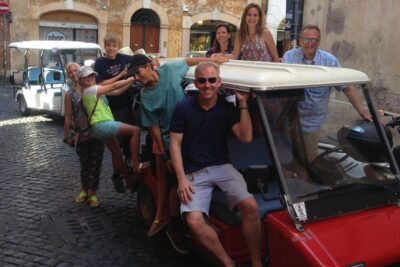
Rome by Golf Cart Private Tour: Beyond the Landmarks
Read our review →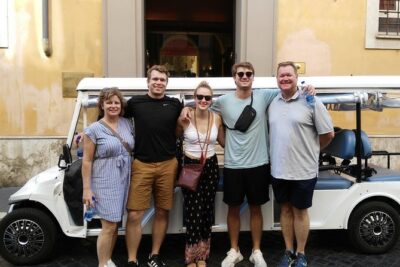
Rome on a Golf Cart Semi-Private Tour Max 6 with Private Option
Read our review →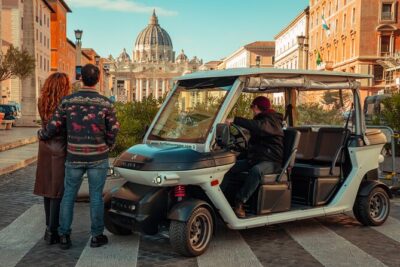
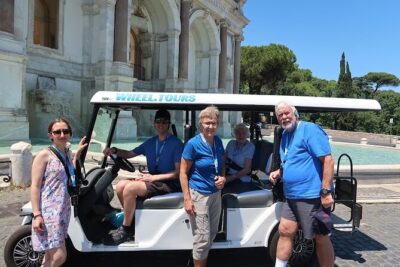
Rome Highlights City Tour by Golf Cart with Gelato
Read our review →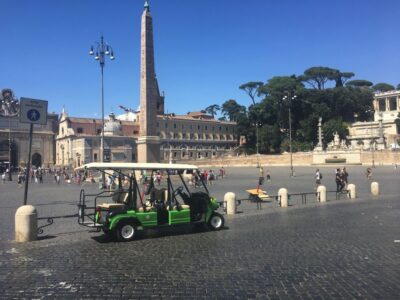
Imperial City Tour by Golf Cart with Optional Transfer
Read our review →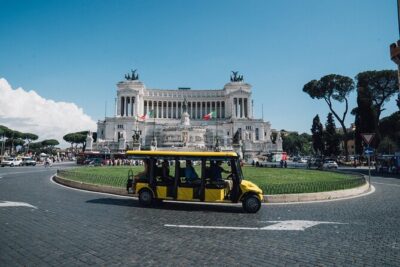
Golf Cart Small-Group Guided Tour: Rome City Highlights
Read our review →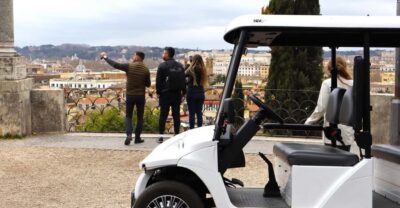
Private/Group 4 Hours Golf Cart SightseeingTour
Read our review →Browse the lists this tour appears in