
Reviewed · TREVI FOUNTAIN & PANTHEON WALKS
Pantheon: The Iconic Ancient Roman Temple – Semi-Private Tour
The best reason to take this tour is simple: the Pantheon looks impressive on its own, but its design only begins to make sense when someone explains how its vast interior, dome, symbols, and changing religious role fit together. Guide Olga di Cagno, an archaeologist, uses drawings and images on an iPad to make the building easier to read.
I like the small-group format, which gives you a better chance to ask questions than a large walking tour. I also like the short, focused timing: in about an hour, you get a clear introduction without giving up half your day. The main consideration is that the visit is entirely centered on one monument, so you should not book it expecting a broader tour of ancient Rome.
In This Review
- Key points to know before booking
- Why the Pantheon deserves a guided visit
- Meeting at Piazza della Rotonda
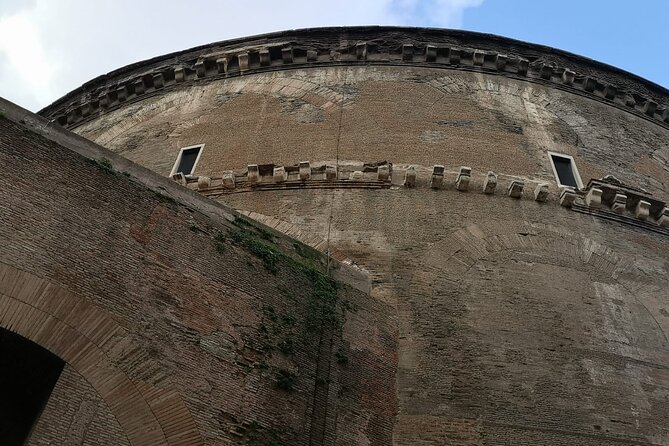
- Seeing the Pantheon from the outside
- Inside the dome and the famous opening above
- A temple, a church, and a living monument
- How Olga’s guiding style shapes the visit
- Is a one-hour tour enough?
- Price and value at $66.54
- Who should book this Pantheon tour?
- Cancellation and planning notes
- Should you book it?
- FAQ
- Where does the Pantheon tour begin?
- Where does the activity end?
- How long does the tour last?
- What language is the tour offered in?
- How many people can join the tour?
- Do I need to cover my shoulders?
Key points to know before booking

- Olga’s archaeology background adds detail about construction, Roman architecture, and the Pantheon’s changing meaning.
- Piazza della Rotonda is both the meeting point and the end point, making the tour easy to fit into a day in central Rome.
- The tour lasts about 50 minutes to one hour, a practical length before lunch, dinner, or another nearby sight.
- An iPad with drawings and images helps explain parts of the structure that are hard to understand by looking up at the dome.
- The group is designed to be small, with tour details listing a maximum of 10 travelers, while the overview refers to up to 15, so confirm the final group limit when booking.
- Shoulders must be covered, an important clothing note for the Pantheon’s current religious use.
Why the Pantheon deserves a guided visit
Rome gives you no shortage of ancient monuments. Many are huge, ruined, or spread across a wide site. The Pantheon is different. It is compact, still largely intact, and experienced from one powerful interior space.
That preservation can fool you. You walk inside, look up, and see a dome that appears almost too perfect to be ancient. Without context, it is easy to admire the room for a minute, take a photo, and move on. A good guide gives your eyes a job. You begin noticing the relationship between the entrance, the walls, the dome, the opening at the top, and the building’s religious symbols.
Olga’s role is especially useful here because her background is in archaeology. She does not simply point out famous features. She explains the structure and the ideas behind it, then connects those details to Rome’s broader story. Her English is described as excellent, which matters when a tour depends on precise explanations of architecture and religious change.
I also like the way this experience treats the Pantheon as a building with several lives. It began as a Roman temple, then became a Christian church. That shift is not a footnote. It changes how you understand the interior, the artwork, the altar, and the building’s survival.
More Trevi and Pantheon walks:
- Rome: Pantheon Timeless Marvel Guided Tour with Entry Ticket
★ 4.9 · 4,002 reviews - Rome: Pantheon Priority Entry Ticket & Audio Guide App
★ 4.1 · 3,234 reviews - Enjoy Spritz and Pasta Making in Piazza Navona
★ 5.0 · 1,681 reviews
Meeting at Piazza della Rotonda
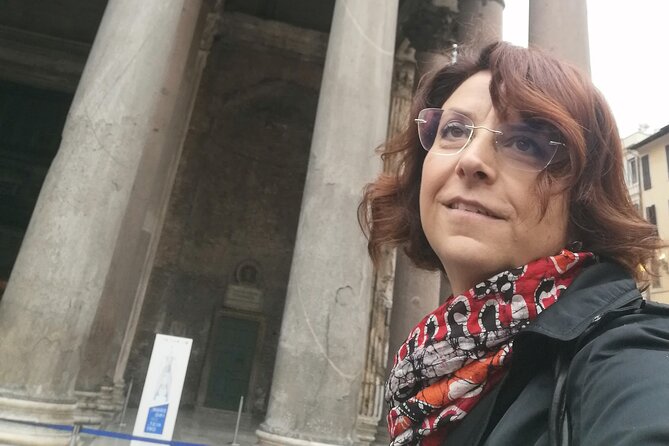
You meet your guide at Piazza della Rotonda, the square directly outside the Pantheon. This is a sensible meeting place because you do not need to navigate a distant office or find a vehicle in Rome’s crowded center.
The square itself can be busy, and the Pantheon is surrounded by cafés, pedestrians, and people taking photographs. Give yourself a little extra time to locate Olga and avoid arriving at the last second. Your mobile ticket is useful, but you should still have the booking details ready on your phone.
The activity returns to the same meeting point after the visit. That makes it easy to continue on foot toward other central sights, though this tour itself does not include transport or additional stops.
One practical point deserves attention. The tour is described as semi-private, with a small group limit. One set of tour information says a maximum of 15 people, while the additional details say a maximum of 10. That is still a much smaller setting than a large city tour, but I would check the confirmed group size if that distinction matters to you.
Seeing the Pantheon from the outside
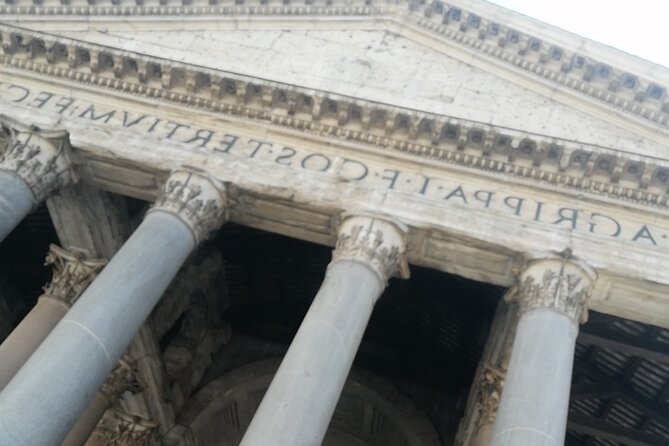
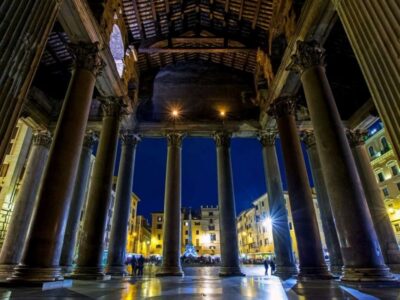
The exterior deserves more than a quick glance before you enter. From the piazza, the building presents a familiar Roman front with its monumental portico and columns. The contrast between that traditional entrance and the enormous round interior is one of the pleasures of the visit.
Olga’s explanations focus on ancient Roman symbols, architectural customs, and the thinking behind the design. This is where an archaeologist’s perspective can help. A photograph shows you the façade. A guide can explain why the entrance was made to feel so formal, how the building expresses power, and how the outer appearance prepares you for the space beyond.
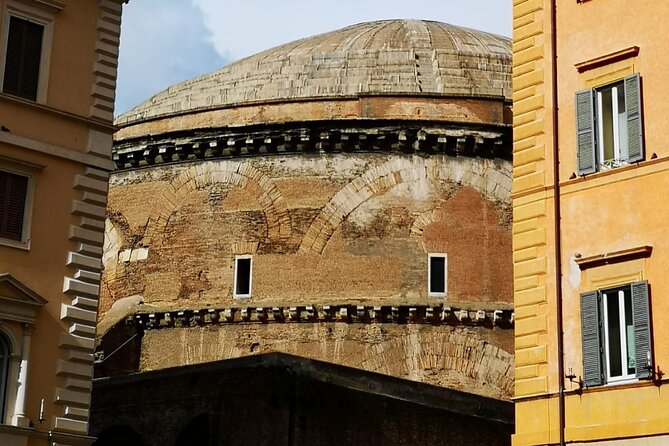
You should also pay attention to scale. The Pantheon is not an isolated ruin in a quiet archaeological park. It is part of modern Rome, surrounded by daily life. You may find yourself standing in a lively piazza one moment and then facing a building that carries centuries of religious and political meaning the next.
The tour does not promise a long exterior walk or a wider neighborhood tour. That is not a flaw if you want the Pantheon explained properly. It simply means the exterior portion is an introduction to the main event inside.
Inside the dome and the famous opening above
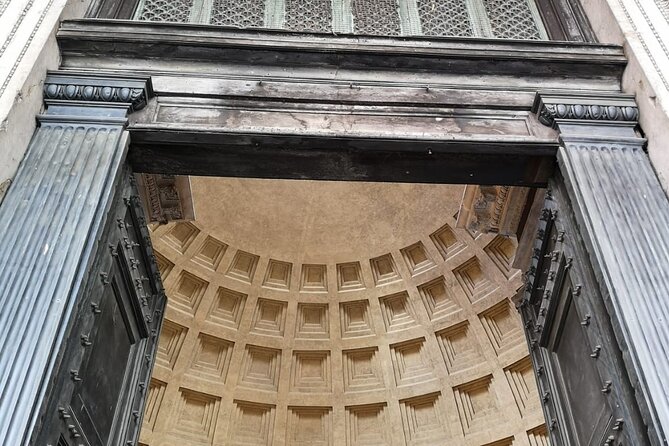
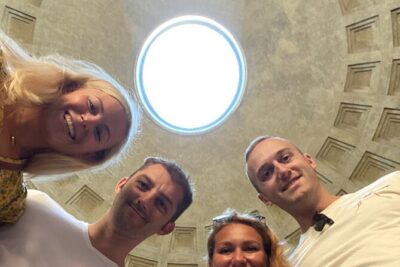
The interior is where the tour earns its keep. The dome and its central opening are well known, but the important question is how they work together. Looking up is memorable. Understanding what you are seeing is better.
Olga uses archaeological drawings and other iPad visuals to support her explanations. This can be valuable because much of the Pantheon’s construction is difficult to see directly. You are looking at finished surfaces, not a cutaway diagram of the original building process. Images can show proportions, earlier forms, or structural ideas that are otherwise hidden.
The opening at the top also changes the mood of the room. Light enters from above, and depending on the conditions, you may notice how the illumination shifts across the interior. The tour information does not promise a particular weather effect, so treat that as a possible feature rather than a scheduled part of the experience.
The building’s engineering is not presented as a dry technical lecture. Olga’s style, as described by the supplied material, combines facts with storytelling and visual aids. She is especially praised for explaining the construction and helping people of different ages stay involved. That makes the tour a good choice for families, provided children can manage a focused hour inside a historic building.
More Rome tours worth comparing
- Rome by Golf Cart Private Tour: Beyond the Landmarks
★ 5.0 · 4,361 reviews - Early Morning Vatican, Sistine, St. Peter’s Semi or Private Tour
★ 5.0 · 3,779 reviews - Rome on a Golf Cart Semi-Private Tour Max 6 with Private Option
★ 5.0 · 2,502 reviews - Rome Private Arrival Transfer: Fiumicino Airport to Hotel in Rome
★ 4.5 · 2,492 reviews
A temple, a church, and a living monument
The Pantheon’s meaning changed over time. It is not only an ancient Roman temple preserved behind glass. It also functions as a Catholic church, and that later use shapes what you see inside today.
Olga explains the relationship between the pagan Roman past and early Christianity. She also discusses the building’s Catholic role, giving you a fuller view than a purely architectural tour would. I find this useful because it prevents a common mistake: treating the ancient and Christian layers as separate attractions rather than parts of one continuing place.
The building’s survival is another central theme. Much of ancient Rome exists as fragments, foundations, or reconstructed remains. The Pantheon gives you a rare chance to experience a nearly complete ancient structure in a form you can enter and understand as a whole.
That does not mean every surface belongs unchanged to the original Roman period. A guide helps you separate the ancient design from later alterations and uses. This is one of the strongest reasons to choose an expert-led visit instead of relying only on a self-guided audio track.
Remember the dress rule. Your shoulders must be covered because the Pantheon is a church. This applies to adults and children, so check your clothing before leaving your hotel. A light scarf or cover-up can solve the problem, but it is better to plan ahead.
How Olga’s guiding style shapes the visit
The most consistent strength here is Olga herself. She is described as warm, enthusiastic, and easy to understand, with a strong command of Roman architecture and archaeology. Her passion comes through without turning the tour into a performance.
That matters in a building where many visitors arrive with the same basic questions. Why was it built? How did it survive? What does the dome represent? Why is a church inside a Roman temple? A guide who welcomes questions can turn those standard points into a conversation suited to your group.
Olga also appears comfortable with different ages and levels of interest. Families can ask simple questions without feeling out of place, while adults who want more detail can focus on engineering, archaeology, or religious change.
The iPad is a practical touch rather than a gimmick. It gives her a way to show drawings and images while standing inside the monument. You are not left trying to imagine every stage of construction from a spoken description alone.
The experience is offered in English. If you are looking for a tour in another language, this will not be the right match.
Is a one-hour tour enough?
For most people, yes, if you want an introduction rather than a full academic study. The advertised length is about 50 minutes to one hour, and the itinerary centers on the Pantheon alone.
That short duration works well in Rome. You can place the tour between other stops without losing a major block of the day. It is also long enough for the guide to explain the exterior, interior, engineering, symbols, and religious layers without racing through the building.
The trade-off is depth. A longer specialist tour might allow more time for questions or a wider discussion of the surrounding area. This experience is better for a clear, concentrated visit. You leave with a framework for appreciating the Pantheon, not a complete course in Roman archaeology.
I would book it early if your schedule is fixed. The experience is booked an average of 53 days ahead, which suggests that popular dates can fill well before a Rome visit. Confirmation is normally provided at booking. If you reserve within one day of the visit, confirmation depends on availability and may arrive as soon as possible.
Price and value at $66.54
At $66.54 per person, this is not the cheapest way to enter the Pantheon. Admission to the monument itself is listed as free within the itinerary, so the fee mainly pays for Olga’s time, preparation, specialist background, group management, and visual material.
The value depends on how you like to visit famous buildings. If you are happy to read a short guide and look around independently, you may prefer to keep the money. The Pantheon is not difficult to enter and does not require a guide simply to appreciate its scale.
I think the price makes more sense if you want to understand what you are seeing. The building’s appeal is tied to details that are not obvious at first glance. An archaeologist explaining the structure can turn a quick stop into a more lasting memory.
The small group also matters. You are paying for a more personal setting than a large tour, though the exact cap should be checked because the supplied details list both 10 and 15 people. A private tour may offer more flexibility, but this semi-private format can give you much of the same access to questions at a lower cost.
Who should book this Pantheon tour?
I would recommend it to first-time visitors who want context without committing to a long city tour. It also suits anyone who enjoys architecture, Roman engineering, archaeology, or the way religious buildings change meaning over time.
Families can benefit from the short format and Olga’s ability to engage more than one age group. Couples and solo visitors may appreciate the chance to ask questions in a small group. If you are visiting Rome for only a few days, this is a neat way to give one major monument your full attention.
You may want to skip it if you prefer silent wandering, dislike scheduled explanations, or already have a specialist Roman architecture tour planned. It is also not the right choice if you need a tour in a language other than English.
Service animals are allowed, the meeting point is near public transportation, and most people can participate. The supplied information does not give detailed accessibility specifications, so contact the provider directly if you have specific mobility needs.
Cancellation and planning notes
Free cancellation is available up to 24 hours before the start time for a full refund. Cancellations or changes made less than 24 hours before the experience are not accepted for a refund, and cut-off times use Rome’s local time.
The tour requires a minimum number of participants. If that minimum is not met and the activity is canceled, you will be offered another date or experience, or a full refund.
Plan to arrive at Piazza della Rotonda with covered shoulders and your mobile ticket ready. Since the tour ends where it begins, you can keep your next Rome plan nearby rather than arranging transport across the city.
Should you book it?
Book this tour if you want the Pantheon to make sense, not simply look beautiful. Olga’s archaeology training, iPad visuals, strong English, and warm teaching style are the main reasons to choose it, while the small group and one-hour length keep the commitment manageable.
The fee is harder to justify for independent visitors who only want a quick look, especially since admission is listed as free. But if you value clear explanations and want to understand the engineering, symbols, and Christian layers of one of Rome’s most remarkable buildings, this is a focused and worthwhile choice. Book early for a firm date, confirm the group limit, and cover your shoulders before you go.
FAQ
Where does the Pantheon tour begin?
The tour begins at Piazza della Rotonda, 00186 Rome, Italy.
Where does the activity end?
The activity ends back at the meeting point in Piazza della Rotonda.
How long does the tour last?
The tour lasts approximately 50 minutes to one hour.
What language is the tour offered in?
The tour is offered in English.
How many people can join the tour?
The information describes a small group, with one detail listing a maximum of 10 travelers and another referring to up to 15. Confirm the final group limit when booking.
Do I need to cover my shoulders?
Yes. Your shoulders must be covered because the Pantheon is also used as a church.
Newest reviews from Rome
- Rome: Vatican Museums & Sistine Chapel Skip-the-Line Ticket★ 4.4 · 148 reviews
- Shared Shuttle Transfer from Rome to Civitavecchia Port★ 5.0 · 148 reviews
- Rome: Crypts & Catacombs After Hours Tour with Bone Chapel★ 4.6 · 149 reviews
- Ghosts Legends and Mysteries of Rome Walking Tour★ 5.0 · 149 reviews
- Skip the Line: Vatican and Sistine Chapel with Guided Tour★ 4.0 · 149 reviews
- Tivoli: Villa Gregoriana Entrance Ticket★ 4.7 · 150 reviews
- Pizza and Tiramisu Cooking Class in Rome, Piazza Navona★ 5.0 · 150 reviews
- Rome: Borghese Gallery Skip-the-Line Entry and Guided Tour★ 4.7 · 150 reviews
Trevi Fountain & Pantheon Walks, compared.
Pantheon Timeless Marvel Guided Tour with Entry Ticket
Read our review →
Pantheon Priority Entry Ticket & Audio Guide App
Read our review →
Enjoy Spritz and Pasta Making in Piazza Navona
Read our review →
Pantheon Elite Guided Tour – Rome’s Iconic Ancient Temple
Read our review →
Pasta & Tiramisu Cooking Class near the Spanish Steps
Read our review →
Traditional Pizza Cooking Class near Piazza Navona
Read our review →
Rome’s Iconic Temple: Pantheon Audio Guided Tour with Fast Access
Read our review →Browse the lists this tour appears in