
Reviewed · ROME
Pastamania in Rome
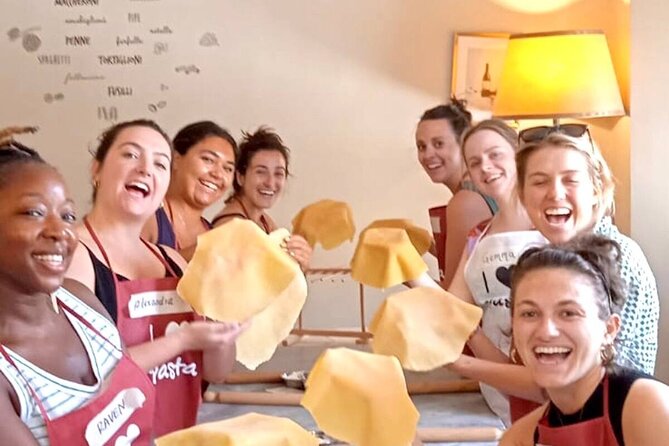
The best part of Pastamania is simple: you make three kinds of fresh pasta from flour and eggs, then sit down and eat what you shaped with your own hands. The class takes place inside historic Palazzo Grazioli, a short walk from the Pantheon and Piazza Venezia, so it fits neatly into a day of central Rome sightseeing.
I like the small-group, hands-on format, and I like that the food is more than a token tasting. You prepare ravioli, tortelli, and fettuccine, then enjoy them with butter and sage or tomato sauce, along with dessert and drinks. The main thing to consider is mobility: the class is not suitable for people with limited mobility, including those using crutches, and group size may vary despite the stated maximum of 10.
In This Review
- Key points to know before you book
- Making pasta inside Palazzo Grazioli
- From flour and eggs to three pasta shapes
- Ravioli
- Tortelli
- Fettuccine
- The sauces and the meal matter as much as the lesson
- Why the instructor makes or breaks the class
- Group size, pace, and the social side
- Is $49.58 a fair price?
- Timing your class with a day in central Rome
- Who should book, and who should think twice?
- My take: book it if you want dinner with a skill attached
- FAQ
- Where does Pastamania take place?
- How long does the pasta class last?
- What kinds of pasta will I make?
- What food is included?
- Is the class offered in English?
- How many people can join the class?
- Is the activity suitable for children?
- Is the class accessible for people with limited mobility?
- Can I cancel for a refund?
Key points to know before you book
- Three pasta shapes in one class: Make ravioli, tortelli, and fettuccine from scratch rather than watching a chef do all the work.
- Historic central setting: The meeting point at Palazzo Grazioli, Via della Gatta 14, is only a few minutes from major Rome sights.
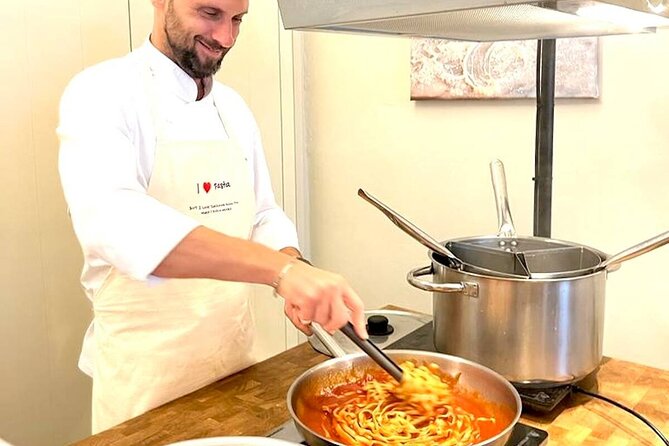
- Guides with different teaching styles: Instructors named in class accounts include Christian, Giorgio, Fabrizio, Luca, Ricardo, Sofia, Martina, and Arianna.
- A full meal at the end: Your pasta comes with sauces, wine or soft drinks, chocolate salami, and in some sessions limoncello or biscuits.
- Good for mixed-age groups: Families, couples, solo participants, older adults, students, and work groups can all take part.
- Plan ahead: The experience is often booked about 25 days before the date, and free cancellation ends 24 hours before the start time.
Making pasta inside Palazzo Grazioli
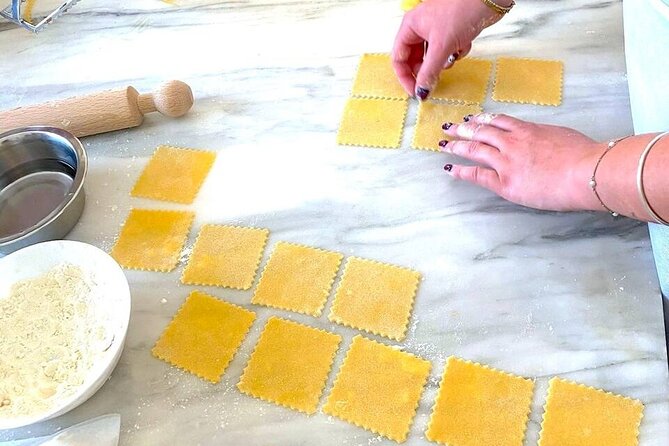
Rome offers endless food tours, but this one gives you a useful souvenir: the ability to make pasta at home. You do not simply watch a demonstration and nibble a sample. You work the dough, roll it thin, fill it, fold it, and shape it.
The setting helps. Palazzo Grazioli is a historic building in the center of Rome, with the class meeting at Via della Gatta 14. From here, you are close to the Pantheon and Piazza Venezia, making the class easy to pair with sightseeing in the old center. You will need to find your own way to the meeting point, but the location is near public transportation.
The experience is offered in English. That matters because pasta-making depends on small instructions: how the dough should feel, how thin to roll it, how much filling to use, and how to seal a stuffed shape without trapping air. An English-speaking instructor can explain those steps as you work, rather than leaving you to copy a gesture without understanding it.
The class lasts about three hours. That is long enough to include instruction, preparation, cooking, eating, and conversation without making the activity feel like a rushed demonstration. If you have only one free afternoon in Rome, you should treat this as a substantial meal and activity, not a quick stop between museums.
Tours travellers often pair with this one in Rome:
- Vatican: Museums & Sistine Chapel Entrance Ticket
★ 4.5 · 144,003 reviews - Vatican Museums & Sistine Chapel Tour with Optional Basilica
★ 4.3 · 67,413 reviews - Vatican Museums, Sistine Chapel & St Peter’s Basilica Guided Tour
★ 4.5 · 39,149 reviews
From flour and eggs to three pasta shapes
The lesson starts with an introduction to fresh pasta and the traditions behind it. Then the practical work begins. You knead the dough, roll it, and turn it into several forms.
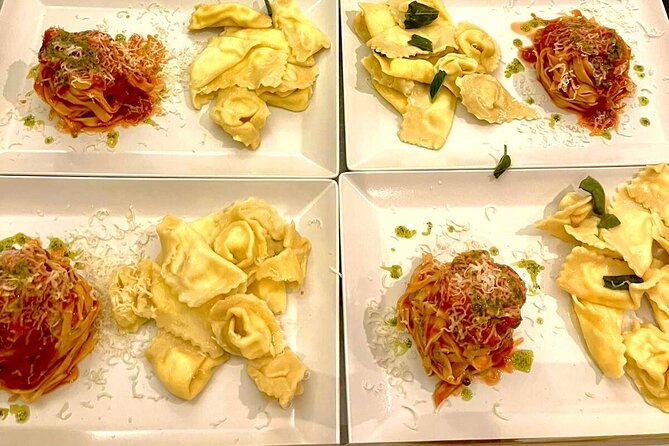
The menu includes ravioli with a Parmesan and ricotta filling finished with truffle oil, tortelli with Parmesan, ricotta, and nutmeg served with butter and sage, and fettuccine with tomato sauce. The exact classroom rhythm can depend on the instructor and group, but the aim is to give you a broad introduction to both stuffed and ribbon pasta.
Ravioli
Ravioli teaches you precision. The filling has to be placed in the right amount, with enough space around it to seal the pasta. Too much filling can split the dough, while too little makes the finished piece feel flat.
The listed filling combines Parmesan and ricotta with truffle oil. That gives the first course a rich, fragrant character without requiring you to prepare a complicated sauce. You learn that good pasta is not only about ingredients. Thickness, moisture, shape, and cooking time all matter.
Tortelli
Tortelli gives you another stuffed shape and another chance to practice sealing and folding. The filling includes Parmesan, ricotta, and nutmeg, while butter and sage provide the sauce.
This is a classic Roman and Italian flavor combination: a few strong ingredients, handled with care. It also lets you compare two stuffed pastas made with related ingredients but shaped differently. For a first class, that comparison is useful because you can see how form affects the bite and how a simple sauce can support fresh pasta.
A completely different way to spend the day in Rome:
- Rome: Colosseum, Palatine Hill and Roman Forum Guided Tour
★ 4.8 · 32,814 reviews - Rome: Guided Tour of Colosseum, Roman Forum & Palatine Hill
★ 4.7 · 27,897 reviews - Rome: Colosseum & Forum with Audio Guide App -Optional Arena
★ 4.2 · 24,770 reviews - Rome: Colosseum, Roman Forum and Palatine Hill Guided Tour
★ 4.5 · 23,903 reviews
Fettuccine
Fettuccine is the most familiar shape of the three, and it may be the easiest one to repeat at home. You roll the dough and cut it into ribbons, then eat it with tomato sauce.
The contrast is welcome. After the detail work of stuffed pasta, fettuccine gives you a direct lesson in rolling and cutting. You leave with a basic method that can be adapted to many sauces. Several class accounts also describe the portions as generous, so do not arrive after a large meal.
The sauces and the meal matter as much as the lesson
A cooking class can be fun but still disappoint if the food served at the end feels like an afterthought. Here, the pasta is cooked and served as the main event.
The planned sauces are butter and sage for the stuffed pastas and tomato sauce for the fettuccine. These are sensible choices for a teaching class. They are not so complex that they hide the pasta, and they allow you to taste the texture of what you made.
The meal is served around a communal table. This changes the mood from a technical workshop into a shared Italian-style meal. You eat the same food you prepared, compare shapes, and talk with the people at your table. The communal setup is particularly good for solo participants, since you are not left working alone in a corner.
Wine is part of the experience, and soft drinks are available for children in at least some sessions. The food also includes chocolate salami, a no-bake Italian-style dessert made with chocolate and biscuit pieces. Some class accounts also include biscuits and limoncello, though you should treat those extras as session details rather than guaranteed parts of the printed sample menu.
The pace may feel social rather than formal. Instructors such as Christian, Giorgio, Fabrizio, Luca, Ricardo, Sofia, Martina, and Arianna are described as friendly, patient, funny, and willing to offer advice for making pasta at home. The personalities may differ, but the class clearly depends on an instructor who can keep both beginners and more confident cooks involved.
Why the instructor makes or breaks the class
Pasta is not hard to explain, but it can be hard to teach well. A good instructor must demonstrate clearly, notice when dough is too dry or too wet, and keep the group moving while still answering individual questions.
Christian is described as energetic and relaxed, with a style that suits both children and older adults. Giorgio is noted for patience, humor, and clear demonstrations, while Fabrizio is praised for sharing practical advice on making and storing pasta at home. Luca is described as welcoming and flexible, including when a participant arrived late.
Other named instructors include Ricardo, Sofia, Martina, and Arianna. Ricardo combines pasta instruction with conversation about wine, Sofia uses humor while explaining the basics, and Arianna is described as sweet and encouraging. These details suggest a class built around approachable teaching rather than a stern culinary-school atmosphere.
That is good news if you are nervous about cooking. You do not need advanced skills to take part. The class is designed for people starting with basic ingredients and learning as they go.
It also suits families. One account describes an instructor helping a nine-year-old, while another describes a class that worked for children aged nine and fifteen as well as older adults. That mix is one of the experience’s strongest features. Parents should still consider the three-hour length and the physical work of kneading and rolling.
Group size, pace, and the social side
The stated maximum is 10 participants, which should allow for personal attention. Yet class accounts describe sessions of six, eight, 12, and even more than 20 people. Group size may depend on the date, room arrangement, or operating changes, so I would confirm the current size if a very small class is important to you.
A smaller group usually means more time at the work surface with the instructor. You can ask about dough texture, shaping, and storage instead of waiting through a long line for help. A larger group can bring more energy and make the communal meal livelier, but individual instruction may be less frequent.
The social element is not a minor extra. People take this class alone, as couples, with friends, in family groups, and as corporate teams. You share a table with people from different places, and the meal gives everyone a natural reason to talk.
For a solo booking, this is one of the better ways to turn a meal into a social evening without committing to a full group tour. For couples, it provides a break from Rome’s churches and ruins. For a family, it gives children a task they can understand and enjoy.
Is $49.58 a fair price?
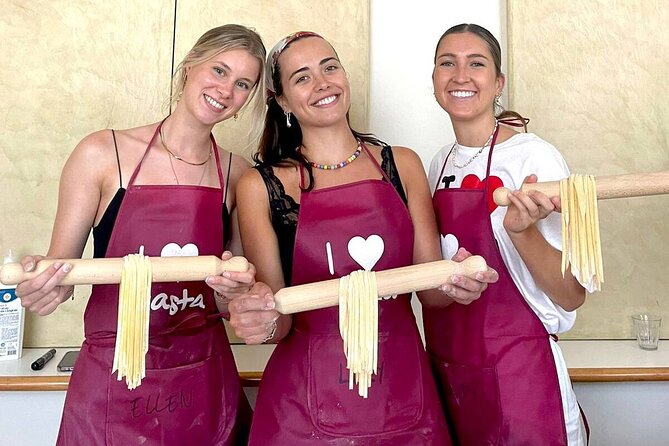
At about $49.58 per person, Pastamania costs more than buying a plate of pasta at a casual Roman restaurant. That comparison is not quite fair, because you are paying for about three hours of instruction, ingredients, a full meal, drinks, dessert, and use of a central venue.
The value is strongest if you count the class as both dinner and an activity. You are not paying for a tiny sample. You make several pasta types and eat them with sauces, and portions are described as filling. The wine, chocolate salami, and possible limoncello add to the meal.
The price is less attractive if you mainly want a quick cooking demonstration or a refined restaurant dinner. This is a participatory class, and part of the cost covers the time and teaching. If you do not want to knead dough, wait for other people, or eat at a communal table, a restaurant may suit you better.
I would also remember the practical value of the lesson. A good pasta class gives you a method you can repeat after returning home. You learn how to work with dough, shape stuffed pasta, prepare simple sauces, and store fresh pasta. That makes the experience more than a one-night meal.
Timing your class with a day in central Rome
The meeting point is Palazzo Grazioli on Via della Gatta, 14, and the class ends at the same place. Since it is near the Pantheon and Piazza Venezia, it pairs well with a walking day through central Rome.
Allow enough time to reach the address without rushing. Rome’s central streets can be confusing, and the class needs to begin on time because dough preparation and cooking follow a set sequence. I would avoid scheduling a major timed attraction immediately afterward. Three hours is approximate, and the meal at the end is part of the experience, not an afterthought to be hurried through.
You can plan the class for lunch or dinner, depending on the available departure time. Since the food is substantial, arrive hungry. One participant’s practical advice is worth following: do not eat a large meal beforehand.
The activity uses a mobile ticket, and confirmation is provided when you book. It is often reserved about 25 days ahead, so do not wait until the last day if your Rome schedule is fixed.
Who should book, and who should think twice?
I would recommend this class to you if you want to do something active, enjoy meeting people, or want a Rome memory you can recreate in your own kitchen. It works especially well for couples and families, and it is also a strong choice for solo visitors who want a friendly evening without arranging their own dinner companions.
It is a good match for beginners. The lesson begins with an introduction and moves into guided practice, so you are not expected to arrive with pasta-making experience. It also works for experienced home cooks who want to compare techniques, though the class is aimed at a broad audience rather than advanced professionals.
Children can take part, and instructors have worked successfully with a nine-year-old and teenagers. The class also suits older adults, provided they are comfortable with the physical demands and the venue’s access limits.
I would hesitate to book this if you have limited mobility, use crutches, or need an accessible venue. The activity is not accessible for people with limited mobility, and it is specifically marked as not recommended for travelers with disabilities. Service animals are allowed, and the location is near public transportation, but those points do not remove the mobility concern.
The class requires a minimum number of participants. If that number is not reached, you may be offered another date or experience, or receive a full refund. You can cancel for a full refund up to 24 hours before the start time. Inside that window, refunds are not available and changes are not accepted.
My take: book it if you want dinner with a skill attached
Pastamania is a practical, social way to connect with Rome’s food culture. Its strongest points are the hands-on work, the three pasta shapes, the central palazzo setting, and the fact that you eat a real meal at the end.
Book it if you want to knead, roll, shape, laugh, and eat. Pick another activity if you prefer a quiet restaurant, a short demonstration, or fully accessible facilities. For most people with three free hours and an appetite, the combination of instruction, food, and easy central location makes the price reasonable.
FAQ
Where does Pastamania take place?
The class starts and ends at Palazzo Grazioli, Via della Gatta, 14, 00186 Roma RM, Italy. It is a few minutes’ walk from the Pantheon and Piazza Venezia.
How long does the pasta class last?
The experience lasts approximately three hours.
What kinds of pasta will I make?
You will prepare ravioli, tortelli, and fettuccine from scratch.
What food is included?
The sample menu includes ravioli with Parmesan and ricotta, truffle oil, and butter and sage; tortelli with Parmesan, ricotta, nutmeg, and butter and sage sauce; fettuccine with tomato sauce; and chocolate salami for dessert.
Is the class offered in English?
Yes. The experience is offered in English.
How many people can join the class?
The stated maximum is 10 participants. A minimum number of participants is also required for the class to operate.
Is the activity suitable for children?
Yes. The experience is suitable for families, and class instruction has accommodated children, including a nine-year-old.
Is the class accessible for people with limited mobility?
No. The activity is not accessible to people with limited mobility, including those using crutches, and it is not recommended for travelers with disabilities. Service animals are allowed.
Can I cancel for a refund?
Yes. You can cancel at least 24 hours before the local start time for a full refund. Cancellations or changes made less than 24 hours before the start time are not accepted for a refund.
Newest reviews from Rome
- Appia Antica & Aqueducts e-Bike Tour – Official Provider★ 4.8 · 21 reviews
- Rome cooking: Gelato & Tiramisu with savoiardi Baking class★ 4.9 · 21 reviews
- Colosseum, Vatican Museum, and Sistine Chapel Experience★ 4.5 · 21 reviews
- The Truffle Experience in Rome★ 4.9 · 21 reviews
- Rome Walking Tour of Holy Sites: Basilica of the Holy Cross in Jerusalem, San Giovanni in Laterano and Scala Santa★ 5.0 · 21 reviews
- Roman Forum and Palatine Hill Access★ 3.5 · 21 reviews
- Private Double Wine Tasting Tour in Frascati – Exclusive★ 5.0 · 21 reviews
- Rome By Night Private Tour with Pick Up★ 5.0 · 21 reviews