
Reviewed · ROME GOLF CART TOURS
Private Piazza’s, Fountains, Monuments & Basilicas Rome Golf Cart
Rome is easiest to grasp from a small, open vehicle that can slip through streets a bus cannot use. This private golf-cart tour sweeps from Janiculum Hill and Trastevere to the Colosseum, Trevi Fountain, the Pantheon, and Piazza del Popolo, giving you a fast first look at the city’s enormous mix of ancient ruins, papal churches, fountains, and neighborhood life.
I especially like the unobstructed views, which make it easier to spot details without peering through glass. I also like the private format and the chance to ask questions as you go. Guides such as Ahmad, Claudio, Alfredo, Alfonso, Mido, and James have been praised for strong storytelling, careful attention to families, and useful advice about where to return later.
The trade-off is simple: this is an orientation tour, not a site visit. You will see every attraction from the outside, and three to four hours is not enough for more than a quick look at Rome’s long list of landmarks. Bring comfortable shoes, since you will get out and walk at several stops.
In This Review
- Key points to know before booking
- Why a private golf cart works well in Rome
- Janiculum Hill and the Fontanone
- Trastevere and the Tiber’s origin story
- The Mouth of Truth and the Orange Garden
- The keyhole, Pyramid of Cestius, and Aurelian Walls
- Baths of Caracalla and the Palatine Hill
- The Colosseum, Arch of Constantine, and Circus Maximus
- Santa Maria Maggiore and the Roman Ghetto
- Castel Sant’Angelo and the historic center
- Trevi Fountain, Spanish Steps, and Piazza del Popolo
- What the $150.18 price means
- Who should book this Rome tour?
- Should you book it?
- FAQ
- How long does the Rome golf-cart tour last?
- What language is the tour offered in?
- Is the golf-cart tour private?
- Where does the tour begin?
- Where does the tour end?
- Are attraction entry tickets included?
- Is lunch included?
- Are morning and afternoon departure times available?
- Are children allowed on the tour?
- Can I cancel the tour for a full refund?
Key points to know before booking
- A private golf cart reaches more than a standard bus: Small streets and hilltop viewpoints are part of the route.
- Janiculum Hill delivers the big opening view: The Belvedere and Fontanone give you a clear panorama across Rome.
- The route covers ancient, Jewish, Christian, and Baroque Rome: You move from the Pyramid of Cestius and Roman Forum to basilicas, fountains, and piazzas.
- Every major sight is viewed from outside: Tickets and interior visits are not included.
- The first day can be a smart time to go: The route helps you decide which sites deserve a longer visit later.
- Morning and afternoon departures add flexibility: The tour lasts about three to four hours and ends at Piazza del Popolo, or nearby if requested.
Why a private golf cart works well in Rome
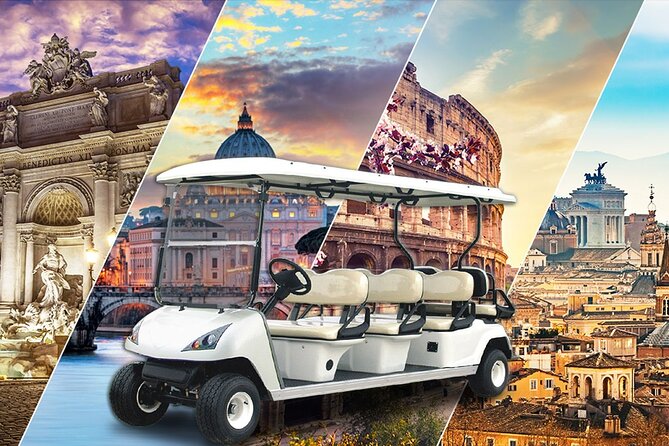
Rome is a city of grand distances, steep hills, narrow lanes, and busy roads. A large coach can show you the main avenues, but it often misses the smaller streets and viewpoints that give the city its character. A golf cart offers a more open ride, with better sightlines and easier access to places that are awkward for full-size vehicles.
The private setup matters most if your group includes children, older adults, or people who do not want to spend the whole day walking. You can stay with your own party rather than fitting into a large group. Children must be accompanied by an adult, and service animals are allowed.
The guide provides live commentary in English. That makes the ride more than a parade of famous names. You hear how imperial Rome, medieval neighborhoods, papal power, Jewish history, fountains, and modern city life fit together. Guides named in the feedback, including Ahmad and Claudio, were singled out for safety, historical detail, and enthusiasm. One guide, Claudio, was described as an artist who brought particular feeling to Rome’s sculpture and fountains.
You should still think of the cart as transportation between short stops, not a substitute for walking. You will want to get out for views, photographs, and a closer look at some locations. Comfortable shoes are a practical choice.
More golf cart tours of Rome:
- Rome by Golf Cart Private Tour: Beyond the Landmarks
★ 5.0 · 4,361 reviews - Rome on a Golf Cart Semi-Private Tour Max 6 with Private Option
★ 5.0 · 2,502 reviews - Rome Highlights by Golf Cart Private Tour
★ 5.0 · 2,379 reviews
Janiculum Hill and the Fontanone
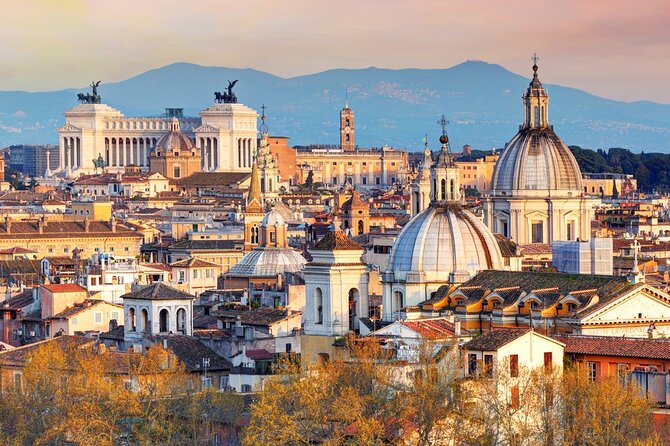
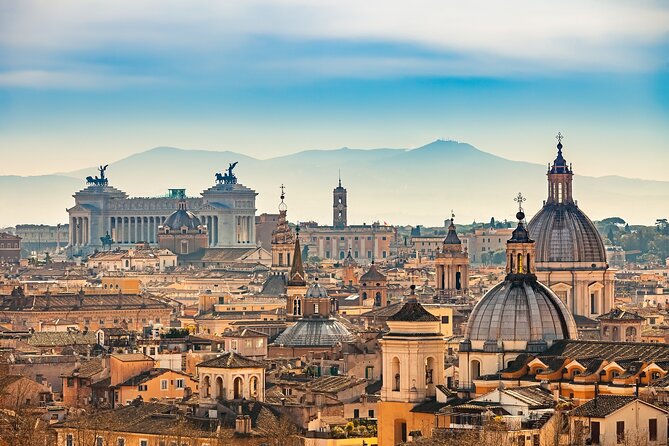
The tour begins with a striking view from the Belvedere del Gianicolo, on the right bank of the Tiber. Janiculum Hill is not one of Rome’s ancient seven hills, but it gives you one of the best elevated views of the city. From the terrace, Rome spreads out below in a broad sweep of domes, rooftops, church towers, and hills.
This is a smart first stop because it gives you a map in your head. After seeing the city from above, the later landmarks make more sense. You can better understand the relationship between the river, Trastevere, the historic center, and the major basilicas.
Nearby, the Fontana dell’Acqua Paola is an imposing wall of stone and water. Built in 1612 at the end of the restored Acqua Paola aqueduct, it was named for Pope Paul V. In Rome, fountains are rarely just decoration. They mark the city’s long struggle to bring water into neighborhoods and turn practical infrastructure into public art.
The hilltop setting can be breezy or sunny, so a light layer and sun protection may help. The stop is about views and context, not entry into a monument.
Trastevere and the Tiber’s origin story
The cart then reaches Trastevere, one of Rome’s most recognizable neighborhoods. Its name means across the Tiber, and its narrow streets preserve a more local, lived-in feel than the grand ceremonial center. The area is known for traditional and newer restaurants, craft beer pubs, artisan shops, simple bed-and-breakfasts, and budget hotels.
You will not get a full neighborhood walk during a citywide route like this. Instead, you get a taste of the setting and a chance to mark Trastevere for a later meal or evening stroll. This is one reason the tour works well near the start of a Rome stay. You can return to the places that catch your eye.
The Tiber also brings Rome’s founding legend into the story. According to tradition, Romulus and Remus were set adrift in a basket, became entangled along the riverbank, and were saved by the she-wolf who nursed them. Romulus later founded Rome in 753 BC. The tale is myth, but it explains why the river remains central to the city’s identity.
The Mouth of Truth and the Orange Garden
At Santa Maria in Cosmedin, you see the famous Mouth of Truth, an ancient marble mask set into the church portico. The familiar legend says that a liar who places a hand inside the mouth will lose it. The mask sits in Piazza della Bocca della Verità, in the area once known as the Forum Boarium, an ancient cattle market.
Because entry is not included, you should not expect an interior visit or a ticketed photo stop inside an attraction. The value here is the quick connection between a popular legend, an old Roman district, and a surviving piece of ancient marble.
The route continues up the Aventine Hill to the Orange Trees Garden, formally Parco Savello. The park covers about 7,800 square meters and offers another fine city view. Its present design dates to 1932 and is associated with Raffaele De Vico.
The Aventine is one of Rome’s quieter hills, and that change of pace is welcome after the traffic and crowds around major landmarks. The view is the main attraction, so allow yourself a moment to look outward rather than rushing straight back to the cart.
More Rome tours worth comparing
- Early Morning Vatican, Sistine, St. Peter’s Semi or Private Tour
★ 5.0 · 3,779 reviews - Rome Private Arrival Transfer: Fiumicino Airport to Hotel in Rome
★ 4.5 · 2,492 reviews - Private Pompeii, Positano & Amalfi coast Tour from Rome
★ 4.5 · 1,888 reviews - Private Departure Transfer: Hotel to Rome Fiumicino Airport
★ 4.5 · 1,050 reviews
The keyhole, Pyramid of Cestius, and Aurelian Walls
The Aventine also provides one of Rome’s most playful viewpoints. Through the keyhole in the central gate of the villa associated with the Knights of Malta, you can see the copper-green dome of Saint Peter’s Basilica at the end of a garden avenue framed by clipped cypress trees.
This is a tiny viewing point, not a full attraction visit. Its appeal comes from the careful framing: Rome’s political and religious symbolism appears through a simple keyhole. Depending on timing and crowd conditions, you may need patience for your look and photograph.
The Pyramid of Cestius brings a different side of Rome into view. Built as a tomb for Gaius Cestius, it was modeled in the style of Nubian pyramids and erected near Porta San Paolo and the Protestant Cemetery. Its sharp geometric form can seem out of place beside Roman streets, which is exactly what makes it memorable.
You also pass the Aurelian Walls, built between AD 271 and 275 under Emperor Aurelian. They replaced the earlier Servian Wall and show how Rome had to protect a city that had grown far beyond its original center. This is a good example of why a guide helps. Without context, a long stretch of old brick may look like just another ruin. With context, it becomes evidence of Rome’s changing size and military needs.
Baths of Caracalla and the Palatine Hill
The Baths of Caracalla were among the largest public bath complexes in ancient Rome, second only to the Baths of Diocletian. Construction began around AD 212 and continued under the emperors Septimius Severus and Caracalla.
You view the baths from outside on this tour, but even the exterior scale is impressive. Roman bathhouses were not simply places to wash. They were public gathering spaces with multiple functions, and their size shows the resources available to imperial Rome.
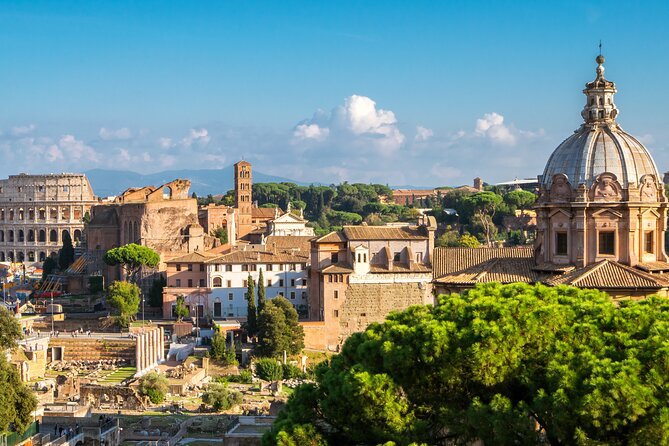
The Palatine Hill follows naturally. It is the central hill among Rome’s traditional seven hills and is often linked with the city’s earliest settlement and the first nucleus of the Roman Empire. From the route, you get a sense of its position beside the Forum and Circus Maximus.
This is one of the moments when you should be realistic about what the tour can provide. The Palatine, Roman Forum, and Colosseum each deserve substantial time inside. Here, you get orientation, exterior views, and commentary. If you want archaeological detail, reserve a separate visit with an entry ticket.
The Colosseum, Arch of Constantine, and Circus Maximus
The Colosseum needs little introduction, but seeing it from the cart places it in a useful setting. It is the largest ancient amphitheater ever built and remains the largest standing amphitheater in the world. Its location beside the Roman Forum and near the Arch of Constantine helps you understand how imperial monuments were arranged around the city’s political heart.
The Arch of Constantine commemorates Constantine’s victory over Maxentius at the Battle of the Milvian Bridge in AD 312. It was commissioned by the Roman Senate, and its decoration draws attention to the way later emperors reused older artistic material.
The Circus Maximus occupies the valley between the Aventine and Palatine hills. This was Rome’s great chariot-racing stadium and a major mass-entertainment venue. The open space can be hard to read without a guide, since much of the original structure is gone. Commentary helps you picture the stadium’s former scale.
These three stops are among the strongest reasons to choose the tour for a first visit. You get a clear outline of ancient Rome without spending the whole day in one archaeological complex. The drawback is that photographs and explanations cannot replace walking through the Colosseum or Forum. Plan those visits separately if they matter to you.
Santa Maria Maggiore and the Roman Ghetto
The Basilica of Saint Mary Major is one of Rome’s four major papal basilicas and the city’s largest Marian church. Its importance comes from both its religious role and its place in Rome’s network of pilgrimage churches.
The exterior gives you a chance to add a major basilica to your mental map, but the church interior is not part of the tour. If you want to see its mosaics, chapels, and decoration, you will need to return on your own.
The Roman Ghetto introduces a different chapter of the city’s past. Established in 1555 in the Sant’Angelo district, it lies near the Tiber and the Theatre of Marcellus. Today, the area is associated with Jewish heritage, restaurants, and historic streets, but its origins reflect centuries of restriction imposed on Rome’s Jewish community.
The route’s range is one of its strengths. You are not shown only the postcard monuments. You also pass through districts that help explain how communities lived under Rome’s changing religious and political systems.
Castel Sant’Angelo and the historic center
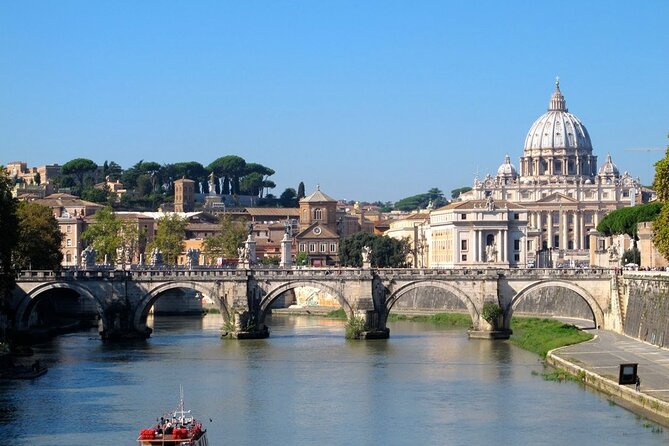
The Mausoleum of Hadrian, now known as Castel Sant’Angelo, began as a tomb for Emperor Hadrian and his family. Later popes used it as a fortress and castle, and it now operates as a museum.
Its round mass beside the Tiber is easy to recognize, but the guide can point out how its role changed over time. That shift from imperial tomb to papal stronghold is a compact lesson in Rome’s habit of building new power onto old structures.
At Piazza Navona, the shape of the square reveals its ancient origin. It follows the elongated oval of the Stadium of Domitian, where Romans watched athletic contests known as agones. The present piazza is famous for its fountains and Baroque architecture, though this experience keeps to exterior views.
The Pantheon is another essential outside stop. Originally a Roman temple commissioned under Augustus and later rebuilt under Emperor Hadrian, it became a Catholic church in AD 609. Its survival gives you an unusually clear link between ancient engineering and later Christian use.
Trevi Fountain, Spanish Steps, and Piazza del Popolo
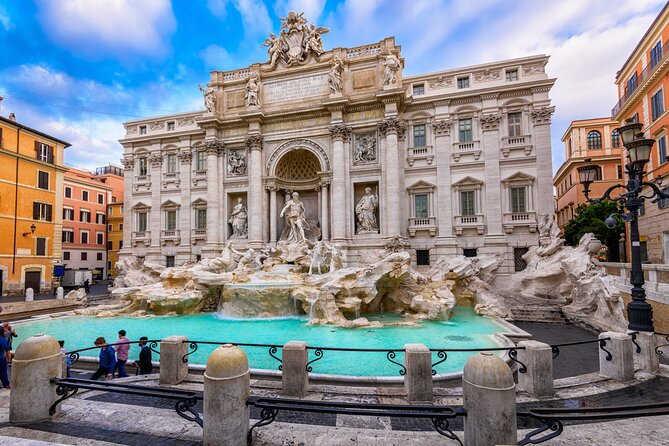
The Trevi Fountain is Rome’s grand 18th-century water display, designed by Nicola Salvi and completed by Giuseppe Pannini in 1762. It is usually crowded, and a short stop lets you see the composition without sacrificing the entire day to one location.
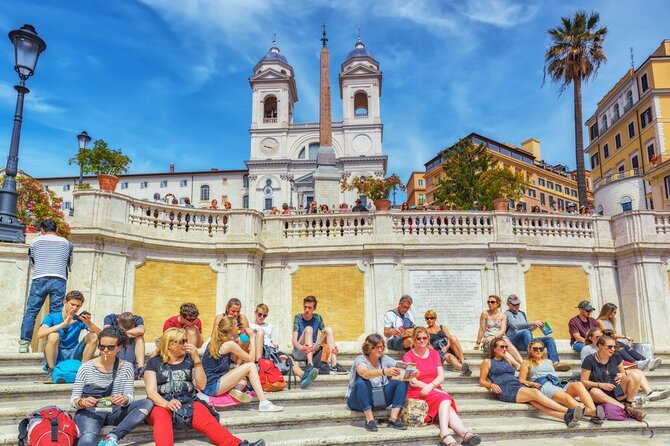
The Spanish Steps connect Piazza di Spagna with Piazza Trinità dei Monti. They climb the slope below the church and offer one of the city’s most recognizable urban scenes. Since this is not a dedicated walking tour, you should expect a quick exterior visit rather than time to linger in every corner.
The nearby Villa Medici sits on the Pincian Hill beside the Borghese Gardens. Its Mannerist architecture and garden setting add another layer to the route, linking Rome’s artistic world with its grand public spaces.
The tour ends at Piazza del Popolo, or nearby if you request it. This broad square takes its modern name from the Italian word for people, though the historic name is linked to poplar trees and the church of Santa Maria del Popolo. Ending here is useful because you are close to the Pincian Hill, Spanish Steps, and other central sights.
What the $150.18 price means
At about $150.18 per person, this is not a budget sightseeing ride. The value depends heavily on your group size and priorities. Since it is a private activity, the price buys control over the pace, a dedicated vehicle, and live commentary rather than a seat on a large bus.
For a family or small group, the cost can make sense if you want a comfortable overview without arranging several taxis. It may also be worthwhile if steep streets and long distances would make a first day tiring. Group discounts are available, which can improve the calculation for larger parties.
The price does not include entry to the Colosseum, Roman Forum, Baths of Caracalla, Castel Sant’Angelo, basilicas, or other ticketed attractions. Lunch is also not included. Think of this as a guided exterior tour and city orientation, then budget separately for the interiors you want to explore.
Who should book this Rome tour?
I would choose this experience for a first day or first full morning in Rome. It covers enough ground to show you what the city offers, then helps you decide where to spend your limited museum and archaeological time.
It is also a good match for families and multigenerational groups. Ahmad was praised for looking after young children, and the private format allows your group to remain together. People who have already visited Rome may also find value in the less obvious viewpoints, including the Janiculum terrace, Aventine keyhole, Pyramid of Cestius, and Aurelian Walls.
I would not choose it as your only Roman sightseeing activity if you want detailed time inside the major monuments. You will need separate tickets and several more hours for that. The tour gives you the outline; your later visits provide the close-up detail.
Confirmation arrives when you book, and most people can participate. The meeting point is the Maya Tours office at Via Germanico 16, where you check in at the front desk. The tour ends at Piazza del Popolo. Free cancellation is available up to 24 hours before the start time, while later cancellations and changes are not accepted. Due to the Jubilee, some monuments or areas may be under restoration, so watch for messages about route changes.
Should you book it?
Book this private golf-cart tour if you want a fast, comfortable introduction to Rome with strong citywide coverage and a guide who can connect the ruins, fountains, churches, and neighborhoods. It is especially useful for first-time visitors, families, older adults, and anyone who wants to save energy for later site visits.
Skip it if your main goal is to enter the Colosseum, walk through the Roman Forum, or spend a long time inside basilicas. At $150.18 per person, the cost is easiest to justify when you value private transportation, flexible group travel, and a broad first look at Rome. For many people, taking it early helps turn a confusing city into a place you can explore with purpose.
FAQ
How long does the Rome golf-cart tour last?
The experience lasts approximately three to four hours.
What language is the tour offered in?
The tour is offered in English with live commentary.
Is the golf-cart tour private?
Yes. Only your group participates in the activity.
Where does the tour begin?
You meet at the Maya Tours office at Via Germanico 16, 00192 Rome. Go inside and check in at the front desk.
Where does the tour end?
The tour ends at Piazza del Popolo. The driver can leave you nearby upon request.
Are attraction entry tickets included?
No. Ticketed sights are visited from the outside only, and entry fees are not included.
Is lunch included?
No. Lunch is not included in the tour price.
Are morning and afternoon departure times available?
Yes. You can choose between morning and afternoon tour timings.
Are children allowed on the tour?
Yes, but children must be accompanied by an adult.
Can I cancel the tour for a full refund?
Yes, if you cancel at least 24 hours before the experience begins. Cancellations or changes made less than 24 hours in advance are not accepted for a refund.
Newest reviews from Rome
- ROME:Colosseum & Ancient Rome – private/small group TOUR★ 5.0 · 24 reviews
- Off the Beaten Track in Rome: Rione VI Parione Private Tour★ 5.0 · 24 reviews
- Cinematic Photoshoot in Rome★ 5.0 · 24 reviews
- Rome: Best of Colosseum and Roman Forum Small Group Guided Tour★ 4.5 · 24 reviews
- The Labyrinth of Rome between catacombs and ancient quarries★ 4.5 · 24 reviews
- Vatican and Trionfale Market Tour with Wine and Food Tasting★ 5.0 · 24 reviews
- private tour: Vatican Museums, Sistine Chapel, St. Peter’s Basilica★ 4.5 · 24 reviews
- Colosseum guided tour with Virtual Reality★ 5.0 · 24 reviews
Rome Golf Cart Tours, compared.
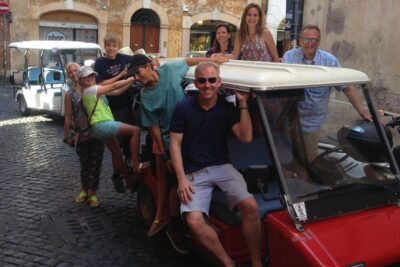
Rome by Golf Cart Private Tour: Beyond the Landmarks
Read our review →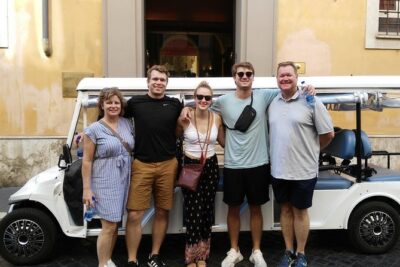
Rome on a Golf Cart Semi-Private Tour Max 6 with Private Option
Read our review →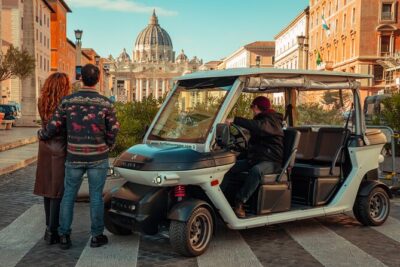
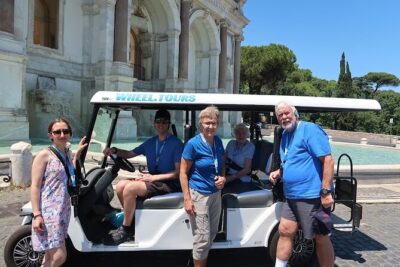
Rome Highlights City Tour by Golf Cart with Gelato
Read our review →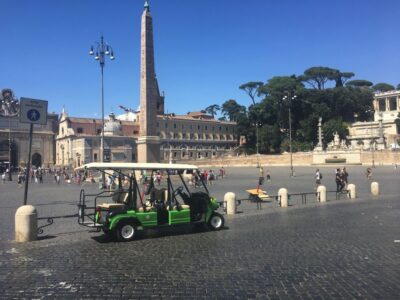
Imperial City Tour by Golf Cart with Optional Transfer
Read our review →
Golf Cart Small-Group Guided Tour: Rome City Highlights
Read our review →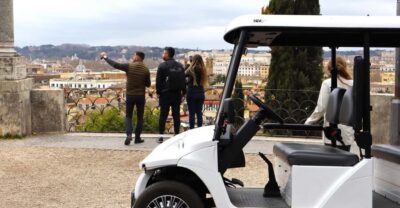
Private/Group 4 Hours Golf Cart SightseeingTour
Read our review →Browse the lists this tour appears in