
Reviewed · TRASTEVERE TOURS
Private Tour – Trastevere and Villa Farnesina
Villa Farnesina gives this Rome walk an unusual opening: you begin inside a Renaissance banker’s villa, looking at frescoes created by Raphael and his workshop before stepping into the lanes of Trastevere. The tour then links art, churches, mosaics, food traditions, and ancient remains in one compact route.
I like the private format, since your guide can tell stories at your pace instead of following a fixed group script. I also like the mix of major art and lesser-seen church spaces, especially Santa Cecilia’s crypt and Roman undergrounds, when access is available.
The main caution is that Santa Cecilia’s lower areas depend on the nuns who manage the building, and Villa Farnesina has occasionally closed despite advance contact. The guide may offer a strong neighborhood walk and help arrange a refund for the affected portion, but you should not book this expecting every interior space to be guaranteed.
In This Review
- Key points to know before booking
- Why this Trastevere tour offers more than a pretty neighborhood walk
- Villa Farnesina, where banking money met Renaissance art
- Walking Trastevere, with time for the neighborhood itself
- Santa Maria in Trastevere and its medieval mosaics
- Santa Cecilia, crypts, and the Roman layers below
- What the guide adds to the experience
- Is $149.78 per person a fair price?
- Who should book this private Rome walk?
- My verdict on Villa Farnesina and Trastevere
- FAQ
- How long does the tour last?
- What time does the tour begin?
- Where does the tour begin?
- Where does the tour end?
- Is the tour private?
- Is the tour offered in English?
- Are admission tickets included?
- Is hotel pickup or private transport included?
- Can I cancel for a full refund?
Key points to know before booking
- Raphael’s world at Villa Farnesina: Spend about an hour with Renaissance frescoes commissioned by banker Agostino Chigi.
- A private walk through Trastevere: Your own group takes the route, with a guide able to focus on your questions and interests.
- Santa Maria’s 13th-century mosaics: See one of Rome’s most important churches dedicated to the Virgin Mary.
- Santa Cecilia’s underground layers: The crypt and ancient Roman remains may be visited if access is granted.
- A guide who brings energy: Vincenzo Spina is praised for lively storytelling, art knowledge, and personal attention.
- A three-hour route with no hotel transfer: Meet at Villa Farnesina at 10:00 a.m. and finish at Santa Cecilia.
Why this Trastevere tour offers more than a pretty neighborhood walk
Trastevere is easy to enjoy without a guide. Its narrow streets, restaurants, wine bars, and old churches make it one of Rome’s most pleasant areas for wandering. The challenge is knowing what you are looking at once you step through a church door.
That is where this tour earns its keep. It connects the neighborhood’s visible pleasures with the layers underneath: Renaissance patronage, medieval mosaics, Christian worship, crypts, and ancient Roman remains. You are not simply moving from one photogenic square to another. You are following a story about how Rome keeps rebuilding itself on top of earlier Rome.
The tour is private, so only your group takes part. That matters in churches, where a good explanation can be hard to hear in a crowd. It also gives you more room to ask about art, architecture, religious traditions, or the daily life of the people who commissioned these buildings.
The guide named for this experience is Vincenzo Spina. His style, based on the details available, is animated and personal rather than dry. He is described as bringing facts, figures, and entertaining stories together, with a clear interest in making art understandable even if you do not normally seek out art history.
The tour lasts about three hours and is offered in English. You should expect a moderate amount of walking and standing. Comfortable shoes are sensible, though the tour data does not specify a distance or a detailed accessibility plan.
More Trastevere tours and tastings:
- Winner 2025 Rome Twilight Trastevere Food Tour by Eating Europe
★ 5.0 · 5,157 reviews - Rome: Trastevere or Jewish Quarter Street Food Tour
★ 4.8 · 3,839 reviews - Rome: Trastevere Food tour with Free-Flowing Fine Wine
★ 5.0 · 2,853 reviews
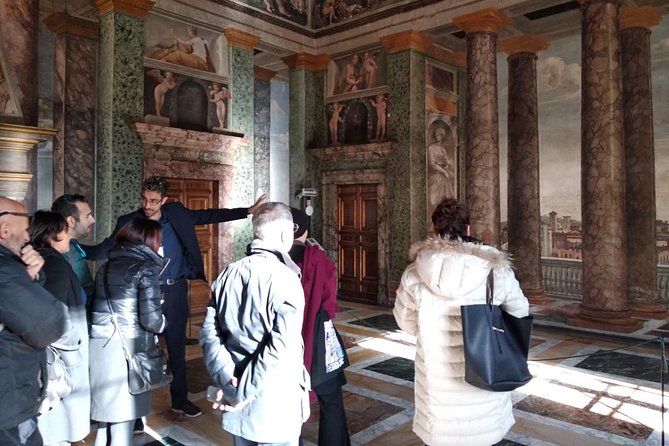
Villa Farnesina, where banking money met Renaissance art
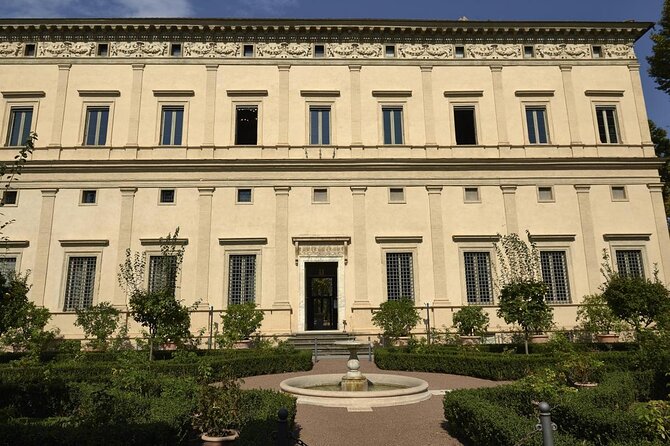
The tour begins at Villa Farnesina, at Via della Lungara 230, at 10:00 a.m. Admission is included, so you do not need to arrange a separate ticket for this stop.
The villa was built in the 16th century for Agostino Chigi, a wealthy banker who wanted a sumptuous home beside the river. Its decoration was not just a display of good taste. It sent a message about Chigi’s money, status, education, and connection to the finest artists of his time.
That makes the villa a useful place to begin. You can look at the paintings as works of art, but your guide can also explain why a banker would fill his home with scenes from classical mythology and why particular artists were invited to work there. The goal is to understand the decoration as both beauty and social advertising.
Raphael is the headline name. He and his school of painters created some of the villa’s most celebrated decoration. An explanation from Vincenzo can help you notice how a master’s design was carried out with the assistance of a workshop, rather than imagining that every brushstroke came from one person.
You spend about an hour here. That is enough time to give the villa serious attention without allowing one interior to consume the whole morning. If Renaissance painting interests you, this may be the strongest art stop in the experience. If you prefer street life and churches, it still provides a useful foundation for understanding Rome’s wealthy patrons before you head into Trastevere.
The practical weakness is access. Villa Farnesina has been closed unexpectedly on at least one occasion, even after the guide contacted the site the day before. In that situation, Vincenzo took the group around the neighborhood for about two hours and arranged for the tour payment to be refunded through the booking company.
That response cannot replace seeing the villa, but it does tell you something useful about the tour’s flexibility. If the villa is essential to your Rome plans, check its status close to the date. If you are happy to treat it as one part of a broader Trastevere experience, the risk is easier to accept.
Walking Trastevere, with time for the neighborhood itself
After Villa Farnesina, the tour continues on foot through Trastevere. The name means across the Tiber, and the district has long had an identity distinct from the grander areas across the river.
The route is described as a walk through a historic, traditional part of Rome known for food, wine, and local customs. The information does not promise a food tasting, restaurant stop, or market visit, so you should think of these as cultural context rather than included activities.
This portion matters because it joins the formal sights together. You see how churches sit within ordinary streets and how a neighborhood can feel both central and separate from Rome’s major tourist axis. A private guide can point out details you might pass without noticing, then adjust the conversation if you want more time on architecture or local history.
Do not expect a coach or private car. Hotel pickup and drop-off are not included, and private transport is not provided. You meet at Villa Farnesina and finish at Basilica di Santa Cecilia in Trastevere. Since the tour is point-to-point, plan the rest of your day around the finishing location rather than expecting to return to your hotel.
The walking is part of the value, but it also sets a physical requirement. You need a moderate level of fitness. The route includes church interiors and neighborhood streets, so this is not a sit-down sightseeing experience.
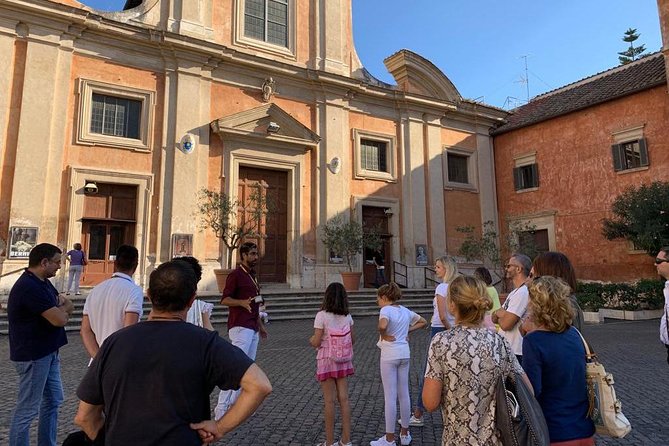
Santa Maria in Trastevere and its medieval mosaics
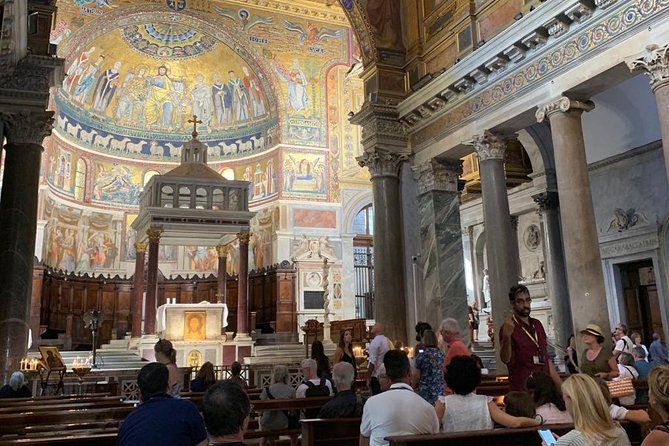
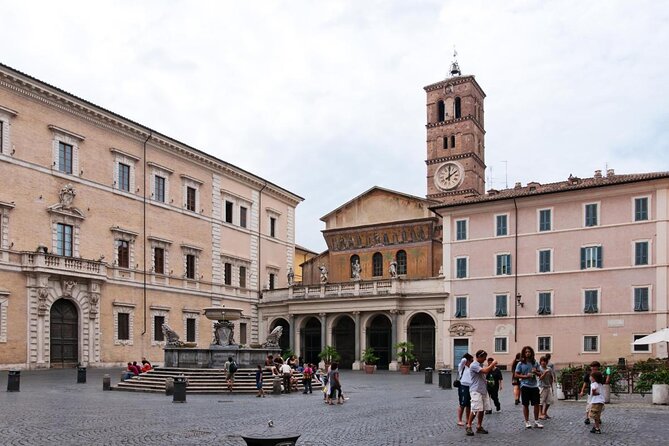
The next major stop is Basilica di Santa Maria in Trastevere, reached during the neighborhood walk. Entry is free, and you spend about 20 minutes here.
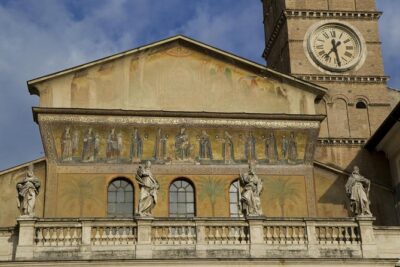
This church is presented as the first in Rome dedicated to the Virgin Mary. Its most important feature for this tour is the 13th-century mosaic decoration. The age of the mosaics gives you a direct link to medieval Rome, quite different from the polished Renaissance setting at Villa Farnesina.
Twenty minutes is a short visit, but it can work well after the villa. You get enough time to see the church and hear why the mosaics matter without turning the morning into a long sequence of formal interiors. The contrast is the point: Villa Farnesina reflects a wealthy patron’s private ambition, while Santa Maria offers a religious setting shaped over many centuries.
A guide is especially useful here because mosaics can be easy to admire without understanding. Their gold surfaces catch the eye, but the arrangement of figures and scenes carries the meaning. You can ask questions on the spot instead of trying to identify the images later from a guidebook.
The short stop also means you should not expect an exhaustive study of every chapel or artwork. If Santa Maria is your chief reason for visiting Trastevere, you may want to return independently with more time. For a three-hour private route, though, the visit gives the itinerary a strong medieval center.
Church access can also depend on religious activity or local conditions. The supplied details do not give a dress code, but respectful clothing and quiet behavior are sensible whenever you visit an active church.
More Rome tours worth comparing
- Rome by Golf Cart Private Tour: Beyond the Landmarks
★ 5.0 · 4,361 reviews - Early Morning Vatican, Sistine, St. Peter’s Semi or Private Tour
★ 5.0 · 3,779 reviews - Rome on a Golf Cart Semi-Private Tour Max 6 with Private Option
★ 5.0 · 2,502 reviews - Rome Private Arrival Transfer: Fiumicino Airport to Hotel in Rome
★ 4.5 · 2,492 reviews
Santa Cecilia, crypts, and the Roman layers below
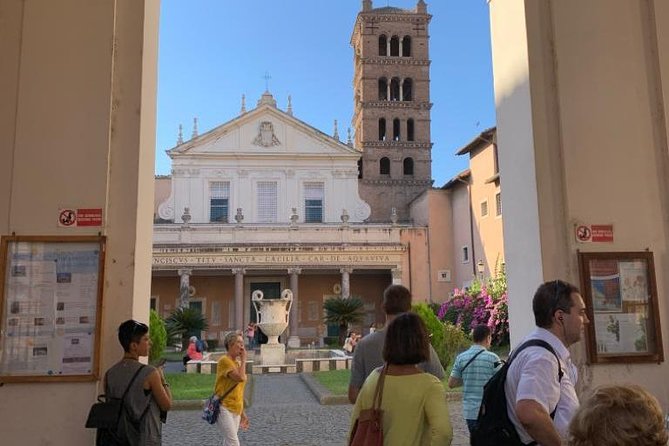
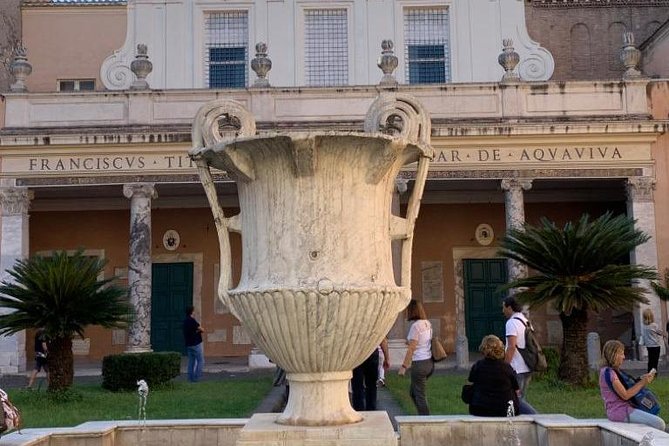
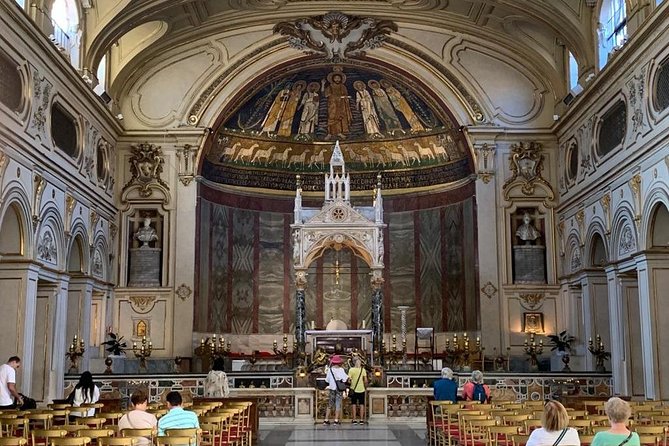
The final scheduled stop is Basilica di Santa Cecilia in Trastevere, at Piazza di Santa Cecilia 22. The visit lasts about 30 minutes, and admission is included.
Santa Cecilia is described as a less familiar church within the district, with mosaics and a long connection to its famous choir. The church’s appeal is not only what you see at floor level. If permission is available, the guide may take you into the crypt and the ancient Roman underground areas beneath the church.
That possibility gives the tour its most distinctive edge. Rome’s churches often preserve several periods in one place, and Santa Cecilia lets you consider that physical layering directly. You may move from Christian art to a lower space connected with ancient Roman foundations or remains. The exact underground access is not guaranteed, since the nuns manage the building.
Keep that condition in mind when setting expectations. The church itself is part of the planned route, while the crypt and underground visit are dependent on permission. If the lower spaces are open, they could be the morning’s most memorable surprise. If they are closed, the stop still provides church art and historical explanation, but the experience will be less complete than you hoped.
The tour ends here, not back at Villa Farnesina. That is convenient if you want to continue exploring Trastevere afterward, but you will need to arrange your own onward transport. The meeting and ending points are both supplied clearly, and the route is close to public transportation.
What the guide adds to the experience
A tour like this depends heavily on the person leading it. The sights are worthwhile, but the difference between a useful visit and a forgettable one is often the explanation between stops.
Vincenzo Spina receives especially strong praise for his energy, friendliness, and ability to keep a three-hour tour moving. His approach appears to combine serious art and architecture with fun stories, which is helpful when a subject could otherwise feel formal or remote.
I would choose this experience for someone who wants interpretation rather than just entry tickets. You can see Santa Maria’s mosaics on your own, but a guide can explain why they matter. You can walk past Villa Farnesina, but a guide can connect Raphael’s work to Chigi’s ambitions and the social world of Renaissance Rome.
The private setting also changes the rhythm. If your group wants more detail on Raphael, you can stay with that subject. If you are less interested in art and more curious about church traditions or ancient remains, you can steer the conversation in that direction.
A small personal touch has also been part of the experience for some groups: Vincenzo has given a parting gift at the end. That is not listed as an included feature, so do not book for that reason. It does, however, fit the picture of a guide who takes an interest in making the outing feel personal.
Is $149.78 per person a fair price?

At $149.78 per person, this is not a budget walk. The price covers a private tour, a professional local guide, and admission tickets where required. Group discounts are available, which may improve the value if you are booking for several people.
The right comparison is not simply a free stroll through Trastevere. You are paying for someone to interpret three different settings: a Renaissance villa, a medieval church, and a church with possible crypt and Roman underground access. You are also paying for a private pace and the convenience of having the route explained in English.
I think the price makes the most sense for a small group that values art, history, and personal guidance. It is harder to justify if you mainly want to wander, take photographs, and stop for food. Trastevere is easy to explore independently, and the tour does not include hotel transfers, transportation, meals, or guaranteed access to every lower area.
The villa closure issue is the main value concern. Since that stop is a major reason for the price, confirm its operating status close to your visit if possible. The guide’s willingness to adapt and arrange a refund in the reported closure situation is reassuring, but the possibility remains a practical limitation.
Who should book this private Rome walk?
This experience suits you if you enjoy churches but want someone to explain what you are seeing. It is also a good fit for a couple, family, or small group that wants to ask questions without slowing down a large tour.
Art lovers will get the most from Villa Farnesina and the discussion of Raphael, his workshop, and Agostino Chigi’s patronage. History-minded visitors will appreciate the movement from Renaissance rooms to medieval mosaics and then toward crypts and ancient Roman remains.
I would be more cautious if you have limited mobility, dislike walking, or need a fully guaranteed schedule. The tour requires moderate fitness, has no private transport, and includes a possible access change at Santa Cecilia. You should also allow time after the tour to make your own way from Piazza di Santa Cecilia.
Free cancellation is available if you cancel at least 24 hours before the 10:00 a.m. start. Changes or cancellations inside that window are not accepted for a refund.
My verdict on Villa Farnesina and Trastevere
Book this tour if you want Trastevere explained through its art and religious buildings, rather than treated as a backdrop for lunch. The strongest features are the private format, the guide’s lively presentation, Raphael’s frescoes, Santa Maria’s mosaics, and the chance to see Santa Cecilia below ground.
I would not book it if your schedule cannot tolerate a possible villa closure or if you want food, transport, or a leisurely unstructured neighborhood stroll. For the right group, though, it offers a smart three-hour link between Renaissance ambition, medieval worship, and the older Roman layers beneath the streets.
FAQ
How long does the tour last?
The tour lasts approximately three hours.
What time does the tour begin?
The tour starts at 10:00 a.m.
Where does the tour begin?
You meet at Villa Farnesina, Via della Lungara 230, 00165 Rome.
Where does the tour end?
The tour ends at Basilica di Santa Cecilia in Trastevere, Piazza di Santa Cecilia 22, 00153 Rome.
Is the tour private?
Yes. Only your group participates in the private activity.
Is the tour offered in English?
Yes. The experience is offered in English.
Are admission tickets included?
Yes. Tickets are included. Entry to Basilica di Santa Maria in Trastevere is free.
Is hotel pickup or private transport included?
No. Hotel pickup, hotel drop-off, and private transportation are not included.
Can I cancel for a full refund?
Yes, if you cancel at least 24 hours before the local start time. Cancellations or changes made less than 24 hours before the start are not accepted for a refund.
Newest reviews from Rome
- ROME:Colosseum & Ancient Rome – private/small group TOUR★ 5.0 · 24 reviews
- Off the Beaten Track in Rome: Rione VI Parione Private Tour★ 5.0 · 24 reviews
- Cinematic Photoshoot in Rome★ 5.0 · 24 reviews
- Rome: Best of Colosseum and Roman Forum Small Group Guided Tour★ 4.5 · 24 reviews
- The Labyrinth of Rome between catacombs and ancient quarries★ 4.5 · 24 reviews
- Vatican and Trionfale Market Tour with Wine and Food Tasting★ 5.0 · 24 reviews
- private tour: Vatican Museums, Sistine Chapel, St. Peter’s Basilica★ 4.5 · 24 reviews
- Skip the Line: Vatican Wheelchair Accessible Private Tour★ 5.0 · 24 reviews
Trastevere Tours, compared.
Winner 2025 Rome Twilight Trastevere Food Tour by Eating Europe
Read our review →
Trastevere or Jewish Quarter Street Food Tour
Read our review →
Trastevere Food tour with Free-Flowing Fine Wine
Read our review →
Trastevere & Campo de Fiori Street Food Walking Tour
Read our review →
Award Winning Trastevere Group Food Tour with Wine
Read our review →
Rome Food Tour: Hidden Gems of Trastevere with Dinner & Wine
Read our review →
Trastevere Guided Food and Wine Tour with 20+ Tastings
Read our review →Browse the lists this tour appears in