
Reviewed · CATACOMBS & CRYPTS
Rome: Catacombs of St. Callixtus Entry Ticket & Guided Tour
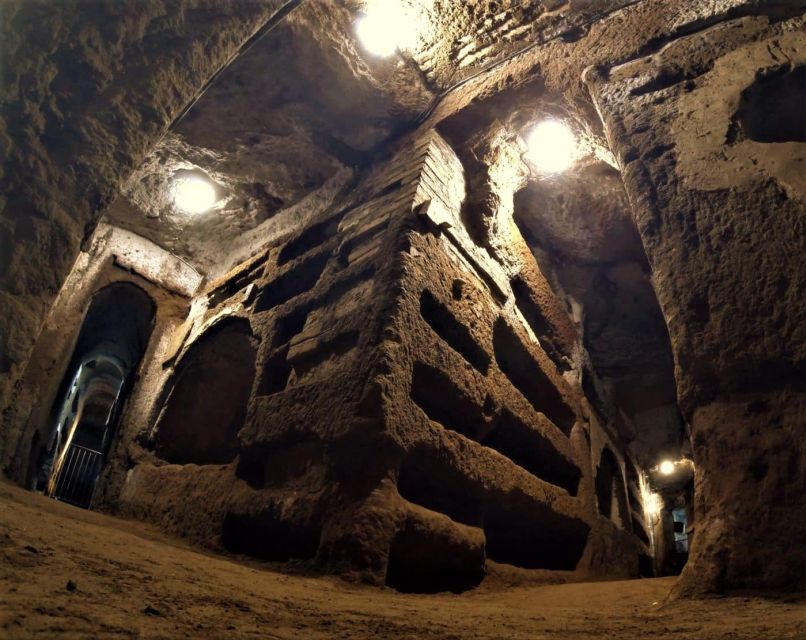
Beneath Rome’s Appian Way, the Catacombs of St. Callixtus take you into the burial ground of an early Christian community. The short route passes the Crypt of the Popes, where nine popes and three bishops were buried, along with chambers cut into the soft underground rock.
I like two things here. First, the guide gives the bare walls a human story, explaining the martyrs, families, burial customs, and church leaders connected with the site. Second, the tour costs about $16, making it an easy way to see a side of Rome that the Colosseum and Vatican cannot offer.
The main drawback is the length. The advertised visit lasts 30 minutes, so this is a focused introduction rather than a broad tour of the entire underground network. The site is also outside the historic center, and you need to plan your transport carefully.
In This Review
- Key points to know before you go
- Why the Catacombs of St. Callixtus matter
- Arriving beneath the Appian Way
- The 30-minute route underground
- The Crypt of the Popes
- The Crypt of St. Cecilia
- Early frescoes and the cubicles of the sacraments
- What the underground conditions are like
- Is 30 minutes enough?
- The value of the $16 ticket
- Who will enjoy this experience most
- Practical advice for a smoother visit
- Should you book the Catacombs of St. Callixtus?
- FAQ
- How long does the Catacombs of St. Callixtus tour last?
- What will I see inside the catacombs?
- Will I see bones or skeletons?
- Can I take photographs inside?
- How do I reach the meeting point from Termini Station?
- Is the tour suitable for people with mobility impairments or claustrophobia?
Key points to know before you go
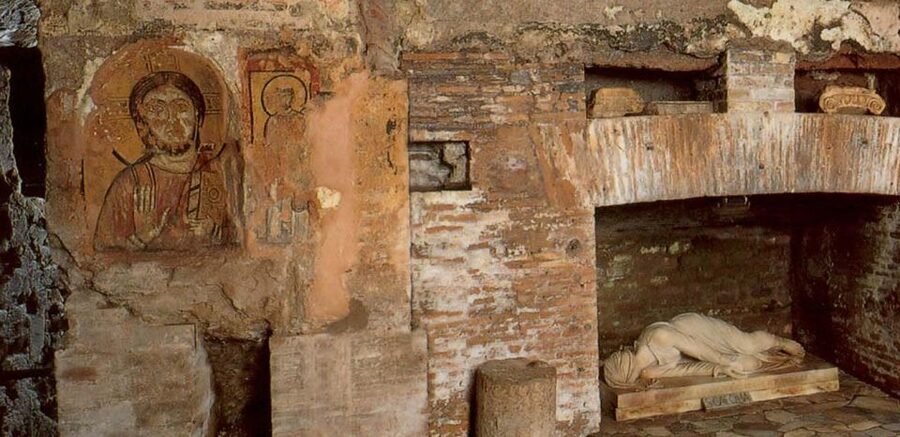
- See the Crypt of the Popes: Nine popes and three bishops were laid to rest in one of the cemetery’s most important chambers.
- Visit the Crypt of St. Cecilia: Learn about the Roman matron associated with the burial of Christian martyrs.
- Expect a guided-only visit: You stay with the group and cannot wander through the catacombs independently.
- Bring a light layer: The underground chambers are cool, around 15°C according to one visitor’s experience.
- Plan the journey from central Rome: Bus connections work, but allow extra time for waiting and finding the ticket office.
- Do not expect exposed bones: The focus is on burial chambers, inscriptions, art, and Christian history, not skeletons.
Why the Catacombs of St. Callixtus matter
Rome’s catacombs are not simply underground tunnels filled with graves. They are records of how early Christian communities cared for their dead, remembered their leaders, and expressed their beliefs during the first centuries of Christianity.
The Catacombs of St. Callixtus are especially important because they served as the official cemetery of Rome’s Christian community. The complex grew over time and is associated with an estimated half a million Christian burials, though only a small section is open on this visit.
You will not see the full extent of the network. That is part of the practical reality of the tour. The route is selected for safety, preservation, and clear storytelling, so your guide can explain the site without sending you into a maze of corridors.
The name comes from Callixtus, a church leader connected with the cemetery’s development. Your guide explains this background as you move through the chambers, helping you understand that the catacombs were organized burial grounds rather than secret hideouts in the modern adventure-movie sense.
I find that context important. Without it, a narrow passage and rows of empty burial niches can seem abstract. With it, the site becomes a glimpse into the lives, beliefs, and burial practices of people who lived nearly 2,000 years ago.
More catacomb and crypt visits from Rome:
- Rome: Crypts and Catacombs Underground Tour with Transfers
★ 4.6 · 5,341 reviews - The Original Roman Crypts and Catacombs Tour with Transfers
★ 4.5 · 4,896 reviews - Rome: Guided Roman Catacombs Tour with Transfers
★ 4.6 · 1,830 reviews
Arriving beneath the Appian Way
The catacombs are not beside the Trevi Fountain or the Pantheon. They sit on the Appian Way, in an area with more open space and greenery than central Rome. The setting feels calmer than the city center, but the distance means you should not treat this as a quick walk-in stop between major sights.
From Termini Station, the listed route is Metro A toward Anagnina to San Giovanni, followed by bus 218 toward Ardeatina. Get off at Fosse Ardeatine, where the catacomb entrance should be in front of you.
Another option is Metro B to Colosseo or Circo Massimo, followed by bus 118 toward Appia or Villa dei Quintili. The stop for this route is Catacombe di San Callisto.
I would allow extra time for either journey. Buses can involve waiting, and the ticket office is not always exactly where a first-time visitor expects it to be. Go directly to the catacomb ticket office, show your voucher, and arrive at least 10 minutes before the scheduled start.
One useful point is easy to miss: your voucher may need to be exchanged for an entry ticket at the office. Do not simply stand near a parking area or assume you can walk straight to the underground entrance. Follow the ticket-office instructions closely.
Public transport is possible, and some people find the bus straightforward. Still, the return journey can be less convenient, especially if you are traveling alone or have a tight schedule. A taxi or ride service may save time, but transport is not included in the $16 price.
The 30-minute route underground
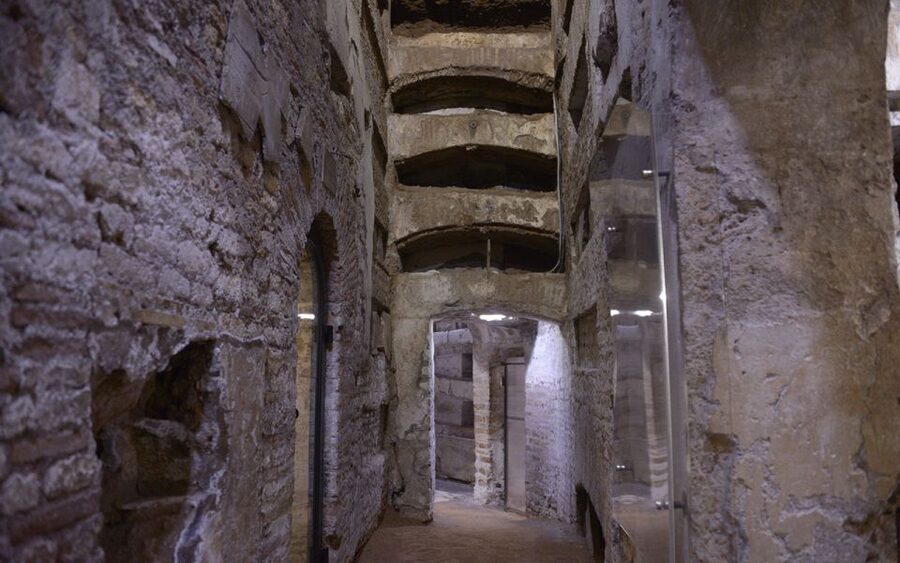
Once the group gathers, the visit is fully guided. You do not explore the chambers on your own, and you need to remain with the group throughout the route.
That arrangement suits the site. The passages are narrow, the history is easy to miss, and the guide provides the lighting and explanation that make the rooms meaningful. It also means you should not expect the freedom to stop wherever you like or spend ten minutes studying a single inscription.
The advertised duration is 30 minutes, though some visits run a little longer. The pace is brisk but not empty. Guides such as Francesca, Sam, Comfort, Arishba, Fr Peter, and Don Sam have been praised for clear explanations, humor, patience, and thoughtful answers to questions.
Guides vary, of course, but the format stays much the same. You move through burial areas while hearing about popes, martyrs, ordinary Christians, and the people who maintained these underground cemeteries.
The group may pause at notable chambers and wall paintings. Since the site is religious as well as archaeological, a respectful tone matters. One guide was a newly ordained priest, while another was an archaeologist, so the character of the presentation can differ from one departure to another.
The Crypt of the Popes
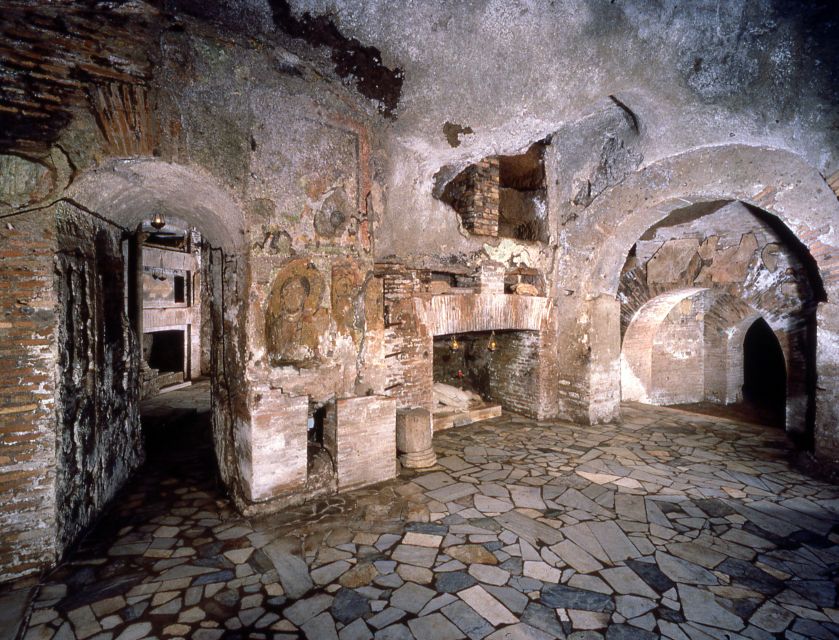
The Crypt of the Popes is the emotional and historical center of the visit. Nine popes and three bishops were buried here, making the chamber a direct link to the early leadership of Rome’s Christian community.
Do not expect grand marble tombs like those found in later Roman churches. The power of the room comes from its age, its location, and the knowledge that Christian leaders were placed here among other members of the community.
Your guide explains the role of the cemetery and identifies the significance of the chamber. This is where a good guide makes a real difference. A bare underground room needs interpretation, and the best guides keep the story clear without burying you in dates and names.
The chamber also helps you see how different early Christian burial was from the grand public monuments that dominate Rome’s center. Here, the setting is close, subdued, and communal.
More Rome tours worth comparing
- Vatican: Museums & Sistine Chapel Entrance Ticket
★ 4.5 · 144,003 reviews - Rome:Hop-On Hop-Off Panoramic Open Bus Ticket 3 Circuits x 1
★ 4.0 · 15,405 reviews - Vatican Museums & Sistine Chapel Skip-the-Line Entry Ticket
★ 4.4 · 13,838 reviews - Rome: Vatican Museums & Sistine Chapel Skip-The-Line Ticket
★ 4.2 · 11,708 reviews
The Crypt of St. Cecilia
The adjoining Crypt of St. Cecilia introduces a different kind of story. Cecilia was a Roman matron remembered for helping ensure that many martyrs received proper burials.
Her connection gives the chamber a personal angle. Instead of hearing only about church officials, you learn about a woman whose actions were linked to the care of the dead during a difficult period for Christians.
The visit does not present the catacombs as a place of spectacle. There are no dramatic skeleton displays on this route, and the focus remains on burial spaces and the people associated with them. If you are hoping to see bones, you may find the experience too restrained.
I consider that restraint a strength. The rooms are moving because of their purpose and age, not because the tour tries to shock you.
Early frescoes and the cubicles of the sacraments
The walls contain some of the oldest frescoes found in Rome’s catacombs. They are not presented as a full museum collection, and lighting can be limited in some corners, but your guide points out what deserves attention.
The paintings matter because they show how early Christians expressed ideas about faith, death, and hope. Even when the artwork is worn, its presence changes the feel of the corridors. You begin to see the catacomb as a place shaped by belief and memory, not only by engineering.
The tour also visits Area I, where the cubicles of the sacraments are located. These burial rooms add another layer to the route, showing how the underground cemetery was arranged in sections and chambers rather than as one unplanned passage.
For me, this is where the tour earns its price. The ticket alone would give you access to an old underground site, but the guide links the art, layout, and burial customs into a story you can follow.
Photography is not allowed inside. That rule may disappoint anyone hoping to collect atmospheric images, but it protects a fragile environment and keeps phones from interrupting the presentation. You will need to enjoy this one with your eyes and memory.
What the underground conditions are like
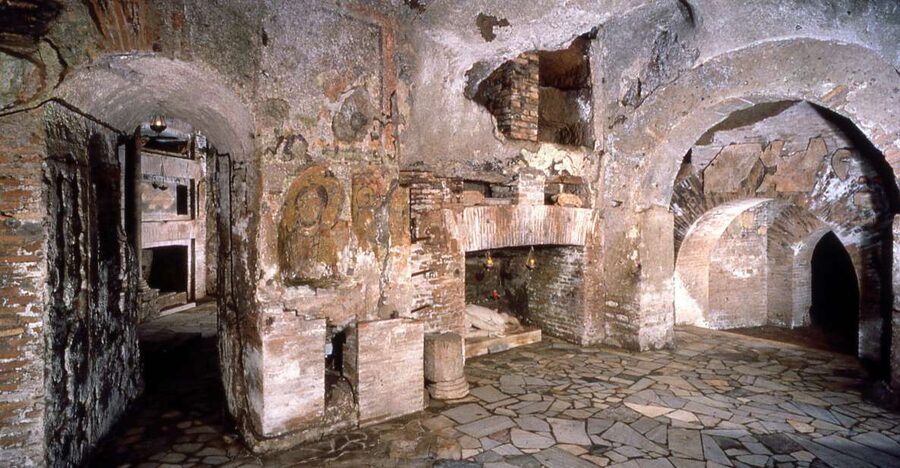
The catacombs are cool, even in Rome’s summer heat. One visitor measured the chambers at about 15°C, and another described the underground as a welcome break from hot streets.
Bring a light jacket or sweater, especially if you are sensitive to cold. Comfortable shoes are also important because the route takes place underground and includes uneven or narrow areas.
This is not a suitable outing for people with mobility impairments. It is also not a good choice if you have claustrophobia. Baby carriages are not allowed, so families with small children need to consider that before booking.
The lack of photography and the enclosed setting make this a listening experience. You will get more from it if you are ready to pay attention to the guide rather than treat the catacombs as a quick photo stop.
Is 30 minutes enough?
Thirty minutes is enough to understand the main story and see the most important open sections. It is not enough for a slow archaeological study or a complete visit to a complex said to extend across roughly 20 kilometers.
That short duration can work well in a busy Rome itinerary. Families with older children or teenagers can get a concentrated history lesson without committing half a day. One family with two older teenagers found the visit worthwhile even though the children were not especially interested in ancient history.
I would not book this as your only activity in the Appian Way area if you want a full day of Roman archaeology. Instead, think of it as a compact stop that pairs well with other nearby sights, provided you leave enough time for transport.
The pace also depends on your guide and group. A strong guide may continue answering questions after the official route ends, as Diane experienced, and may point out other places to see on the property or nearby. That extra conversation can turn a quick tour into a more satisfying visit.
The value of the $16 ticket
At about $16 per person, this is a good-value Rome activity for anyone interested in early Christianity, archaeology, or unusual burial customs. The ticket includes entry and a live guided tour, so you are not paying only to walk through empty corridors.
The value is strongest because the guide supplies the meaning. The Crypt of the Popes, St. Cecilia’s chamber, the frescoes, and Area I become much more memorable when someone explains their purpose and connections.
Still, price is not the only cost. You also spend time reaching the site, and a taxi can add to the total. If you are staying far from the center or have only one day in Rome, the journey deserves consideration.
The tour also offers free cancellation up to 24 hours before the scheduled time and a reserve-now, pay-later option. Those terms help if your Rome plans are still shifting, though you should check the available departure time before building the rest of your day around it.
Who will enjoy this experience most
I would recommend the catacombs to you if you want Rome’s quieter, less polished side. The visit is a good fit for people who enjoy archaeology, religious history, ancient art, and places that require a little imagination.
It also suits families with older children and teens. The visit is short, the guide-led format keeps things moving, and the underground setting gives the history a physical presence that a museum label cannot match.
Solo visitors can book it, but I would be especially careful with directions and the return trip. Give yourself time to find the ticket office, and consider your transport home before you arrive.
The experience is less suitable for very young children, anyone who needs step-free access, or anyone expecting a dramatic bone-filled crypt. It is also not ideal for visitors who want to explore independently or take photographs.
Practical advice for a smoother visit
Wear shoes that you can walk in comfortably. Choose clothing that works for a cool underground setting, even if Rome is hot above ground.
Arrive at the ticket office at least 10 minutes early with your voucher ready. If the location seems unclear, ask specifically for the catacomb ticket office rather than relying on a nearby parking area as your reference point.
Use the bus routes listed for the journey from central Rome, but allow for waiting time. If your schedule is tight, a taxi or ride service may be easier, particularly on the way back.
Listen for the guide’s meeting instructions once the group forms. The visit is fully guided, so you need to stay together. That keeps the group moving and helps protect the underground site.
Finally, set your expectations before you go. You will see burial niches, chambers, frescoes, and historic spaces. You will not see exposed skeletons, and you cannot take photographs inside.
Should you book the Catacombs of St. Callixtus?
Book this tour if you want a focused, inexpensive look at early Christian Rome and do not mind traveling beyond the center. The Crypt of the Popes, the Crypt of St. Cecilia, and the ancient frescoes give the 30-minute visit real substance.
I would especially choose it for a second or third day in Rome, when you have already seen the headline monuments and want something quieter. It also works for families with older children, history fans, and visitors seeking a cooler break from the summer heat.
Skip it if you need accessible facilities, dislike enclosed spaces, or expect visible bones and free time to wander. For everyone else, the combination of a low price, a live guide, and an unusually personal look at Rome’s first Christian communities makes this a sensible addition to your itinerary.
FAQ
How long does the Catacombs of St. Callixtus tour last?
The advertised duration is 30 minutes. Some visits may last slightly longer if the guide answers questions after the main route.
What will I see inside the catacombs?
You will visit the Crypt of the Popes, the Crypt of St. Cecilia, early frescoes, and Area I, including the cubicles of the sacraments.
Will I see bones or skeletons?
No. This visit focuses on burial chambers, wall art, and the history of the cemetery rather than exposed bones.
Can I take photographs inside?
No. Photography inside the catacombs is not allowed.
How do I reach the meeting point from Termini Station?
Take Metro A toward Anagnina to San Giovanni, then bus 218 toward Ardeatina and get off at Fosse Ardeatine. The entrance should be in front of you.
Is the tour suitable for people with mobility impairments or claustrophobia?
No. The experience is not suitable for people with mobility impairments or claustrophobia. Baby carriages are also not allowed.
Newest reviews from Rome
- Rome: Vatican Museums & Sistine Chapel Skip-the-Line Ticket★ 4.4 · 148 reviews
- Shared Shuttle Transfer from Rome to Civitavecchia Port★ 5.0 · 148 reviews
- Rome: Crypts & Catacombs After Hours Tour with Bone Chapel★ 4.6 · 149 reviews
- Ghosts Legends and Mysteries of Rome Walking Tour★ 5.0 · 149 reviews
- Skip the Line: Vatican and Sistine Chapel with Guided Tour★ 4.0 · 149 reviews
- Tivoli: Villa Gregoriana Entrance Ticket★ 4.7 · 150 reviews
- Pizza and Tiramisu Cooking Class in Rome, Piazza Navona★ 5.0 · 150 reviews
- Rome: Borghese Gallery Skip-the-Line Entry and Guided Tour★ 4.7 · 150 reviews
Catacombs & Crypts, compared.

Crypts and Catacombs Underground Tour with Transfers
Read our review →
The Original Roman Crypts and Catacombs Tour with Transfers
Read our review →


Rome EBike Tour: Appian Way, Catacombs & Roman Aqueducts
Read our review →
Catacombs and Capuchin Crypt Guided Tour with Transfer
Read our review →
St. Peter’s Basilica Priority Access Tour with Dome & Crypt
Read our review →
Appian Way, Catacombs, & Roman Aqueducts E-bike Tour
Read our review →Browse the lists this tour appears in