
Reviewed · ROME GOLF CART TOURS
Rome: City Highlights Private Golf Cart Tour
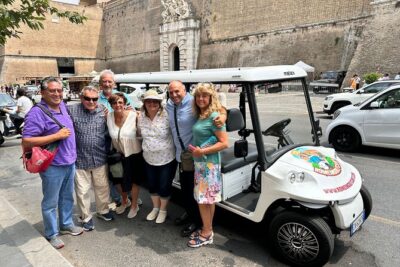
Rome’s ancient streets make a golf cart surprisingly useful. In three hours, you can roll from the Colosseum to the Spanish Steps, pause at the Pantheon, reach Janiculum Hill, and still have time for a Roman food tasting. It is a fast, open-air way to get your bearings.
I especially like the private format and the pickup and drop-off flexibility. Guides such as Valerio, Fabio, Massi, Giulio, and Marco have been praised for adjusting the route to family interests, elderly relatives, mobility limits, cruise schedules, and repeat visits. The cheese, meat, wine, espresso, pizza, or arancini stops also give the sightseeing a tasty local break.
The trade-off is simple: this is an overview, not a museum tour. Most stops are photo pauses, and entrance fees are not included. You will see a great deal from the cart, but you should plan separate visits if you want time inside the Colosseum, Pantheon, or Vatican Museums.
In This Review
- Key points to know before you book
- Why a golf cart makes sense in Rome
- From the Colosseum to Circus Maximus
- Piazza Venezia and the grand center of Rome
- The Pantheon and Rome’s church art
- Spanish Steps, St. Peter’s Square, and Janiculum Hill
- The Roman food tasting
- What the guides add to the ride
- Who gets the most value from the $49 price
- Should you book the Rome private golf cart tour?
- FAQ
- How long is the Rome private golf cart tour?
- What landmarks are included on the route?
- Can the route be customized?
- Is hotel pickup and drop-off included?
- Is food included?
- Are attraction entrance fees included?
- Which languages are available?
- What should I bring?
Key points to know before you book
- Three hours covers a huge part of central Rome: The route links ancient monuments, piazzas, churches, viewpoints, and major landmarks with little long-distance walking.
- Your guide can change the route: Pickup and drop-off points are flexible, and the tour can reflect your priorities or the places you have already seen.
- Food is part of the experience: Expect a tasting at a selected local eatery, with past stops including family-run delis, cheese and meat shops, pizza, arancini, espresso, wine, and Roman specialties.
- It works well for families and older visitors: The cart saves tired feet and has helped groups traveling with young children, walking frames, and limited time.
- The churches are worth special attention: Sant’Ignazio di Loyola and St. Louis of the French bring you close to the art of artists including Caravaggio, with other churches and works by Michelangelo, Bernini, and Borromini part of the wider focus.
- Bring sun protection and listen carefully: Wear comfortable shoes, sunglasses, a hat, and sunscreen. Some people found it hard to hear from the back of the cart without headsets.
Why a golf cart makes sense in Rome
Rome is not one tidy sightseeing district. Its major sights spread across hills, piazzas, ancient ruins, and neighborhoods where a short map distance can involve uneven paving and a surprising amount of walking.
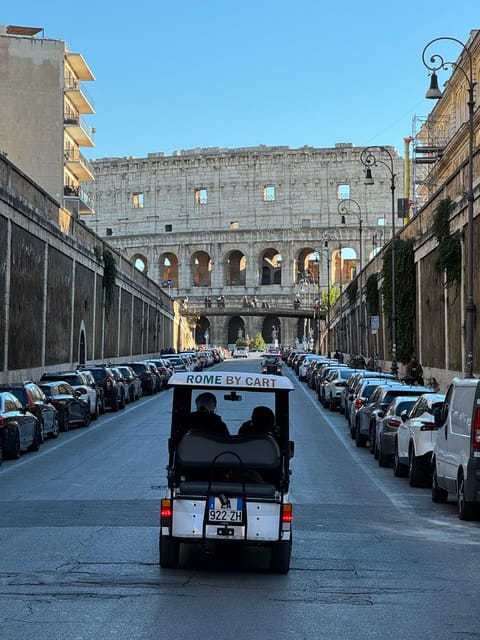
The golf cart gives you a moving view between stops. You are not sealed inside a bus, and you can get close to places that larger vehicles cannot reach. The open sides also let you see fountains, facades, street life, and passing views while your guide explains what you are seeing.
This format is especially useful on your first day. You can see the shape of the city, note the places you want to revisit, and save your energy for the sites you plan to enter later. It also makes sense if Rome is only one stop on a short trip or if you have a fixed cruise transfer to catch.
The private setup is the key advantage. Instead of following a fixed script, you can ask to spend more time on churches, fountains, ancient Rome, food, family interests, or viewpoints. Guides have adjusted tours for repeat visitors and for groups that had already visited some major sights.
Do not confuse flexibility with unlimited time. Three hours passes quickly, especially with traffic, photo stops, and a food break. Think of this as a carefully packed introduction to Rome rather than a full visit to every attraction.
More golf cart tours of Rome:
- Rome by Golf Cart Private Tour: Beyond the Landmarks
★ 5.0 · 4,361 reviews - Rome on a Golf Cart Semi-Private Tour Max 6 with Private Option
★ 5.0 · 2,502 reviews - Rome Highlights by Golf Cart Private Tour
★ 5.0 · 2,379 reviews
From the Colosseum to Circus Maximus
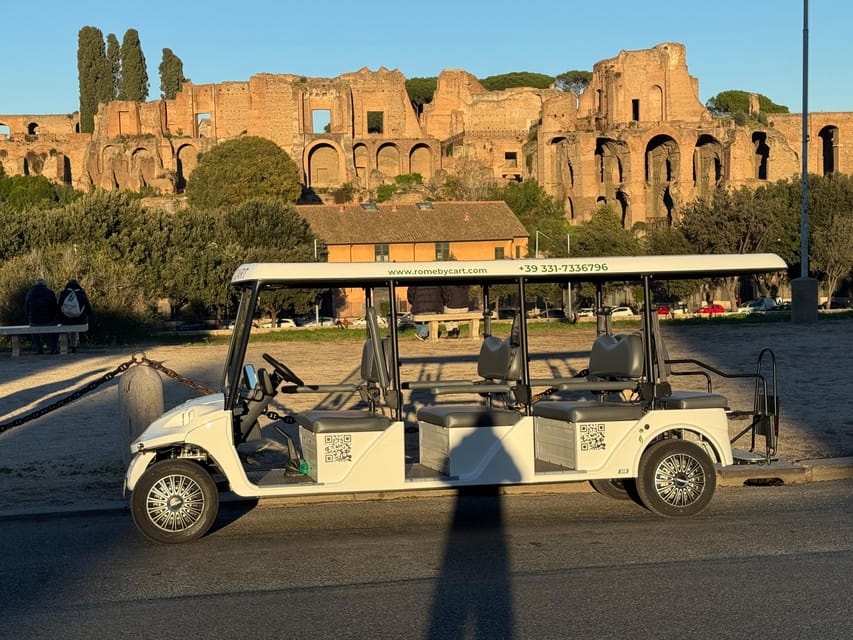
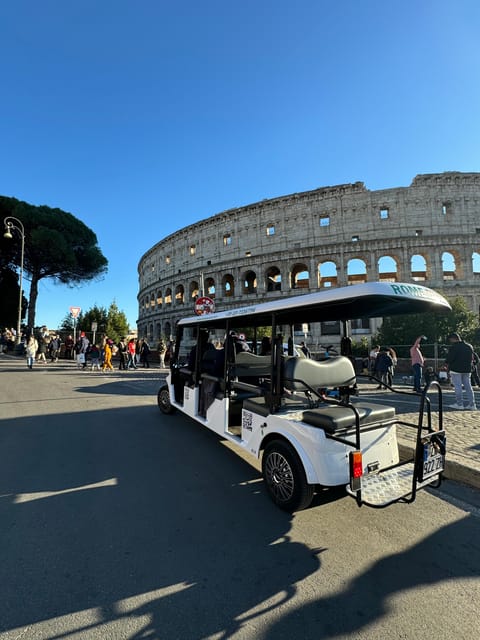
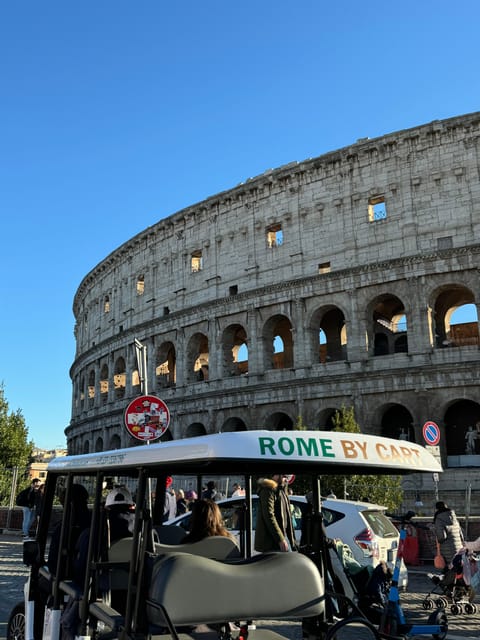
The Colosseum is usually the first major stop, with about 20 minutes for photographs and an explanation from the guide. From the cart, you get the dramatic exterior, the surrounding archaeological setting, and a useful first lesson in how ancient Rome was organized.
That 20 minutes is enough for pictures and orientation, not an interior visit. Since admission is not included, you will need another booking if you want to walk through the amphitheater and its underground levels. The same applies to the Roman Forum and Palatine Hill, which may be pointed out or included in a customized route but are not part of the included admissions.
Next comes Circus Maximus, the long valley once used for public spectacles and chariot races. It is a broad, open site, so the guide’s explanation matters more than the view alone. You get a sense of its size and its place between Rome’s hills without committing to a long walk.
The route then climbs toward the Giardino degli Aranci, or Orange Garden. Allow about 15 minutes here. The garden is valued for its calm setting and elevated city view, making it a good contrast to the noise and stone of the Colosseum area.
The golf cart is useful on this stretch. You can reach a hilltop viewpoint without turning the morning into a workout. Still, comfortable shoes matter because the tour includes getting out, standing, and some walking on historic paving.
Piazza Venezia and the grand center of Rome
The Altar of the Fatherland receives about 15 minutes. Its bright white marble and enormous scale make it one of Rome’s easiest buildings to recognize. From nearby streets and squares, your guide can explain its role in modern Italian national history and point out the ancient and papal layers around it.
This is a photo stop rather than an extended visit inside the monument. If you want its paid panoramic lift or interior exhibits, those costs are separate and are not part of this activity.
Piazza Navona is given about 20 minutes, which is enough to take in its long oval shape, fountains, churches, and lively public setting. The square follows the outline of an ancient stadium, and the guide can connect that older Roman footprint with the baroque work associated with Bernini and Borromini.
This is one of the places where a good guide adds real value. You can look at a fountain and see decoration, or you can learn how papal patrons, rival artists, and Roman power shaped the square. The route promises stories about myths, popes, artists, and local customs, so this is a strong stop for visitors who want context rather than a checklist of names.
The Pantheon and Rome’s church art
The Pantheon gets about 15 minutes. Its ancient columns and vast domed interior are among Rome’s essential sights, but the scheduled stop does not guarantee entry. Admission is not included, and you should treat the golf cart visit as an exterior introduction unless your guide is able to adjust the route around your own ticket.
One useful detail comes from a group that already had Pantheon tickets. Their guide changed the timing to help them use those tickets, which shows how the private format can work when you tell the guide your plans in advance. Do not rely on this as a promise, but do share your timed admissions when booking or at pickup.
The church portion is one of the tour’s more unusual features. At Sant’Ignazio di Loyola, you can see a church known for illusionistic decoration, paintings, and the grand visual language of Rome’s religious art. The stop is listed as about 10 minutes, so expect a focused explanation rather than a slow art visit.
St. Louis of the French gets about 15 minutes. Its Caravaggio paintings are the main draw, and the church brings you close to major art without the scale and crowds of a large museum. The guide can also connect this church to the wider work of Michelangelo, Bernini, and Borromini found around Rome.
Churches can be easy to skip when you are racing between famous monuments. I would pay attention here. Rome’s art is not only in ticketed museums. Some of its best paintings, sculptures, mosaics, and frescoes are in working churches, where you can see them in the setting for which they were made.
More Rome tours worth comparing
- Early Morning Vatican, Sistine, St. Peter’s Semi or Private Tour
★ 5.0 · 3,779 reviews - Rome Private Arrival Transfer: Fiumicino Airport to Hotel in Rome
★ 4.5 · 2,492 reviews - Private Pompeii, Positano & Amalfi coast Tour from Rome
★ 4.5 · 1,888 reviews - Private Departure Transfer: Hotel to Rome Fiumicino Airport
★ 4.5 · 1,050 reviews
Spanish Steps, St. Peter’s Square, and Janiculum Hill
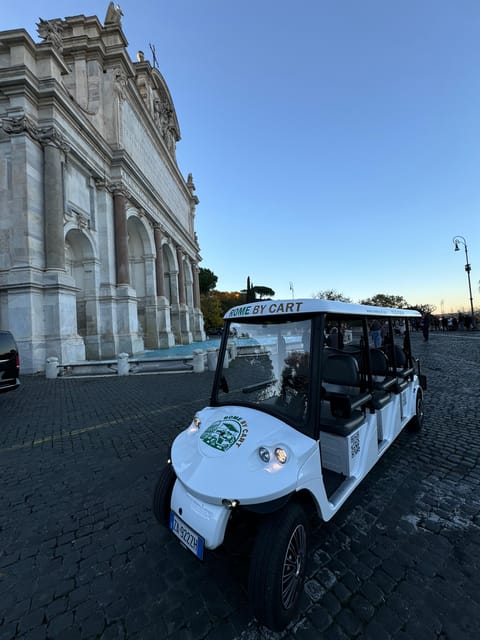
The Spanish Steps receive around 20 minutes. This is a good pause for photos and for taking in the grand stairway, the surrounding lanes, and the connection to the elegant shopping district. The cart can bring you close, but you should expect people, traffic, and uneven surfaces around the area.
St. Peter’s Square is another 20-minute stop. The great colonnade and basilica facade provide one of Rome’s most powerful sights, even if you are not entering Vatican City attractions. This is a useful place to ask your guide about papal Rome, the square’s design, and how the city changes as you cross from ancient imperial landmarks into the center of Catholic power.
The final major viewpoint is Janiculum Hill, with roughly 20 minutes for the view. From above, Rome becomes easier to understand. Domes, rooftops, church towers, and distant hills form a broad picture that ground-level sightseeing cannot provide.
Timing can make a difference here. One group caught sunset and came away with especially good photographs. If you have a choice of starting times, ask what the light will be like at Janiculum Hill, though the final view will depend on the day and the route.
A night tour offers a different mood. Monuments and fountains are lit, summer heat may be less intense, and the city can feel very different from the daytime Rome of tour groups and traffic. The exact stops and light will vary, but the private format gives you a better chance to shape the evening around your interests.
The Roman food tasting
The food stop is not an afterthought. It gives the tour a break from monuments and lets you talk with people connected to local food.
Past tastings have included fresh cheese and cured meat at a family-owned deli, wine, espresso, pizza, arancini, lasagna, meatballs, and potatoes. At some stops, the shop owner explains the products and how they fit into Roman food culture. You may also get suggestions for restaurants or food to buy for home.
The exact tasting is not specified as a fixed menu, so ask your guide what is planned. One particularly useful feature of the private tour is that guides have asked groups what they wanted to eat. For one family, teenagers chose pizza, and the guide arranged a meal with several samples. That is a good example of how the experience can feel personal rather than prepackaged.
You should also treat the food as a tasting, not necessarily a full meal. The included description promises local cuisine, but it does not set out the quantity, menu, or drinks in detail. If you have allergies, dietary restrictions, or strong preferences, tell the provider before the tour.
A practical tip: bring a reusable cup if you avoid single-use plastic. One food stop used small disposable cups for wine. It is a minor detail, but useful if you care about reducing waste.
What the guides add to the ride
The driver-guide makes or breaks a sightseeing ride. The strongest part of this experience is the personal style reported across guides including Valerio, Fabio, Marco, Massi, Giulio, Pippo, Max, Philip, Stefano, and Alberto.
Valerio has been especially good at answering questions, changing the pace, and adapting tours for families and older relatives. Fabio is praised for safe driving, flexibility, and making short visits count. Massi is described as generous with information and easygoing, while Giulio has a gift for tailoring the food and sightseeing to the group.
Those names are useful if the booking system lets you request a guide, but a specific person cannot be guaranteed from the information provided. The important point is to tell your guide what matters before the cart starts moving. Mention repeat visits, must-see churches, food interests, mobility needs, timed tickets, and your desired drop-off point.
There is one recurring practical weakness: hearing the guide while the cart is moving. People seated at the back sometimes found that headsets would have helped. If you miss a point, ask the guide to repeat it, and consider sitting where you can hear clearly.
The tour is offered in English, Spanish, Italian, and Portuguese. A live guide is included, which is far more useful here than a recorded narration because the route and explanations can change around your questions.
Who gets the most value from the $49 price
At $49 per person, the tour offers solid value if you want a broad introduction to Rome and would otherwise pay for several hours of taxis, a standard sightseeing ride, and a separate food stop. The private vehicle, pickup and drop-off service, guide, sightseeing, and tasting are included.
The value is strongest for a family or small private group that wants to cover a lot without tiring children or older adults. It also works well for a couple on a short visit, a cruise passenger with only a few hours, or a repeat visitor who wants lesser-known corners rather than the same standard route.
The price is less compelling if your main goal is detailed access to monuments. You still pay entrance fees separately, and the photo-stop format cannot replace time inside the Colosseum, Pantheon, Vatican Museums, or other ticketed sights.
I would book it early in a short Rome visit, then use the information to plan deeper visits. Free cancellation up to 24 hours before the tour and reserve-now, pay-later terms also make it easier to fit into a changing schedule.
Wear comfortable shoes even though the cart saves walking. Add sunglasses, a hat, sunscreen, and a camera. The cart is open to the sun, and Rome’s stone streets are not kind to flimsy footwear.
Should you book the Rome private golf cart tour?
Book this if you want to see Rome’s major sights quickly, prefer a private guide, or need to limit walking. It is especially useful for first-time visitors, families, older relatives, and anyone with only one day or a short port stop.
Book it early in your stay if you want help choosing what to visit next. Ask about the food stop, mention any timed tickets, and explain your priorities before pickup.
Skip it if you want long museum visits or a slow archaeological tour. For most people seeking a lively overview, good viewpoints, local bites, and a flexible route, the $49 price is a sensible way to begin your Roman adventure.
FAQ
How long is the Rome private golf cart tour?
The tour lasts three hours. Starting times depend on availability.
What landmarks are included on the route?
The listed route includes the Colosseum, Circus Maximus, Giardino degli Aranci, Altar of the Fatherland, Piazza Navona, Pantheon, Spanish Steps, St. Peter’s Square, Janiculum Hill, Sant’Ignazio di Loyola, and St. Louis of the French.
Can the route be customized?
Yes. The private format lets you discuss your interests with the guide, and pickup and drop-off points can be chosen. Guides have also adjusted routes for repeat visitors and groups with existing plans.
Is hotel pickup and drop-off included?
Pickup and drop-off service is included. The tour information says you can choose your pickup and drop-off point in Rome.
Is food included?
Yes. A tasting of local cuisine is included, with stops at selected local eateries. The exact menu and amount are not fixed in the provided information.
Are attraction entrance fees included?
No. Entrance fees to attractions are not included.
Which languages are available?
Live guides are available in English, Spanish, Italian, and Portuguese.
What should I bring?
Bring comfortable shoes, sunglasses, a hat, sunscreen, and a camera. Some walking is involved, and the open-air cart can expose you to the sun.
Newest reviews from Rome
- Rome: Vatican Museums & Sistine Chapel Skip-the-Line Ticket★ 4.4 · 148 reviews
- Shared Shuttle Transfer from Rome to Civitavecchia Port★ 5.0 · 148 reviews
- Rome: Crypts & Catacombs After Hours Tour with Bone Chapel★ 4.6 · 149 reviews
- Ghosts Legends and Mysteries of Rome Walking Tour★ 5.0 · 149 reviews
- Skip the Line: Vatican and Sistine Chapel with Guided Tour★ 4.0 · 149 reviews
- Tivoli: Villa Gregoriana Entrance Ticket★ 4.7 · 150 reviews
- Pizza and Tiramisu Cooking Class in Rome, Piazza Navona★ 5.0 · 150 reviews
- Rome: Borghese Gallery Skip-the-Line Entry and Guided Tour★ 4.7 · 150 reviews
Rome Golf Cart Tours, compared.
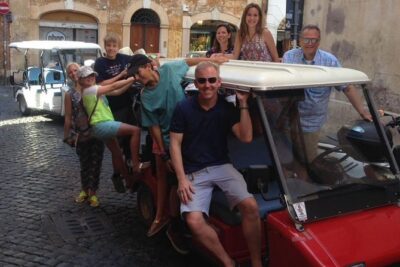
Rome by Golf Cart Private Tour: Beyond the Landmarks
Read our review →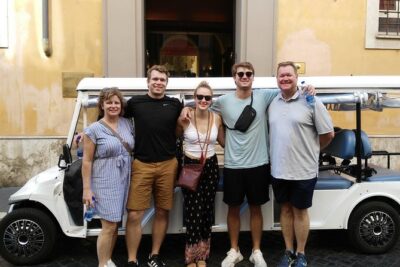
Rome on a Golf Cart Semi-Private Tour Max 6 with Private Option
Read our review →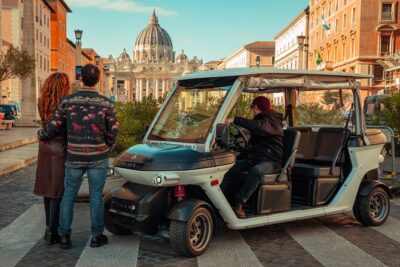
Rome Highlights City Tour by Golf Cart with Gelato
Read our review →
Imperial City Tour by Golf Cart with Optional Transfer
Read our review →
Golf Cart Small-Group Guided Tour: Rome City Highlights
Read our review →
Private/Group 4 Hours Golf Cart SightseeingTour
Read our review →Browse the lists this tour appears in