
Reviewed · TREVI FOUNTAIN & PANTHEON WALKS
Rome: Highlights Tour with Pantheon & Trevi Fountain
Rome’s ancient and Baroque heart fits neatly into this three-hour walk, but the real surprise is the visit to Vicus Caprarius, an underground Roman neighborhood near Trevi Fountain. You will move from grand piazzas to cool archaeological chambers, then pop back up beside one of Rome’s most famous sights.
I like the way the tour combines the Pantheon and gelato with practical advice for the rest of your stay. I also like that local guides such as Tiberio, Martina, Rosa, Emma, and Sev have been praised for making the stories clear and personal. The main drawback is the pace: this is a moderate walking tour with stairs and uneven surfaces, not a good fit for wheelchairs, strollers, or anyone who struggles to walk for three hours.
- Underground Rome at Vicus Caprarius: Explore the remains of an ancient neighborhood beneath the streets near Trevi Fountain.
- The Pantheon indoors: Learn about the dome, the building’s long history, and the important figures buried inside.
- A proper gelato stop: Taste a scoop while learning how traditional gelato differs from factory-made ice cream.
- Baroque art at Sant’Ignazio: See the church’s striking frescoes, a quieter stop between the Pantheon and Trevi.
- Useful Rome advice: Guides offer restaurant suggestions, drinking-fountain tips, and help with getting around.
- A strong first-day route: Finish near the Spanish Steps after seeing several central sights without arranging transport.
In This Review
- Why this three-hour Rome walk works as a first introduction
- Meeting at Piazza Navona beneath the Brazilian flag
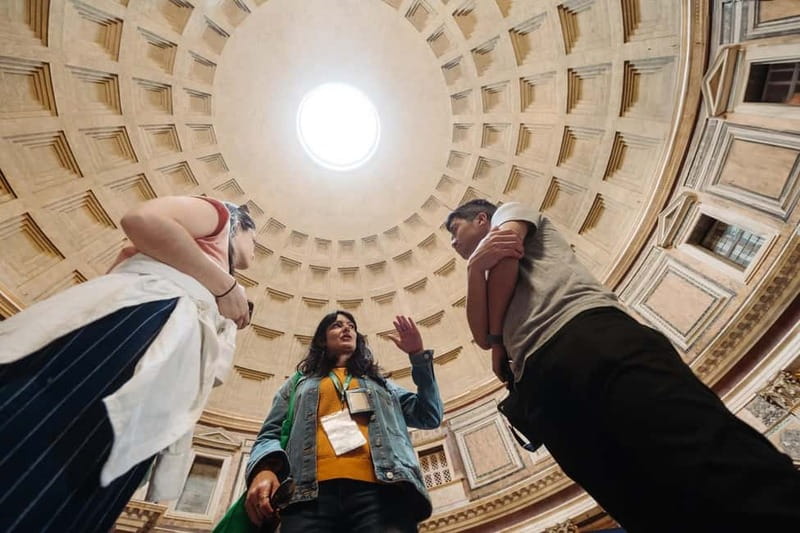
- Entering the Pantheon and looking up
- A gelato break with a lesson attached
- Sant’Ignazio and Rome’s theatrical Baroque style
- Going below street level at Vicus Caprarius
- Tossing a coin at Trevi Fountain
- Finishing at the Spanish Steps
- What the guides add to the route
- Timing, pace, and who should book
- Is $55.80 a fair price?
- Should you book the Pantheon and Trevi Fountain tour?
- FAQ
- How long does the Rome highlights tour last?
- Where does the tour begin?
- How early should I arrive?
- Is the tour conducted in English?
- Is gelato included?
- Are admission tickets included?
- Does the tour include hotel pickup?
- Can I bring a stroller or use a wheelchair?
- What should I wear and bring?
Why this three-hour Rome walk works as a first introduction
At $55.80 per person, this tour gives you three hours with an English-speaking guide, admission to the Pantheon, admission to Vicus Caprarius, and gelato. That is a fair price for a central Rome walk that includes two paid entrances rather than only exterior photo stops.
You are paying less for a checklist of monuments than for help making sense of the city. Rome can feel confusing at first. Ancient streets, churches, fountains, and layers of ruins appear one after another, and a good guide explains how they connect.
The route is also useful because it covers places you might otherwise treat as separate stops. You begin at Piazza Navona, enter the Pantheon, pause for gelato, visit Sant’Ignazio, go underground near Trevi Fountain, and finish at the Spanish Steps. You get a broad look at central Rome without spending time changing buses or finding each place on your own.
I would book it early in your stay. Several guides use the walk to explain where to eat, how to use Rome’s public drinking fountains, and which sights deserve more of your time. That advice can help shape the rest of your visit.
Meeting at Piazza Navona beneath the Brazilian flag
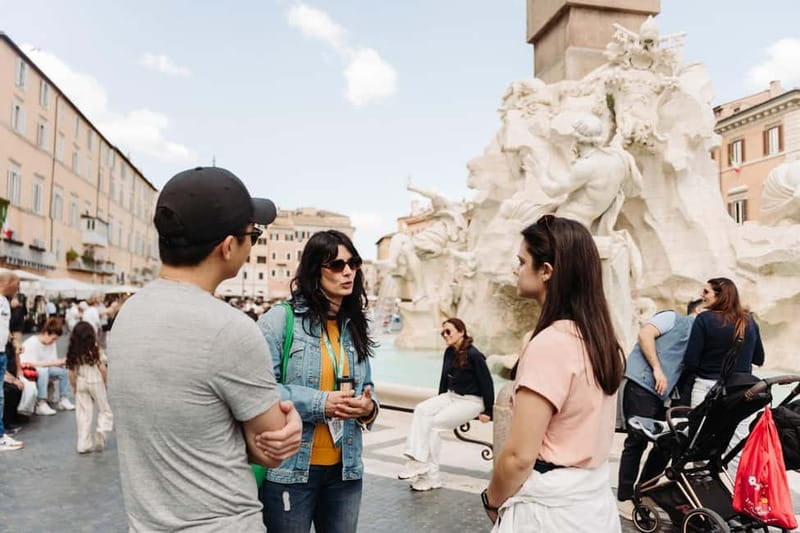
The starting point is Piazza Navona, 14, in front of the Embassy of Brazil. Look for the guide holding a green Walks sign and meet under the Brazilian flag. Arrive 15 minutes before the scheduled start, since a busy square is a poor place to make a last-second search.
Piazza Navona is a fitting opening scene. The long square follows the shape of an ancient Roman stadium, and its centerpiece is Bernini’s Fountain of the Four Rivers. You receive a short guided walk here, with time to take in the buildings, fountains, and steady Roman street life.
This is a public square, so it can be crowded and noisy. That is part of the setting, but it also explains why headsets matter. Headsets are provided for groups larger than six, and they help you hear the guide while standing near fountains or moving through packed streets.
More Trevi and Pantheon walks:
- Rome: Pantheon Timeless Marvel Guided Tour with Entry Ticket
★ 4.9 · 4,002 reviews - Rome: Pantheon Priority Entry Ticket & Audio Guide App
★ 4.1 · 3,234 reviews - Enjoy Spritz and Pasta Making in Piazza Navona
★ 5.0 · 1,681 reviews
Entering the Pantheon and looking up
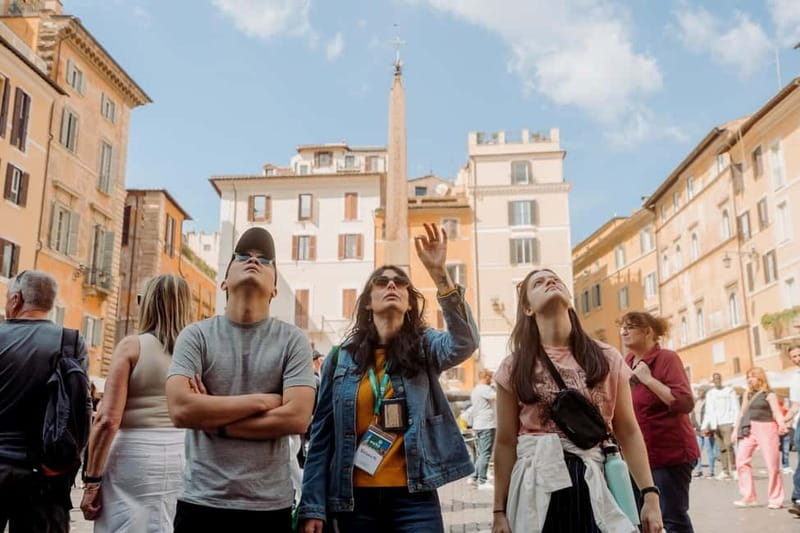
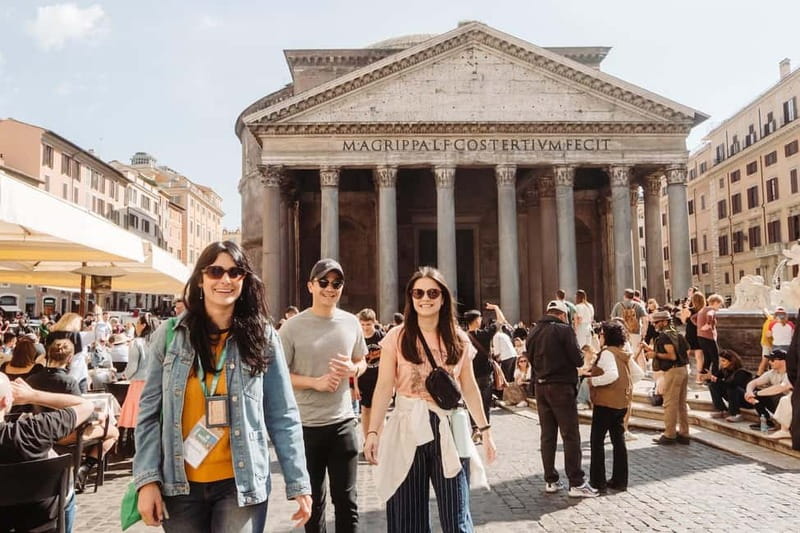
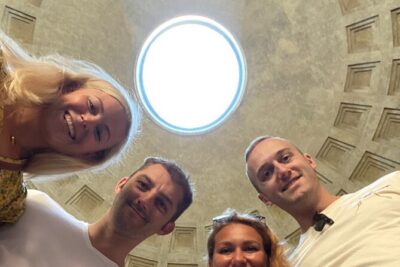
The Pantheon is the first major interior stop, and it earns its place on the route. It remains one of the best-preserved buildings from ancient Rome, with a vast dome that still makes visitors stop and look upward.
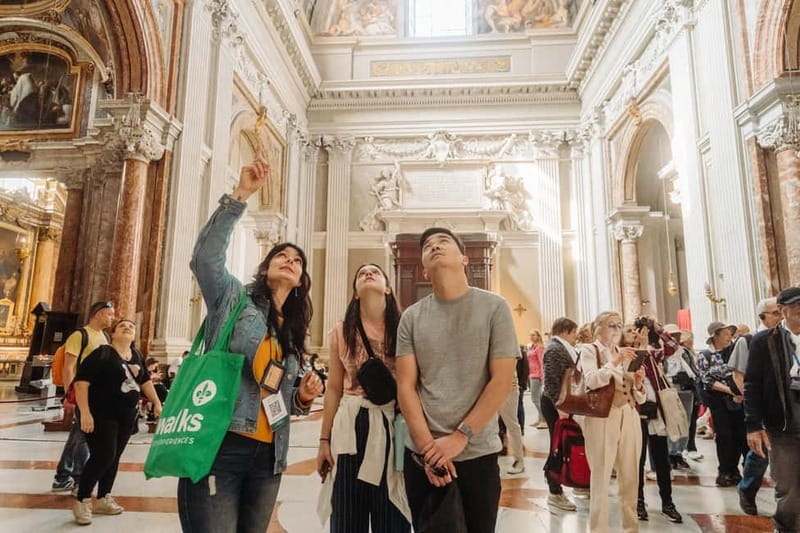
Your guide explains the building’s past, the design of its dome, and the notable people laid to rest inside. The value here is not simply getting through the doorway. A guide gives you a way to read the structure, so the columns, walls, and ceiling become part of a larger story.
The visit lasts about 25 minutes. That is enough for a focused explanation and some looking around, but not enough for an unhurried architectural study. If the Pantheon is one of your main interests, you may want to return independently later if time allows.
Dress carefully. Shorts, short skirts, and sleeveless shirts are not allowed on this tour. Comfortable shoes matter more than fashionable ones, since the day involves steady walking on Rome’s old streets.
A gelato break with a lesson attached

The gelato stop lasts about 15 minutes at a local café or gelateria. One scoop may sound like a small inclusion, but it gives the walk a welcome pause and adds a taste of everyday Italy to a schedule filled with monuments.
The guide explains how traditional Italian gelato differs from mass-produced ice cream. You will learn what to look for while choosing gelato during the rest of your trip, which makes this more useful than a simple sweet break.
The stop is short, so do not expect a full food tour. It is best viewed as a chance to rest your feet, enjoy a cold treat, and ask the guide for restaurant suggestions. One guide also shared practical advice about Rome’s public drinking fountains, including how to use them properly. Bring a refillable bottle if you want to take advantage of the city’s water stops.
Sant’Ignazio and Rome’s theatrical Baroque style

The Church of Sant’Ignazio di Loyola is a smart addition to the route. It is not usually the first place people name when planning Rome, yet its interior gives you a strong example of Baroque art and illusion.
The guided visit lasts around 20 minutes. You will see the church’s frescoes and hear how the decoration creates a sense of height and movement. This is a useful contrast to the Pantheon. The Pantheon impresses through ancient structure and engineering, while Sant’Ignazio shows Rome’s later taste for drama, color, and visual surprise.
The church also breaks up the major sights. You are not simply walking from one famous fountain to another. You get a quieter interior stop where the guide can point out details you might miss while exploring alone.
A completely different way to spend the day in Rome:
- Vatican: Museums & Sistine Chapel Entrance Ticket
★ 4.5 · 144,003 reviews - Vatican Museums & Sistine Chapel Tour with Optional Basilica
★ 4.3 · 67,413 reviews - Vatican Museums, Sistine Chapel & St Peter’s Basilica Guided Tour
★ 4.5 · 39,149 reviews - Rome: Colosseum, Palatine Hill and Roman Forum Guided Tour
★ 4.8 · 32,814 reviews
Going below street level at Vicus Caprarius

Vicus Caprarius, also called The Water City, is the most distinctive part of the tour. You enter the remains of an ancient Roman neighborhood beneath the modern streets near Trevi Fountain.
The visit takes about 30 minutes and includes admission. Underground archaeology gives you a different picture of Rome. Above ground, the city can look like a collection of grand churches, palaces, and fountains. Below, you see the traces of ordinary buildings and older layers hidden under later construction.
This stop adds real variety to the walk. It is cooler and darker than the streets, and the change in setting helps you understand how much of Rome is built over its own past. The guide’s explanation is particularly useful here because ruins can otherwise be difficult to read.
There are practical limits. The tour is not suitable for wheelchair users, strollers, or people with mobility impairments, and you need to walk at a moderate pace. Underground spaces and stairs may be uncomfortable if you need a fully accessible route. This is one of the clearest reasons to check the physical demands before booking.
Tossing a coin at Trevi Fountain
After emerging from Vicus Caprarius, you reach the Trevi Fountain. The timing works well: you move from an ancient neighborhood below ground to the grand theatrical fountain above it.
The guided stop lasts about 15 minutes and includes time for photographs. Your guide explains the traditions and legends connected with the fountain, including the familiar coin-tossing custom. You can take part in the ritual, then pause to study the sculpture and the water.
Trevi Fountain is one of Rome’s busiest sights, and a short stop is realistic. You will not have the space or quiet for a long, reflective visit. Still, having a guide explain the scene before you take photos makes the stop more meaningful than simply arriving, snapping a picture, and moving on.
The guide may also explain what happens to the coins collected from the fountain. One particularly useful detail is that the money is used to benefit the city. That small bit of context gives the ritual a more practical side.
Finishing at the Spanish Steps
The route concludes at the Spanish Steps, where you receive another guided walk and hear about the artists, poets, and visitors who have gathered there over the centuries. This is a good ending because it leaves you in a central part of Rome with plenty of options for the rest of the day.
The steps are more than a photo point. They offer a sense of how Rome’s public spaces have long attracted people who come to meet, watch, work, and wander. You will also have a clear landmark from which to continue exploring.
The published route ends at the Spanish Steps, while the meeting information also says the activity ends back at the meeting point. Since those details do not perfectly match, confirm the final drop-off point when you book. In either case, the listed itinerary finishes at the Spanish Steps.
What the guides add to the route

Guide quality matters greatly on a tour like this because the walking itself is easy to arrange. The difference comes from how well someone explains the buildings and handles the city.
The guides praised by name include Emma, Tiberio, Martina, Rosa, Sev, Cristina, and Enza. Their styles differ, but the strongest pattern is clear: you want a guide who can explain history in plain language, answer questions, and give useful advice beyond the official stops.
Tiberio, for example, was especially good at helping visitors plan the rest of a short Rome stay. Martina brought strong personal interest in Rome’s past, while Rosa and Sev were praised for making the sites accessible to both adults and children. Emma was noted for keeping a family engaged, and one group ranging from age 10 to 70 found the tour enjoyable for everyone.
Cristina brought humor and a distinctly Roman personality. Enza offered restaurant guidance and basic tips for getting around the city. Those small details matter because Rome rewards practical help. Knowing where to refill water, how to judge a restaurant, and how to move through crowded areas can save you time and money later.
Some groups receive headsets, especially when there are more than six people. They generally make it easier to follow the commentary, though sound can be less reliable underground. If you already have compatible headphones, one useful tip is to bring them so you can use both earpieces and reduce street noise.
Timing, pace, and who should book

The three-hour duration is long enough to introduce Rome but short enough to fit around another major visit. An evening departure can work well, especially if you want cooler temperatures and an easy first look at the city after arriving.
You should still expect a proper walking workout. The route includes public squares, old pavements, church interiors, an archaeological site below street level, and the Spanish Steps. Wear supportive shoes and bring water, especially during hot weather.
This tour suits:
- First-time visitors who want a central Rome orientation
- Couples looking for a simple introduction with a gelato break
- Families with older children who can keep a moderate pace
- Solo visitors who want context and restaurant advice
- Anyone who prefers a guide to explain famous sights rather than only photograph them
It is less suitable for anyone seeking a slow, highly specialized art tour. It also is not suitable for wheelchairs, strollers, or people with mobility limitations. Babies and very young children may be difficult to manage because strollers are not allowed.
Is $55.80 a fair price?
I consider $55.80 a reasonable price for what is included. You receive a live English-speaking guide, a three-hour walking route, Pantheon entry, Vicus Caprarius entry, gelato, and headsets for larger groups.
The value is strongest if you are new to Rome. On your own, you could walk past Piazza Navona, the Pantheon, Sant’Ignazio, Trevi Fountain, and the Spanish Steps for less money, but you would need to arrange your own admissions and research. You might also miss the underground ruins or fail to notice details inside the church.
The value is weaker if you already know central Rome well or prefer to linger at every stop. The schedule allows only a short time at each location, and the Trevi Fountain stop is mainly for explanation and photographs. Think of this as a well-organized orientation, not a full study of each monument.
Free cancellation up to 24 hours before the start and the option to reserve now and pay later make the booking less rigid. Check the available starting times, since the schedule changes by date.
Should you book the Pantheon and Trevi Fountain tour?
I would book this tour for your first day or evening in Rome if you want a friendly overview with real interior visits. The mix of the Pantheon, Sant’Ignazio, gelato, underground archaeology, Trevi Fountain, and Spanish Steps gives you much more variety than a simple fountain walk.
Choose it especially if you value a guide’s practical advice. The best part may be what you learn between the headline sights: where to find good food, how to use public fountains, and how to understand the city’s layers.
Skip it if you need an accessible route, dislike moderate walking, or want hours inside each monument. For everyone else, the $55.80 price buys a useful first map of central Rome, plus enough stories to make the next few days easier and more rewarding.
FAQ
How long does the Rome highlights tour last?
The tour lasts three hours. Starting times vary, so you need to check availability for your chosen date.
Where does the tour begin?
Meet at Piazza Navona, 14, in front of the Embassy of Brazil under the Brazilian flag. Your guide will hold a green Walks sign.
How early should I arrive?
Arrive 15 minutes before the scheduled start time.
Is the tour conducted in English?
Yes. The tour includes a live English-speaking guide.
Is gelato included?
Yes. The tour includes a gelato tasting at a local café or gelateria.
Are admission tickets included?
Yes. Admission to the Pantheon and Vicus Caprarius, also called The Water City, is included.
Does the tour include hotel pickup?
No. Hotel pickup and drop-off are not included.
Can I bring a stroller or use a wheelchair?
No. The tour is not suitable for wheelchair users, people with mobility impairments, or strollers. Baby strollers are also not allowed.
What should I wear and bring?
Wear comfortable shoes. Shorts, short skirts, and sleeveless shirts are not allowed.
Newest reviews from Rome
- ROME:Colosseum & Ancient Rome – private/small group TOUR★ 5.0 · 24 reviews
- Off the Beaten Track in Rome: Rione VI Parione Private Tour★ 5.0 · 24 reviews
- Cinematic Photoshoot in Rome★ 5.0 · 24 reviews
- Rome: Best of Colosseum and Roman Forum Small Group Guided Tour★ 4.5 · 24 reviews
- Vatican and Trionfale Market Tour with Wine and Food Tasting★ 5.0 · 24 reviews
- private tour: Vatican Museums, Sistine Chapel, St. Peter’s Basilica★ 4.5 · 24 reviews
- The Labyrinth of Rome between catacombs and ancient quarries★ 4.5 · 24 reviews
- Colosseum guided tour with Virtual Reality★ 5.0 · 24 reviews
Trevi Fountain & Pantheon Walks, compared.
Pantheon Timeless Marvel Guided Tour with Entry Ticket
Read our review →
Pantheon Priority Entry Ticket & Audio Guide App
Read our review →
Enjoy Spritz and Pasta Making in Piazza Navona
Read our review →
Pantheon Elite Guided Tour – Rome’s Iconic Ancient Temple
Read our review →
Pasta & Tiramisu Cooking Class near the Spanish Steps
Read our review →
Traditional Pizza Cooking Class near Piazza Navona
Read our review →
Rome’s Iconic Temple: Pantheon Audio Guided Tour with Fast Access
Read our review →Browse the lists this tour appears in