
Reviewed · MUSEUMS
Rome: Leonardo da Vinci Exhibition Entrance Ticket
Leonardo da Vinci’s drawings can feel like clever ideas trapped on paper. This small exhibition in Rome gives them wooden frames, gears, wings, bridges, pulleys, and moving parts. You can see more than 65 full-scale machines based on his designs, and you can handle many of them yourself. I love the bridge-building station and the way the models make Leonardo’s engineering easier to grasp. The nine 3D holograms add another layer, showing paintings and inventions in a lively multimedia display.
I also like the cool underground setting, which makes this a useful break from Rome’s summer heat, and the chance to see the unusual 43 BC tomb of Auro Irzio beneath the building. The main drawback is size: this is not a grand museum, and many visitors finish in 45 to 60 minutes. Some machines also show wear, and the room numbering can be confusing if you follow the audio guide too closely.
In This Review
- Key points
- Leonardo’s Paper Ideas Become Full-Size Machines
- Four Sections Built Around Water, Air, Fire, and Earth
- Seven Interactive Installations That Reward Curiosity
- Nine Holograms Add a Modern Layer
- Why the Optional Audio Guide Is Worth Considering
- The Strange Ancient Tomb Beneath the Palazzo
- How Long the Visit Takes
- Is the $10 Ticket Good Value?
- Who Will Enjoy This Exhibition Most?
- Practical Tips for a Better Visit
- Should You Book the Leonardo da Vinci Exhibition?
- FAQ
- Where is the Leonardo da Vinci exhibition in Rome?
- How much does admission cost?
- How long is the ticket valid?
- How long should I allow for the visit?
- Is a guide included with the ticket?
- Is an audio guide available?
- Can I touch the inventions?
- Is the exhibition suitable for children?
- Is the exhibition wheelchair accessible?
- Can I cancel my booking?
Key points
- Over 65 working models: See full-scale reproductions of Leonardo’s machines for engineering, flight, water, warfare, music, and transport.
- Hands-on exhibits: Touch and operate many displays, then build your own version of Leonardo’s bridge.
- Nine 3D holograms: Watch holographic presentations of Leonardo’s inventions and paintings.
- Four natural elements: The exhibition uses water, air, fire, and earth to explain Leonardo’s studies.
- Ancient underground tomb: Look down into a natural pond containing the tomb of Auro Irzio, dating from 43 BC.
- Good short stop in central Rome: The exhibition is near Campo de’ Fiori and Piazza Navona, with entry available until one hour before closing.
Leonardo’s Paper Ideas Become Full-Size Machines
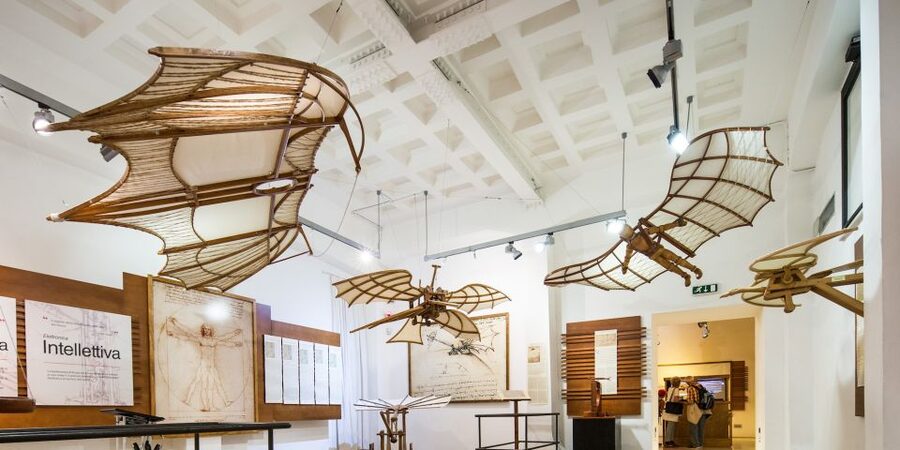
The main reason to visit is simple: you get to see Leonardo’s sketches turned into physical objects. His notebooks are packed with gears, screws, wings, bridges, pumps, weapons, and mechanical studies. A drawing can be hard to read, even when you admire the mind behind it. A full-scale reproduction lets you see how the parts fit together.
The exhibition focuses on Leonardo as an engineer and inventor, not only as the painter of the Mona Lisa and The Last Supper. You will still find a copy of The Last Supper, along with material about his artistic work, but the strongest part of the visit is the practical side of his thinking.
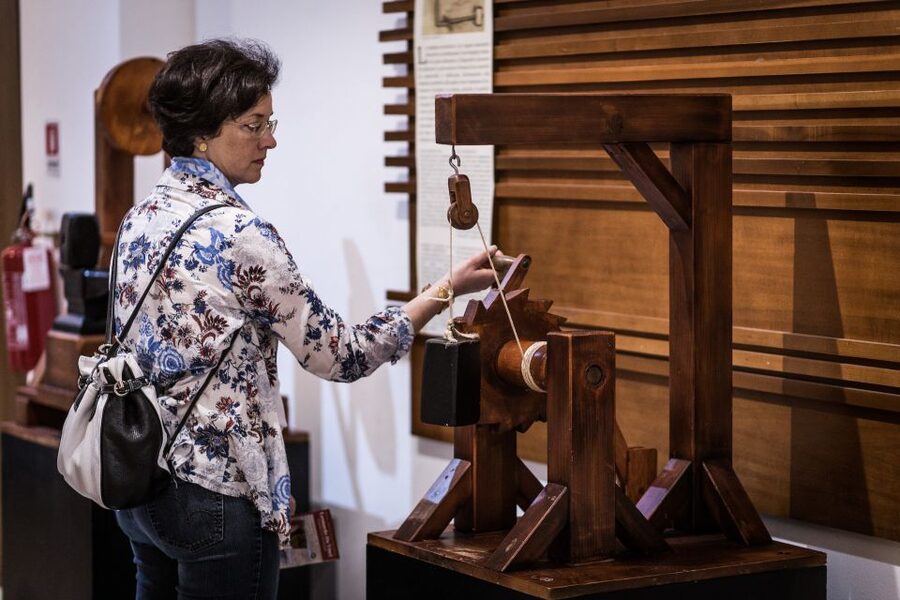
I find the machines especially useful for families and anyone who learns by handling objects. You can turn, push, test, and examine many of the models. That physical contact changes the visit from a display of old ideas into a simple lesson in mechanics.
The models cover several areas. You might see machines connected with flight, military engineering, water movement, scientific instruments, architecture, and musical devices. The variety matters because Leonardo did not work in one narrow field. He moved between art, anatomy, engineering, science, sculpture, and architecture with unusual ease.
More museums and galleries in Rome:
- Vatican: Museums & Sistine Chapel Entrance Ticket
★ 4.5 · 144,003 reviews - Vatican Museums & Sistine Chapel Tour with Optional Basilica
★ 4.3 · 67,413 reviews - Vatican Museums, Sistine Chapel & St Peter’s Basilica Guided Tour
★ 4.5 · 39,149 reviews
Four Sections Built Around Water, Air, Fire, and Earth
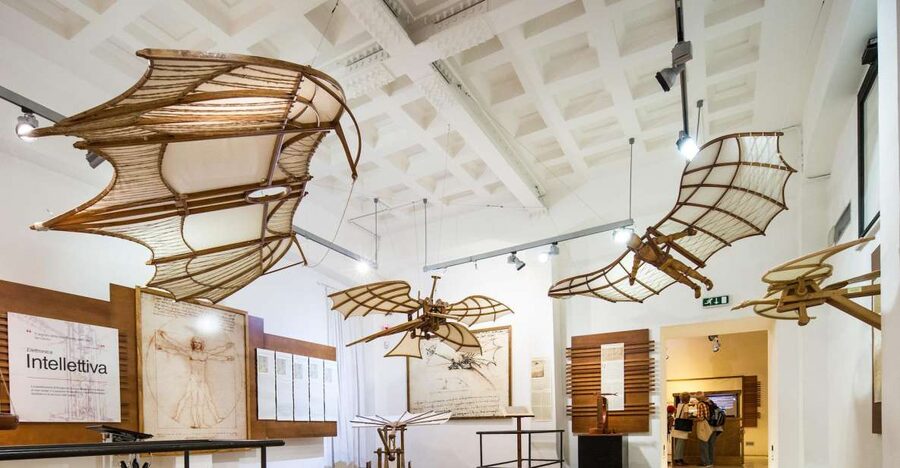
The exhibition is arranged in four sections based on the elements of water, air, fire, and earth. This structure gives the displays a clear theme, although the path is not always perfectly obvious. Room numbers do not always flow in a natural order, so take a moment at the start to get your bearings.
The water section helps explain Leonardo’s interest in movement, currents, channels, and machines that could control or use water. This is more than a collection of boats and pumps. It shows how closely he watched nature and then tried to copy its systems in a practical way.
In the air section, you can look at Leonardo’s studies of flight and machines inspired by birds. The models cannot prove that his flying designs would have worked exactly as drawn, but they let you inspect the shapes and mechanisms he imagined. This is one of the most approachable parts of the exhibition for children, since the idea of human flight needs little explanation.
The fire section connects with force, energy, weapons, and mechanical action. It includes military ideas and machines that show Leonardo thinking about defense and attack. The exhibition does not treat him only as a peaceful artist. His work also served rulers and armies, and the military models add an important complication to the familiar image of Leonardo.
The earth section brings together construction, architecture, bridges, and mechanical instruments. This is where the bridge-building activity becomes particularly useful. You can try to assemble your own version of a bridge inspired by Leonardo’s design, then see how a simple structure can gain strength through its arrangement.
Seven Interactive Installations That Reward Curiosity
Seven interactive installations use Leonardo’s drawings to explain his ideas. Their value is not just entertainment. They help you see how he moved from observation to design.
At many museums, you are told not to touch anything. Here, touching is part of the plan. You can test the movement of selected machines, inspect their parts up close, and work out what each mechanism is meant to do. For a child, this makes the exhibit feel like a workshop. For an adult, it can prompt useful questions about balance, leverage, rotation, and construction.
The displays are not all equally clear. One visitor found the touch and do not touch instructions unclear, and some areas include trip hazards. Keep younger children close, especially around crowded display points and mechanical parts.
The hands-on design works best when you slow down. You could race through the rooms and simply photograph the machines, but the real value comes from spending a few minutes with one or two models. Try to work out the purpose of a device before reading the explanation. Then compare your guess with Leonardo’s original idea.
Nine Holograms Add a Modern Layer
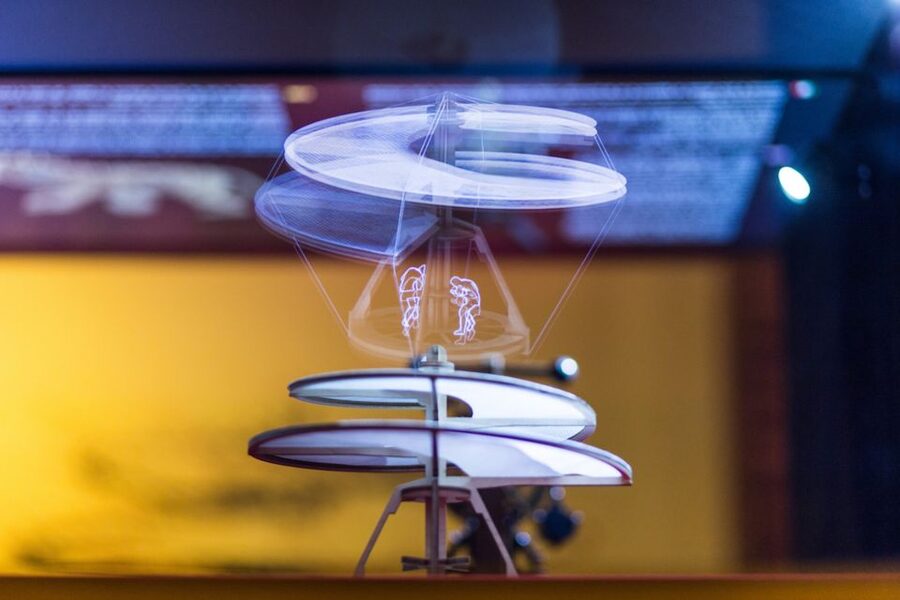
The nine holograms are one of the exhibition’s more unusual features. They present Leonardo’s paintings and inventions in 3D, adding movement and visual drama to the mechanical displays.
These holograms are not a substitute for original Leonardo paintings. This is a reproduction-based exhibition, and you should book it for access to the models and explanations rather than for rare artworks. Still, the holographic presentations help break up the technical material and make Leonardo’s work easier to follow.
The multimedia element also gives the exhibition a calmer, more polished rhythm. Soft background music and short videos support the displays without turning the visit into a loud theme-park show. If you prefer traditional museums with original objects and quiet galleries, the staging may feel a little theatrical. If you want a clear, accessible introduction, it works well.
More Rome tours worth comparing
- Rome:Hop-On Hop-Off Panoramic Open Bus Ticket 3 Circuits x 1
★ 4.0 · 15,405 reviews - Vatican Museums & Sistine Chapel Skip-the-Line Entry Ticket
★ 4.4 · 13,838 reviews - Rome: Vatican Museums & Sistine Chapel Skip-The-Line Ticket
★ 4.2 · 11,708 reviews - Vatican Museums & Sistine Chapel Skip-the-Ticket-Line Tour
★ 4.3 · 10,486 reviews
Why the Optional Audio Guide Is Worth Considering
Your ticket includes exhibition entry and a gadget, but no guide. An audio guide is available at an additional cost, and I would consider it if Leonardo’s engineering interests you or if you want more than a quick look.
The audio guide adds background and detailed explanations, including links between Leonardo’s ideas and modern transport or architecture. Several exhibits are easier to understand when someone explains the drawing, the intended movement, and the problem Leonardo was trying to solve.
The audio route is not perfectly matched to the room order. The exhibit numbers can jump between rooms, and you may need to check where the next stop is rather than simply follow the sequence. That small inconvenience is manageable, especially if you treat the guide as a reference rather than a strict walking route.
Written explanations are available in English, making the basic visit possible without an audio device. The optional guide is most useful for adults who want more context, older children who will listen, and anyone who already has an interest in Leonardo’s machines.
The Strange Ancient Tomb Beneath the Palazzo
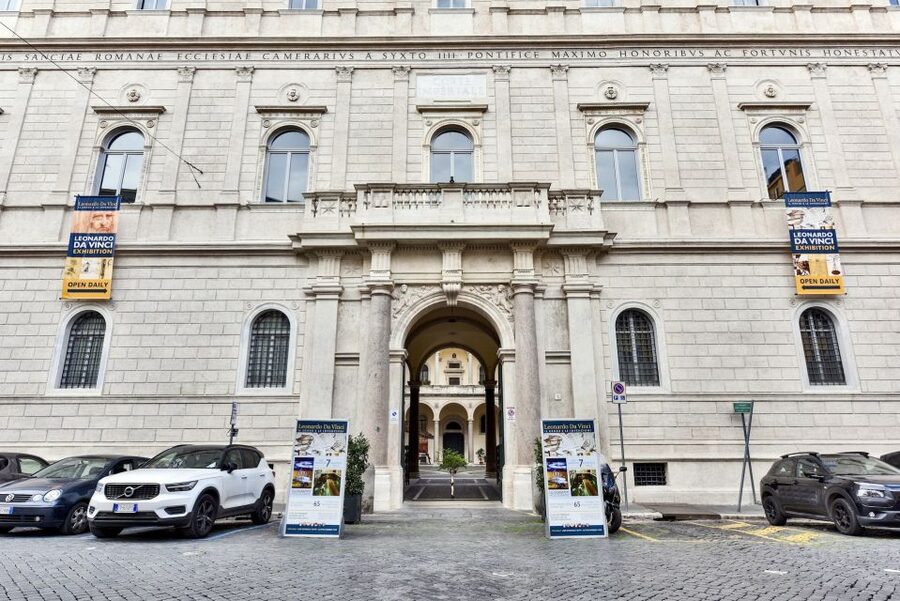
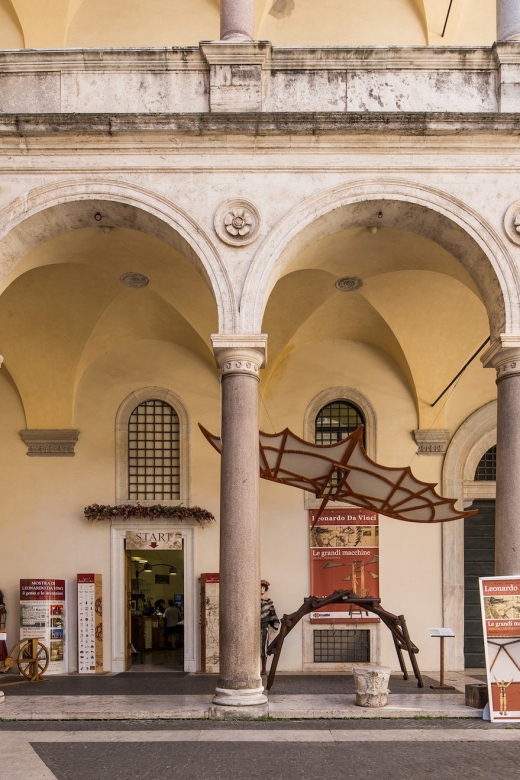
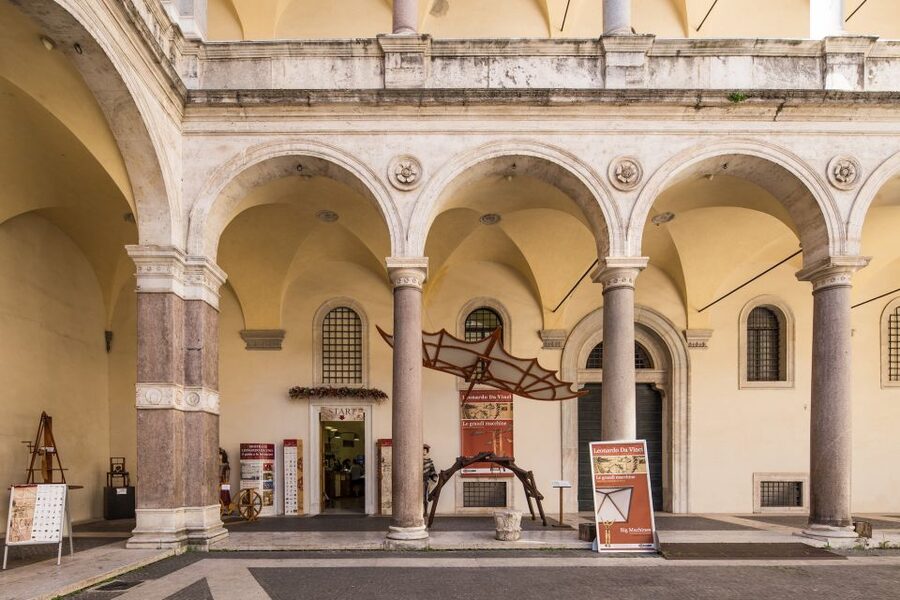
The setting adds a surprise that has little to do with Leonardo. The Mostra di Leonardo da Vinci occupies part of the Palazzo della Cancelleria, a Vatican-owned building near Campo de’ Fiori and Piazza Navona.
The palace itself is worth noticing for its architecture. The upper floor houses the Sacra Rota, the church tribunal that handles marriage annulment cases. You will not be visiting that area as part of the exhibition, but the building’s wider role gives the stop a stronger sense of place than a purpose-built modern gallery.
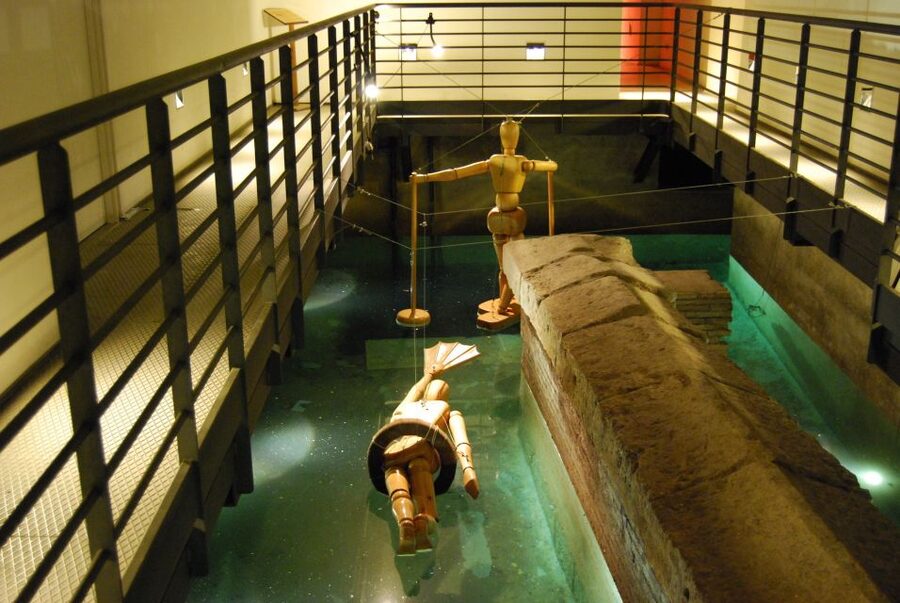
Below the exhibition, you can see the tomb of the architect Auro Irzio, dating from 43 BC. The tomb sits in an underground natural pond, an unexpected sight in the middle of central Rome. It is not a major archaeological museum display, so do not expect a large excavation. Think of it as a brief, atmospheric extra that connects the building to Rome’s ancient past.
This underground setting has a practical benefit too. On a hot day, the cooler rooms offer a welcome rest from the streets. The exhibition is also reported as accessible to wheelchair users, though the presence of trip hazards means families should still move carefully.
How Long the Visit Takes
Plan on 45 to 60 minutes for a straightforward visit. That is the most useful estimate if you read the main explanations, try several machines, and watch some of the holograms.
You can spend closer to two hours if you study every panel, use the audio guide, watch the short videos, and discuss the models with your family. The exhibition is not huge, but interactive displays slow you down in a good way. A child may want to repeat the same mechanical test several times, while an adult may linger over a bridge, flying machine, or scientific instrument.
Because entry is valid for one day, you have some flexibility around your Rome sightseeing schedule. The last entry is available until one hour before closing, so do not arrive at the final minute. The exact opening times and available starting times should be checked when booking.
I would place this visit between larger sights rather than build an entire afternoon around it. It fits naturally with a walk around Piazza Navona, Campo de’ Fiori, and the surrounding historic center.
Is the $10 Ticket Good Value?
At about $10 per person, the ticket is reasonably priced for a central Rome attraction. You are not paying for a large collection of original masterpieces, so the value depends on what you want.
For a quick 45-minute stop, the price is fair because the exhibition offers many physical models, interactive pieces, holograms, and the underground tomb. For a longer visit with an audio guide, it becomes an even better choice for families or people interested in design and engineering.
The low price also makes it easy to add this to a day of sightseeing without feeling that you have made a major commitment. It is cheaper and less demanding than Rome’s headline museums, and it can fill a gap in your schedule.
You should compare the official website before booking, since discounts may sometimes be available there. The attraction also offers free cancellation up to 24 hours before the visit and a reserve-now, pay-later option, which can help if your Rome plans are still shifting.
Who Will Enjoy This Exhibition Most?
I would recommend it most strongly to:
- Families with school-age children who enjoy touching and testing displays.
- Adults interested in engineering, architecture, science, aviation, or military design.
- Visitors who want a short indoor activity near Piazza Navona.
- Anyone looking for a quieter alternative to Rome’s busiest sights.
- Leonardo fans who want to see his inventions represented in three dimensions.
- Visitors needing a cool break during a hot day.
It is less suitable if your main goal is to see original Renaissance paintings. The art material supports the story, but the focus is on reproductions and explanations. It is also not the best choice for very young children who may struggle with trip hazards or unclear touch instructions.
The exhibition can work for all ages, but adults should set expectations. Some machines are basic reproductions, not polished museum masterpieces, and a few may show wear. Their purpose is to make an idea understandable, not to provide a perfect historical reconstruction.
Practical Tips for a Better Visit
Go earlier in the day or around 5 p.m. if you prefer a quieter experience. The exhibition can feel especially pleasant when you have room to try the machines without waiting.
Allow extra time for the audio guide, but do not worry if its numbering seems out of order. Check the room layout as you move through the displays.
Read the English panels even if you skip the audio guide. The written material gives enough basic information to follow the main themes, while the guide adds detail rather than making the visit possible.
Look closely at the original drawings beside the models. The best moments come when you compare Leonardo’s quick lines with the full-scale object built from them.
Finish with the gift shop if you are looking for something different from the usual Rome souvenirs. It carries items connected with Leonardo and his inventions, and it gives children a chance to continue the building and design theme after the visit.
Should You Book the Leonardo da Vinci Exhibition?
Book it if you want an affordable, hands-on museum stop that shows Leonardo as an inventor, engineer, scientist, and designer. The full-scale machines and interactive stations are the real draw, while the holograms, audio guide, and underground tomb add variety.
Skip it if you are seeking original Leonardo paintings or a large, formal art museum. For most visitors, though, this is a smart 45-minute addition to a day near Piazza Navona and Campo de’ Fiori. The modest price, central location, cool underground rooms, and practical displays make it a particularly good choice for families and curious minds.
FAQ
Where is the Leonardo da Vinci exhibition in Rome?
The exhibition is at Mostra di Leonardo da Vinci, Piazza della Cancelleria 1, near Campo de’ Fiori and Piazza Navona.
How much does admission cost?
The listed price is $10 per person.
How long is the ticket valid?
The ticket is valid for one day.
How long should I allow for the visit?
A typical visit takes about 45 to 60 minutes, although you can spend up to two hours if you study the displays and use the audio guide.
Is a guide included with the ticket?
No. The ticket includes exhibition entry and a gadget, but no guide. An audio guide or additional guide is available at extra cost.
Is an audio guide available?
Yes. An audio guide is available for an additional fee and provides extra explanations about the exhibits and Leonardo’s work.
Can I touch the inventions?
You can touch and operate almost all of the machines on display. Some areas may have different instructions, so follow the signs and staff guidance.
Is the exhibition suitable for children?
Yes. The interactive models and bridge-building activity can work well for children. Take extra care with small children because some areas have trip hazards and unclear touch instructions.
Is the exhibition wheelchair accessible?
Yes, the activity is listed as wheelchair accessible.
Can I cancel my booking?
You can cancel up to 24 hours in advance for a full refund. A reserve-now, pay-later option is also available.
Newest reviews from Rome
- Rome: Vatican Museums & Sistine Chapel Skip-the-Line Ticket★ 4.4 · 148 reviews
- Shared Shuttle Transfer from Rome to Civitavecchia Port★ 5.0 · 148 reviews
- Rome: Crypts & Catacombs After Hours Tour with Bone Chapel★ 4.6 · 149 reviews
- Ghosts Legends and Mysteries of Rome Walking Tour★ 5.0 · 149 reviews
- Skip the Line: Vatican and Sistine Chapel with Guided Tour★ 4.0 · 149 reviews
- Tivoli: Villa Gregoriana Entrance Ticket★ 4.7 · 150 reviews
- Pizza and Tiramisu Cooking Class in Rome, Piazza Navona★ 5.0 · 150 reviews
- Rome: Borghese Gallery Skip-the-Line Entry and Guided Tour★ 4.7 · 150 reviews
Museums, compared.


Vatican Museums & Sistine Chapel Tour with Optional Basilica
Read our review →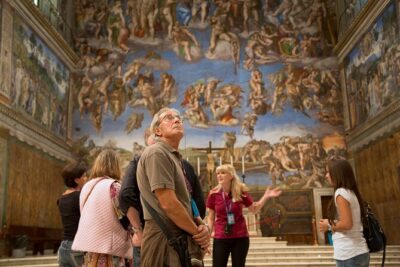
Vatican Museums, Sistine Chapel & St Peter’s Basilica Guided Tour
Read our review →
Vatican Museums, Sistine Chapel & Basilica Tour
Read our review →
Vatican Museums & Sistine Chapel Skip-the-Line Entry Ticket
Read our review →Vatican Museums, Sistine Chapel & Basilica Tour
Read our review →
Vatican Museums & Sistine Chapel Guided Tour
Read our review →
Vatican Museums & Sistine Chapel Skip-The-Line Ticket
Read our review →Browse the lists this tour appears in