Reviewed · MUSEUMS
Rome: Private Leonardo da Vinci Exhibition Guided Tour
Leonardo da Vinci’s most surprising talent may not be his painting. It may be his habit of treating the whole world as a machine worth taking apart. Inside Rome’s Palazzo della Cancelleria, this private tour turns his sketches into full-size working models, 3D holograms, and hands-on displays you can touch.
I like the interactive machines, since you can handle many of them rather than simply peer through glass. I also like the chance to see an ancient tomb from 43 B.C. below the palace, where it sits in a natural underground pond. The main consideration is that this is an exhibition about Leonardo’s ideas and engineering, not a collection of his original paintings.
The price is listed as $93 per group of up to one person, so check the booking screen carefully if you are traveling with more than one person. The private format, flexible language choices, and access to extra workshops can make the cost worthwhile, especially for families or visitors who want time to ask questions.
In This Review
- Key points at a glance
- Entering Palazzo della Cancelleria
- Four sections built around Leonardo’s ideas
- More than 65 machines you can actually handle
- Holograms that make Leonardo’s work move
- Water, Air, Fire, and Earth in practical form
- Science, aviation, and military design
- The 43 B.C. tomb beneath the exhibition
- Why a private guide changes the visit
- Price, timing, and practical value
- Who should book this Leonardo tour?
- Should you book it?
- FAQ
- Where does the Leonardo da Vinci tour take place?
- How long does the tour last?
- Is the tour private?
- Which languages are available?
- What can I see in the exhibition?
- Can I touch the machines?
- Is the tour wheelchair accessible?
- What is the cancellation policy?
Key points at a glance
- Nine holograms in 3D: See Leonardo’s paintings and inventions presented as moving, three-dimensional images.
- More than 65 full-scale machines: Examine reproductions based on Leonardo’s designs for science, flight, water, and military use.
- Hands-on learning: Touch and operate many displays, then try building your own version of one of Leonardo’s bridges.
- A Roman tomb underground: Find the tomb of architect Auro Irzio, dating from 43 B.C., in a natural pond below the palace.
- Private multilingual guiding: Tours are offered in English, Italian, French, Spanish, German, and Portuguese.
- Family-friendly explanations: Art historians can adjust explanations for children and provide access to more workshops.
Entering Palazzo della Cancelleria
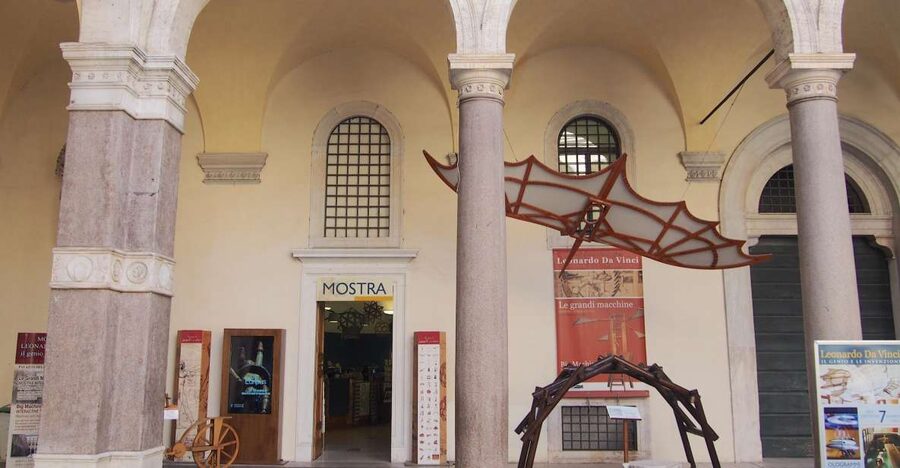
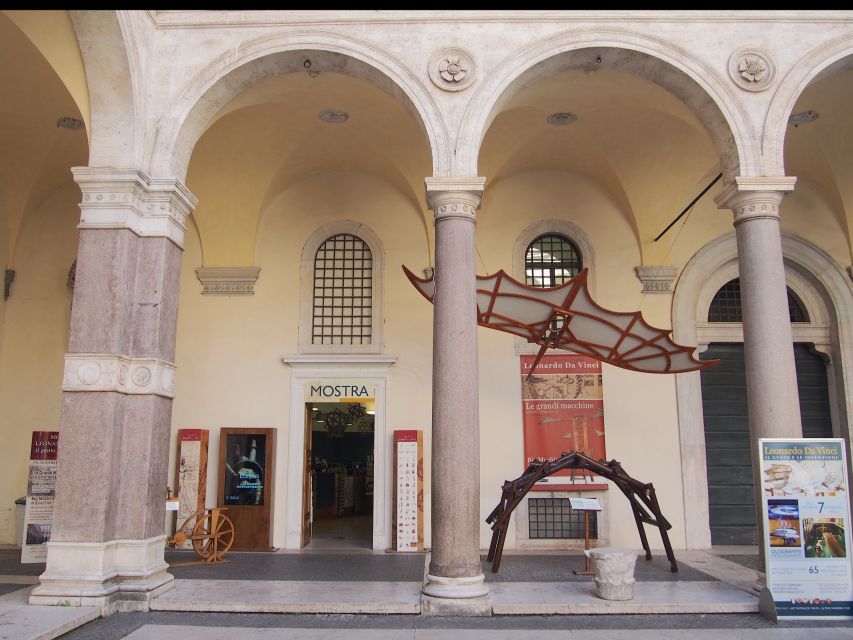
The setting gives this experience a useful extra layer. The Leonardo exhibition is inside Palazzo della Cancelleria, a palace owned by the Vatican. You are not walking into a modern science center with polished metal and bright signs. The building itself is part of the visit.
The upper floor houses the Sacra Rota, the church court connected with marriage annulments. That is not the focus of the tour, and you should not expect a full palace tour, but it helps explain why the venue feels more historic than a stand-alone exhibition hall.
You meet 15 minutes before departure, then enter with your guide without waiting in the regular ticket line. The exact meeting instructions and starting time should be checked when you book, since several tour times may be available.
The skip-the-line entry matters most when Rome is busy. This is a fairly short activity, so losing 20 or 30 minutes at the entrance would take a large bite out of your visit. Keep your schedule simple around it, especially if you have a timed reservation elsewhere.
More museums and galleries in Rome:
- Vatican: Museums & Sistine Chapel Entrance Ticket
★ 4.5 · 144,003 reviews - Vatican Museums & Sistine Chapel Tour with Optional Basilica
★ 4.3 · 67,413 reviews - Vatican Museums, Sistine Chapel & St Peter’s Basilica Guided Tour
★ 4.5 · 39,149 reviews
Four sections built around Leonardo’s ideas
The exhibition is arranged in four sections linked to the elements and forces Leonardo studied: Water, Air, Fire, and Earth. This layout helps you see how he connected art, science, engineering, and observation.
Leonardo did not separate subjects as neatly as a modern school timetable. Water could lead to a study of currents, bridges, pumps, or military defenses. Air could lead toward flight. Fire could connect with weapons and mechanical power. Earth could point toward construction, anatomy, and the physical world around him.
That structure is valuable because you are not simply walking past unrelated replicas. You are following a way of thinking. A guide can explain why a design mattered and how Leonardo moved from watching nature to drawing a machine.
The experience also works well for visitors who know little about Leonardo beyond the Mona Lisa. You do not need an art background. The machines make his thinking easier to grasp because you can see how a sketch might become a device with gears, levers, wings, or supports.
More than 65 machines you can actually handle
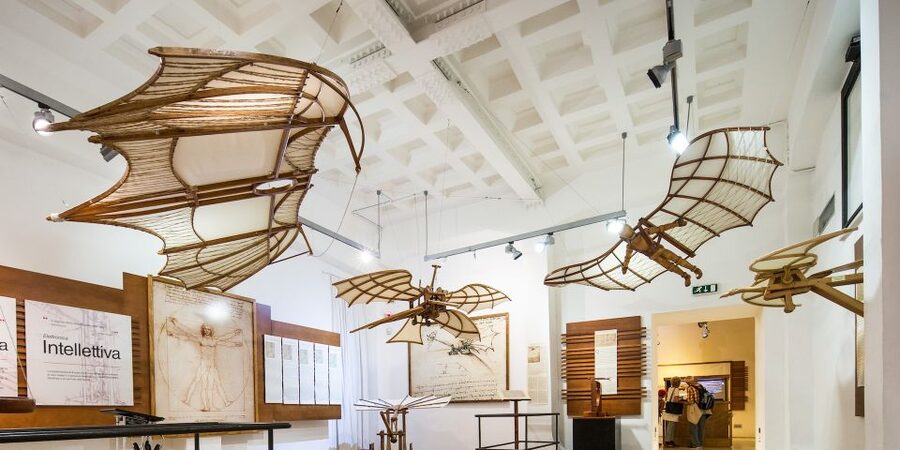
The center of the visit is the collection of more than 65 full-scale machines made from Leonardo’s designs. These are reproductions, not original Renaissance objects, but their size gives you a better sense of the problems Leonardo was trying to solve.
A drawing of a bridge can look simple on paper. A full-size model shows the balance, weight, and construction issues involved. You can also build your own version of one bridge attributed to Leonardo’s design, which turns a short explanation into a practical challenge.
I find this part especially useful for families. Children do not have to stand quietly while an adult explains Renaissance history. They can test, touch, and build. The child-friendly explanations are another advantage of booking a private guide, since the pace and wording can be adjusted.
Still, do not expect every machine to operate like a museum demonstration. The information says you can touch and play with almost all of the displays, but the exhibition is still built around reproductions and explanations. Your guide remains important for showing what each model is meant to demonstrate.
The hands-on approach also gives adults something to do. You may understand Leonardo’s idea faster by moving a mechanism than by reading a long panel. If you like practical science museums, this will likely be the strongest part of the tour.
Holograms that make Leonardo’s work move
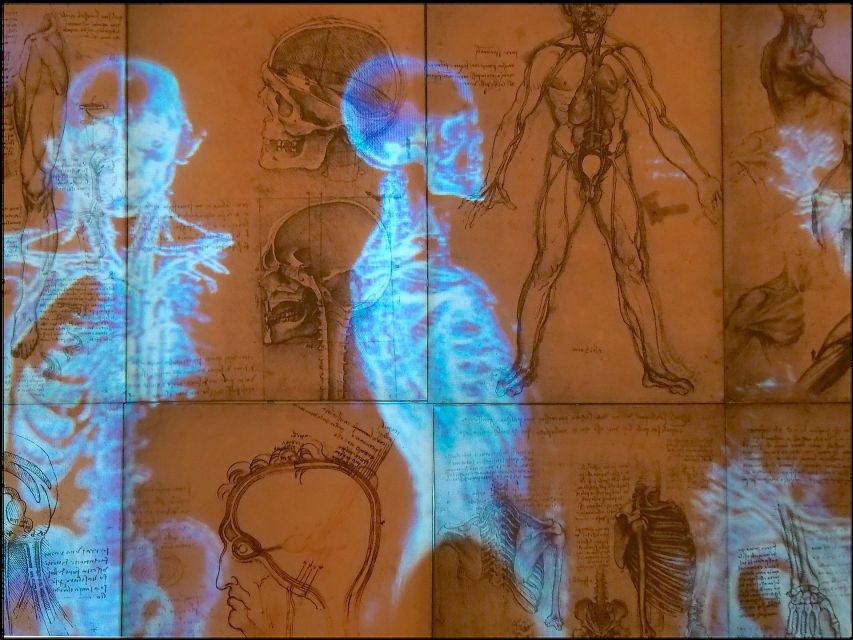
Nine holograms show Leonardo’s paintings and inventions in three dimensions. This is a modern presentation of a Renaissance subject, and it changes the mood of the visit.
The holograms are not original works. They are designed to show details, movement, and depth in a way a flat reproduction cannot. For a painting, that can suggest layers or features. For an invention, it can help you picture how a mechanism might work.
The display may appeal most to visitors who want a quick visual explanation rather than a long art lecture. It also gives children another way into the subject. A guide can connect what you see in the hologram with the full-scale machines nearby.
The trade-off is that anyone seeking Leonardo’s original art will need to visit other museums. This exhibition focuses on ideas, replicas, images, and interpretation. Think of it as an introduction to Leonardo the inventor and observer, not a substitute for seeing his original paintings.
More Rome tours worth comparing
- Rome by Golf Cart Private Tour: Beyond the Landmarks
★ 5.0 · 4,361 reviews - Early Morning Vatican, Sistine, St. Peter’s Semi or Private Tour
★ 5.0 · 3,779 reviews - Rome on a Golf Cart Semi-Private Tour Max 6 with Private Option
★ 5.0 · 2,502 reviews - Rome Private Arrival Transfer: Fiumicino Airport to Hotel in Rome
★ 4.5 · 2,492 reviews
Water, Air, Fire, and Earth in practical form
Leonardo’s studies of the four elements give the tour its intellectual shape. Water is not presented only as a scenic subject. It becomes a problem to study, control, and use.
The same applies to air. His interest in flight appears alongside broader questions about movement and engineering. The exhibition lets you consider how close observation of birds and air might lead to experiments with aviation.
Fire brings the military and mechanical side of Leonardo’s work into view. Earth connects with building, weight, structure, and the physical body. The exhibition also includes a film about Leonardo’s inventions and another section on his anatomy studies.
The anatomy material is important because it shows the range of his curiosity. Leonardo was not studying machines in isolation. He examined the human body, water, air, and natural forces as connected subjects.
I would pay attention to the film if you enjoy context. It gives you a pause from the models and can help organize what you have already seen. If you are visiting with young children, ask the guide to explain the anatomy section in an age-appropriate way.
Science, aviation, and military design
The exhibition brings you close to Leonardo’s work in science, aviation, and military engineering. These areas show both his imagination and his practical limits.
Some designs feel remarkably forward-looking. Others are better understood as experiments on paper. That distinction is worth keeping in mind. Leonardo produced many studies, but not every machine became a successful working invention.
A good guide can help you separate the brilliant observation from the speculative leap. This is where the private format has real value. You can stop at a machine, ask what it was intended to do, and spend more time on the subjects that interest you.
The guided tour is available in English, Italian, French, Spanish, German, and Portuguese. A German-language visit led by Julia was praised for answering questions and making the experience memorable. French-language guides were also described as passionate and especially good with children. If language matters to you, choose it at booking rather than leaving it to chance.
The guide’s role is not just to name each device. It is to explain the problem Leonardo was addressing. That makes the displays easier to remember after you leave.
The 43 B.C. tomb beneath the exhibition
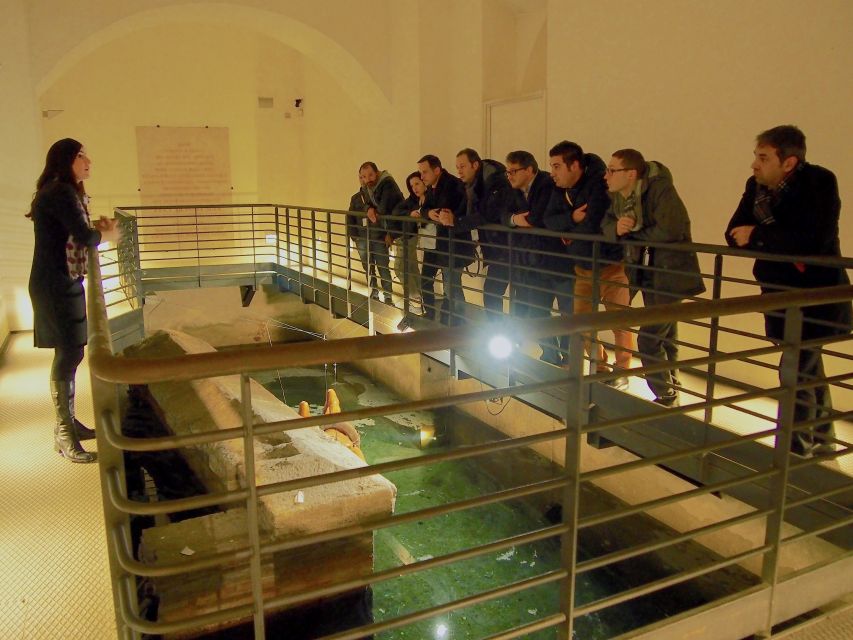
The most unexpected stop is below the palace. The tomb of architect Auro Irzio dates to 43 B.C. and is set in a natural underground pond.
This ancient feature changes the visit from a single-subject museum outing into a small piece of Roman archaeology as well. You are not only looking at Renaissance replicas. You are also seeing evidence of Rome’s much older past beneath a Vatican-owned palace.
The tomb is a brief part of the overall experience, but it may be the detail you remember most. It gives the exhibition a strong sense of place. Leonardo’s machines could be displayed in many cities. A Roman tomb under this particular building is specific to Rome.
The supplied information does not describe the length of the tomb visit or the precise conditions below ground. If you have mobility concerns, confirm the route when booking. The activity is listed as wheelchair accessible, but conditions at individual historic features can vary.
Why a private guide changes the visit
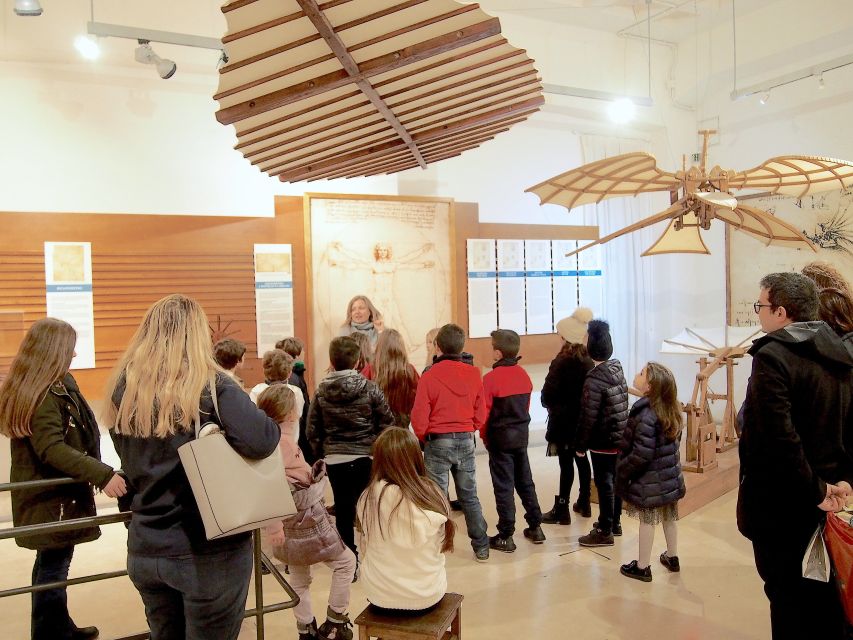
A private tour gives you more control than a standard group explanation. You can ask about a machine, request a simpler explanation for children, or spend more time in a workshop.
The tour also provides access to more workshops. That can make the difference between a quick look at models and a more active session built around them. Ask your guide what is available on your date, since the exact workshop experience is not specified.
Families are a strong match for this format. A child who is restless during a traditional museum visit may stay engaged when invited to build a bridge or operate a model. One guide was noted for patience with children, while another French-language guide was praised for keeping children interested.
Adults benefit too. Leonardo’s work crosses art, anatomy, mechanics, architecture, and military design. A private guide can follow your questions rather than forcing everyone through the same fixed level of detail.
The private setup can also help if your group has mixed interests. One person can ask about engineering while another asks about painting or the palace. The experience lasts about 1.5 to 2 hours, long enough to cover the main sections without turning into an exhausting half-day museum visit.
Price, timing, and practical value
At $93 per group up to one person, the listed price needs careful checking. The wording suggests a private booking structure, but you should confirm how additional people are priced before paying. A solo visitor gets privacy, but the cost may feel high compared with a regular museum entrance.
For a family or small private party, the value improves if the booking price covers the group under the provider’s terms. You are paying for the guide, exhibition entry, skip-the-line access, and a more flexible explanation, not just admission to the displays.
The experience includes a small gadget, which is a pleasant extra but should not influence your decision. The real value is the guide’s time and the ability to interact with the machines.
Allow up to two hours for the tour itself, plus time to arrive 15 minutes early. The central location at Palazzo della Cancelleria makes it easy to pair with other sights in Rome, but do not cram it between two tight timed entries. The guide may spend longer on questions, and that is one of the reasons to choose a private visit.
Free cancellation is available up to 24 hours before the tour for a full refund. You can also reserve and pay later, which helps if your Rome schedule is still changing.
Who should book this Leonardo tour?
I would choose this experience for families, curious first-time visitors, and anyone who learns better by seeing a mechanism work. It is also a good pick if you want a shorter indoor activity that adds science and engineering to a Rome sightseeing plan.
Art lovers should set their expectations correctly. You will see holographic presentations of Leonardo’s paintings, but the exhibition is not built around original masterpieces. If your main goal is famous Renaissance artwork, spend your museum time elsewhere and treat this as a companion experience.
History-minded visitors will appreciate the Roman tomb and the palace setting. Science and design enthusiasts will probably spend most of their time with the full-scale machines. Children can take part in the physical displays, while the guide can shape the explanations around their age.
The experience is wheelchair accessible, and tours are offered in six languages. Meet 15 minutes early, confirm your meeting instructions, and select the language that suits your group.
Should you book it?
Book this tour if you want Leonardo presented as an inventor, engineer, and relentless observer rather than only as the painter of the Mona Lisa. The full-scale machines, nine holograms, bridge-building activity, and underground Roman tomb give the visit more variety than a standard exhibition.
Skip it if you want original Leonardo paintings or a quiet, traditional art museum. Also check the unusual per-group pricing before you commit.
For families and small groups, the private format is the main reason to book. For solo visitors, compare the total cost with a regular exhibition ticket. If the price works for your group, this is a lively and practical way to spend 1.5 to 2 hours in Rome.
FAQ
Where does the Leonardo da Vinci tour take place?
The exhibition is inside Palazzo della Cancelleria in Rome, in the Lazio region of Italy. The palace is owned by the Vatican.
How long does the tour last?
The guided experience lasts approximately 1.5 to 2 hours. You should arrive at the meeting point 15 minutes before departure.
Is the tour private?
Yes. The experience is described as a private guided tour, with access to additional workshops.
Which languages are available?
Guiding is available in Italian, French, Spanish, English, German, and Portuguese.
What can I see in the exhibition?
You can see nine 3D holograms, more than 65 full-scale machines based on Leonardo’s designs, videos about his inventions and anatomy studies, and displays covering Water, Air, Fire, and Earth.
Can I touch the machines?
You can touch and play with almost all of the machines on display. You may also build your own version of one of Leonardo’s bridges.
Is the tour wheelchair accessible?
Yes. The activity is listed as wheelchair accessible.
What is the cancellation policy?
You can cancel up to 24 hours in advance for a full refund. The activity also offers a reserve-now, pay-later option.
Newest reviews from Rome
- ROME:Colosseum & Ancient Rome – private/small group TOUR★ 5.0 · 24 reviews
- Off the Beaten Track in Rome: Rione VI Parione Private Tour★ 5.0 · 24 reviews
- Cinematic Photoshoot in Rome★ 5.0 · 24 reviews
- Rome: Best of Colosseum and Roman Forum Small Group Guided Tour★ 4.5 · 24 reviews
- private tour: Vatican Museums, Sistine Chapel, St. Peter’s Basilica★ 4.5 · 24 reviews
- The Labyrinth of Rome between catacombs and ancient quarries★ 4.5 · 24 reviews
- Vatican and Trionfale Market Tour with Wine and Food Tasting★ 5.0 · 24 reviews
- Colosseum guided tour with Virtual Reality★ 5.0 · 24 reviews
Museums, compared.
Vatican Museums & Sistine Chapel Tour with Optional Basilica
Read our review →
Vatican Museums, Sistine Chapel & St Peter’s Basilica Guided Tour
Read our review →
Vatican Museums, Sistine Chapel & Basilica Tour
Read our review →
Vatican Museums & Sistine Chapel Skip-the-Line Entry Ticket
Read our review →Vatican Museums, Sistine Chapel & Basilica Tour
Read our review →
Vatican Museums & Sistine Chapel Guided Tour
Read our review →