Reviewed · VATICAN MUSEUMS & SISTINE CHAPEL
Special First Entry Vatican Museums Small Group Tour
The great advantage here is early access to the Vatican Museums, where a 7:30 am start can make a real difference. You’ll move through the grand galleries, see Raphael’s Rooms and the Sistine Chapel, and hear your guide through a headset instead of trying to catch every word in a noisy corridor.
I like the small group of 20 or fewer and the included skip-the-line ticket. I also like the headsets, since the Vatican can feel like a moving river of people. The main caution is timing: arrive 10 minutes early, because a late arrival might mean losing your entrance.
In This Review
- Key points
- Why the 7:30 am Vatican entrance matters
- The upper galleries: maps, woven wall hangings, and candleholders
- Classical sculpture in the Vatican Museums
- Raphael’s Rooms and the art of papal ambition
- Michelangelo’s Sistine Chapel
- How the guide and headset shape the visit
- Is $70.88 a fair price?
- Clothing, identification, and physical demands
- Who should book this Vatican tour?
- Final recommendation
- FAQ
- What time does the tour start?
- Where is the meeting point?
- How long does the tour last?
- Is skip-the-line admission included?
- Is St. Peter’s Basilica part of the tour?
- What should I wear?
- Is there a deposit for the headset equipment?
Key points
- 7:30 am start: An early visit gives you a better chance to see the galleries before the heaviest crowds.
- Four focused Vatican stops: You’ll visit the upper galleries, classical sculpture rooms, Raphael’s Rooms, and the Sistine Chapel.
- Group of 20 or fewer: Small enough to follow a guide without the feel of a huge tour.
- Headsets included: You can hear the commentary while standing in large, echoing rooms.
- St. Peter’s Basilica is not included: The tour ends at the Sistine Chapel, so plan a separate visit if you want to enter the basilica.
- Strict clothing rules: Knees and shoulders must be covered for everyone, with no shorts or sleeveless tops.
Why the 7:30 am Vatican entrance matters
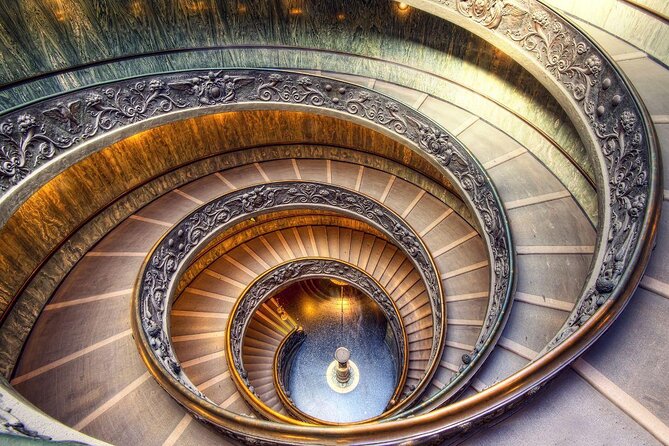
The Vatican Museums are vast, famous, and often crowded. A morning start does not make the complex quiet, but it gives you a useful head start before the main tide of visitors fills the halls.
You’ll meet at Via Vespasiano 28 in Rome at 7:30 am. The practical move is to arrive at least 10 minutes before that time for check-in. This is not the kind of appointment where you should cut things close. The entrance is timed, and arriving late could cost you access to the museum.
The tour is listed as about two hours, while the included guide service is described as 2.5 hours. Allow roughly two to two and a half hours for the experience, with the exact pace depending on the group and the time spent at each sight.
The meeting point is near public transportation, which helps if you are staying elsewhere in Rome. Hotel pickup and drop-off are not included, so you’ll need to make your own way to the Vatican area.
More Vatican Museums and Sistine Chapel entries:
- Vatican: Museums & Sistine Chapel Entrance Ticket
★ 4.5 · 144,003 reviews - Vatican Museums & Sistine Chapel Tour with Optional Basilica
★ 4.3 · 67,413 reviews - Vatican Museums, Sistine Chapel & St Peter’s Basilica Guided Tour
★ 4.5 · 39,149 reviews
The upper galleries: maps, woven wall hangings, and candleholders
Your first major section is the Vatican Museums’ upper galleries. This part of the visit gives you a sense of the scale of the collection before the tour narrows its focus to famous sculptures and paintings.
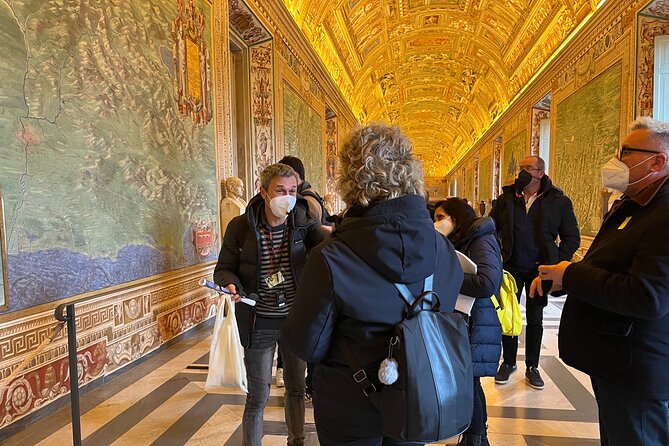
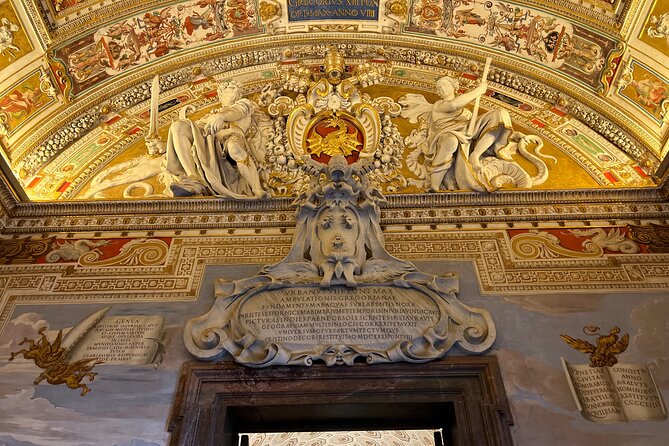
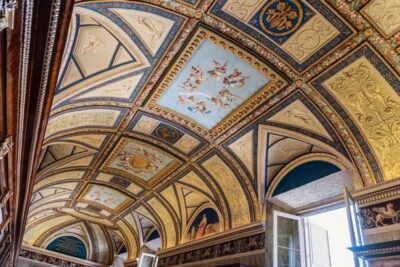
You’ll pass through the Gallery of Maps, the Gallery of Tapestries, and the Gallery of Candelabra. Rather than rushing straight toward Michelangelo, you begin with long ceremonial corridors filled with art overhead, along the walls, and beneath your feet.
The Gallery of Maps is especially useful for understanding how the Vatican presents art. The painted maps are not just decoration. They show how geography, power, religion, and artistic skill once came together in a single grand interior.
Look up as you walk. The ceilings can compete with the wall displays for your attention, and the floor itself may be covered with detailed mosaic work. The setting creates the pleasant problem of having too much to see at once.
That visual overload is part of the Vatican’s character, but it can also be tiring. You may find yourself looking at a ceiling fresco while missing a painting or sculpture beside you. This is where the guide and headset earn their keep. A guide can tell you where to focus instead of leaving you to process every surface on your own.
Classical sculpture in the Vatican Museums
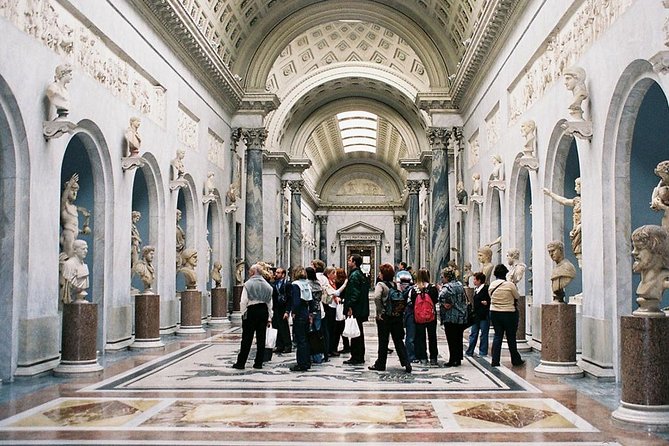
The next section includes the Apollo of Belvedere, the Laocoön, and Nero’s Bathtub. These objects give the tour a different mood from the painted galleries.
The Apollo of Belvedere is one of the Vatican’s best-known classical sculptures. The Laocoön group is another major highlight, showing a dramatic struggle in marble. Nero’s Bathtub adds a more unusual note, since it connects the museum’s monumental art with the daily world of ancient Roman luxury.
This part is valuable because it places the Vatican’s Christian collections beside the artistic ideals of the ancient Mediterranean. You are not simply moving from one famous room to another. You are seeing how the museum brings sculpture, architecture, religion, and Roman power into one route.
The stop is scheduled for about 30 minutes. That is enough time for an introduction to the major objects, but not enough for a long, technical lecture on every piece. If you already know classical art well, you may want more time. If you are visiting Rome for the first time, the focused pace helps keep the day from becoming a museum marathon.
Raphael’s Rooms and the art of papal ambition
Raphael’s Rooms receive about 40 minutes, the longest stop listed on the route. That makes sense. These rooms are among the Vatican’s most important painted interiors, and they reward a slower look.
Raphael and his workshop decorated these rooms for the papal apartments. The paintings combine religious subjects, philosophy, theology, and the image of papal authority. Your guide can help you connect the scenes rather than treating them as a string of pretty walls.
The most famous room is often associated with the School of Athens, where ancient philosophers appear in an idealized architectural setting. The point is not only to identify famous faces. The room shows how Renaissance artists and patrons used classical learning to support a broader vision of culture and faith.
This is one of the places where a guide adds real value. Without context, you might remember only the crowded composition and bright colors. With a clear explanation, you can notice the way figures are arranged, how gestures direct your eye, and how the room served the people who lived and worked in the papal residence.
The 40-minute stop also gives you a little breathing room. Still, do not expect to study every fresco at length. The Vatican is too large for that within a short guided visit.
More ways to visit the Vatican:
- Rome: Vatican Museums, Sistine Chapel & Basilica Tour
★ 4.3 · 13,872 reviews - Vatican Museums & Sistine Chapel Skip-the-Line Entry Ticket
★ 4.4 · 13,838 reviews - Rome: Vatican Museums, Sistine Chapel & Basilica Tour
★ 4.7 · 13,217 reviews - Skip-the-Line Group Tour of the Vatican, Sistine Chapel & St. Peter’s Basilica
★ 4.5 · 12,779 reviews
Michelangelo’s Sistine Chapel
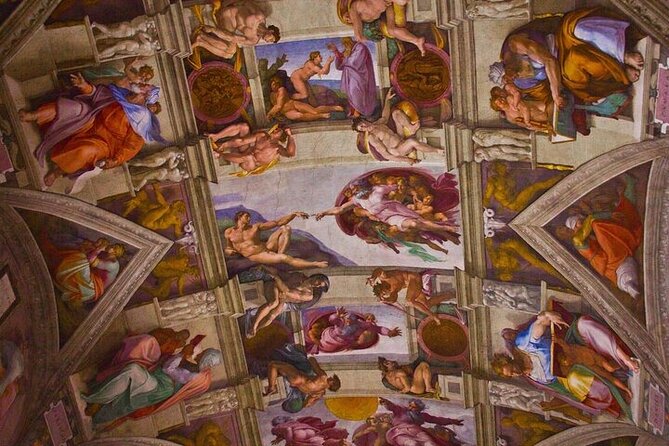
The final stop is the Sistine Chapel, scheduled for about 10 minutes. Here you’ll see Michelangelo’s ceiling frescoes and the Last Judgment on the altar wall, painted during the 1500s for the popes Julius II and Paul III.
The chapel is a place to slow your eyes, even if the visit itself is short. Look first at the ceiling, then at the large altar wall. The scenes are packed with figures, movement, and visual connections, so it helps to arrive with a basic idea of what you are seeing.
Silence rules apply inside the Sistine Chapel, and the guide’s commentary may be limited once you enter. The explanation you receive before entering is therefore important. Listen carefully in the galleries, then use your time in the chapel to look upward and take in the scale.
The Sistine Chapel is not a quiet private room during public visiting hours. Even with early entry, you may encounter many other people. The early start improves your odds, but it does not create an empty chapel.
The tour ends at the Sistine Chapel. St. Peter’s Basilica is not included, and you should not assume that this booking provides entry to the basilica or the dome. If the basilica is a priority, plan it as a separate part of your Rome schedule.
How the guide and headset shape the visit
A Vatican visit can be hard to follow without help. The rooms are large, the route is busy, and your attention is pulled in several directions at once.
A professional guide is included for roughly 2.5 hours, along with headsets. The headset lets you stay near the guide while still seeing the art, rather than crowding around one person and trying to hear over the room.
This is particularly useful in the galleries and sculpture rooms. You can pause briefly to look at a ceiling or mosaic, then continue listening. In a group of 20 or fewer, the tour should be easier to manage than a large coach-style group, though the Vatican itself may still feel crowded.
Claudia has led this route and has been praised for making the large museum easier to navigate. Guide assignments can vary, so you should not book on the assumption that she will lead your departure. The important point is that the tour depends heavily on the quality of the guide’s choices: what to explain, what to skip, and where to position the group.
Is $70.88 a fair price?
At $70.88 per person, this is not the cheapest way to enter the Vatican Museums. You are paying for more than admission. The price includes early skip-the-line access, a professional guide, and a headset, all in a group capped at 20 people.
That can be good value if you have limited time in Rome or prefer structure. The Vatican’s collections can easily overwhelm you, and a guided route helps you spend your time on major rooms instead of wandering without a plan.
The value is weaker if you prefer to move at your own speed, spend an hour with one painting, or avoid fixed schedules. A two-hour visit is a highlights tour, not a full examination of the museums. You will see important sections, but you will not cover everything the Vatican has to offer.
The early hour is also part of the price. If you are willing to arrive early and follow a set route, you gain a better shot at experiencing the galleries before the day reaches its busiest point. If you would rather sleep late and browse slowly, a self-guided visit may suit you better.
Clothing, identification, and physical demands
The Vatican enforces a dress code because the museums include places of worship. Men and women must cover their knees and shoulders, and shorts or sleeveless tops are not allowed. Dress for entry, not just for Rome’s weather. A refused entrance would erase the value of the ticket and the tour.
The activity requires a moderate level of physical fitness. You should be comfortable walking through large museum spaces and standing during explanations. The provided information does not specify wheelchair arrangements or a detailed route for mobility needs, so contact the provider before booking if this is important for you.
For children under 18, bring a current passport or ID document as proof of age on the day of the tour. This is a firm practical detail, not something to leave at the hotel.
There is also a refundable €10 deposit at the meeting point for the radio equipment. You receive it back after returning the radios. If a radio is not returned, the charge is €30 per unit, so keep track of the headset equipment during the visit.
Who should book this Vatican tour?
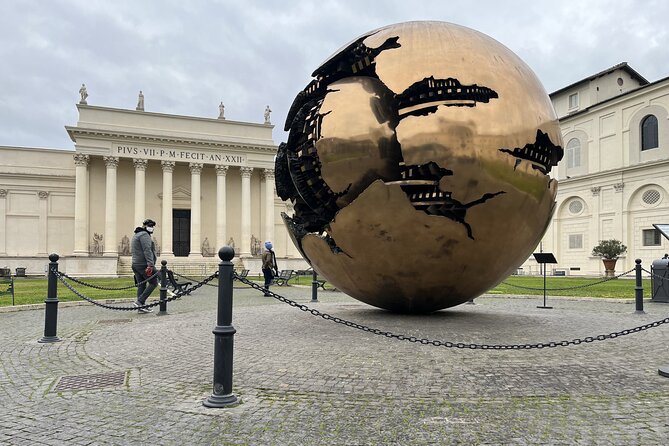
I would choose this tour if you are visiting Rome for the first time, have only a short window for the Vatican, or want help sorting the major sights from the endless details.
It also suits you if you value an early start and like having a guide explain the meaning behind the art. The headset is a small feature with a large practical benefit, especially when the rooms become noisy.
Families with older children may find the focused route easier than a long unstructured museum visit, provided everyone can meet the walking demands and follow the dress rules. The ID requirement for children under 18 is worth remembering.
I would think twice if you want St. Peter’s Basilica included, since it is not part of this experience. I would also hesitate if you dislike groups, fixed meeting times, or short visits with limited time for independent looking.
The 20-person maximum keeps the group reasonably contained, but it does not remove the crowds from the Vatican. You are buying a more organized entry, not a private museum.
Final recommendation
Book this tour if you want an early, guided introduction to the Vatican Museums with the major highlights arranged in a sensible order. The strongest reasons are the 7:30 am entry, the small group, the headset, and the chance to focus on Raphael’s Rooms and the Sistine Chapel without handling the route alone.
Skip it if your main goal is St. Peter’s Basilica, a relaxed full-day museum visit, or complete freedom to linger. For most first-time Rome visitors with limited time, the price is reasonable for the structure and early access, provided you arrive on time and dress correctly.
FAQ
What time does the tour start?
The tour starts at 7:30 am. You should arrive 10 minutes early for check-in.
Where is the meeting point?
The meeting point is Via Vespasiano, 28, 00192 Rome, Italy. The area is near public transportation.
How long does the tour last?
The experience is listed as approximately two hours, while the included professional guide service is described as 2.5 hours. Plan for roughly two to two and a half hours.
Is skip-the-line admission included?
Yes. Early skip-the-line access and admission tickets to the Vatican Museums and the listed stops are included.
Is St. Peter’s Basilica part of the tour?
No. St. Peter’s Basilica is not included. The tour ends at the Sistine Chapel.
What should I wear?
Your knees and shoulders must be covered. Shorts and sleeveless tops are not allowed for men or women because of the Vatican’s dress requirements.
Is there a deposit for the headset equipment?
Yes. You will be asked for a fully refundable €10 deposit at the meeting point. You receive it back when you return the radios. A missing radio incurs a €30 charge per unit.
More Museums in Rome
- Rome: Vatican Museums & Sistine Chapel Guided Tour
★ 4.3 · 12,117 reviews - Rome: Vatican Museums & Sistine Chapel Skip-The-Line Ticket
★ 4.2 · 11,708 reviews - Vatican Museums & Sistine Chapel Skip-the-Ticket-Line Tour
★ 4.3 · 10,486 reviews - Vatican Museums, Sistine Chapel & St Peter’s Basilica Tour
★ 4.6 · 10,222 reviews
Newest reviews from Rome
- ROME:Colosseum & Ancient Rome – private/small group TOUR★ 5.0 · 24 reviews
- Off the Beaten Track in Rome: Rione VI Parione Private Tour★ 5.0 · 24 reviews
- Cinematic Photoshoot in Rome★ 5.0 · 24 reviews
- Rome: Best of Colosseum and Roman Forum Small Group Guided Tour★ 4.5 · 24 reviews
- The Labyrinth of Rome between catacombs and ancient quarries★ 4.5 · 24 reviews
- Vatican and Trionfale Market Tour with Wine and Food Tasting★ 5.0 · 24 reviews
- private tour: Vatican Museums, Sistine Chapel, St. Peter’s Basilica★ 4.5 · 24 reviews
- Skip the Line: Vatican Wheelchair Accessible Private Tour★ 5.0 · 24 reviews
Vatican Museums & Sistine Chapel, compared.
Vatican Museums & Sistine Chapel Tour with Optional Basilica
Read our review →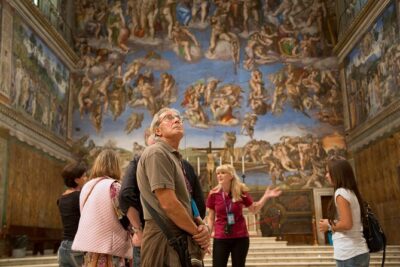
Vatican Museums, Sistine Chapel & St Peter’s Basilica Guided Tour
Read our review →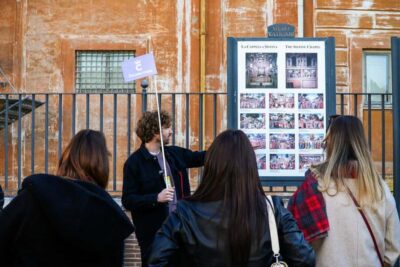
Vatican Museums, Sistine Chapel & Basilica Tour
Read our review →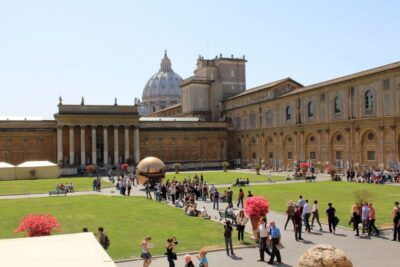
Vatican Museums & Sistine Chapel Skip-the-Line Entry Ticket
Read our review →Vatican Museums, Sistine Chapel & Basilica Tour
Read our review →
Skip-the-Line Group Tour of the Vatican, Sistine Chapel & St. Peter’s Basilica
Read our review →