
Reviewed · ROME
Taste of Testaccio: Special 15 Year Anniversary Edition
The most delicious surprise in Rome may be a neighborhood that many visitors never reach. Testaccio gives you old markets, family-run food shops, Roman street snacks, and three classic pastas without the crowds around the Colosseum. This 3.5-hour walk also adds an ancient pyramid and a cemetery linked to John Keats.
I like the hands-on market stop, where you make bruschetta from fresh local ingredients, and I like the way the meal builds from small bites to carbonara, amatriciana, cacio e pepe, and gelato. Guides such as Luca, Katherine, Francesca, Giuseppe, and Valter have earned warm praise for making the tour relaxed and personal. The main drawback is simple: at $131.81, this is not a cheap food walk, and the exact stops and tastings can change.
In This Review
- Key points at a glance
- Why Testaccio makes a better food setting than central Rome
- Starting at Volpetti with cheese, cured meat, and Prosecco
- The Pyramid of Cestius and Rome’s Protestant Cemetery
- Making bruschetta inside Testaccio Market
- Trapizzino and Testaccio’s working-class food tradition
- Monte Testaccio, a hill made from oil jars
- Three Roman pastas at Flavio al Velavevodetto
- Finishing with old-school gelato at Giolitti
- Is $131.81 a fair price?
- Guides make the difference
- Practical details before you book
- Who should book Taste of Testaccio
- Should you book it?
- FAQ
- Where does the Taste of Testaccio tour start?
- Where does the tour end?
- How long does the tour last?
- What food is included?
- Do I make the bruschetta myself?
- Which Roman pastas do I taste?
- Is the tour offered in English?
- Can children join the experience?
- Can dietary requirements be accommodated?
- How many people can join the tour?
Key points at a glance
- Three Roman pastas in one sitting: Taste carbonara, amatriciana, and cacio e pepe with local wine at Flavio al Velavevodetto.
- A real market activity: Make your own tomato bruschetta with ingredients bought from Testaccio vendors.
- Food and archaeology together: See the Pyramid of Cestius, the Protestant Cemetery, the old slaughterhouse, and Monte Testaccio.
- A small group of up to 12: The size leaves room for conversation and easier contact with your guide.
- A full meal, not just a nibble: Cured meats, cheeses, buffalo mozzarella, supplì, trapizzino, pasta, pastry, espresso, and gelato may all appear.
- Useful Rome food advice: Learn how to recognize authentic artisan gelato and get practical Food & the City tips.
Why Testaccio makes a better food setting than central Rome
Testaccio sits south of Rome’s busiest sightseeing zone. Its identity grew around food, work, trade, and the former city slaughterhouse, rather than grand imperial monuments alone. That gives the walk a different feel from a standard Rome highlights tour.
You still get history, but it arrives between bites. One moment you may be tasting cheese at Salumeria Volpetti. The next, you are hearing how discarded Roman oil jars became a hill or why Testaccio developed a strong tradition of quinto quarto, the cooking of offal and other less prized cuts.
I find this combination especially useful early in a Rome visit. You get a neighborhood orientation, a substantial meal, and a list of foods to order later. The tour ends only a couple of blocks from where it begins, so you can stay in Testaccio for a drink, return to the market, or use the nearby public transport connections.
The group is capped at 12 people. That is large enough to keep the price below a private tour, but small enough for a guide to answer questions and help at the market. Some departures may be much smaller. One group had only two people, which made the walk feel like a casual meal with a local guide.
Tours travellers often pair with this one in Rome:
- Vatican: Museums & Sistine Chapel Entrance Ticket
★ 4.5 · 144,003 reviews - Vatican Museums & Sistine Chapel Tour with Optional Basilica
★ 4.3 · 67,413 reviews - Vatican Museums, Sistine Chapel & St Peter’s Basilica Guided Tour
★ 4.5 · 39,149 reviews
Starting at Volpetti with cheese, cured meat, and Prosecco
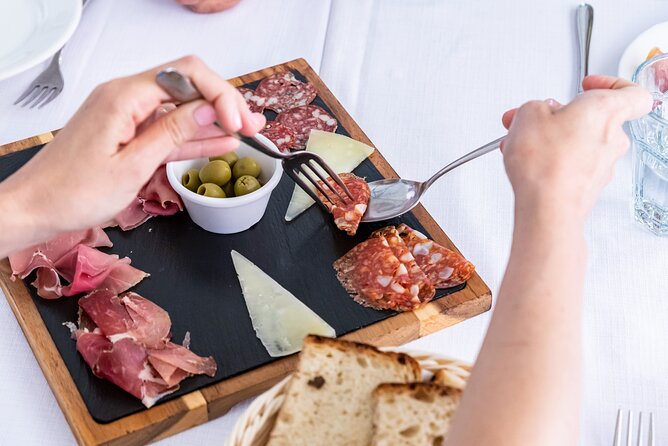
The meeting point is Piazza Testaccio, 39. From there, the route commonly begins at Salumeria Volpetti, one of Testaccio’s best-known food shops. You can expect a spread of Italian cured meats and artisanal cheeses, along with olive oil and balsamic vinegar.
This opening works well because it introduces the building blocks of Italian food before the larger meal arrives. You taste several products side by side and get a basic sense of how salt, fat, acidity, and sweetness work together. A glass of crisp Prosecco is included for the anniversary edition.
Volpetti is also a useful place to remember for later. The shop carries around 150 cheeses, so it is more than a quick tasting counter. If you want to bring something home, ask your guide about transport and packing options, though extra purchases are your responsibility.
The advertised sample menu also includes Italian charcuterie, DOCG wine, espresso, and a typical pastry. Do not expect every item to appear in exactly the same form. Food selections depend on the day and season, but the tour is designed around a broad run of Roman and Italian tastes.
The Pyramid of Cestius and Rome’s Protestant Cemetery
Testaccio’s food story is broken up with one of Rome’s oddest monuments, the Pyramid of Cestius. This authentic Egyptian-style pyramid is about 2,000 years old and sits in the middle of the city, close to the neighborhood’s southern edge.
You do not visit it as a full interior tour. The stop lasts about 15 minutes, giving you time to see the structure and hear why an Egyptian-style tomb appears in ancient Rome. It is a good reminder that Rome absorbed ideas, styles, and goods from far beyond Italy.
The nearby Protestant Cemetery adds another layer. John Keats is buried there, and the grounds offer a quiet pause from the streets. The walk does not turn into a long literary or architectural lecture, but the cemetery helps connect Testaccio with Rome’s later international life.
This portion is also a practical reason to wear comfortable shoes. The tour lasts around three and a half hours and includes walking between food stops. The route is not presented as a strenuous hike, but you will be on your feet and outdoors for part of it.
Making bruschetta inside Testaccio Market
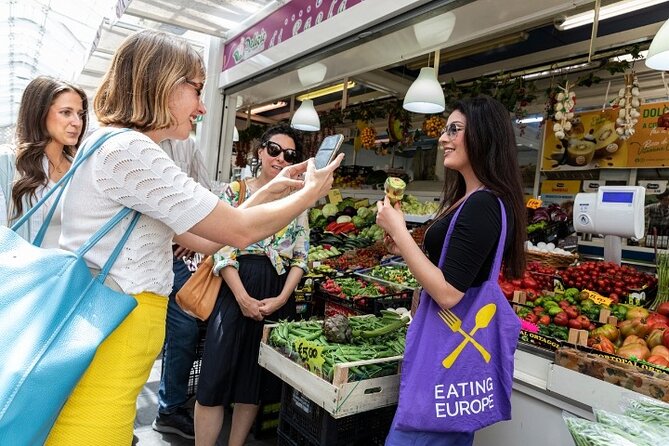
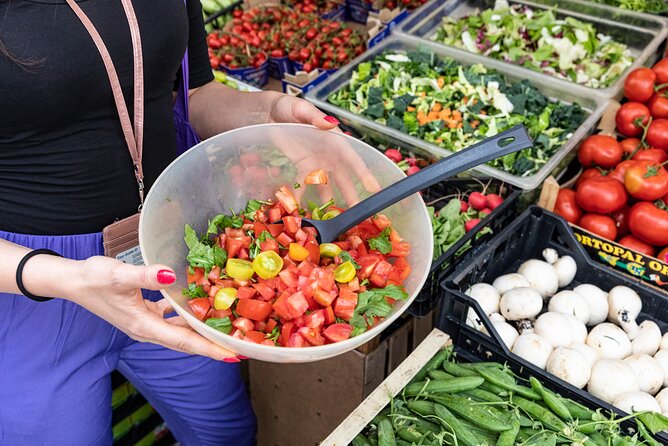
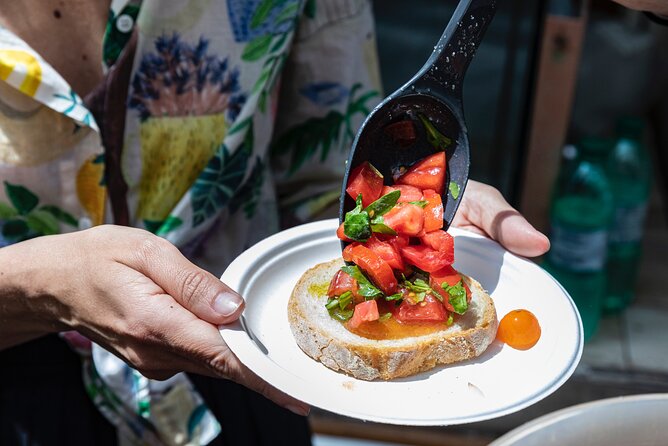
Testaccio Market is the heart of the walk for many people. Instead of simply watching vendors work, you make your own bruschetta using fresh tomatoes and other ingredients gathered from market stalls.
That small task adds real value. You learn what the guide considers good bread, ripe tomatoes, garlic, cheese, and olive oil, then taste the result immediately. One particularly useful detail is that the guide may have a market vendor assemble or finish the bruschetta for the group, turning a basic snack into a shared local ritual.
The market also introduces you to the everyday side of Roman food shopping. You can look at produce, speak with vendors, and see how the quality of simple ingredients drives the cooking. The buffalo mozzarella in the caprese salad is another highlight, especially when paired with fresh tomatoes.
The market tasting can include:
- Fresh tomato bruschetta
- Buffalo mozzarella in a caprese salad
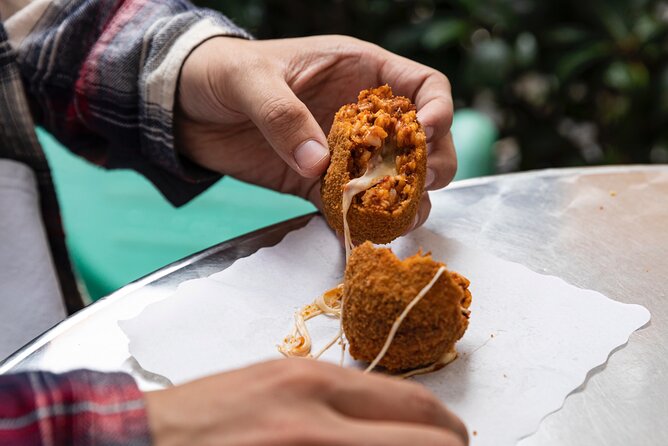
- Supplì, Rome’s fried rice ball
- Other classic fried street food
Supplì is Rome’s answer to the question of what to do with rice, tomato sauce, and cheese. The outside is fried, while the inside is soft and savory. It is related to arancini, but you are tasting the Roman version here.
The market is indoors, which helps on a hot day. Even so, the route includes outdoor walking, and Rome can be very hot in summer. Bring water and do not arrive after skipping all food for the day. You will eat a lot.
A completely different way to spend the day in Rome:
- Rome: Colosseum, Palatine Hill and Roman Forum Guided Tour
★ 4.8 · 32,814 reviews - Rome: Guided Tour of Colosseum, Roman Forum & Palatine Hill
★ 4.7 · 27,897 reviews - Rome: Colosseum & Forum with Audio Guide App -Optional Arena
★ 4.2 · 24,770 reviews - Rome: Colosseum, Roman Forum and Palatine Hill Guided Tour
★ 4.5 · 23,903 reviews
Trapizzino and Testaccio’s working-class food tradition
A stop at Trappizino introduces trapizzino, a triangular pocket of pizza bianca filled with saucy Roman-style dishes. The sample menu lists hunter-style chicken, though fillings and locations can vary.
Trapizzino is a good example of the tour’s approach. It is portable street food, but it carries the flavors of home cooking. You get something casual and filling before sitting down to the more formal pasta tasting.
The route also passes the former slaughterhouse complex. This is where Testaccio’s food culture becomes easier to understand. The slaughterhouse helped shape the local economy, and workers received or purchased cuts that wealthier households often avoided. Those ingredients became the basis for quinto quarto cooking.
Your guide may explain how dishes made from offal, tail, tripe, and other secondary cuts became important Roman specialties. You are not required to like every traditional dish, and the tour does not promise that every tasting will focus on offal. The point is to understand why Roman cooking includes strong, direct flavors and makes careful use of the whole animal.
Monte Testaccio, a hill made from oil jars
Monte Testaccio looks like a natural hill, but it was built from broken fragments of millions of ancient Roman amphorae. These large jars carried olive oil into Rome. Once emptied, many were discarded in the same area, forming a mound over time.
It is a wonderfully practical piece of ancient history. Instead of another marble monument, you are looking at the remains of the empire’s food supply system. Rome needed enormous quantities of oil for cooking, lighting, trade, and daily life, and the hill records that demand in pottery shards.
The stop also ties directly to the neighborhood’s modern identity. Testaccio did not grow randomly. Its location, storage areas, slaughterhouse, market, and working population all helped make food central to local life.
The walk may not include a full archaeological visit inside Monte Testaccio. You should think of it as a short interpretive stop along the route, not a separate museum tour. That keeps the pace moving toward lunch.
Three Roman pastas at Flavio al Velavevodetto
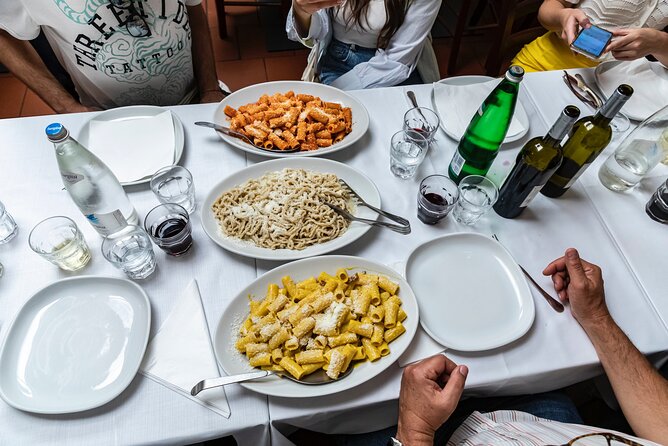
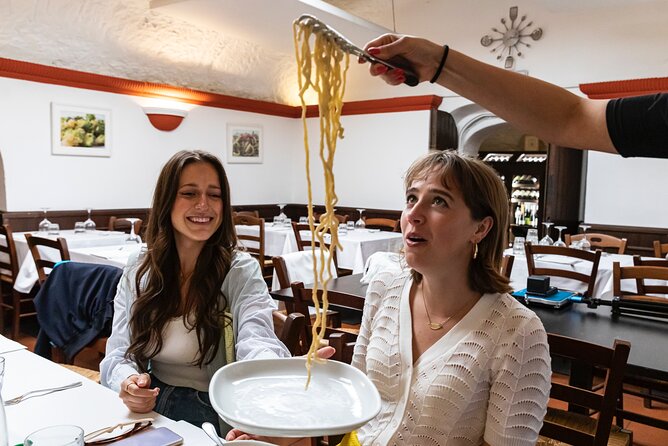
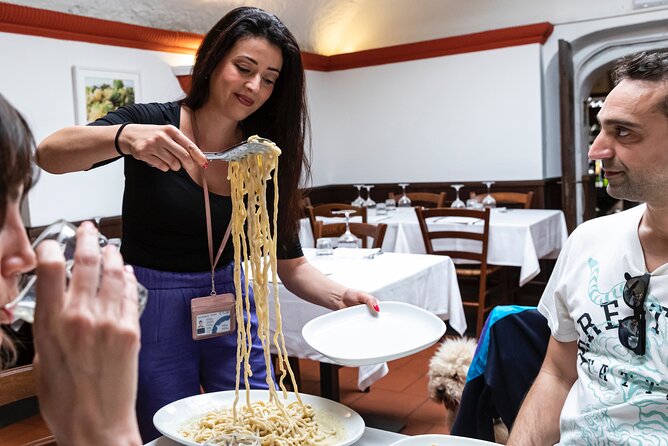
The sit-down meal is the tour’s main event. At Flavio al Velavevodetto, you taste three famous Roman pastas: carbonara, amatriciana, and cacio e pepe, usually paired with local wine.
These dishes are simple on paper and easy to get wrong. Carbonara should be creamy without relying on cream. Amatriciana combines tomato with cured pork and a firm savory edge. Cacio e pepe depends on cheese, pepper, pasta water, and timing. Tasting all three in one meal lets you compare how a small set of ingredients creates very different results.
I like that the guide explains the sauces while you eat. This is more useful than hearing a long food lecture before lunch, because you can connect the explanation with what is on your plate.
The restaurant setting also gives you a break from walking. A review of the route described this as a cool, comfortable part of a hot-day tour, and that matters in Rome. You can slow down, eat properly, and ask questions without trying to keep up with a moving group.
The meal may be too much if you expect a light tasting tour. Cured meats, cheese, bruschetta, caprese, fried food, trapizzino, three pastas, wine, pastry, and gelato add up. Come hungry, but not so hungry that you rush through the early food stops.
Finishing with old-school gelato at Giolitti
The final food stop is Giolitti Caffe and Gelateria, described as a 105-year-old neighborhood gelateria. It is a fitting ending because gelato gives the walk a cool, sweet finish after several savory courses.
The useful lesson here is how to spot real artisan gelato rather than judging only by bright colors or towering displays. Your guide explains what to look for, including the difference between natural-looking flavors and artificial presentation.
You can sample the gelato and note which flavors appeal to you. Save room for it. Several routes end with gelato, and it is one of the easiest parts of the experience to repeat later on your own.
The stated stop lasts about 25 minutes. That is enough time for a tasting and a short explanation, though not a full tour of the gelateria’s history. The end point is Via Amerigo Vespucci, 35, only a couple of blocks from the starting area.
Is $131.81 a fair price?
At $131.81 per person, this tour costs more than buying a supplì, pasta lunch, and gelato independently. You are paying for the guide, the planning, the introductions to vendors, multiple tastings, restaurant food, and the convenience of combining Testaccio’s food and history in one route.
The value improves if you would otherwise book a separate food tour and neighborhood walk. The included food is substantial, and the meal alone covers much more than a few sample bites. Wine, beer, Prosecco, espresso, and food are included in the planned tastings, though extra drinks and gratuities are not.
The price makes less sense if you are a very light eater, have severe food allergies, or prefer choosing every dish yourself. It is also not the best fit if your main goal is to enter archaeological sites. The pyramid, cemetery, slaughterhouse area, and amphora hill are viewed as parts of a walking route.
Group discounts are available, and the maximum group size is 12. The tour is offered in English with a local English-speaking guide. It is typically booked well ahead, with an average lead time of about 62 days, so popular dates may disappear early.
Guides make the difference
The strongest part of this experience is the guide’s role. Names connected with particularly well-received departures include Luca, Katherine, Francesca, Giuseppe, Valter, Gabriele, Giorgia, Amin, Valeria, Rishad, Fabio, and Gianluca.
You should not assume you will receive a particular guide unless the booking confirms it. Still, the pattern is clear: the guide is expected to explain Roman food, keep the group comfortable, and maintain good relationships with the local vendors.
A good guide also controls the pace. One departure with Giuseppe became a relaxed conversation because the group was tiny. Other guides, including Luca and Katherine, were praised for balancing food information with local history rather than turning the walk into a formal classroom.
The Food & the City insider tips are worth using. Ask about ordering pasta, identifying gelato, choosing market products, and finding local food after the tour. Write down recommendations while they are fresh, since Rome has no shortage of places that look appealing but are aimed mainly at passing sightseers.
Practical details before you book
Meet at Piazza Testaccio, 39, in Rome. The walk ends at Via Amerigo Vespucci, 35. Hotel pickup and drop-off are not included, so allow time to reach the piazza and arrive early.
The tour requires at least two participants. If that minimum is not met, the operator will contact you about another date, another experience, or a refund. The group can include no more than 12 people.
Most people can participate, and service animals are allowed. Children under four do not need a ticket, but children aged three and under do not receive the food tastings. Paid tickets with food are available from age four.
Dietary needs should be noted at booking or sent by email. Vegetarian and gluten-free requests may be accommodated when possible. The experience is not suitable for severe or life-threatening allergies to ingredients used on the tour, and the operator does not accept responsibility for food allergies or intolerances.
The itinerary is not rigid. Tastings and stops can change with the season or the day. That is normal for a market-based food walk, but you should book it for the overall style and quantity of food, not one guaranteed pastry or vendor.
Free cancellation is available if you cancel at least 24 hours before the local start time. Changes or cancellations inside that window are not refunded.
Who should book Taste of Testaccio
I would choose this tour if you want to eat your way through a real Roman neighborhood and prefer local context to a checklist of central monuments. It is especially good for first-time visitors who want help with Roman food, as well as repeat visitors who have already seen the major sights.
It suits curious eaters, couples, families with older children, and solo visitors who like the easy social rhythm of a small group. The food portions make it useful as a late-morning or midday activity, but plan the rest of your day around a full stomach.
I would think twice if you have serious food allergies, strict dietary limits, limited mobility, or little interest in pasta and traditional Roman food. I would also skip it if you want a private tour or a long, in-depth visit inside the pyramid, cemetery, or archaeological sites.
Should you book it?
Yes, if you want a generous food tour with history woven into the route. Testaccio feels like a smart choice for eating beyond central Rome, and the market, pasta meal, and gelato lesson give you plenty to remember and repeat.
Book it early if your dates are fixed, and tell the operator about dietary needs before you go. Expect the menu to shift, arrive hungry, wear comfortable shoes, and budget for a tip and any extra drinks. At $131.81, it is a splurge, but a worthwhile one for someone who wants a guided introduction to Rome’s food culture rather than a few isolated snacks.
FAQ
Where does the Taste of Testaccio tour start?
The tour starts at Piazza Testaccio, 39, 00153 Roma RM, Italy.
Where does the tour end?
It ends at Via Amerigo Vespucci, 35, 00153 Roma RM, Italy, a couple of blocks from the starting point.
How long does the tour last?
The experience lasts approximately 3 hours and 30 minutes.
What food is included?
The planned tastings can include cured meats, Italian cheeses, olive oil, balsamic vinegar, Prosecco, fresh tomato bruschetta, buffalo mozzarella, caprese salad, supplì, trapizzino, three Roman pastas, local wine, espresso, pastry, and gelato.
Do I make the bruschetta myself?
Yes. At Testaccio Market, you make your own bruschetta with fresh tomatoes and ingredients sourced from local vendors.
Which Roman pastas do I taste?
The pasta tasting includes carbonara, amatriciana, and cacio e pepe at Flavio al Velavevodetto.
Is the tour offered in English?
Yes. A local English-speaking guide leads the tour.
Can children join the experience?
Children under four can join without a ticket, but food is not included for children aged three and under. Paid tickets with food are available for children aged four and up.
Can dietary requirements be accommodated?
Vegetarian, gluten-free, and other dietary requests may be accommodated when possible if you notify the operator by email or add a note when booking. The experience is not suitable for severe or life-threatening food allergies.
How many people can join the tour?
The group has a maximum of 12 people, and at least two participants are required for the tour to operate.
Newest reviews from Rome
- Rome: Vatican Museums & Sistine Chapel Skip-the-Line Ticket★ 4.4 · 148 reviews
- Shared Shuttle Transfer from Rome to Civitavecchia Port★ 5.0 · 148 reviews
- Skip the Line: Vatican and Sistine Chapel with Guided Tour★ 4.0 · 149 reviews
- Rome: Crypts & Catacombs After Hours Tour with Bone Chapel★ 4.6 · 149 reviews
- Ghosts Legends and Mysteries of Rome Walking Tour★ 5.0 · 149 reviews
- Tivoli: Villa Gregoriana Entrance Ticket★ 4.7 · 150 reviews
- Pizza and Tiramisu Cooking Class in Rome, Piazza Navona★ 5.0 · 150 reviews
- Rome: Borghese Gallery Skip-the-Line Entry and Guided Tour★ 4.7 · 150 reviews