
Reviewed · TIVOLI DAY TRIPS
Tivoli Day Tour from Rome : Hadrian’s Villa and Villa D’Este
Hadrian’s Villa and Villa d’Este offer two very different escapes from Rome: one is a vast imperial retreat of broken temples and baths, the other a Renaissance pleasure garden built around water. That contrast is the real appeal of this Tivoli day trip.
I like the easy bus ride from central Rome and the fact that admission, a guide, and lunch are bundled into the price. I also like the chance to see Villa d’Este properly, since its fountains, waterfalls, and long garden paths are easy to rush past on your own.
The main caution is physical: this is a walking-heavy day with stairs, uneven ground, and an expansive garden. The set-menu lunch can also take longer than some people want, and guide quality may vary by departure.
In This Review
- Key points at a glance
- Why Tivoli makes a smart day away from Rome
- Hadrian’s Villa: an emperor’s enormous country retreat
- Villa d’Este: fountains, stairs, and Renaissance spectacle
- Guides can shape the entire day
- Is the $179.58 price fair?
- Who should book this Tivoli day trip?
- Practical advice for making the day better
- Should you book it?
- FAQ
- Where does the Tivoli tour begin?
- Where does the tour end?
- How long does the tour last?
- Is hotel pickup included?
- What transportation is used?
- What sites are included?
- Is lunch included?
- How much walking is involved?
- What happens if the tour does not reach its minimum group size?
Key points at a glance
- Two villas, two eras: Compare Hadrian’s second-century Roman palace with Cardinal d’Este’s late Renaissance retreat.
- A proper break from Rome: The drive to Tivoli takes roughly 40 to 45 minutes, putting countryside and open views between you and the capital.
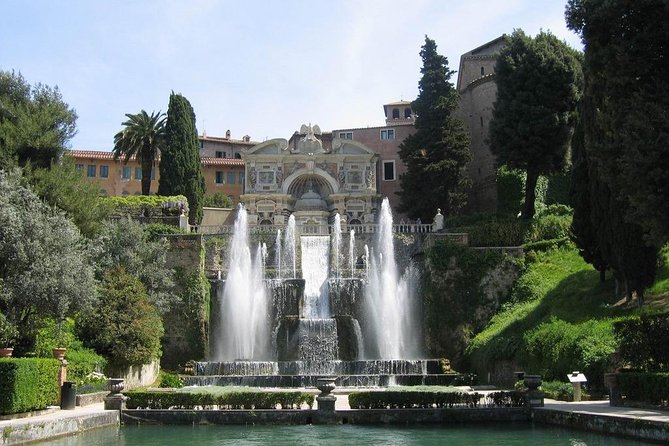
- Villa d’Este is the visual star: Allow your attention to follow the water downhill through fountains, pools, and waterfalls.
- Lunch is included: You receive a set menu at a local Tivoli restaurant, with wine included on some departures.
- Small or medium group format: The vehicle may be a coach or minivan, with groups capped at 25 people.
- Plan for steady walking: Hadrian’s Villa takes about two and a half hours, and Villa d’Este adds more paths and stairs.
Why Tivoli makes a smart day away from Rome
Rome can fill every hour with famous churches, crowded squares, and ancient streets. Tivoli gives you a change of pace without requiring a long journey. The town has been a retreat for wealthy Romans, emperors, cardinals, and popes for more than 2,000 years, and the two villas show why.
The trip begins at 10 a.m. at Via Marsala, 82, near Rome’s central transport area. You meet the guide there, board an air-conditioned bus or minivan, and ride toward Tivoli. Hotel pickup is not included, so you need to reach the meeting point yourself.
The ride takes about 40 to 45 minutes, depending on traffic. That is long enough to leave the city behind, but short enough that the day does not feel dominated by transportation. The tour lasts about seven hours and returns to the original meeting point.
I consider the transport a useful part of the package. Hadrian’s Villa and Villa d’Este are close to each other but outside Rome, and arranging both sites independently can mean managing regional transport, entrance tickets, and timing. The tradeoff is a fixed schedule, so you give up the freedom to linger or leave early.
More Tivoli day trips:
- From Rome: Villa D’Este and Hadrian’s Villa Tivoli Day Tour
★ 4.5 · 2,060 reviews - Tivoli Full Day Trip from Rome: Hadrian’s Villa and Villa D’Este
★ 4.5 · 1,730 reviews - Hadrian’s Villa and Villa d’Este Half-Day Trip from Rome
★ 3.5 · 808 reviews
Hadrian’s Villa: an emperor’s enormous country retreat
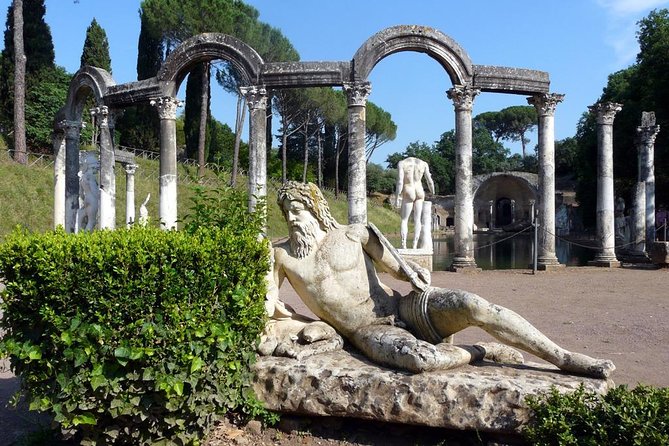
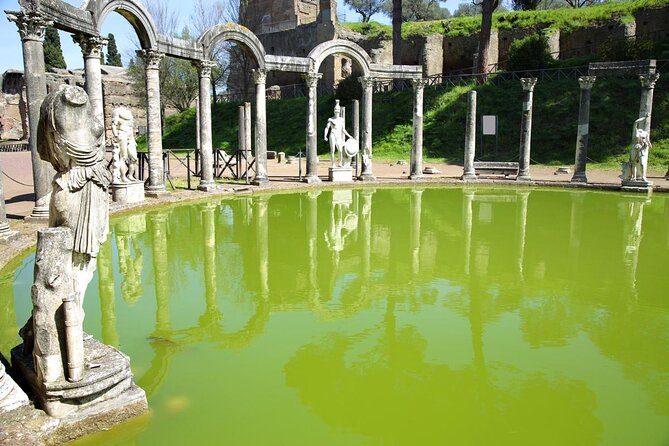
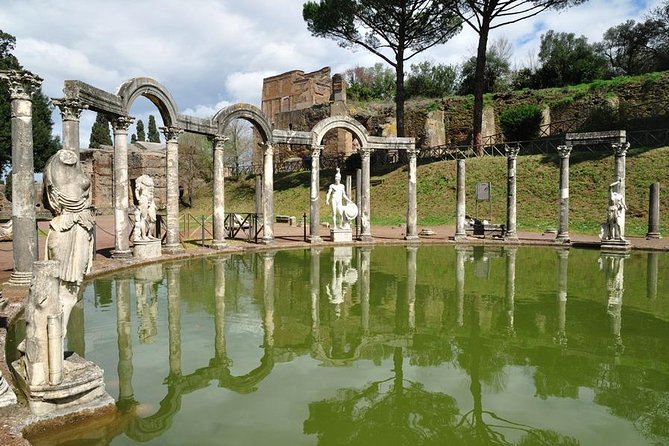
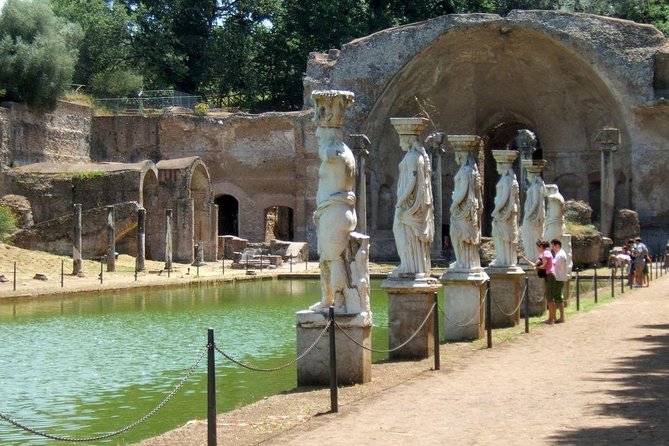
The first stop is Villa Adriana, commonly called Hadrian’s Villa. Emperor Hadrian used the complex as a summer residence and officially moved there in AD 128. This was not a simple country house. It was a sprawling imperial estate with temples, theaters, pools, thermal baths, steam rooms, statues, and formal spaces for receiving important people.
A guide helps you make sense of the ruins. On your own, the site can look like a series of elegant but disconnected walls. With historical explanation, the scale becomes clearer. You begin to picture a working palace complex, where political business, leisure, bathing, worship, and ceremony all took place within one grand estate.
The guided visit lasts about two hours and 30 minutes. That is enough time to see the main areas, though not enough to inspect every corner of the archaeological site. Hadrian’s Villa is extensive, so you should not expect a slow, scholarly examination of every building.
The setting is part of the pleasure. You get broad views across the surrounding countryside, plus plenty of space for photographs. The ruins are less polished than Rome’s best-preserved monuments, but that raw quality is exactly what makes the visit rewarding. Columns, statues, and fragments show the ambition of the complex, while the missing sections make you use your imagination.
One practical point matters here: get an orientation map if one is available. It can help you understand the layout of the site, especially because the villa is so large. A few people have found that a quick introduction to the map would have made the first part of the visit easier to follow.
The ground is uneven, and you will be walking for a substantial stretch. Wear shoes with good support. The tour requires a moderate level of fitness, and this is not the place for anyone hoping to spend the morning seated.
Villa d’Este: fountains, stairs, and Renaissance spectacle
After Hadrian’s Villa, the group goes to Villa d’Este in Tivoli. Lunch comes first at a local restaurant, followed by the walk through the villa and gardens. The meal is served as a set menu, and it is described as hearty and generous. Wine is included on some departures, though you should not assume every menu will be identical.
Lunch provides a welcome pause between the two sites. It also gives you a taste of the town rather than keeping you inside the tour vehicle. Still, the meal may feel lengthy if you would rather spend every available minute in the gardens. If your priority is photography or garden design, the lunch stop is the part of the schedule most likely to test your patience.
Villa d’Este began as a Benedictine convent before Cardinal Ippolito II d’Este transformed it into a Renaissance palace. He was the son of Lucrezia Borgia, and the villa reflects the ambition and display expected from a powerful Renaissance churchman.
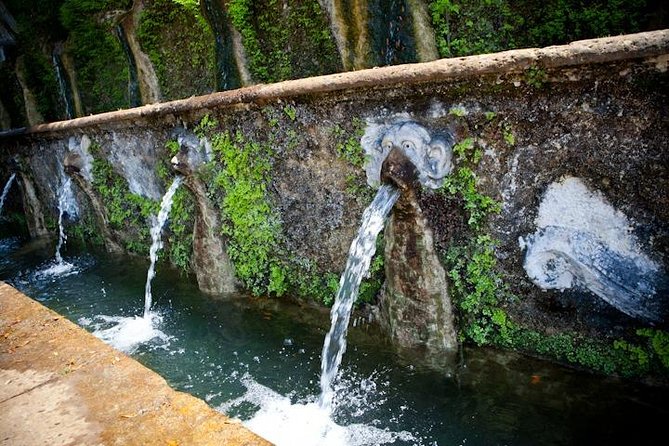
The palace itself receives a shorter visit than the gardens. That is sensible. The interiors matter, but the main event is outside, where water moves through the property in a carefully planned sequence of fountains, pools, channels, and waterfalls.
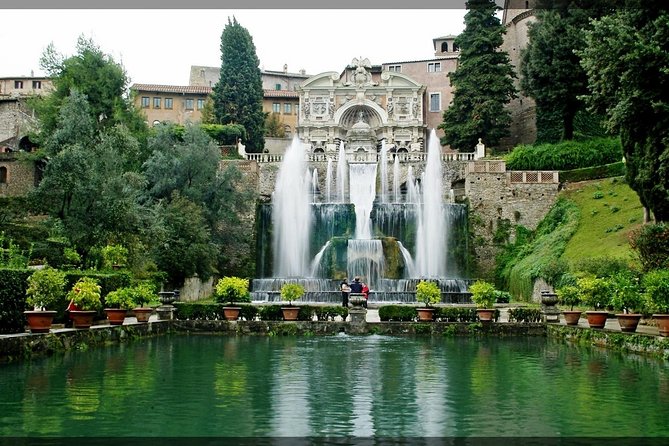
The famed Fountain of Neptune is one of the major sights, but do not stop there. The gardens extend well beyond the first impressive viewpoint. Walk as far as the schedule allows, because the lower sections reveal more water features and shaded paths. You can easily see the most photographed fountain and still miss much of what makes Villa d’Este special.
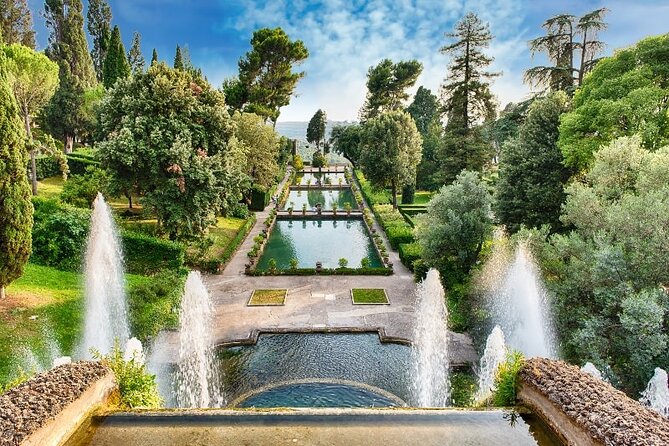
The gardens are manicured rather than wild, with Renaissance design controlling the views and water flow. You will encounter stairs and sloping paths, so the visit is not a flat stroll. One useful feature is that someone who cannot manage the full walk may be able to wait on the exterior patio overlooking the gardens while the rest of the group continues.
For many people, Villa d’Este becomes the favorite stop. Its fountains provide motion and sound after the stillness of the Roman ruins, and the garden scale gives the afternoon a satisfying finish. Spring can be especially attractive, with fresh growth adding color to the formal design.
Guides can shape the entire day
The sites are strong enough to justify a visit on their own, but the guide determines how much you take away. Guides named Carolina, Diana, Pamela, Joanna, and Maria Teresa have led departures, and Maria Teresa has been described as a local Tivoli guide with family roots in the area and training in history and archaeology.
That kind of local connection can add meaning to the gardens and the town. A good guide does more than identify a temple or fountain. The guide explains why an emperor chose Tivoli, how the villas were used, and what the water system meant to Renaissance power and display.
The audio headsets provided when needed are helpful in larger groups or when you are standing several paces away from the guide. The maximum group size is 25, so this is not a private tour. It can feel intimate in a small minivan, while a full group may make questions and conversation less easy.
Guide quality is not perfectly predictable. Some departures have been praised for a friendly, well-paced explanation, while others have felt casual or loosely organized. That is an important point at this price. You are paying partly for interpretation, not only for a ride and two entrance tickets.
The best guides on this route make the contrast between the villas clear. Hadrian’s Villa is about imperial scale and Roman engineering. Villa d’Este is about Renaissance ambition, garden planning, and water as theater. If the guide connects those themes, the day feels like one coherent story rather than two unrelated stops.
A completely different way to spend the day in Rome:
- Vatican: Museums & Sistine Chapel Entrance Ticket
★ 4.5 · 144,003 reviews - Vatican Museums & Sistine Chapel Tour with Optional Basilica
★ 4.3 · 67,413 reviews - Vatican Museums, Sistine Chapel & St Peter’s Basilica Guided Tour
★ 4.5 · 39,149 reviews - Rome: Colosseum, Palatine Hill and Roman Forum Guided Tour
★ 4.8 · 32,814 reviews
Is the $179.58 price fair?
At $179.58 per person, this is not a bargain-priced outing. It is also not an unreasonable price for a guided seven-hour excursion that includes transport, entrance fees, a set-menu lunch, and interpretation at two major sites.
The value depends on how you normally travel. If you are comfortable arranging regional transportation and buying tickets yourself, you may prefer a self-guided day and keep more control over the schedule. If you want the simplest way to fit both villas into one day, the package has a practical advantage.
Lunch adds value, especially because it removes the need to search for a restaurant between sites. The air-conditioned vehicle also matters in warm weather, after several hours on foot. You are paying for convenience, coordination, and the chance to focus on the places instead of the mechanics of reaching them.
I would be more cautious if your main reason for booking is a private or highly detailed archaeological tour. The group can reach 25 people, and some guides may provide a stronger interpretation than others. For a small-group experience, check the departure details carefully, since some outings use a smaller minivan.
The tour is often booked well ahead, with an average booking lead time of about 81 days. That suggests you should not leave it until the last moment if Tivoli is important to your Rome plans. At the same time, the experience requires at least six participants, so a departure can be canceled if that minimum is not met.
The booking is non-refundable and cannot be changed for personal reasons. If the operator cancels because the minimum group size is not reached, you are offered another date or experience, or a full refund. That makes travel insurance and a little schedule flexibility sensible, especially if your Rome visit is short.
Who should book this Tivoli day trip?
I would recommend it to first-time visitors who want one easy day outside Rome, history lovers who enjoy guided context, and anyone who wants to see both villas without organizing separate transportation. It also suits repeat visitors who have already covered Rome’s central monuments and want a quieter cultural outing.
Families with older children may find the two-site format engaging, especially if the children enjoy ruins, fountains, and open spaces. The seven-hour duration is manageable, but the walking and stairs may be tiring for younger children or anyone with limited mobility.
Garden lovers should give this tour serious consideration. Villa d’Este rewards patience, and the water features are far more impressive when you walk beyond the first viewpoint. People interested mainly in palace interiors may find the visit less satisfying, since the garden receives more attention than the rooms.
You should think twice if you dislike fixed meal times or group schedules. The set lunch is part of the plan, and you cannot simply skip ahead to the fountains. Likewise, anyone seeking a slow day with long independent stops may prefer to visit independently.
Practical advice for making the day better
Meet at Via Marsala, 82, and allow enough time to find the exact departure point. The tour does not collect you from your hotel, so this first leg is your responsibility.
Wear comfortable walking shoes. Hadrian’s Villa has uneven archaeological ground, while Villa d’Este adds slopes and stairs. Bring water, especially in warm weather, and keep your camera ready for the countryside views, ruins, fountains, and long garden perspectives.
At Hadrian’s Villa, pay attention to the guide’s explanation before moving too quickly toward the most photogenic ruins. The complex is large, and its meaning comes from understanding how the spaces connected.
At Villa d’Este, do not judge the garden from the first terrace. Walk through as much of it as the schedule permits. The Fountain of Neptune is famous for a reason, but the smaller fountains, pools, trees, and waterfalls help you understand the full design.
If your departure uses a larger group, stay close enough to hear the guide or use the supplied headset. Ask for clarification early if the site layout is confusing. A short question at the start can save you from feeling lost later.
Should you book it?
Book this tour if you want an efficient, guided day that combines ancient Rome, Renaissance design, lunch, and comfortable transport. The strongest reasons are the pairing of two very different villas and the chance to see Villa d’Este’s gardens without spending your day working out connections and tickets.
Skip it if you need a private pace, dislike long lunches, or want to explore every corner independently. Also consider the walking demands before booking. For most visitors with moderate fitness, though, this is a rewarding change from Rome’s center, with Villa d’Este providing the memorable final act and Hadrian’s Villa supplying the historical weight.
FAQ
Where does the Tivoli tour begin?
The tour begins at Via Marsala, 82, 00185 Rome, Italy, at 10:00 a.m.
Where does the tour end?
The activity ends back at the original meeting point in Rome.
How long does the tour last?
The full experience lasts approximately seven hours.
Is hotel pickup included?
No. Hotel pickup and drop-off are not included, so you need to reach the central meeting point yourself.
What transportation is used?
You travel between Rome and Tivoli in an air-conditioned bus or, for smaller groups, a minivan.
What sites are included?
The tour includes guided visits to Hadrian’s Villa and Villa d’Este, with entrance fees included for both.
Is lunch included?
Yes. Lunch is a set menu at a typical local restaurant in Tivoli.
How much walking is involved?
You should expect a moderate level of physical activity, including considerable walking and stairs at both villas, especially in the gardens of Villa d’Este.
What happens if the tour does not reach its minimum group size?
The tour requires at least six participants. If it is canceled because that minimum is not reached, you are offered another date or experience, or a full refund.
Newest reviews from Rome
- Rome: Vatican Museums & Sistine Chapel Skip-the-Line Ticket★ 4.4 · 148 reviews
- Shared Shuttle Transfer from Rome to Civitavecchia Port★ 5.0 · 148 reviews
- Rome: Crypts & Catacombs After Hours Tour with Bone Chapel★ 4.6 · 149 reviews
- Ghosts Legends and Mysteries of Rome Walking Tour★ 5.0 · 149 reviews
- Skip the Line: Vatican and Sistine Chapel with Guided Tour★ 4.0 · 149 reviews
- Tivoli: Villa Gregoriana Entrance Ticket★ 4.7 · 150 reviews
- Pizza and Tiramisu Cooking Class in Rome, Piazza Navona★ 5.0 · 150 reviews
- Rome: Borghese Gallery Skip-the-Line Entry and Guided Tour★ 4.7 · 150 reviews
Tivoli Day Trips, compared.

Villa D’Este and Hadrian’s Villa Tivoli Day Tour
Read our review →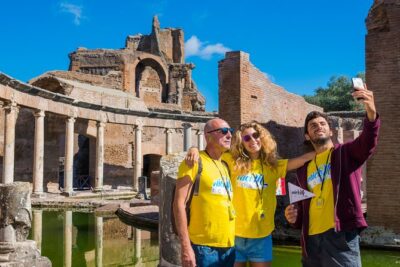
Tivoli Full Day Trip from Rome: Hadrian’s Villa and Villa D’Este
Read our review →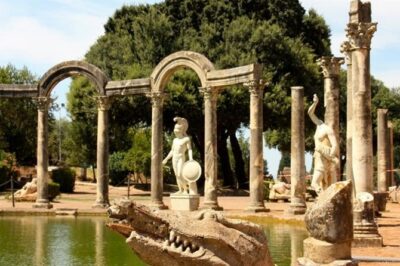
Hadrian’s Villa and Villa d’Este Half-Day Trip from Rome
Read our review →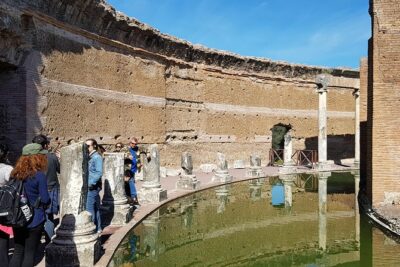
Tivoli Villas Full Day Trip From Rome with Lunch
Read our review →
Villa d’Este and Hadrian’s Villa Tour with Lunch
Read our review →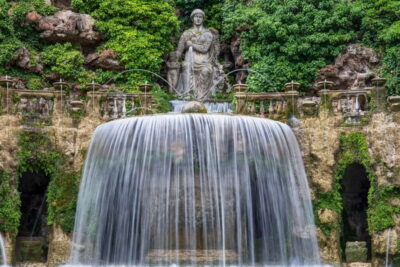
Villa D’Este & Villa Adriana Pass & App Audioguide
Read our review →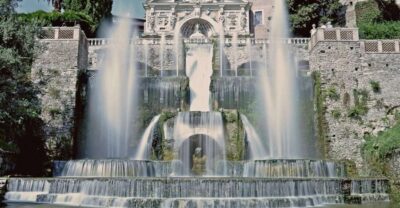
Tivoli Day Trip with Villa d’Este and Villa Adriana
Read our review →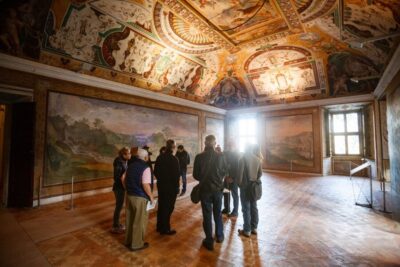
Hadrian’s Villa and Villa d’Este Half-Day Tour
Read our review →Browse the lists this tour appears in