
Reviewed · ROME
Welcome To Rome Experience
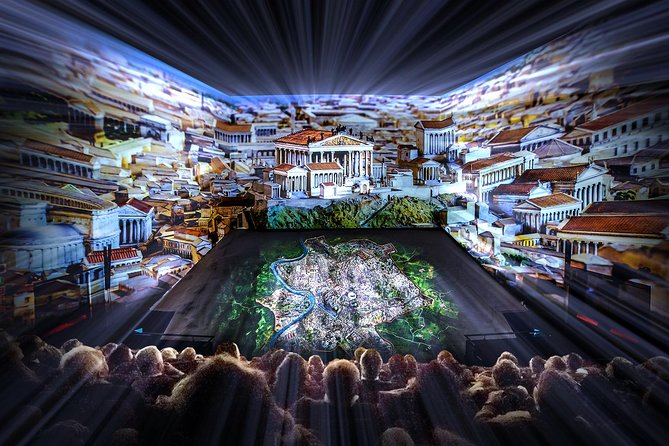
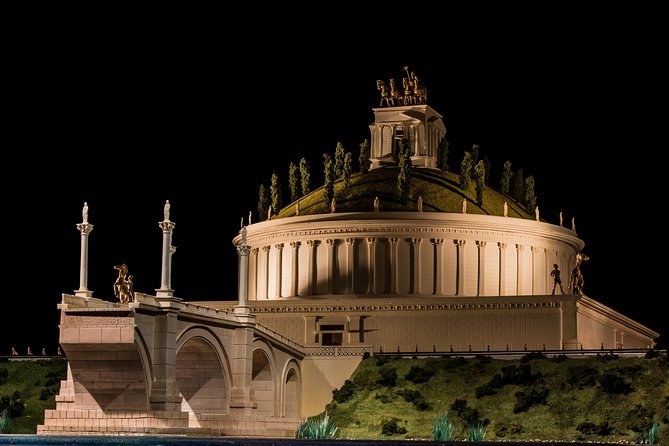
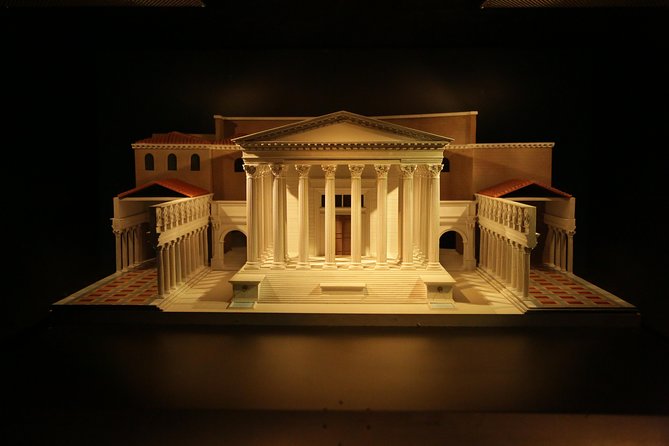
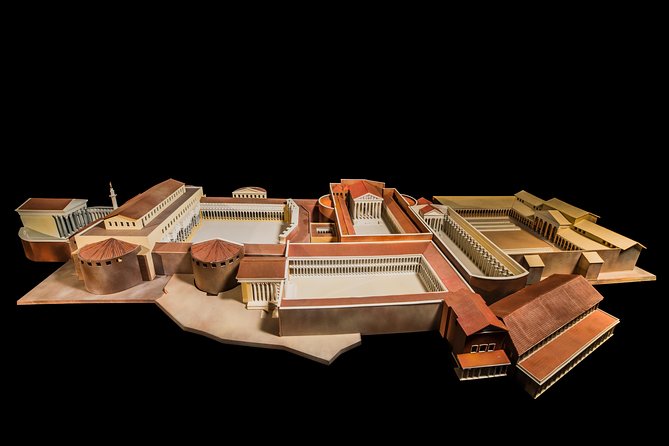
Rome’s ancient monuments make far more sense after you have seen them rebuilt. At Welcome to Rome, 3D models and projections show how famous ruins may have looked in their prime, then connect those images to the city you see today. In about an hour, you move from Rome’s early geology to its ancient, medieval, Renaissance, and Baroque periods.
I like two things right away: the show gives you a quick mental map of Rome’s past, and it works well for families who need pictures, sound, and movement rather than a long lecture. The central location and several showings each day also make this easy to fit around sightseeing.
The main drawback is the format. You spend part of the experience standing in small exhibit rooms before reaching the seated film, and the amount of historical detail may be too much for some young children. A few technical and maintenance problems have also been reported, so this is not a polished museum visit in every respect.
In This Review
- Key points at a glance
- Why See Rome Before You Start Sightseeing?
- The Four Small Rooms: Models, Audio, and Projections
- The Theater Film and Rome’s Changing Eras
- How It Helps at the Colosseum, Forum, and Palatine Hill
- Is $21.77 a Good Price for One Hour?
- Timing, Location, and Practical Details
- Who Will Enjoy It Most?
- What Could Be Improved?
- My Verdict: Book It Before Your Ancient-Site Day
- FAQ
- How long does Welcome to Rome last?
- What is included with admission?
- Is the experience offered in English?
- Where is Welcome to Rome located?
- Is the venue near public transportation?
- Are service animals allowed?
- Can I cancel for a refund?
Key points at a glance
- Rome rebuilt in 3D: See reconstructions of monuments and buildings alongside their present-day ruins.
- Four introductory exhibit rooms: Move between audiovisual stations before the main film.
- About 30 minutes in the theater: The final film gives you a broad account of Rome’s development.
- Useful before major ruins: The presentation can help you picture the Forum, Colosseum, Palatine Hill, and Circus Maximus.
- Family-friendly but not for every child: Visual effects hold attention, though children under eight may tire of the history.
- Central and flexible: The venue is on Corso Vittorio Emanuele II, near public transportation, with multiple daily showings.
Why See Rome Before You Start Sightseeing?
Rome can be confusing at first. You walk past a church built over Roman foundations, turn a corner, and find a Renaissance palace facing a Baroque fountain. The city’s story is not arranged in neat chapters. Ancient, medieval, papal, and modern Rome are layered on top of one another.
Welcome to Rome gives you a fast set of reference points. You learn how the early terrain shaped the city, how Rome developed through different periods, and how key buildings once looked. I find that especially helpful before visiting the Roman Forum, where scattered columns and broken walls require a fair amount of imagination.
This is not a substitute for walking through the actual ruins. It is a primer. Think of it as a one-hour orientation that helps you notice more when you are outside.
The experience is particularly useful on your first day. If jet lag or travel fatigue rules out a major museum or a long guided walk, this gives you an easy first look at Rome without demanding several hours. It can also serve as a bridge between sightseeing plans, since the venue is in the city center and offers more than one showing per day.
Tours travellers often pair with this one in Rome:
- Vatican: Museums & Sistine Chapel Entrance Ticket
★ 4.5 · 144,003 reviews - Vatican Museums & Sistine Chapel Tour with Optional Basilica
★ 4.3 · 67,413 reviews - Vatican Museums, Sistine Chapel & St Peter’s Basilica Guided Tour
★ 4.5 · 39,149 reviews
The Four Small Rooms: Models, Audio, and Projections
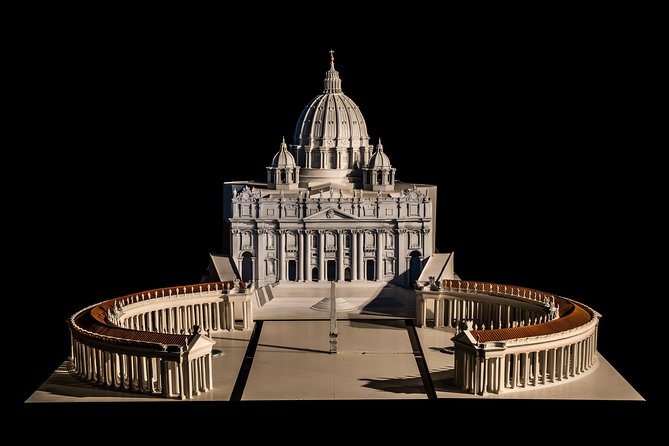
The opening section takes place across four small rooms or stations. You move from one display to the next, watching demonstrations built around models, projections, and audiovisual narration.
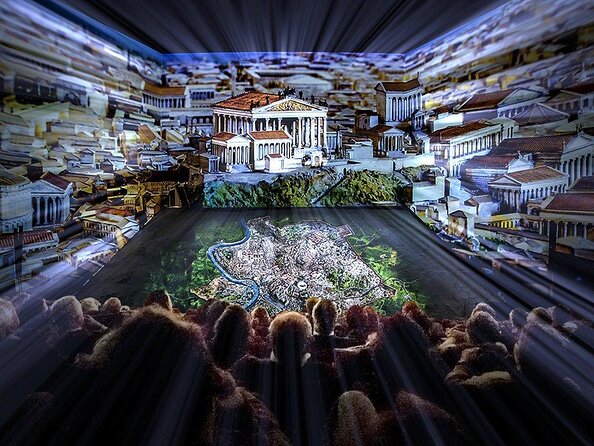
The most useful feature is the contrast between Rome now and Rome then. A ruined structure can be difficult to read from street level. A model or projected reconstruction fills in the missing roof, columns, walls, and surrounding buildings. You start to understand that the Forum was not simply a field of ruins, but a working center packed with public buildings and activity.
The presentation also touches on Rome’s beginnings, including a short geological explanation of the area. Starting with volcanoes and the early terrain may sound basic, but it gives the city a physical setting before the presentation moves into architecture and politics.
You will not sit throughout this part. That matters after a morning spent walking on Rome’s hard streets. The rooms are compact, and some people may find the movement between stations tiring, especially if they have already spent hours sightseeing. There are no reported seats at the display stations, so plan on standing until the theater portion.
The audio adds structure to the visuals. The narration is designed to explain what you are seeing rather than simply decorate the projections. The booking is offered in English, and audio equipment is part of the presentation. Check that your device is working at the start and ask staff for help if it is not. Staff assistance is available for equipment problems.
The Theater Film and Rome’s Changing Eras
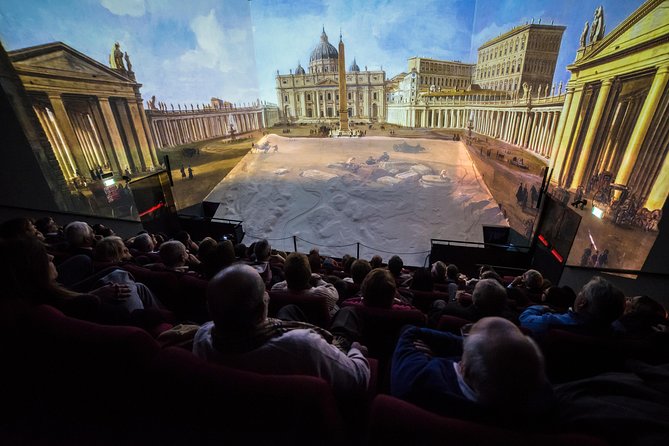
The final section takes place in an auditorium, where you sit for a film of roughly 30 minutes. This is the part I would most want to protect in my schedule, since it gives the broader story room to develop.
The film moves through Rome’s major periods and helps you see the relationship between them. You get an introduction to Classical, Medieval, Renaissance, and Baroque Rome, along with examples of how buildings and monuments changed over time.
That sequence is valuable because Rome is not only an ancient city. A first-time visitor can easily focus on the Colosseum and Forum, then miss the later layers that make the city distinctive. Churches, palaces, streets, and public spaces often reflect several periods at once. The film gives you a basic framework for recognizing those shifts.
The film also returns to buildings in their earlier form. Seeing a monument before it became a ruin can make the real site more striking later. At the Colosseum, for example, you may pay closer attention to its original scale and structure. At the Forum or Palatine Hill, the reconstructed images can help you connect isolated remains to a once-organized center.
Some people will find the film the strongest part of the experience because it allows you to sit and absorb the story. Others may prefer the models and 3D effects, especially children who respond better to short visual demonstrations. The presentation tries to serve both groups, but its pace remains educational rather than thrilling.
How It Helps at the Colosseum, Forum, and Palatine Hill
I would schedule Welcome to Rome before your ancient-site day if possible. The connection is most direct at the Roman Forum and Palatine Hill, where even a good guide must ask you to picture buildings that no longer exist.
The display’s reconstructed views can help you read the remains. Instead of seeing only fragments, you begin looking for the position of a temple, the line of a street, or the footprint of a public building. You gain a sense of how Rome’s center fit together.
The same is true at the Circus Maximus. The present-day site is broad and open, and much of its original form is gone. A visual reconstruction gives you a better idea of the scale and purpose of the space.
The experience can also help with Rome’s churches, museums, and palaces. The film’s outline of different eras gives you a simple question to carry through the rest of your visit: Is this Classical, Medieval, Renaissance, or Baroque? That question will not explain everything, but it can make your sightseeing more alert and less like a string of unrelated stops.
Do not expect detailed archaeological analysis. The show aims for a broad picture in a short time. If you already have a strong background in Roman history, you may find the ancient section too brief and the explanations too general.
A completely different way to spend the day in Rome:
- Rome: Colosseum, Palatine Hill and Roman Forum Guided Tour
★ 4.8 · 32,814 reviews - Rome: Guided Tour of Colosseum, Roman Forum & Palatine Hill
★ 4.7 · 27,897 reviews - Rome: Colosseum & Forum with Audio Guide App -Optional Arena
★ 4.2 · 24,770 reviews - Rome: Colosseum, Roman Forum and Palatine Hill Guided Tour
★ 4.5 · 23,903 reviews
Is $21.77 a Good Price for One Hour?
At $21.77 per person, this is not a bargain attraction in the same category as a free piazza or a self-guided walk. You are paying for a purpose-built multimedia presentation, equipment, staff, and a central venue. The real question is how useful that orientation will be for your trip.
I think the price works best for first-time visitors who plan to see several historic sites. If the experience helps you understand the Forum, Palatine Hill, Colosseum, churches, and palaces over the next few days, it can earn its keep by making those visits more rewarding.
For a family, the cost is harder to judge. Children who enjoy screens, models, and visual effects may get a lot from it. Children under eight, or teens who dislike guided historical explanations, may not stay engaged. If everyone in your group is already tired of museums and history, the ticket may feel expensive for an hour.
The admission is more useful when you treat it as trip preparation rather than a standalone show. I would not choose it instead of Rome’s major monuments. I would choose it to make those monuments easier to understand.
Timing, Location, and Practical Details
The address is Corso Vittorio Emanuele II, 203, in central Rome. The venue is near public transportation, which makes it a practical stop between other plans. Multiple showings each day give you some room to work around meals, church visits, or a timed entry elsewhere.
The full visit lasts about one hour. The last entry is one hour before closing, so do not assume you can arrive just before the doors shut. Your confirmation is sent at booking, and the ticket is mobile, which saves you from carrying a printed voucher.
Book about three weeks ahead if you want a particular time. The average advance booking period is 21 days, which suggests that popular dates and convenient showings can fill before the day itself. Still, the short duration and multiple daily sessions make this easier to place than a full-day tour.
Service animals are allowed, and most people can participate. The standing portion is worth noting if you have limited energy or are planning it after a long day on foot. The auditorium provides the main chance to sit, and seating conditions may not always be perfect.
Free cancellation is available if you cancel at least 24 hours before the start time. Cancellations or changes made within 24 hours are not refunded or accepted, and the cut-off follows local Rome time.
Who Will Enjoy It Most?
I would recommend this to a first-time visitor who wants context before tackling Rome’s major sights. It is also a good fit for families with children who enjoy visual demonstrations and for adults who want a short history lesson without committing to a half-day guided tour.
It works well for the person who arrives in Rome with a long sightseeing list but little sense of how the city fits together. The show gives you a starting framework quickly.
It is less suitable if you want a quiet museum with objects to inspect at your own pace. The experience moves you through its stations and then places you in a theater. You are following a prepared presentation, not choosing your own route through an exhibition.
I would also hesitate if ancient Rome is your only interest. The show includes Rome’s origins and ancient monuments, but it also covers later periods. Its aim is to explain the city’s full development, not provide an exhaustive account of imperial Rome.
What Could Be Improved?
The concept is strong, but the physical setup can affect your impression. The opening rooms are small, and some visitors may find the repeated standing and moving less comfortable than expected. Adding seating at the display stations would make the experience easier after a full day of walking.
Audio equipment can occasionally need attention. If your unit is not working properly, tell a staff member promptly rather than trying to follow along without the narration.
The theater has also received criticism for worn seating and untidy facilities. These issues do not change the content, but they matter when you are paying more than $20 for a short indoor attraction. I would keep expectations focused on the models, projections, and film rather than on a polished museum building.
The ancient portion may feel too short for history fans. If you want detailed military, political, or archaeological coverage, you will need a more specialized tour or guide afterward. Welcome to Rome offers the outline, not every chapter.
My Verdict: Book It Before Your Ancient-Site Day
Book Welcome to Rome if you want a visual, one-hour introduction that will help you make sense of Rome’s layers. I especially like it as an early-trip activity, before the Colosseum, Roman Forum, and Palatine Hill. The reconstructions give you something practical to look for when you reach the real ruins.
At $21.77, the value depends on your interests and your group. History-minded adults and families with visually curious children are the best match. If your children are very young, your teens dislike historical presentations, or you already know Roman history well, the price may feel high for the amount of material.
For most first-time visitors, I would place it near the beginning of the trip, allow the full hour, and arrive with reasonable expectations. You are not getting a full museum or a detailed archaeological course. You are getting a compact visual map of Rome, and that map can make the rest of your visit easier to follow.
FAQ
How long does Welcome to Rome last?
The experience lasts approximately one hour. The final film takes about 30 minutes, with the remaining time spent moving through audiovisual displays.
What is included with admission?
Admission includes the multimedia Welcome to Rome experience, including the exhibit stations, audiovisual presentation, projections, interactive elements, and final film.
Is the experience offered in English?
Yes. The booking information lists English as the available language.
Where is Welcome to Rome located?
It is located at Corso Vittorio Emanuele II, 203, 00186 Roma, Italy.
Is the venue near public transportation?
Yes. The venue is near public transportation in Rome’s city center.
Are service animals allowed?
Yes. Service animals are allowed, and most people can participate.
Can I cancel for a refund?
Yes. You can cancel up to 24 hours before the experience start time for a full refund. Cancellations or changes made less than 24 hours before the start time are not accepted or refunded.
Newest reviews from Rome
- Rome: Vatican Museums & Sistine Chapel Skip-the-Line Ticket★ 4.4 · 148 reviews
- Shared Shuttle Transfer from Rome to Civitavecchia Port★ 5.0 · 148 reviews
- Rome: Crypts & Catacombs After Hours Tour with Bone Chapel★ 4.6 · 149 reviews
- Ghosts Legends and Mysteries of Rome Walking Tour★ 5.0 · 149 reviews
- Skip the Line: Vatican and Sistine Chapel with Guided Tour★ 4.0 · 149 reviews
- Tivoli: Villa Gregoriana Entrance Ticket★ 4.7 · 150 reviews
- Pizza and Tiramisu Cooking Class in Rome, Piazza Navona★ 5.0 · 150 reviews
- Rome: Borghese Gallery Skip-the-Line Entry and Guided Tour★ 4.7 · 150 reviews