
Reviewed · WALKING TOURS
Alternative Walking Tour of Rome’s City Center & Hidden Gems
Rome’s grandest sights are only half the story. This 2.5-hour walking tour links Trajan’s Column, Trevi Fountain, the Pantheon, and Piazza Navona with stories of papal families, political scheming, murder, betrayal, and artistic propaganda. I like the way it gives you the famous Rome you came to see, then adds the back-room story that makes those monuments easier to understand. I also like the small-group feel and the guides’ lively style, especially Simone, Jacopo, Iris, and Jacob, who are repeatedly praised for clear explanations, humor, and useful advice for the rest of your stay.
The main thing to watch is the tip-based price. The advertised booking cost is only $3.77, but the guides work for gratuities, with a usual suggested range of €10 to $50 at the end. The final cost is still good for a long, guide-led introduction to central Rome, but you should treat it as a paid experience rather than a truly free tour.
In This Review
- Key points at a glance
- Starting beside Trajan’s Column
- Piazza Venezia and the machinery of power
- The secret stop and the monastery
- Trevi Fountain beyond the postcard view
- Sant’Ignazio and Rome’s visual tricks
- The Pantheon in a five-minute stop
- Piazza Navona and the final Roman connections
- The guide makes or breaks this walk
- Is the $3.77 booking price really the cost?
- Who will enjoy this Rome walking tour?
- Practical details before you book
- Should you book it?
- FAQ
- How long does the walking tour last?
- Where does the tour begin?
- Where does the tour finish?
- Which major sights are included?
- Is this a free walking tour?
- What languages are available?
- Can I cancel the booking?
Key points at a glance
- A history tour with a family-power angle: Learn how dynasties, popes, artists, and political leaders shaped Rome.
- The major sights are included: Trajan’s Column, Piazza Venezia, Trevi Fountain, Sant’Ignazio, the Pantheon, and Piazza Navona all feature in the route.
- Less familiar stops add character: A secret stop, a monastery, unusual inscriptions, and less-public religious spaces broaden the usual Rome walk.
- Storytelling is the main attraction: Expect scandals, corruption, crime, war, betrayal, legends, and dark jokes alongside art and architecture.
- English and Spanish guides lead the walk: Past guides have included Simone, Jacopo, Iris, Jacob, Simona, and Simon.
- Good for a first orientation: You finish in Piazza Navona with a better sense of how ancient, papal, artistic, and modern Rome fit together.
Starting beside Trajan’s Column
The tour begins on the steps of Chiesa del Santissimo Nome di Maria al Foro Traiano, beside Trajan’s Column and Trajan’s Forum. This is a useful starting point because you are already in the middle of Rome’s political core, not standing on a bland street waiting for a guide.
Look for the guide holding a sign with the tour name. From here, the walk starts with a 15-minute visit and explanation of Trajan’s Column. The column is more than a dramatic photo stop. Its carved spiral tells the story of Emperor Trajan’s campaigns, and the surrounding Forum helps you picture how imperial Rome used monuments to display military strength and public authority.
I like beginning here because the guide can introduce a central theme of the walk: Rome was built by people who wanted to be remembered. Emperors, popes, noble families, and artists all used stone, fountains, churches, and public squares to make power visible.
The first stop also sets the tone for the guide’s approach. You are not simply handed dates and names. The point is to connect the monument with ambition, rivalry, and the people who paid for it.
More walking tours in Rome:
- Rome: Trastevere & Campo de Fiori Street Food Walking Tour
★ 4.9 · 2,768 reviews - Rome: Paranormal Night Walking Tour & Secret Backstreets
★ 4.9 · 1,921 reviews - Rome by Night Walking Tour – Legends & Criminal Stories
★ 4.5 · 1,003 reviews
Piazza Venezia and the machinery of power
The walk continues to Piazza Venezia, where you get a short five-minute sightseeing and photo stop. The time is brief, so do not expect an extended architectural lecture here.
Still, the square matters as a transition. It connects the ancient imperial center with the later political city, and it gives the guide a natural place to explain how Rome kept changing while reusing its old spaces. This is one reason the tour works well as an opening walk. You begin to see Rome as a series of layers rather than a collection of separate monuments.
If you want a long pause for photographs, you may find this stop a little quick. The focus is on the story and the route, not on giving every landmark unlimited viewing time.
The secret stop and the monastery
The itinerary then moves away from the most obvious sights for a secret stop and a monastery. These portions take about five minutes and 25 minutes respectively, making the monastery one of the longer stops on the walk.
The exact details of the secret stop can vary, so the attraction is partly the surprise. The tour promises places and views that are not normally part of a standard Rome route, and past experiences have included access to a religious site that is not usually open to the public. One account describes the guide persuading a priest to allow the group to see something normally closed off.
That kind of moment is valuable, but you should keep expectations sensible. Access to a religious interior can depend on permission, timing, or local conditions. The tour does include Papal Private Gardens admission, yet the supplied schedule does not spell out precisely where or how that access fits into every departure.
The monastery stop is where the walk’s interest in powerful families and the Church can come together. Rome’s churches are not scattered by accident. They reflect devotion, competition, family prestige, artistic patronage, and the long reach of papal authority.
Guides such as Simone have been praised for explaining architecture, Church politics, Latin inscriptions, and even ancient Greek. That matters here. A guide who can read old inscriptions may point out details you would otherwise pass without noticing.
Trevi Fountain beyond the postcard view
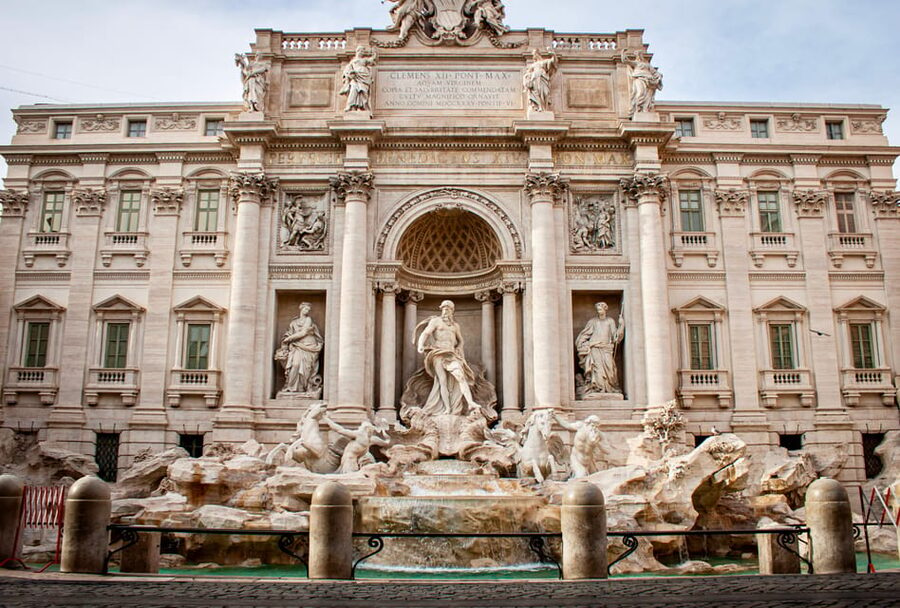
Trevi Fountain gets about 15 minutes, including a break, photos, guided sightseeing, and free time. This is not enough for a slow, quiet visit, especially if the square is crowded, but it is enough to understand the fountain as a piece of public messaging rather than just a famous place to toss a coin.
Expect the guide to discuss why fountains became symbols of power and propaganda. In Rome, water was practical, political, and theatrical. A grand fountain could show that a pope or ruling family had the money and influence to improve the city while also attaching its name to a memorable public monument.
The free time is useful for photographs, but keep your group in sight. Trevi Fountain can be noisy and packed, and the walk continues on foot. Comfortable shoes matter more here than clever planning, since the route combines busy squares with quieter side streets and church interiors.
The stop also gives you a chance to compare the tour’s style with a standard sightseeing walk. You will certainly see the famous fountain, but the guide’s job is to explain who benefited from its presence, what message it sent, and how Rome’s public art often mixed beauty with political self-promotion.
More Rome tours worth comparing
- Rome: City Sightseeing Hop-on Hop-off Bus with Audioguide
★ 4.0 · 16,045 reviews - City Sightseeing Rome Hop-On Hop-Off Bus Tour
★ 3.5 · 5,446 reviews - Rome: Fettuccine Pasta Cooking Class in Rome’s City Center
★ 4.8 · 2,414 reviews - Vatican City: Vatican Museums & Sistine Chapel Entry Ticket
★ 4.3 · 2,185 reviews
Sant’Ignazio and Rome’s visual tricks
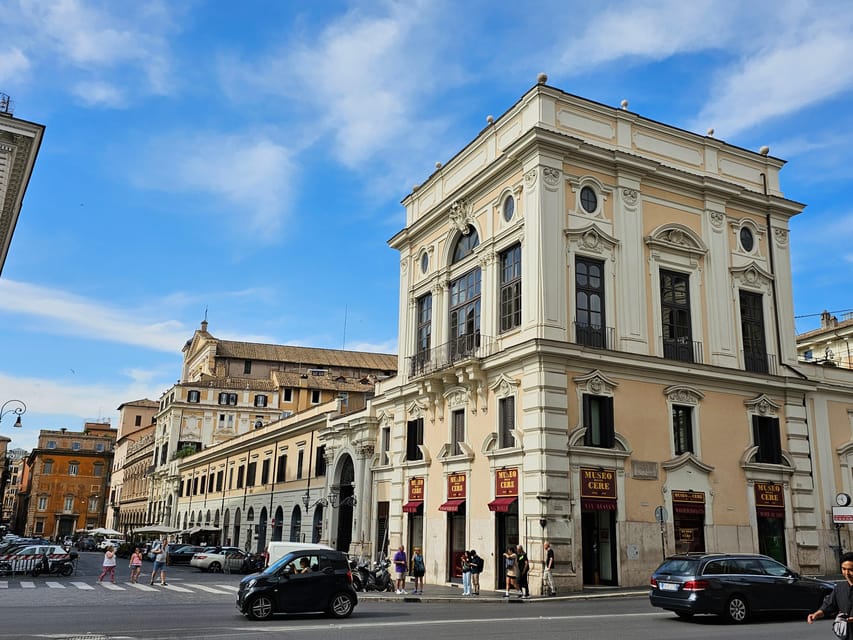
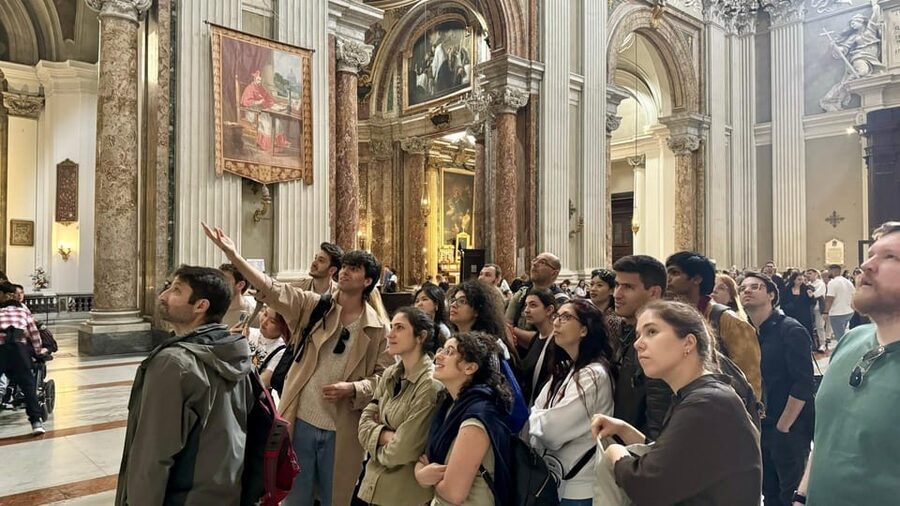
The Church of Sant’Ignazio di Loyola receives about 10 minutes. This is one of the most rewarding stops for anyone interested in art, architecture, or optical illusion.
The church is known for its remarkable ceiling fresco, and it offers a strong example of how Rome’s churches use painting and architecture to shape what you think you are seeing. The stop is short, so the guide has to be selective, but the church gives you a clear look at the connection between faith, art, and persuasion.
I especially like this part of the walk because it adds something beyond ancient ruins. Rome is not only about emperors and marble. It is also about artists solving difficult architectural problems, Church leaders commissioning spectacular interiors, and visitors being encouraged to look upward and believe what their eyes appear to show them.
The Colonna district around the church also fits the tour’s family-centered theme. The route helps you understand that central Rome was shaped by institutions and dynasties competing for attention. A church could serve as a place of worship, a family statement, an artistic showcase, and a political tool at the same time.
The Pantheon in a five-minute stop
The Pantheon follows Sant’Ignazio, with around five minutes for photos, a guided visit, and sightseeing. That is a very short allocation for one of Rome’s most important ancient buildings.
The benefit is that you get context without spending your entire day at one monument. The guide can explain why the Pantheon matters and connect it to Rome’s wider story of reuse, conversion, and survival. The building’s present identity is tied to its later life as a church, not only its ancient Roman origin.
The limitation is obvious: if you want a full architectural study, time to sit inside, or a detailed look at every feature, this tour will not provide it. Think of the Pantheon stop as a strong introduction. You can return later if you want a slower visit.
This is also a good example of the tour’s overall balance. It covers a lot of ground and gives you a useful framework, but it cannot replace specialist visits to the Pantheon, Trevi Fountain, or any other major site.
Piazza Navona and the final Roman connections
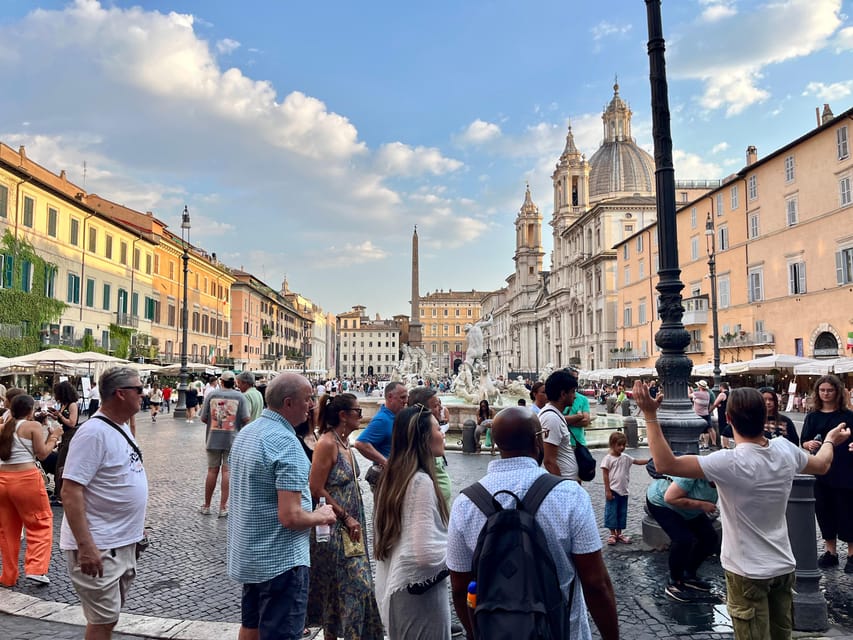
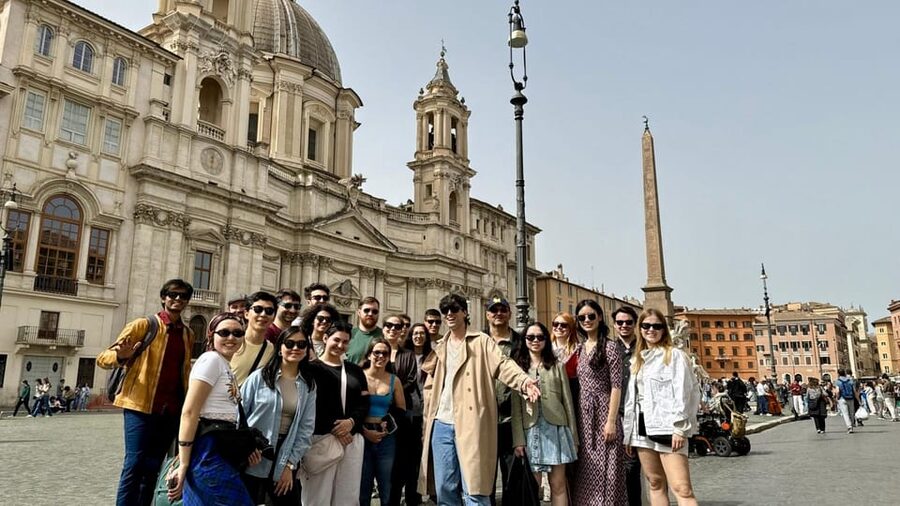
The walk ends in Piazza Navona after about 15 minutes of sightseeing and guided commentary. This is a sensible finish. The square is one of central Rome’s best places to bring together ancient urban planning, Baroque art, fountains, Church influence, and family rivalry.
Piazza Navona’s long shape follows the outline of an ancient stadium, while its later fountains and churches show how Rome repeatedly built new meaning on top of old foundations. The guide can connect the city’s ancient myths, religious power, artistic ambition, and everyday public life in one final setting.
Ending here also leaves you well placed for the rest of your day. The tour does not provide a formal onward itinerary, but guides often offer suggestions about places to see next. Jacopo, in particular, has been praised for giving practical recommendations that helped visitors plan another visit to Rome.
You may want to stay in Piazza Navona after the tour rather than rushing away. It is a useful spot to review the route, compare the monuments you have seen, and decide which ones deserve a longer return visit.
The guide makes or breaks this walk
This experience depends heavily on the person leading it. The strongest reports point to a clear pattern: the guides are energetic, personable, and comfortable answering questions.
Simone is praised for passion, humor, strong English, and detailed explanations of Roman political and architectural history. Jacopo is often singled out for his storytelling, clear accent, family-history focus, and ability to make a complicated subject easy to follow. Iris is described as animated, informative, and funny, while Jacob is noted for his historical expertise, considerate pacing, and ability to keep the group together.
The guide names and styles can vary by departure. You should book this walk for its subject and route, not on the assumption that one particular guide will lead every outing.
One useful detail: the walk generally does not use headphones. That can be a real advantage in a city where many tours turn into a silent march behind an audio receiver. Face-to-face conversation makes it easier to ask questions, though it also means you need to stay close enough to hear the guide in busy places.
The route has also worked well with small groups. One departure had only a single participant, while other groups were described as small and intimate. Group size is not guaranteed, but a compact group allows a more relaxed pace and better questions.
Is the $3.77 booking price really the cost?
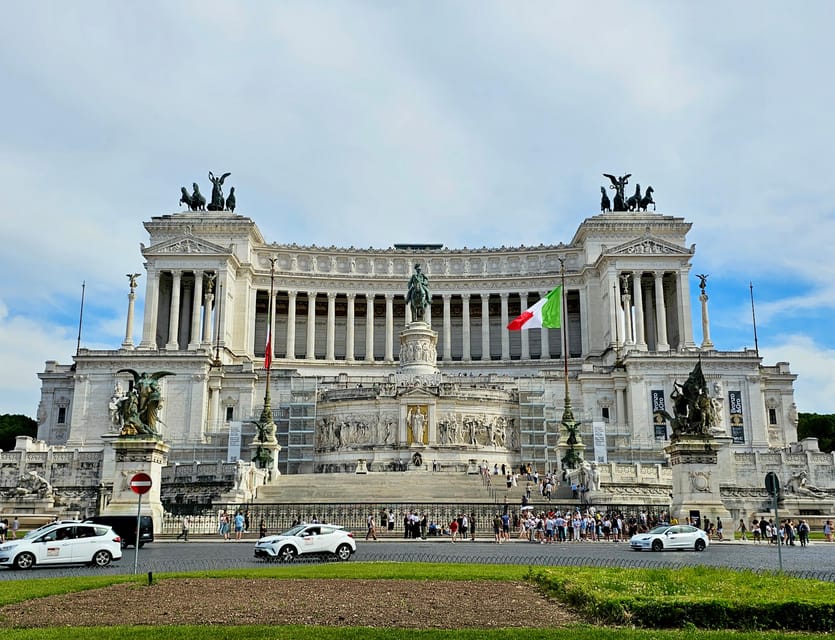
The listed price is $3.77 per person, but the tour operates on a pay-what-you-want model. Guides earn their income from tips, and the usual tip is stated as €10 to $50 per person.
That makes the experience good value if you are comfortable paying a fair gratuity. At the lower end, you are getting 2.5 hours of guiding for roughly the cost of a quick snack. At the higher end, the price begins to resemble a conventional walking tour, but you are still receiving a route that combines major monuments, lesser-known places, and access to Papal Private Gardens.
I recommend deciding your tip before the tour ends. The guide is working for it, and the experience includes enough material to deserve more than a token payment when the storytelling, pacing, and explanations work well. Cash or card payment is available according to the supplied information.
The low upfront fee can also make this a useful choice when you want to test a guide-led experience without paying the full amount in advance. Just do not mistake the booking price for the complete expected expense.
Who will enjoy this Rome walking tour?
I would choose this for a first visit if you want a broad introduction before tackling individual museums and monuments. It explains how the ancient city, papal Rome, Baroque Rome, and modern everyday life connect.
It also suits repeat visitors. The route still includes Trevi Fountain, the Pantheon, Piazza Navona, and other major sights, but the family stories, inscriptions, Church politics, and side stops give you a different way to read places you may already know.
The tour is especially good for you if:
- You enjoy history told through personalities, scandals, and rivalries.
- You want famous sights plus lesser-known places.
- You like asking questions rather than listening to a fixed script.
- You appreciate dark humor and politically incorrect jokes.
- You want recommendations for the rest of your Rome visit.
- You prefer walking and conversation to a headphone-based tour.
It may be less suitable if you want a slow photographic tour, a specialist art lecture, or extended interior visits. The schedule is full, and the Pantheon, Piazza Venezia, and Trevi Fountain stops are brief.
The route also includes churches and religious sites. Dress and behavior should be respectful, and you should be ready for changes if a religious space is busy or access is restricted.
Practical details before you book
The meeting point is the steps of Chiesa del Santissimo Nome di Maria al Foro Traiano, beside Trajan’s Column and Trajan’s Forum. Give yourself time to find the church, since central Rome has several similarly named religious buildings and the starting point is identified by the column and forum.
The walk lasts 2.5 hours and is offered in English or Spanish. Starting times vary, so check the available departure when booking.
Wear shoes you can walk in comfortably. The route moves through central streets, squares, church interiors, and archaeological areas, with several stops for photos and explanations.
You can cancel up to 24 hours before the start for a full refund, and you can reserve now while paying later. Those terms are helpful if your Rome plans are still shifting.
Should you book it?
Book this tour if you want Rome explained through people and power, not just dates and building names. The best part is the combination of major sights and unexpected stops, delivered by guides who bring humor, questions, inscriptions, art, and family rivalries into the same walk.
I would be clear about two things before booking. The tip is the real payment, and the tour gives you an overview rather than long visits inside every monument. If that suits your plans, the route is a strong value and a smart way to get your bearings in the historic center.
FAQ
How long does the walking tour last?
The tour lasts 2.5 hours.
Where does the tour begin?
It begins on the steps of Chiesa del Santissimo Nome di Maria al Foro Traiano, beside Trajan’s Column and Trajan’s Forum. The guide holds a sign with the tour name.
Where does the tour finish?
The tour finishes in Piazza Navona.
Which major sights are included?
The route includes Trajan’s Column, Piazza Venezia, Trevi Fountain, the Church of Sant’Ignazio di Loyola, the Pantheon, and Piazza Navona.
Is this a free walking tour?
It has a $3.77 booking price, but it uses a pay-what-you-want model. Guides work for tips, and the usual tip is between €10 and $50 per person.
What languages are available?
The tour is offered in English and Spanish.
Can I cancel the booking?
Yes. You can cancel up to 24 hours in advance for a full refund. You can also reserve now and pay later.
Newest reviews from Rome
- Rome: Vatican Museums & Sistine Chapel Skip-the-Line Ticket★ 4.4 · 148 reviews
- Shared Shuttle Transfer from Rome to Civitavecchia Port★ 5.0 · 148 reviews
- Skip the Line: Vatican and Sistine Chapel with Guided Tour★ 4.0 · 149 reviews
- Rome: Crypts & Catacombs After Hours Tour with Bone Chapel★ 4.6 · 149 reviews
- Ghosts Legends and Mysteries of Rome Walking Tour★ 5.0 · 149 reviews
- Tivoli: Villa Gregoriana Entrance Ticket★ 4.7 · 150 reviews
- Pizza and Tiramisu Cooking Class in Rome, Piazza Navona★ 5.0 · 150 reviews
- Rome: Borghese Gallery Skip-the-Line Entry and Guided Tour★ 4.7 · 150 reviews
Walking Tours, compared.
Trastevere & Campo de Fiori Street Food Walking Tour
Read our review →
Paranormal Night Walking Tour & Secret Backstreets
Read our review →
Rome by Night Walking Tour – Legends & Criminal Stories
Read our review →
Guided City Center Evening Sightseeing Walking Tour
Read our review →
Best of Rome Walking Tour including Trevi Fountain
Read our review →

Forbidden History Walking Tour & Pub Crawl with Drinks
Read our review →
Guided Small Group Walking Tour of City Highlights
Read our review →Browse the lists this tour appears in