
Reviewed · ROME
Ancient Rome: Archeological area Largo Argentina
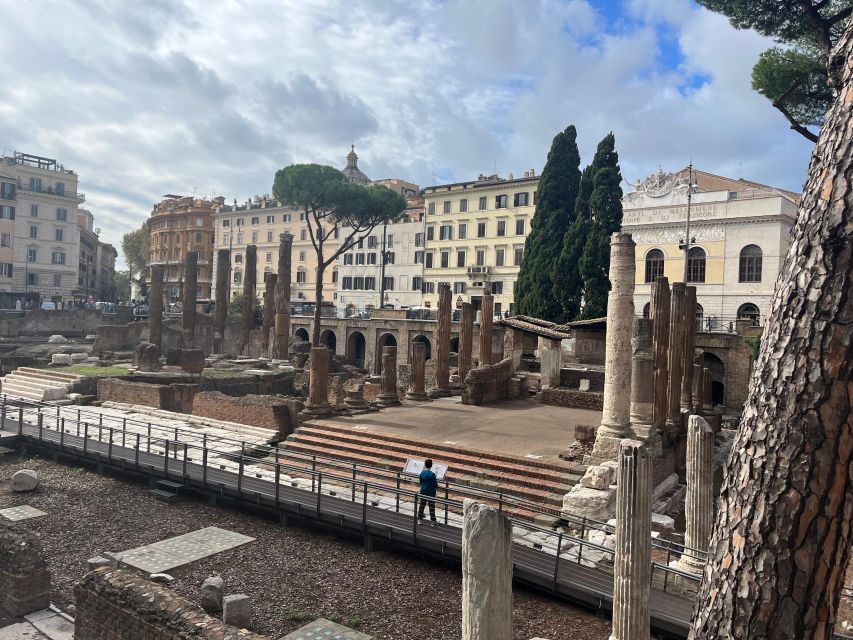
The most haunting detail at Largo di Torre Argentina is not a grand monument, but a spot among broken foundations: the Curia of Pompey, where Julius Caesar was killed on the Ides of March in 44 BC. You can look down into the archaeological area and connect one of Rome’s best-known political murders with the stones beneath modern streets.
I like the chance to see four temples from the 4th to 1st centuries BC, and I like the short multimedia film, which reconstructs how the ruins may have looked long ago. The main catch is that this is not a guided walking tour, and the ticket office is about a six-minute walk from the archaeological site.
In This Review
- Key points to know before visiting
- Why Largo Argentina matters
- Starting at Touristation Aracoeli
- Seeing the four Republican temples
- Finding the Curia of Pompey
- Following the site through imperial and medieval Rome
- What the one-hour format feels like
- The audio guide and multimedia film
- Is $23 a fair price?
- Who should choose this experience?
- Practical details to keep in mind
- Should you book Largo Argentina?
- FAQ
- Where do I meet for the Largo Argentina experience?
- Does the selected time refer to entry at Largo Argentina?
- Is a guided tour included?
- What can I see at Largo Argentina?
- Is the site connected with Julius Caesar’s assassination?
- How long does the activity last?
- What should I bring, and what is not allowed?
Key points to know before visiting
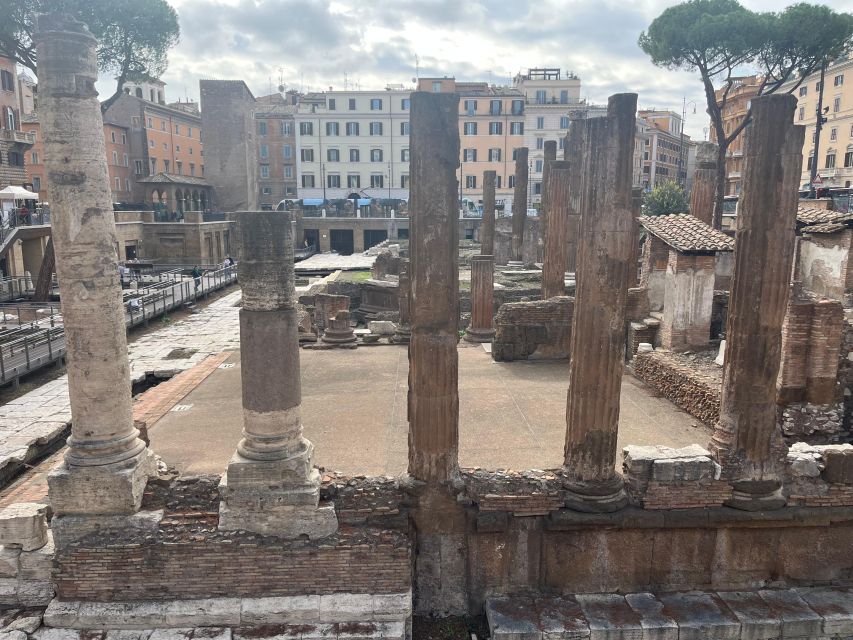
- Four ancient temples: See the remains of a sacred complex dating from the 4th through 1st centuries BC.
- Caesar’s assassination site: The ruins preserve the tuff base of the Curia of Pompey, linked to Caesar’s death in 44 BC.
- Multimedia introduction: Watch a film lasting about 25 to 30 minutes before visiting the site.
- English audio guide: Use the Rome audio guide app as you walk through the archaeological area.
- Short, focused visit: Plan on about one hour, though the video and ticket redemption add time around the visit.
- Ancient ruins in modern Rome: Look down from the city streets onto an archaeological island surrounded by present-day traffic and buildings.
Why Largo Argentina matters
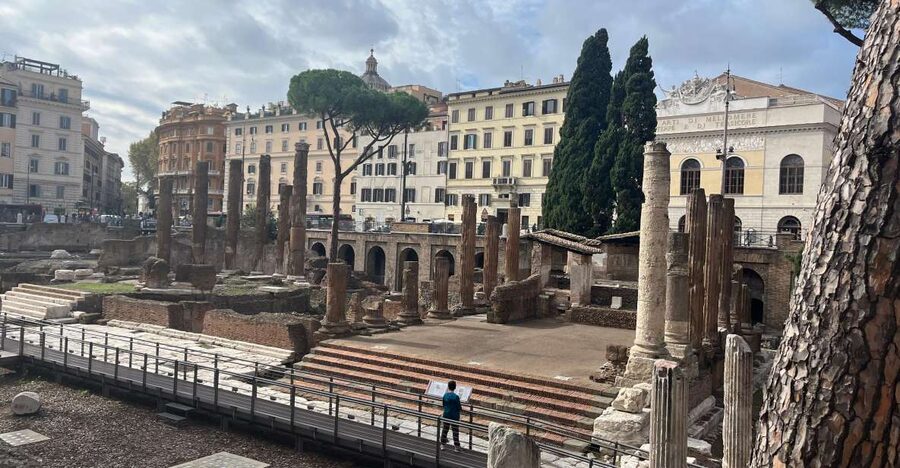
Rome gives you ancient monuments in many forms. The Colosseum is huge and theatrical. The Pantheon is remarkably intact. Largo Argentina is different. You look down into a broad excavation where four temple complexes, walls, paving, and later construction layers sit below the level of modern Rome.
The site was uncovered during major excavations and demolitions between 1926 and 1930. Those works exposed the sacred area and revealed how many periods had occupied the same patch of ground. The result is not a polished ruin with every building restored. It is a layered archaeological record, and you need to use the audio guide and your imagination to make sense of it.
I find that especially useful for understanding how Rome grew. The temples belong to the Roman Republic, but the area continued to change through the imperial period and the Middle Ages. The ruins show that ancient Rome did not simply vanish one day. Buildings were repaired, altered, reused, and eventually buried beneath the city.
The setting also gives the visit its odd charm. You are near busy modern streets, yet the remains sit like an ancient island below street level. Rome keeps moving around you while the foundations preserve events from more than 2,000 years ago.
Tours travellers often pair with this one in Rome:
- Vatican: Museums & Sistine Chapel Entrance Ticket
★ 4.5 · 144,003 reviews - Vatican Museums & Sistine Chapel Tour with Optional Basilica
★ 4.3 · 67,413 reviews - Vatican Museums, Sistine Chapel & St Peter’s Basilica Guided Tour
★ 4.5 · 39,149 reviews
Starting at Touristation Aracoeli
The time on your reservation refers to your appointment at Touristation Aracoeli, Piazza d’Aracoeli 16, not necessarily the moment you enter Largo Argentina. Look for the office with a fountain and orange flags in front.
This distinction matters. You should allow time to find the office, redeem your voucher, and receive the materials before heading to the archaeological area. One practical estimate places the walk from the office to Largo Argentina at about six minutes, so the two locations are close but not identical.
At the office, you receive assistance at the meeting point, a paper city map, WiFi access, and instructions for the visit. You also watch the included ancient Rome multimedia presentation. The supplied information describes it as a 30-minute video, while the on-site experience has been described as about 25 minutes, so I would plan for roughly half an hour.
The film is one of the more useful parts of the package. It overlays reconstructions onto the surviving buildings, helping you picture temples and public spaces that now survive mostly as foundations. If you have just arrived in Rome, this gives you a quick introduction before you begin looking at the actual remains.
Still, do not confuse the film with a live guide. There is no guided tour included. The staff helps with the meeting point and entry, but the site itself is meant to be explored with the audio guide app and your own attention.
Seeing the four Republican temples
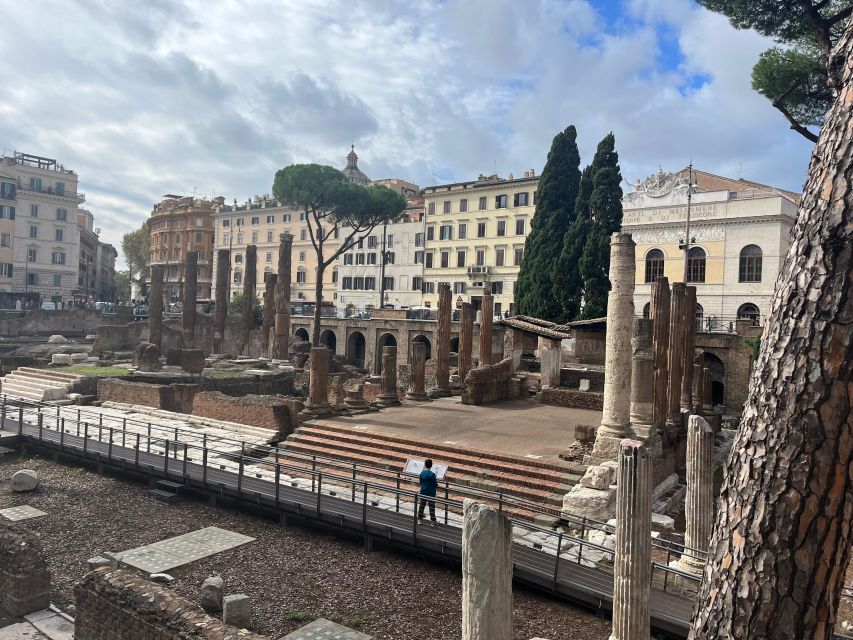
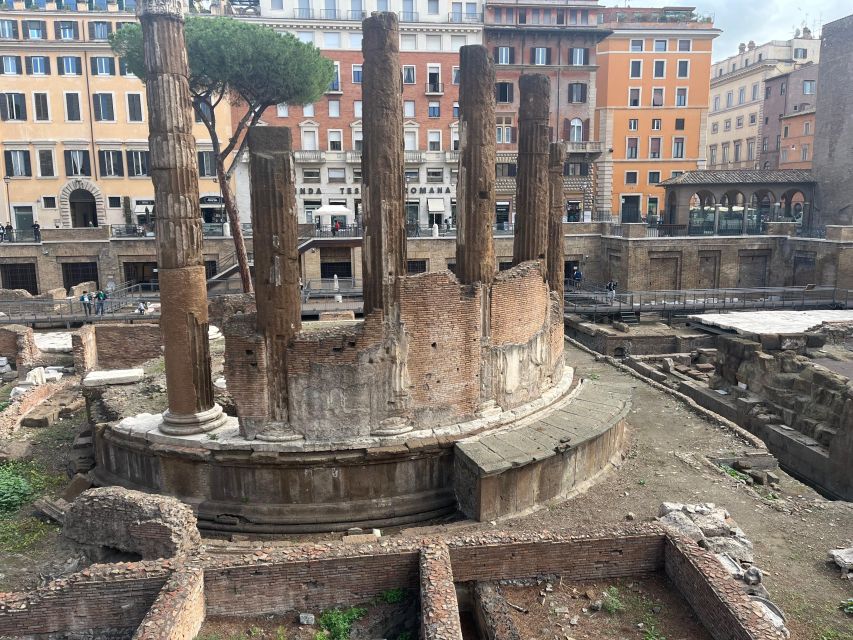
The central attraction is the group of four temples, built between the 4th and 1st centuries BC. Their remains do not offer the clean, upright columns you may hope to see in a textbook image. Instead, you are studying foundations, platforms, fragments, and the arrangement of the sacred area.
That may sound modest, but the layout is the point. The remains let you see how Roman religious architecture occupied a formal public space. The four temples were built at different times, which helps show the changing power and wealth of Republican Rome.
The audio guide can help you understand what you are looking at, especially if you do not already know Roman temple plans. Without some explanation, the stones can blur together. With the app, you can connect each platform to a period and purpose, then compare the construction phases.
I recommend taking your time with the overall plan before focusing on individual fragments. First, look at how the temples sit in relation to one another. Then notice the later walls and additions around them. This is an archaeological site rather than a single restored building, so the story emerges from the arrangement.
The visit is a good choice if you enjoy ruins that require interpretation. It is less satisfying if you want a large monument you can enter and photograph from many angles. Much of what you see is viewed from above, and the experience depends on the explanations supplied by the app and video.
Finding the Curia of Pompey
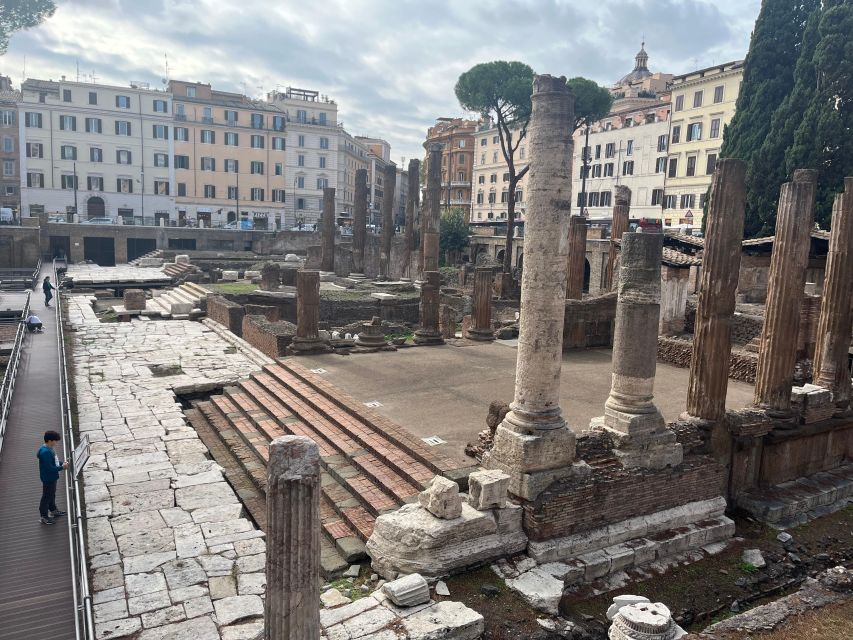
The most famous place here is the remains of the Curia of Pompey. Ancient sources connect this area with the assassination of Julius Caesar on March 15, 44 BC, the Ides of March.
The scene was political as much as personal. Caesar had become the dominant figure in Roman government, and a group of senators killed him in a meeting place associated with Pompey. At Largo Argentina, the surviving tuff base helps locate that event in the real city rather than in a vague historical past.
I like this part of the visit because it makes a familiar story more precise. You are not simply hearing that Caesar was stabbed in Rome. You are looking at the archaeological remains linked to the meeting place where the attack occurred.
At the same time, it is important to keep expectations in check. The site does not preserve a complete senate chamber waiting for you to walk through it. You see ruins and foundations, and the audio guide provides the bridge between the stones and the ancient sources.
That gap between what survives and what happened is part of the appeal. Rome often asks you to read a place in layers. Here, the lower foundations point toward the Republican period, while later construction shows how the area continued to be used after Caesar’s death.
A completely different way to spend the day in Rome:
- Rome: Colosseum, Palatine Hill and Roman Forum Guided Tour
★ 4.8 · 32,814 reviews - Rome: Guided Tour of Colosseum, Roman Forum & Palatine Hill
★ 4.7 · 27,897 reviews - Rome: Colosseum & Forum with Audio Guide App -Optional Arena
★ 4.2 · 24,770 reviews - Rome: Colosseum, Roman Forum and Palatine Hill Guided Tour
★ 4.5 · 23,903 reviews
Following the site through imperial and medieval Rome
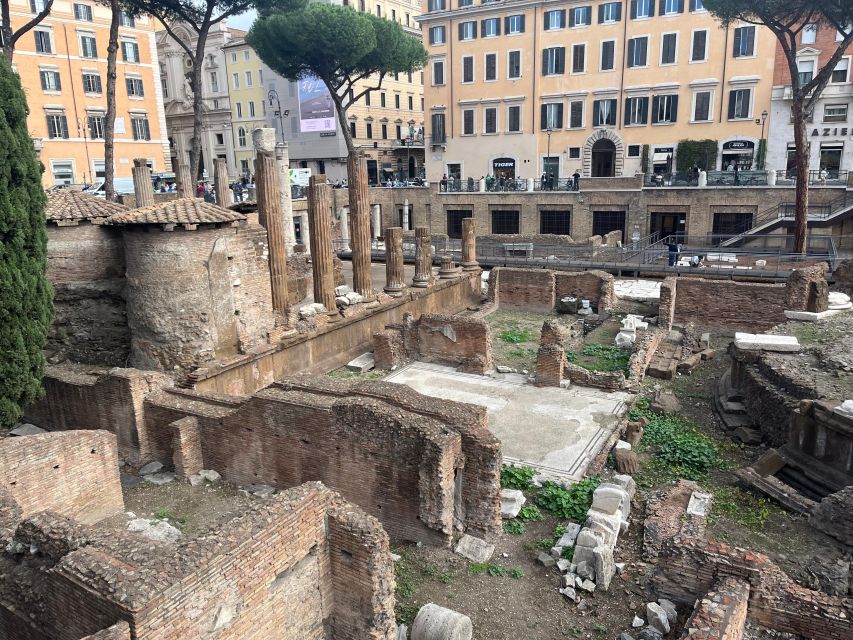
Largo Argentina is not only a Caesar stop. Its archaeological record covers more than two millennia, including imperial phases of the temples and structures from the medieval period.
This long sequence gives the visit more weight than a single famous story. You can consider what happened after the Republic, when Roman buildings were repaired and altered under the emperors. Later, medieval structures occupied or reused parts of the old sacred area.
I find this particularly helpful for reading Rome as a living city. Ancient ruins were not always treated as museum pieces. They became part of later neighborhoods, religious buildings, homes, and infrastructure. The area’s layers reflect repeated use, neglect, change, and rediscovery.
The multimedia presentation is useful here because reconstruction can show the buildings at different stages. The excavation itself gives you the physical evidence, while the video offers a clearer picture of lost walls, columns, and spaces.
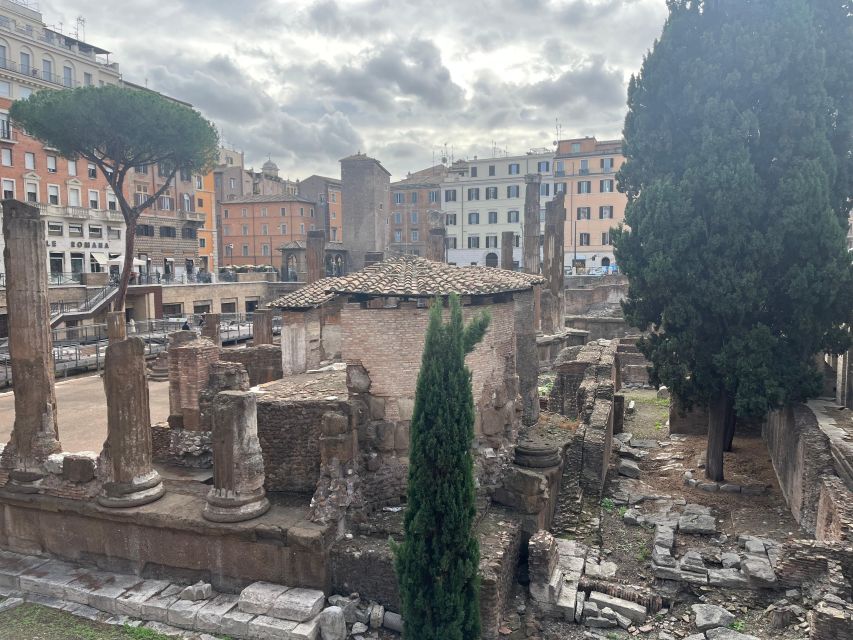
You should allow yourself a few quiet minutes to take in the contrast. The city around Largo Argentina is modern and active, but the excavation below records Roman religious life, imperial alterations, and medieval occupation. That contrast is one of the strongest reasons to include the site in a Rome itinerary.
What the one-hour format feels like
The advertised duration is one hour, making this a manageable stop between larger sights. The timing works well if you want a compact history lesson rather than a full morning activity.
But the schedule begins at Touristation Aracoeli, and the multimedia film takes roughly 25 to 30 minutes. Add the walk to the excavation and the time needed to explore the temples, and you should not treat the one-hour figure as a promise that you will spend a full hour among the ruins.
The short format is a plus for many visitors. You can learn the basic story, see the main archaeological features, and move on to another part of central Rome. It also suits families or first-time visitors who want a clear introduction without committing to a long lecture.
The limitation is depth. You will not receive the kind of extended discussion that a private archaeologist or specialist guide might provide. If you want detailed answers about every temple, building phase, and source, you may wish to supplement the audio guide with your own reading.
The booking includes skip-the-ticket-line entry, but the practical value may vary. The main benefit is having an arranged entry and assistance at the office. Buying directly at the archaeological area may be possible, and one recent experience found that skipping the line was not essential. I would consider the package most useful for the video, audio guide, and convenience, not simply for queue protection.
The audio guide and multimedia film
The audio guide is provided through a Rome app in English. Since there is no live guide, this app carries much of the interpretation once you reach the site.
I like audio guides at archaeological areas when they explain what is no longer visible. Here, that means helping you identify the four temple platforms, understand the Curia of Pompey, and follow the area’s later imperial and medieval phases.
You should bring a charged phone and be ready to use the app, although the supplied information does not specify technical requirements beyond the included app and WiFi. The paper map is useful as a backup while you get oriented.
The film gives you a different kind of help. Instead of asking you to imagine every missing structure from a foundation, it overlays reconstructions and shows how the buildings may have appeared in earlier periods. One version of the experience included about 25 minutes of this presentation, while the package description gives 30 minutes.
I consider the video a real part of the value at $23, especially if this is your first ancient Roman archaeological site. If you already know Republican temple architecture and prefer to walk straight to the ruins, the film may feel like extra time before the main event.
Is $23 a fair price?
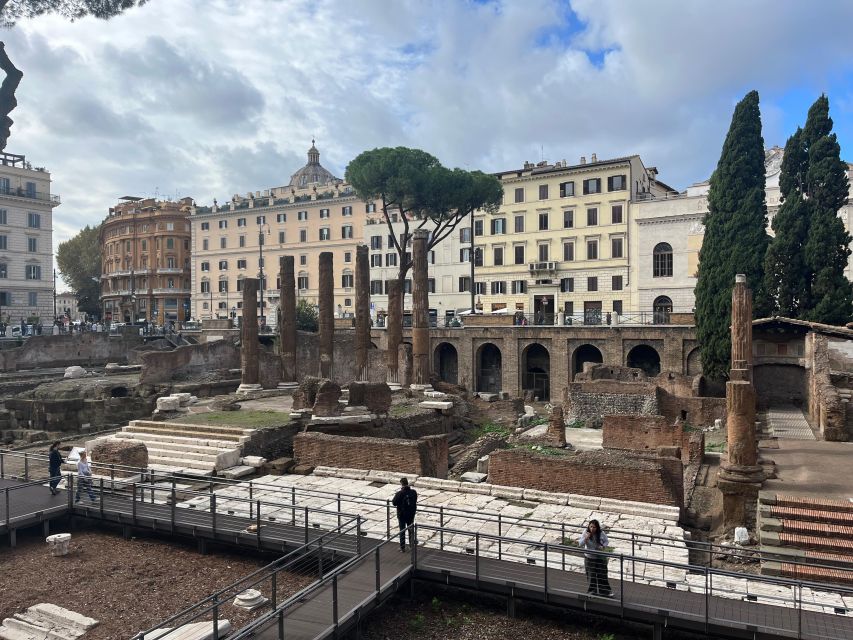
At $23 per person, this is not the cheapest way to glimpse Largo Argentina. Much of the site can be seen from outside, and it is possible that a visitor focused only on the general view would not feel the need to pay for entry.
The price makes more sense when you use everything included: reserved access, the multimedia presentation, the English audio guide, staff assistance, a city map, and WiFi. You are paying for interpretation and a prepared visit, not only for a look over the barrier.
I would call the value fair for a visitor who wants context. The video helps reconstruct the missing buildings, and the audio guide gives you a way to read the archaeological remains instead of simply photographing them. The package also reduces the uncertainty of arriving at an unfamiliar site.
I would be more cautious if you are already comfortable interpreting Roman ruins on your own. In that case, the outside view may satisfy you, and the skip-the-line feature may not save much time. The best reason to book is the educational material, not the claim that entry alone is hard to arrange.
Who should choose this experience?
I would recommend Largo Argentina for first-time Rome visitors who want to understand the city beyond its most famous monuments. The site is especially good for anyone interested in Julius Caesar, the Roman Republic, archaeology, or the way ancient and medieval buildings overlap.
It also suits people with a tight schedule. One hour gives you a focused stop, and the area is central enough to pair with other sightseeing in Rome, although transport is not included.
Families may appreciate the film because it turns low foundations into recognizable ancient buildings. The Caesar story also gives younger visitors a clear hook. The visit may be less appealing to someone who wants interactive activities, a live storyteller, or a large monument with interior rooms.
If you prefer a completely self-directed outing, remember that the main ticket may not be necessary for a quick outside view. If you want an explanation in English and a visual reconstruction of the site, the package offers more than the street-level glimpse.
Practical details to keep in mind
Bring your passport, as it is listed among the required items. Pets, glass objects, luggage, large bags, alcohol, and drugs are not allowed.
The activity is offered in English, including the audio guide. Food, drinks, and transport are not included, so plan those separately.
You can cancel up to 24 hours before the scheduled time for a full refund, and the reserve-now-pay-later option lets you hold a place without paying immediately. The key timing detail remains the same: your selected time is for Touristation Aracoeli, not simply for arrival at the excavation.
Should you book Largo Argentina?
I would book this experience if you want the Caesar connection explained clearly, need an English audio guide, and like the idea of seeing digital reconstructions before examining the real ruins. The film and app make the low foundations easier to understand, and the four temples provide a strong look at early Roman public architecture.
I would skip it if you only want a quick photograph from outside or if you already know the site well. At $23, the value depends on using the educational extras. For most first-time visitors, those extras make Largo Argentina a worthwhile one-hour addition to a Rome sightseeing day.
FAQ
Where do I meet for the Largo Argentina experience?
You meet at Touristation Aracoeli, Piazza d’Aracoeli 16. Look for the fountain and orange flags in front of the office entrance.
Does the selected time refer to entry at Largo Argentina?
No. The selected time refers to your appointment at Touristation Aracoeli, where you redeem your voucher and receive assistance before continuing to the archaeological area.
Is a guided tour included?
No. A live guided tour is not included. The package provides an English audio guide app instead.
What can I see at Largo Argentina?
You can see four temples dating from between the 4th and 1st centuries BC, the remains of the Curia of Pompey, imperial phases of the temples, and medieval structures.
Is the site connected with Julius Caesar’s assassination?
Yes. The remains preserve the tuff base of the Curia of Pompey, identified as the site where Julius Caesar was killed on the Ides of March in 44 BC.
How long does the activity last?
The listed duration is one hour. The included multimedia presentation lasts about 25 to 30 minutes, and you should also allow time to walk from the Touristation office to the archaeological site.
What should I bring, and what is not allowed?
Bring your passport. Pets, glass objects, luggage, large bags, alcohol, and drugs are not allowed.
Newest reviews from Rome
- Fiumicino Airport Arrivals Private Transfer Free with private half day tour of Rome★ 5.0 · 23 reviews
- Full Day Tour of Rome★ 5.0 · 23 reviews
- Private Tour – Palazzo Barberini★ 5.0 · 23 reviews
- From Rome: Private Day-Tour of Tuscany★ 4.3 · 23 reviews
- Rome at the Sunset; Navona, Trevi Fountain, Pantheon and more★ 5.0 · 23 reviews
- Rome Key Sights Golf Cart Tour | Private & Groups★ 5.0 · 23 reviews
- Rome: Wonders of Ancient Rome at Dusk★ 4.8 · 23 reviews
- Private Golf Cart Twilight Tour Rome★ 4.5 · 23 reviews