
Reviewed · EVENING EXPERIENCES
Ancient Rome’s Ultimate Night Walk
Rome is at its most atmospheric after sunset, when the monuments glow and the traffic thins. This walk links ancient ruins with modern Italy, moving from the unification monument at Piazza Venezia to the Roman Forum and the seat of today’s prime minister.
I like two things in particular: Michelangelo’s Piazza del Campidoglio gives the route an artistic centerpiece, and the compact group size of 15 or fewer should make it easier to hear the guide. The complimentary nightcap at the end is a pleasant touch.
The main caution is reliability in poor weather or around schedule changes. One family reported waiting in the rain without a guide and being unable to shift the booking, so confirm the meeting details carefully and arrive prepared for an outdoor walk.
In This Review
- Key points
- Why Rome works better after sunset
- Starting at Via dei Serpenti and Piazza Venezia
- The Quirinale, from papal residence to presidential palace
- Michelangelo’s Piazza del Campidoglio
- Via dei Fori Imperiali and the Roman Forum
- Piazza di Pietra and the columns of Hadrian’s Temple
- Piazza Colonna and the modern Italian government
- What $84.33 means in practical value
- Who should book this night walk
- Booking, weather, and one important caution
- Should you book Ancient Rome’s Ultimate Night Walk?
- FAQ
- Where does the tour start?
- What time does the walk begin?
- Where does the tour finish?
- How long does the experience last?
- Is the tour conducted in English?
- What happens if bad weather cancels the tour?
Key points
- Rome after dark: See major monuments under evening lighting, when the city feels calmer and more dramatic.
- Michelangelo’s Campidoglio: Visit one of Rome’s most elegant civic squares, designed by Michelangelo.
- Six central stops: Cover Piazza Venezia, the Quirinale, the Roman Forum, Hadrian’s Temple, and Piazza Colonna.
- A short but history-heavy route: Spend about 15 minutes at most stops, with only 5 minutes at Piazza di Pietra.
- Small English-speaking group: The maximum is 15 people, and the tour uses a mobile ticket.
- Nightcap included: Finish near the Italian prime minister’s office with a complimentary drink.
Why Rome works better after sunset
This 2-hour-30-minute walk gives you a useful evening introduction to Rome without requiring a museum ticket or a long day on your feet. The route is built around public squares, government buildings, temples, and ruins, so the city itself supplies the setting.
I like the timing. A 7 pm start lets you spend the day on indoor sights, then switch to Rome’s open-air monuments. The exact amount of daylight will depend on the season, but the tour is designed around the night-time character of the city.
The route also tells a broad story. You begin with the birth of modern Italy, move through papal and royal power, reach the symbolic center of ancient Rome, and finish with the institutions of the present-day republic. That gives the walk more shape than a simple parade of famous buildings.
You are not entering the Colosseum, the Roman Forum, or any museum on this experience. Instead, you see and discuss the sites from outside. That makes the tour easy to fit into an itinerary, though anyone wanting interior access will need a separate booking.
More walking tours in Rome:
- Rome: Trastevere & Campo de Fiori Street Food Walking Tour
★ 4.9 · 2,768 reviews - Rome: Paranormal Night Walking Tour & Secret Backstreets
★ 4.9 · 1,921 reviews - Rome by Night Walking Tour – Legends & Criminal Stories
★ 4.5 · 1,003 reviews
Starting at Via dei Serpenti and Piazza Venezia
The meeting point is Via dei Serpenti, 89, in central Rome. You should allow extra time to find it, especially if you are arriving by public transport or walking through the evening crowds. The tour uses a mobile ticket, and confirmation is provided when you book.
The first stop is Piazza Venezia, about 15 minutes from the start. This is where the walk introduces the story of Italian unification and the large monument built to honor it.
The square is one of Rome’s great orientation points. It connects the old city with major roads leading toward the Forum and the Capitoline Hill. The monument’s size can be startling, but the real value here is the political story behind it: Italy was not always one unified nation, and the modern country grew from a nineteenth-century movement to bring separate states together.
This is a good opening because it gives you a modern reference point before the tour turns toward ancient Rome. Look for the contrast between the broad, formal monument and the older streets and ruins nearby. The square can be busy and noisy, so stay close to the guide while crossing or moving between viewpoints.
The Quirinale, from papal residence to presidential palace
From Piazza Venezia, the walk continues to Piazza del Quirinale. The stop lasts about 15 minutes and focuses on the building’s changing role.
The Quirinale was once a principal papal residence. Later, it became a home for Italy’s royal family. Today, it is the seat of the Italian president. In a single square, you get a quick lesson in three different phases of Italian power: the papal state, the monarchy, and the republic.
That shift is one of the best reasons to take the walk with a guide. A building can look impressive on its own, but the political changes give the site meaning. You are not just looking at a grand palace. You are seeing how Rome’s rulers changed as Italy itself changed.
The stop is relatively short, so do not expect a detailed architectural tour. The guide’s explanation is the main event here. If you enjoy political history and the way buildings are reused over time, this will likely be one of the more interesting stops.
Michelangelo’s Piazza del Campidoglio
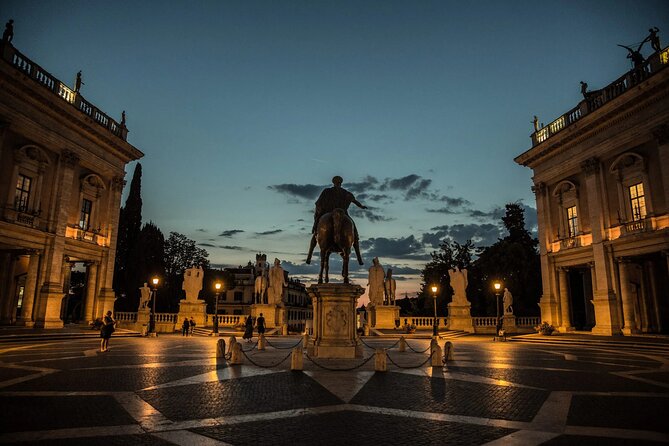
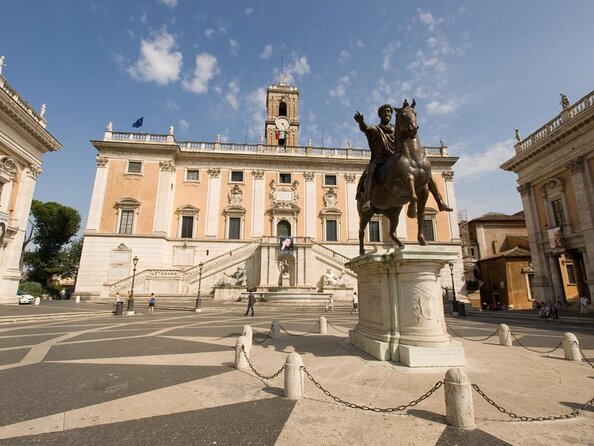
Piazza del Campidoglio is the artistic high point of the walk. Michelangelo designed the square, which sits on the Capitoline Hill and serves as the civic center associated with Rome’s mayor.
The space is famous for its carefully planned design. Michelangelo created a setting that feels ordered and theatrical, with the buildings and pavement working together rather than appearing as separate pieces. Even with only about 15 minutes here, you can appreciate how different it feels from the more chaotic streets around it.
I especially like this stop because it breaks up the ancient and political material with a clear work of Renaissance design. It also shows how Rome continually rebuilds itself on top of earlier layers. The hill has ancient importance, yet the square you see today reflects a later vision of civic Rome.
The tour does not include an interior visit to the Capitoline Museums. That is worth noting if you want to see more of Michelangelo’s design or the museum collections. This stop is about the square, its setting, and its connection to city government.
More Rome tours worth comparing
- Rome: City Highlights Open-Top Bus Night Tour
★ 4.1 · 2,038 reviews - Vespa Sidecar Tour By Night with Pickup
★ 5.0 · 1,803 reviews - Rome by Night – Ebike Small Group Tour – Food and Wine (Option)
★ 5.0 · 1,275 reviews - Colosseum Sunset Tour with Entry
★ 4.5 · 1,230 reviews
Via dei Fori Imperiali and the Roman Forum
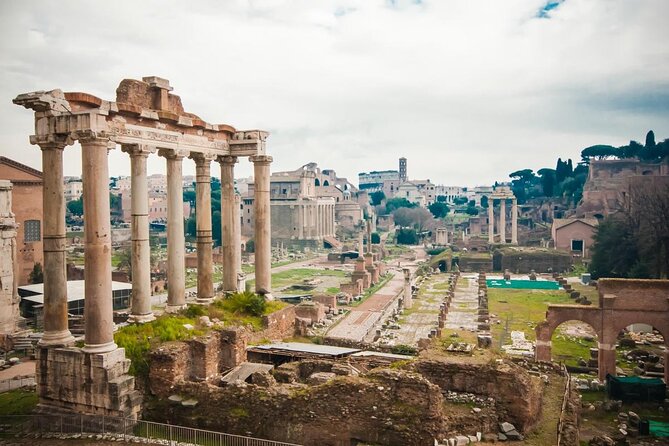
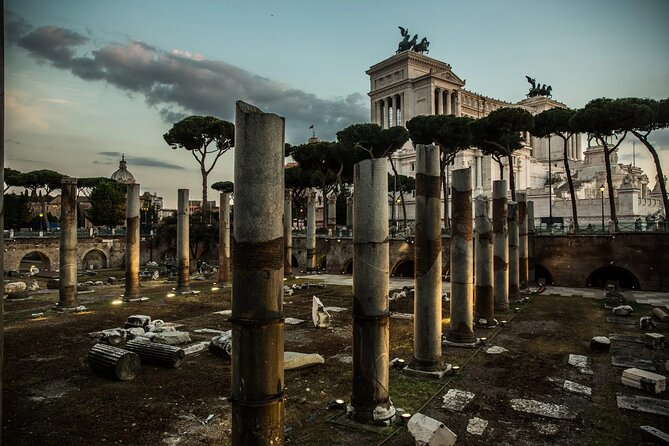
The walk then reaches Via dei Fori Imperiali, where you intersect with views of the ancient Roman Forum. The Forum was once the center of Roman public life and, for centuries, one of the key political and religious centers of the Western world.
This is where the route most clearly shifts into antiquity. Ruined columns, broken walls, and open archaeological ground can be hard to read without context. A guide helps you picture the Forum as a functioning public center rather than a scattered field of stones.
At night, the ruins can take on a different mood. Lighting often picks out columns and walls while leaving other parts in shadow. You may not see every detail, but the overall scale and layout become easier to appreciate from the road.
The tradeoff is that this is an outside view. You will not walk through the archaeological area as part of the tour, and 15 minutes is enough for an introduction, not a full explanation of the Forum. If you plan to visit the Forum during the day, this evening stop works well as a preview. If this is your only look at ancient Rome, you may want a separate daytime visit.
Piazza di Pietra and the columns of Hadrian’s Temple
Piazza di Pietra is a very short stop, about five minutes, but it offers one of the route’s neatest details. The facade of the local Chamber of Commerce incorporates the original columns of the Temple of Hadrian.
This is classic Rome: ancient material remains part of the modern city instead of being separated behind a fence. The columns rise directly from the square, and the building behind them gives you an immediate sense of how old Roman structures were reused and absorbed into later architecture.
Because the stop is brief, listen closely for the explanation and take a quick look around before the group moves on. This is not a place for a long pause, but it is an excellent example of Rome’s layered construction.
I find details like this more useful than another grand monument viewed from a distance. They show how ordinary city life can continue around ancient remains. The square also gives the route a change of pace after the large archaeological views along Via dei Fori Imperiali.
Piazza Colonna and the modern Italian government
The final scheduled stop is Piazza Colonna, about 15 minutes from the route. The square connects the story of Rome’s powerful families with the office of the Italian prime minister.
The name points to the Colonna family, one of the influential Roman families that played a role in the city’s long political and religious story. The square also contains the column of Marcus Aurelius, though the supplied tour details place particular attention on the surrounding power structure and the nearby government seat.
Ending here makes sense. The walk has moved from ancient imperial authority to papal rule, monarchy, local civic government, and the modern Italian state. You finish in a place where national politics still operates today.
The tour ends at Piazza Colonna, near the seat of the Italian prime minister. It is a central location, useful if you want to continue on foot or find dinner afterward. The complimentary nightcap gives the ending a social touch, though the details of the drink and venue are not specified, so you should not book this expecting a full food or bar experience.
What $84.33 means in practical value
At $84.33 per person, this is not the cheapest way to see Rome’s historic center. You are paying for a guided evening walk, an English-speaking guide, a small maximum group of 15, and the included nightcap.
The value depends on how much context you want. If you already know Rome well and are comfortable reading ruins and political monuments on your own, the price may feel high for a route made up of free outdoor stops. If you are new to the city, the guide can connect places that otherwise seem unrelated.
The compact group matters here. A group of 15 is still large enough to feel social, but much easier to manage than a big crowd. You can generally expect the guide’s explanations to be more audible, though the actual experience will depend on the guide and the pace of the group.
One particularly positive guide experience involved Nick, who was praised for bringing Rome’s past to life with a strong narrative and a friendly manner. Guides can vary, but that gives you a useful standard: this tour works best when the storytelling is as important as the sightseeing.
The walk is also a good use of an evening because it does not consume a full day. You can visit paid attractions earlier, rest or eat beforehand, and then see a different side of central Rome. The price is easier to justify if you value a clear story and a small group more than admission tickets.
Who should book this night walk
I would choose this experience for a first or second visit to Rome, especially if you want an organized introduction to the historic center. It suits people who enjoy political stories, ancient ruins, public squares, and architecture more than long indoor museum visits.
It is also a sensible choice for couples, solo visitors, and families who want a short evening activity. Most people can participate, service animals are allowed, and the meeting point is near public transportation.
You should be comfortable walking outdoors for two and a half hours. The tour requires good weather, and Rome’s evening conditions can change. Wear practical shoes and bring a light rain layer, even if the forecast looks promising.
This is less suitable if you need step-free access, though the supplied details do not give a full route-accessibility assessment. It is also not the right choice if your priority is entering the Forum, climbing monuments, or touring the interiors of government buildings.
Booking, weather, and one important caution
The tour is offered in English and usually sells about two weeks ahead, with an average booking time of 14 days. If your dates are fixed, booking early is sensible, especially since the group limit is 15.
Free cancellation is available if you cancel at least 24 hours before the 7 pm start. Changes or cancellations inside that window are not accepted for a refund. The local cut-off time applies.
Poor weather can cancel the experience. If that happens, you should be offered another date or a full refund. The same applies if the minimum number of participants is not reached.
There is one practical warning. A family once arrived for a rainy evening after asking to move the booking because of a delayed flight. They reported that nobody arrived by 7:15 and that repeated calls went unanswered, followed by a denied refund request. This appears to be an isolated but serious service failure, so save the meeting instructions and the provider’s contact details, and allow time to reach Via dei Serpenti, 89.
Should you book Ancient Rome’s Ultimate Night Walk?
Book it if you want a story-led evening walk that links modern Italy, papal Rome, Renaissance design, and ancient ruins in one compact route. The highlights are the changing political story, Michelangelo’s Campidoglio, the nighttime views along the Imperial Forums, and the small-group format.
Skip it if you want extensive archaeological access, indoor sightseeing, or a fully flexible rainy-day plan. At $84.33, the tour makes the most sense for someone who values interpretation and a well-shaped route rather than admission to attractions.
For a first evening in Rome, I think the itinerary is thoughtfully arranged. Just confirm the meeting point, watch the weather, and keep the 24-hour cancellation rule firmly in mind.
FAQ
Where does the tour start?
The tour starts at Via dei Serpenti, 89, 00184 Rome, Italy.
What time does the walk begin?
The scheduled start time is 7 pm.
Where does the tour finish?
The tour ends at Piazza Colonna, near the seat of the Italian prime minister.
How long does the experience last?
The walk lasts approximately 2 hours and 30 minutes.
Is the tour conducted in English?
Yes. The experience is offered in English.
What happens if bad weather cancels the tour?
If poor weather causes a cancellation, you will be offered a different date or a full refund.
Newest reviews from Rome
- ROME:Colosseum & Ancient Rome – private/small group TOUR★ 5.0 · 24 reviews
- Off the Beaten Track in Rome: Rione VI Parione Private Tour★ 5.0 · 24 reviews
- Cinematic Photoshoot in Rome★ 5.0 · 24 reviews
- Rome: Best of Colosseum and Roman Forum Small Group Guided Tour★ 4.5 · 24 reviews
- The Labyrinth of Rome between catacombs and ancient quarries★ 4.5 · 24 reviews
- Vatican and Trionfale Market Tour with Wine and Food Tasting★ 5.0 · 24 reviews
- private tour: Vatican Museums, Sistine Chapel, St. Peter’s Basilica★ 4.5 · 24 reviews
- Colosseum guided tour with Virtual Reality★ 5.0 · 24 reviews
Evening Experiences, compared.
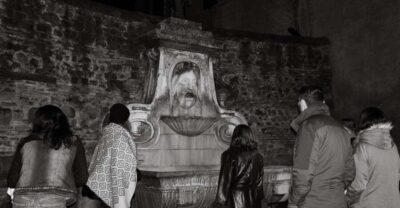
Paranormal Night Walking Tour & Secret Backstreets
Read our review →
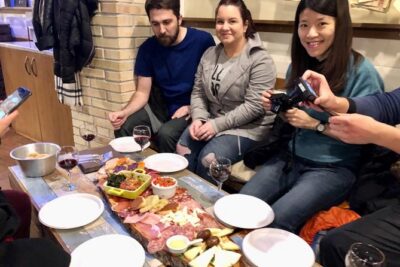
Rome by Night – Ebike Small Group Tour – Food and Wine (Option)
Read our review →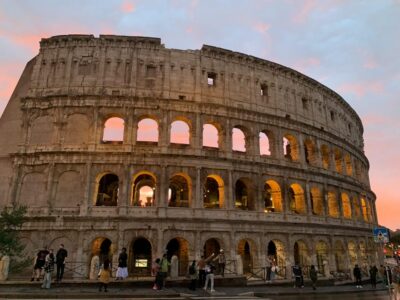
Rome by Night Walking Tour – Legends & Criminal Stories
Read our review →
Guided City Center Evening Sightseeing Walking Tour
Read our review →
Colosseum by Evening Guided Tour with Optional Arena Floor Access
Read our review →Browse the lists this tour appears in