
Reviewed · CATACOMBS & CRYPTS
Appian Way, Catacombs and Aqueducts Park Tour with Top E-Bike
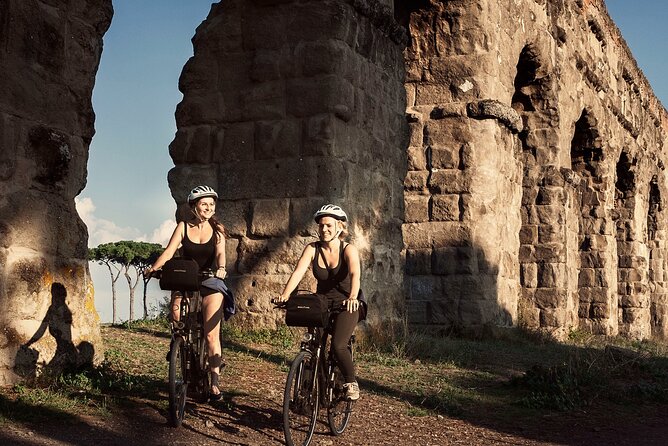
Rome’s ancient outskirts are far too spread out for a pleasant walk. This Appian Way e-bike tour solves that problem neatly, carrying you from the Aurelian Walls to catacombs, imperial ruins, and the great aqueducts in one long, scenic loop. The six-hour version adds a proper catacomb visit, Villa dei Quintili, and the Baths of Caracalla.
I like two things right away: the electric assistance keeps the 27-kilometer route manageable, and the small groups, limited to 10 people, give guides such as Arina, Claudia, Fabio, Lorenzo, and Bita room to explain what you are seeing. You get far beyond the usual Colosseum and Vatican circuit.
The catch is simple: this is not a casual bicycle outing. About 40 percent of the ride uses city streets, and 60 percent is off-road, with bumpy surfaces, tight paths, and occasional traffic. You should feel confident on a bike before booking.
In This Review
- Key points to know before you pedal off
- Why an e-bike is the right tool for the Appian Way
- Leaving Rome through Porta San Sebastiano
- The Ancient Appian Way and its changing scenery
- Choosing between the four-hour and six-hour routes
- Catacombs of San Callisto and San Sebastiano
- Circus of Maxentius and Cecilia Metella
- Villa dei Quintili on the six-hour route
- Aqueducts Park and Rome’s ancient water system
- Baths of Caracalla and the return ride
- Guide quality and group size
- Price, timing, and who gets the best value
- Should you book the Appian Way e-bike tour?
- FAQ
- Where does the tour begin and end?
- How long is the tour?
- How far do you ride?
- Is the tour suitable for beginner cyclists?
- Are helmets provided?
- What is included with the e-bike?
- Are the catacombs included in both tour versions?
- Is food included?
Key points to know before you pedal off
- The six-hour tour is the fuller choice: It includes a 45-minute guided catacomb visit, Villa dei Quintili, Santa Maria Nova, and the Baths of Caracalla.
- The route covers about 17 miles: Expect roughly 27 kilometers over four to six hours, not a short sightseeing spin.
- E-bikes do the heavy lifting: The motor reduces effort, but it does not remove the need for balance, attention, and control.
- The scenery changes quickly: You ride from Rome’s city streets to ancient paving stones, open fields, sheep pastures, and towering aqueducts.
- Some traffic is unavoidable: The carefully planned route limits exposure, but city riding is part of connecting the two archaeological parks.
- Weekdays may feel calmer: Sundays can bring more pedestrians and cyclists to the Appian Way and Aqueducts Park.
Why an e-bike is the right tool for the Appian Way
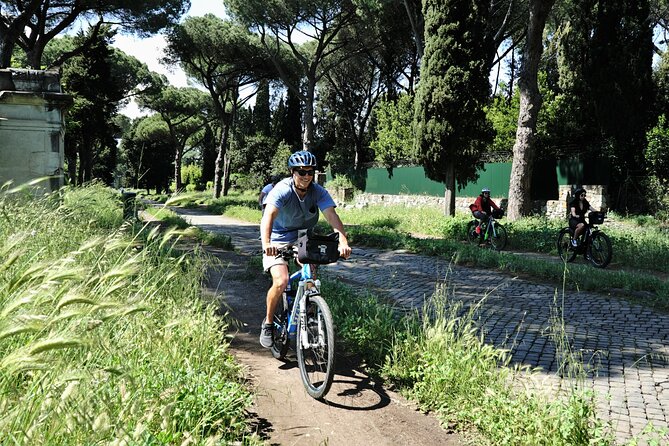
The Appian Way, or Via Appia Antica, is not one compact monument. It is a long ancient road running through a broad archaeological area outside Rome’s center. Walking even a portion can leave you seeing only the first few sights before the distance becomes a problem.
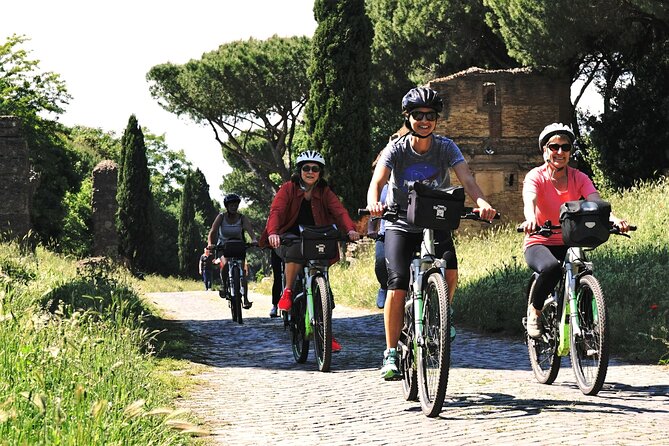
The e-bike changes the scale of the day. You can cover the road, catacombs, imperial ruins, and aqueducts without spending all your energy on the ride itself. You can also turn off the assistance if you want more exercise, though most people will appreciate having the motor ready for the longer stretches and rougher surfaces.
The bikes include anti-puncture tires, a front bag, a water bottle, and a helmet. The equipment has a 300-pound, or 136-kilogram, weight limit. Children aged 9 and above can ride a suitably sized e-bike, while children aged 5 to 8 can use a child extension.
Still, the motor does not make you a cyclist. You need to brake, steer, keep a safe distance, and handle uneven ground. One useful bit of practical advice: if you have back or neck trouble, the bumpy park paths may not be comfortable.
More catacomb and crypt visits from Rome:
- Rome: Crypts and Catacombs Underground Tour with Transfers
★ 4.6 · 5,341 reviews - The Original Roman Crypts and Catacombs Tour with Transfers
★ 4.5 · 4,896 reviews - Rome: Catacombs of St. Callixtus Entry Ticket & Guided Tour
★ 4.6 · 3,037 reviews
Leaving Rome through Porta San Sebastiano
The ride begins at Via Labicana 49, a convenient central meeting point near public transportation. From there, the group heads toward Porta San Sebastiano, a grand gateway in the third-century Aurelian Walls.
This opening section gives you a quick lesson in Rome’s layered defenses. The gate is not a long stop, but it marks the shift from the dense center to the older roads beyond it. The guide also has to get the group safely through the first city section, so listen closely to instructions and keep your eyes on the road.
Around 40 percent of the total route is in the city. The company uses selected streets intended to reduce traffic exposure, but you should not expect a completely traffic-free ride. Some riders have found that moving slowly in a group through narrow paths and city sections requires extra concentration.
The Ancient Appian Way and its changing scenery
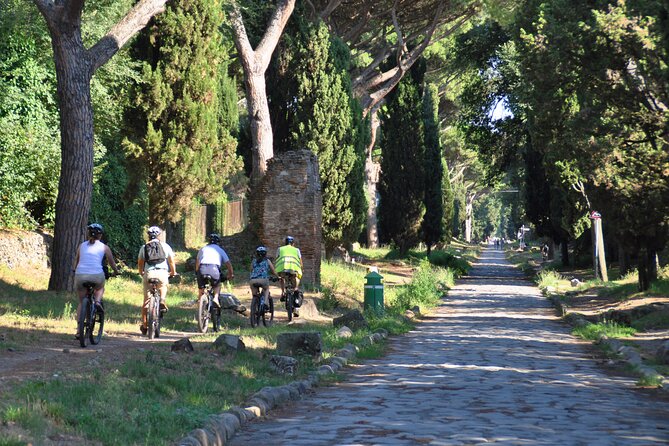
The Appian Way begins almost quietly. The modern city gradually thins out, and the road takes on a more rural character. Ancient stones, Roman ruins, trees, fields, and low hills replace the traffic and buildings of central Rome.
This is the heart of the tour. You are not simply arriving at a monument, taking a picture, and leaving. The road itself is the attraction. It helps you understand how Roman power moved people, armies, trade, and messages across Italy.
The ride is especially appealing if you want a break from indoor museums and crowded central streets. The route reaches open country where sheep graze in the surrounding pastures. You get a more spacious view of Rome, with the city’s ancient infrastructure spread across the countryside rather than packed into a single site.
The trade-off is the surface. About 60 percent of the ride takes place off-road, and the paths can be rough. Some riders have found narrow sections nerve-racking, especially when trying to look around while moving. Pull over when you want photographs. Do not try to take pictures while steering through a tight stretch.
Choosing between the four-hour and six-hour routes
The four-hour option is the better fit if you have limited time or want a lighter day. It includes the main Appian Way route, the catacombs area, Circus of Maxentius, Cecilia Metella, and the Aqueducts Park. On Wednesdays, the catacomb portion changes and may not be included in the four-hour route.
The six-hour route costs more time but adds real substance. You receive a 45-minute guided visit inside the catacombs, then continue to Villa dei Quintili and Santa Maria Nova before reaching the aqueducts and Baths of Caracalla.
I would choose the six-hour version if ancient Rome is a main reason for your visit. The longer route gives you time to stop, listen, and see the area as a connected network of roads, estates, burial places, waterworks, and public buildings. If you have only one day in Rome or prefer a brisk overview, four hours may be enough.
On Wednesdays, allow up to 30 extra minutes. The four-hour tour may run for four and a half hours, and the six-hour tour may reach six and a half hours. From January 14 to February 11, 2026, the same extra time applies.
More Appian Way days out:
- Rome EBike Tour: Appian Way, Catacombs & Roman Aqueducts
★ 5.0 · 1,766 reviews - Rome: Appian Way, Catacombs, & Roman Aqueducts E-bike Tour
★ 4.9 · 1,421 reviews - Rome:Appian Way E-bike Tour with Catacombs, Aqueducts & Food
★ 4.9 · 1,210 reviews - Rome Underground: Catacombs Tour, Aqueducts and Appian Way
★ 5.0 · 1,007 reviews
Catacombs of San Callisto and San Sebastiano
The catacombs provide the tour’s most atmospheric stop. San Callisto began in the second century and became one of the major Christian burial sites beneath Rome. The underground complex held the remains of roughly half a million people, a number that gives the visit a sobering scale.
In the four-hour tour, the catacombs receive only a short pause for reflection. The six-hour tour includes the 45-minute guided visit, which is the better choice if you want to understand the tunnels, burial practices, and religious setting rather than simply see the entrance.
On Wednesdays, the six-hour route visits the Catacombs of San Sebastiano instead of San Callisto. On Easter Sunday, April 5, 2026, the catacombs are closed, so the six-hour tour does not run.
The underground visit also means a change of pace. After riding outdoors, you move into a confined and solemn place. Anyone uncomfortable in enclosed spaces should think carefully before choosing the longer route.
Circus of Maxentius and Cecilia Metella
The Circus of Maxentius is part of a fourth-century imperial complex that included a villa, mausoleum, and chariot-racing venue. The remains show how an emperor could build an entire private world outside the city center, complete with entertainment and burial buildings.
The stop is brief, but the setting makes it useful. You can picture the circus not as an isolated ruin but as one part of a working imperial estate.
Nearby, the Mausoleum of Cecilia Metella is one of the Appian Way’s most recognizable structures. This first-century funerary monument was built for a young woman from a wealthy patrician family. Its size tells you much about Roman status: even a single family tomb could be built on a grand scale and positioned beside one of the empire’s great roads.
You may not spend long at either site, since the tour covers a large area. The guide’s explanation is important here. Without context, the ruins can look like scattered stone. With a clear explanation, they become pieces of Roman family power, public display, and imperial planning.
Villa dei Quintili on the six-hour route
The Villa dei Quintili is reserved for the longer tour. This sprawling second-century estate belonged to two extremely wealthy brothers who later became associated with Roman imperial power.
The site gives you a different look at ancient Rome from the catacombs and public roads. Here, the focus is private luxury and land ownership. The scale of the grounds also reinforces why a bicycle is useful. You can reach an area that would be tiring to connect on foot while still seeing it as part of the larger Appian Way region.
Santa Maria Nova is included in this same section of the six-hour route. The stop adds another layer to the long history of the area, where ancient Roman remains and later religious use share the same space.
Aqueducts Park and Rome’s ancient water system
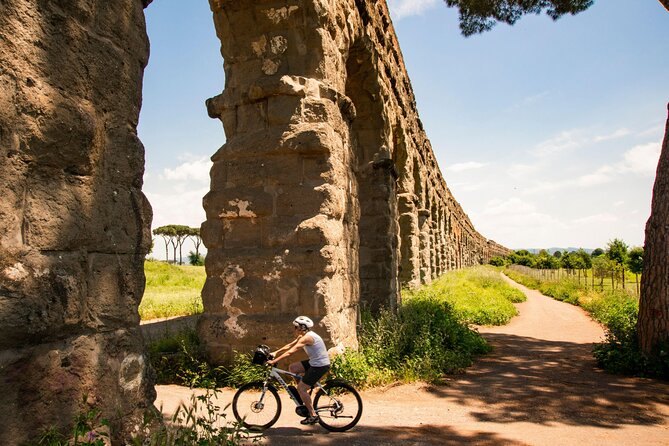
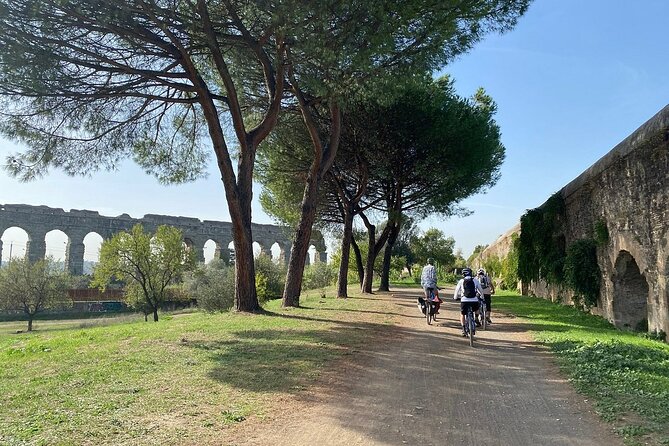
The Aqueducts Park is the visual high point for many people. Huge arches cross open fields, creating one of the most memorable outdoor views near Rome.
Your guide explains how Rome’s water supply worked, including the underground channels and elevated aqueducts that carried water into the city. The engineering is easier to appreciate when you see the scale of the structures in an open setting.
This is also a good place for a food break if you bring something or buy food along the route. No meal or drink is included, but there are a few chances to purchase refreshments. Pack or buy something before you become hungry, since the route is long and the stops are arranged around the ride rather than a formal restaurant meal.
The park can be busy on Sundays, with local walkers and cyclists sharing the paths. A weekday departure may make it easier to ride at a comfortable pace and enjoy the views without constantly watching for people ahead.
Baths of Caracalla and the return ride
The six-hour tour ends its sightseeing route with a view of the Baths of Caracalla. These enormous public baths were central to Roman social life, not merely places to wash. Romans went to the baths to exercise, meet friends, relax, and take part in public culture.
You see the baths from a favorable vantage point rather than taking an extended indoor tour. That keeps the day moving and gives you one final reminder of how much Roman life depended on large public buildings.
Afterward, the group returns to the starting point at Via Labicana. By then, you will have crossed city streets, ancient roads, park paths, and open countryside. It is a full physical day even with electric assistance.
Guide quality and group size
A maximum of 10 people per guide is one of the tour’s practical strengths. A guide can keep the group together, help with city traffic, adjust the pace, and answer questions without turning the ride into a large procession.
The guides bring different personalities to the day. Arina has been praised for making the ride fun and clear, while Claudia is described as engaging and friendly. Fabio is noted for his enthusiasm for Rome’s past, and Lorenzo has handled questions about the aqueducts and Appian Way with ease. Other guides, including Bita, Zak, Stefan, Ali, Christian, Khalid, Han, and David, have also led tours.
The guide matters more here than on a simple bike rental. You are riding through places where the meaning is not always obvious. A good explanation turns a mausoleum, road fragment, or water channel into part of a larger story.
There is one point to keep in mind: group riding can feel slow. One rider found the pace overly cautious and felt that bicycles were sometimes too close together. That may not be a problem for you, especially if safety and sightseeing matter more than speed, but strong cyclists should not expect a fast ride.
Price, timing, and who gets the best value
At $102.79 per person, this is not the cheapest way to see Rome. The price includes a quality e-bike, helmet, bottle, front bag, local guide, and, on the six-hour version, a guided catacomb visit.
The value comes from combining sites that are difficult to connect by public transportation or on foot. A taxi could move you between areas, but it would not give you the steady outdoor view of the road, fields, ruins, and aqueducts. Renting a bike alone may cost less, but you would need to plan the route, manage city connections, and supply your own historical context.
I think the price is easier to justify if you choose six hours, have at least two days in Rome, and want a major outing beyond the central monuments. The four-hour option offers better time value for a packed itinerary.
This tour suits confident cyclists, active families with older children, and people who want fresh air with their ancient history. It is less suitable for anyone uneasy on a bike, anyone seeking a fully relaxed ride, or anyone with physical concerns about rough ground. Children aged 5 to 8 can use the provided extension, but the route is considered difficult with a child seat or extension attached.
Free cancellation is available up to 24 hours before the start time. The tour requires at least four participants, and a smaller booking may be canceled with an alternative or full refund offered.
Should you book the Appian Way e-bike tour?
Book it if you want to see a side of Rome that most walking routes cannot reach. The combination of the Appian Way, catacombs, imperial ruins, and aqueducts gives you a broader sense of ancient Roman life than another short visit to a central monument.
Choose the six-hour route if the catacombs matter to you, you have the time, and you want Villa dei Quintili and the Baths of Caracalla included. Choose four hours for a strong overview with less time in the saddle.
I would skip it if you are not self-confident on a bicycle or if rough paths and city traffic sound stressful. For everyone else, this is a memorable, active way to get beyond Rome’s center, with electric assistance making a long archaeological route practical.
FAQ
Where does the tour begin and end?
The tour begins at Via Labicana 49, 00184 Rome, Italy. It ends back at the same meeting point.
How long is the tour?
You can choose a four-hour or six-hour route. On Wednesdays, the tour may last 30 minutes longer because of a route change. The same extension applies from January 14 to February 11, 2026.
How far do you ride?
The route covers approximately 17 miles, or 27 kilometers. About 60 percent takes place off-road in the parks.
Is the tour suitable for beginner cyclists?
The tour requires a moderate fitness level and is not recommended if you lack confidence on a bicycle. The difficulty is intermediate, with rough paths, narrow sections, and some city traffic.
Are helmets provided?
Yes. Helmets are provided free of charge and must be worn during the tour.
What is included with the e-bike?
The tour includes a top-quality e-bike with anti-puncture tires, a front bag, a biodegradable water bottle, and a helmet. A local guide is also included.
Are the catacombs included in both tour versions?
The six-hour version includes a 45-minute guided catacomb visit. The four-hour version includes only a short pause near the catacombs, and on Wednesdays that stop is not included.
Is food included?
No. Food and drinks are not included, but the route offers some opportunities to buy refreshments for a suitable break.
More E-Bikes in Rome
- Rome: Appian Way E-Bike Tour Catacombs, Aqueducts & Picnic
★ 4.6 · 727 reviews - Rome: Appian Way & Catacomb Sunset E-bike Tour with Aperitif
★ 4.5 · 682 reviews - Appian Way & Aqueducts small group e-bike tour(catacombs & food)
★ 5.0 · 531 reviews - Rome:Appian Way E-bike Tour, Catacombs, Aqueducts & Transfer
★ 4.9 · 404 reviews
More Cycling Tours in Rome
- Rome: Top Highlights & Hidden Gems Tour by Cannondale E-Bike
★ 4.9 · 1,760 reviews - Rome City Small Group Bike Tour with quality Cannondale EBike
★ 5.0 · 1,380 reviews - Rome by Night – Ebike Small Group Tour – Food and Wine (Option)
★ 5.0 · 1,275 reviews - Rome: E-Bike Night Tour with Food and Wine Tasting
★ 4.9 · 1,131 reviews
Newest reviews from Rome
- Rome: Vatican Museums & Sistine Chapel Skip-the-Line Ticket★ 4.4 · 148 reviews
- Shared Shuttle Transfer from Rome to Civitavecchia Port★ 5.0 · 148 reviews
- Rome: Crypts & Catacombs After Hours Tour with Bone Chapel★ 4.6 · 149 reviews
- Ghosts Legends and Mysteries of Rome Walking Tour★ 5.0 · 149 reviews
- Skip the Line: Vatican and Sistine Chapel with Guided Tour★ 4.0 · 149 reviews
- Tivoli: Villa Gregoriana Entrance Ticket★ 4.7 · 150 reviews
- Pizza and Tiramisu Cooking Class in Rome, Piazza Navona★ 5.0 · 150 reviews
- Rome: Borghese Gallery Skip-the-Line Entry and Guided Tour★ 4.7 · 150 reviews
Catacombs & Crypts, compared.

Crypts and Catacombs Underground Tour with Transfers
Read our review →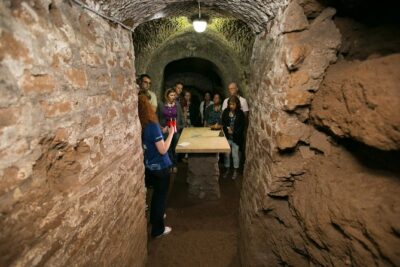
The Original Roman Crypts and Catacombs Tour with Transfers
Read our review →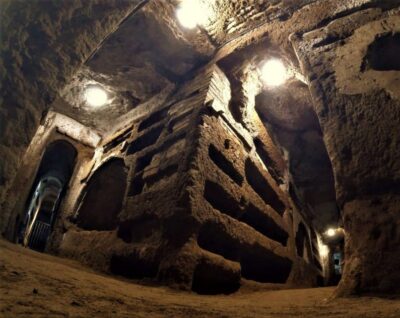
Catacombs of St. Callixtus Entry Ticket & Guided Tour
Read our review →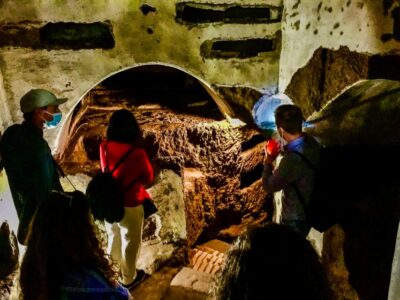

Rome EBike Tour: Appian Way, Catacombs & Roman Aqueducts
Read our review →
Catacombs and Capuchin Crypt Guided Tour with Transfer
Read our review →
St. Peter’s Basilica Priority Access Tour with Dome & Crypt
Read our review →Browse the lists this tour appears in