
Reviewed · POMPEII & NAPLES DAY TRIPS
From Rome: Pompeii and Herculaneum by High-Speed Train
Pompeii and Herculaneum in one day is a serious dose of ancient Rome, made practical by a 70-minute high-speed train from Roma Termini. Instead of spending hours on a bus, you reach Naples quickly, then let the tour team handle the local driving to both archaeological sites.
I like two things here: you see the grand public spaces of Pompeii and the more intimate homes of Herculaneum, and you have an archaeologist to explain what you are looking at. The main drawback is time. Pompeii gets about two hours with the guide and only 30 minutes of free time, so lunch and photographs can feel rushed.
In This Review
- Key points at a glance
- Why the fast train makes this Rome day trip work
- Pompeii first: a city rather than a single monument
- Thirty minutes for food, photos, and a quick look around
- Herculaneum offers a closer, more domestic experience
- What the archaeologist adds
- Transport, timing, and the shared minibus
- Is $222.77 a fair price?
- Who should book this experience?
- Should you book the Pompeii and Herculaneum day trip?
- FAQ
- How long is the tour from Rome?
- Where does the tour begin?
- Where do I meet the guide in Naples?
- How long does the train from Rome to Naples take?
- How much time is spent at Pompeii?
- How much time is spent at Herculaneum?
- Are meals included?
- Is the tour suitable for people with limited mobility?
Key points at a glance
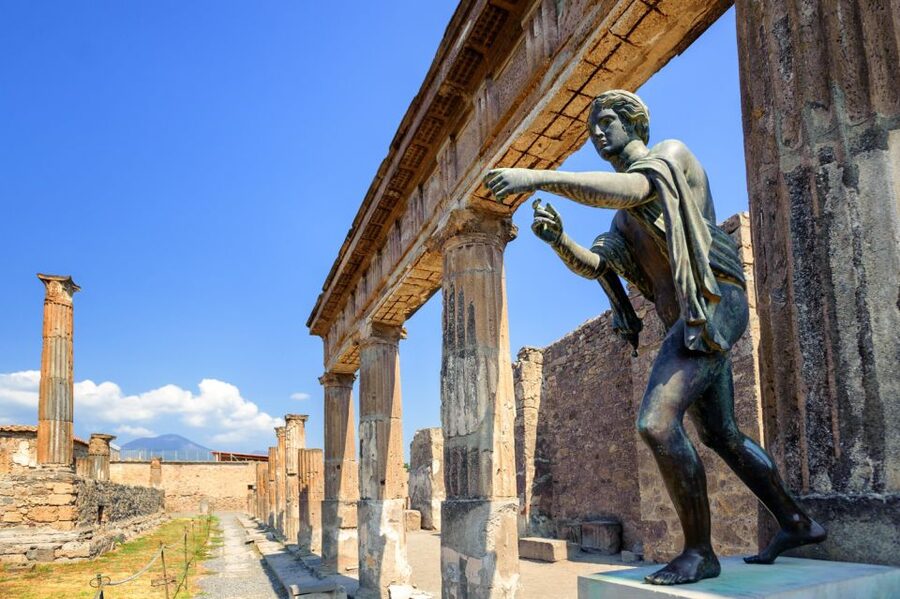
- High-speed rail saves the day: The Rome to Naples journey takes about 70 minutes each way, rather than tying you to a long bus ride.
- Two sites, two different stories: Pompeii shows a large Roman city, while Herculaneum gives you a closer look at houses, decorations, and the ancient shore.
- Archaeologists lead both visits: Guides such as Michele, Raphael, Diego, Giulia, and Paolo have been praised for explaining both daily life and the eruption itself.
- The plaster casts are unforgettable: Pompeii’s casts of people and animals make the disaster personal in a way that ruins alone cannot.
- Plan for uneven ground: You will walk about one mile in Pompeii and half a mile in Herculaneum, often on old stone surfaces.
- Lunch is not included: You get 30 minutes of free time at Pompeii, so a quick meal is wiser than a leisurely restaurant stop.
Why the fast train makes this Rome day trip work
The distance between Rome and the Bay of Naples makes this a long day, but the train keeps it within reason. You leave from Roma Termini, travel independently with pre-booked tickets, and arrive at Naples Central Station in roughly 70 minutes. That is the key advantage of this experience.
At Naples, you meet the guide in front of the STARHOTEL TERMINUS entrance, opposite the station. Look for the ASKOS TOURS sign. One practical warning: the meeting point can be easy to miss in the movement around the station, and the sign may not be especially large. Give yourself time to get off the train, cross the station area, and find the entrance without panic.
From there, a shared van or minibus takes you to Pompeii in about 30 minutes. You do not need to work out regional trains, arrange a taxi, or figure out how to connect the two sites. That transport is a major part of the price.
The return follows the same pattern: minibus to Naples Central Station, then the fast train back to Roma Termini. Build a little breathing room into your plans after the official finish. The tour ends back at the meeting point, but rail schedules and station navigation are still your responsibility once the group separates.
More Pompeii and Naples day trips from Rome:
- From Rome: Pompeii, Amalfi Coast, and Sorrento Day Trip
★ 4.6 · 7,031 reviews - From Rome: Pompeii, Amalfi Coast and Positano Day Trip
★ 4.6 · 6,620 reviews - Pompeii, Amalfi Coast and Positano Day Trip from Rome
★ 4.5 · 6,250 reviews
Pompeii first: a city rather than a single monument
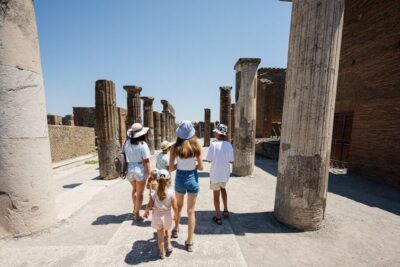
Pompeii is often treated as one famous ruin, but it is really a broad Roman town. The two-hour guided visit helps you read it as a place where people lived, worked, worshiped, ate, entertained themselves, and ran businesses.
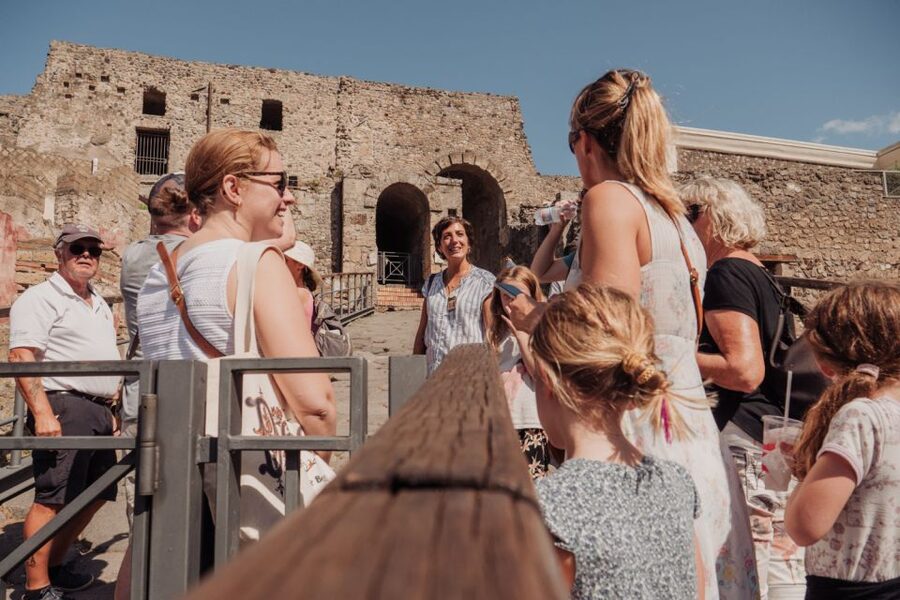
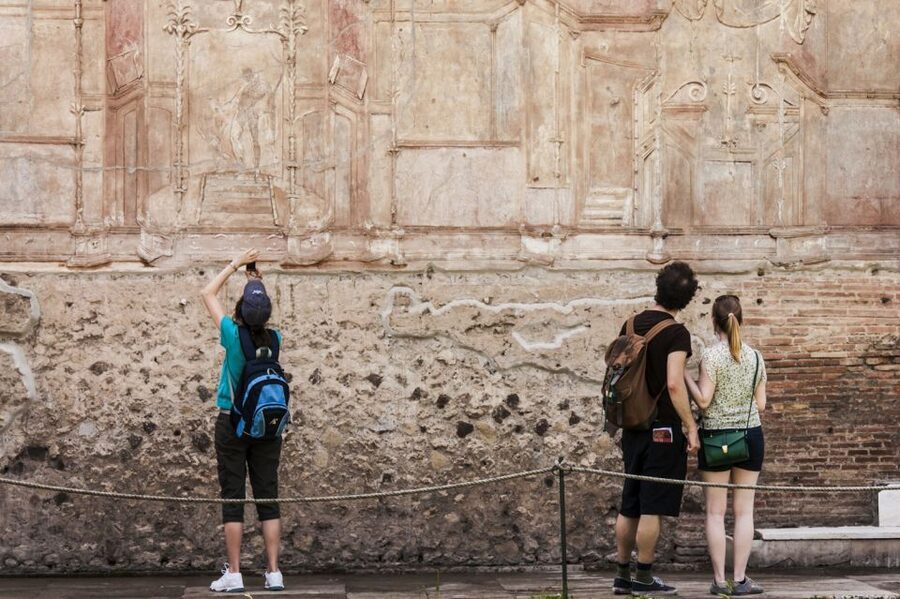
Your archaeologist guide takes you through key buildings and recently opened houses. The value of an archaeological guide is clearest here. Without context, a wall can look like a wall. With an explanation of its use, decoration, or position in the city, the same wall begins to show how Roman life was organized.
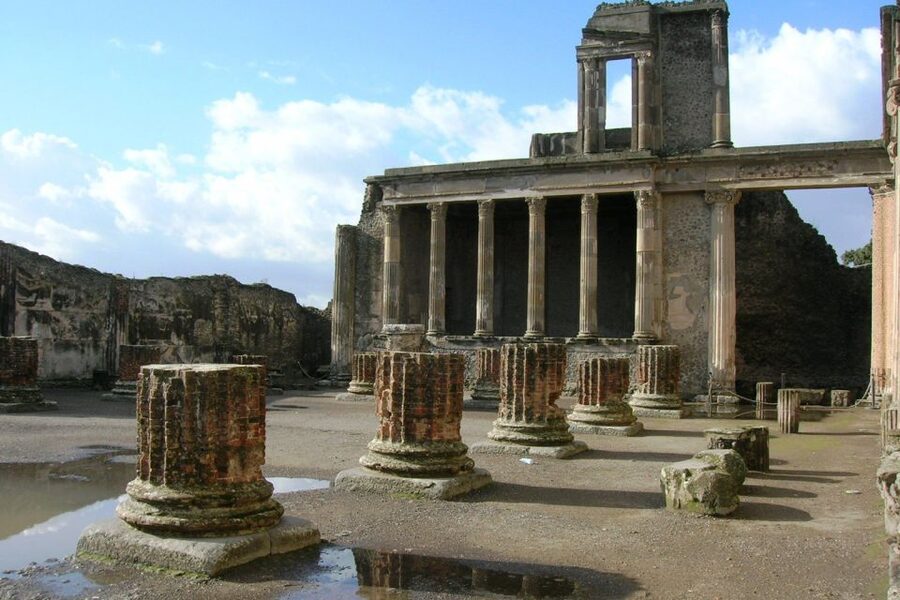
The route includes the forum, one of Pompeii’s central public areas, along with other major buildings. You also visit the brothel, a stop that usually gets attention because it offers a direct, earthy glimpse of ordinary commercial life. The guide can connect these places to the wider city instead of presenting them as isolated curiosities.
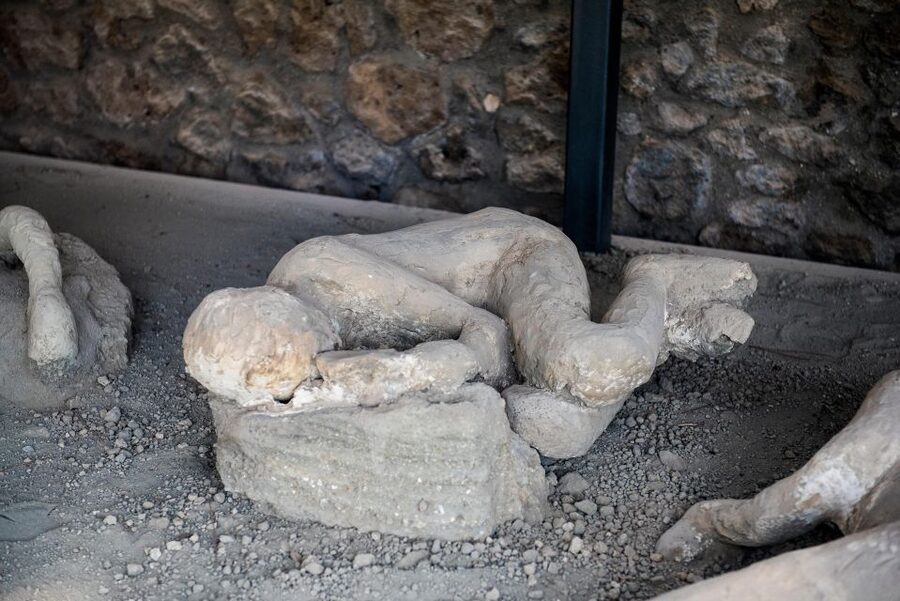
The plaster casts are another important stop. These are not original bodies. They were made from cavities left in the hardened volcanic material, preserving the shapes of people and animals caught in the eruption. Seeing these forms at close range changes the tone of the visit. Pompeii is not only about architecture and painted walls. It is also about the people who did not escape.
Expect a brisk walking pace. The route covers about one mile, but the uneven ancient streets can make it feel like more. Wear sturdy, comfortable shoes. Sandals, flip flops, and high heels are not allowed, and they would not be sensible on the old stone paving anyway.
Thirty minutes for food, photos, and a quick look around
After the guided portion at Pompeii, you have about 30 minutes of free time. This is useful, but it is not a relaxed lunch break.
Food options near the entrance can be limited, and getting a table and finishing a meal inside the allotted time may be difficult. I would choose something quick and keep your order simple. If you want a proper sit-down lunch, this schedule may disappoint you.
You can also use the break for a bathroom stop, a few photographs, or a little shopping. Some people would prefer to spend all of this time inside the ruins, especially since the guided visit moves quickly. That is the tradeoff built into seeing both Pompeii and Herculaneum on the same day.
If photographs matter to you, do not wait until the free-time period to take them all. Keep your camera ready during the guided walk, while still listening to the explanations. The short schedule does not leave much room to retrace your steps.
Herculaneum offers a closer, more domestic experience
The minibus transfer from Pompeii to Herculaneum takes about 30 minutes. The second archaeological visit lasts about two hours, and this site feels different from Pompeii almost at once.
Pompeii gives you the scale of a city. Herculaneum lets you look more closely at houses and domestic spaces. The House of Neptune and Amphitrite is one of the named highlights, with its decorative features and household setting. It helps you see how Roman homes were designed and adorned, rather than focusing only on streets and public buildings.
The visit also includes the beach area, where hundreds of skeletons are preserved. This is one of the most sobering parts of the day. It provides a stark reminder that the eruption affected people in different ways across the Bay of Naples. Your guide can explain the archaeological evidence and the theories about the earthquakes, ash, heat, and eruption of Mount Vesuvius.
Herculaneum is smaller in the planned route, but that does not make it less important. For many people, its preserved houses and personal details are the most memorable part of the day. The walking distance is about half a mile, though the surfaces remain uneven and the visit still requires time on your feet.
More Rome tours worth comparing
- Rome to Pompeii Guided Tour with Wine & Lunch by High Speed Train
★ 5.0 · 1,379 reviews - Ancient Ostia Antica Semi-Private Day Trip from Rome by Train with Guide
★ 4.5 · 579 reviews - From Rome: Ostia Antica Guided Half-Day Trip by Train
★ 4.8 · 486 reviews - Rome: Pompeii Tour with Wine and Lunch by High Speed Train
★ 4.8 · 485 reviews
What the archaeologist adds
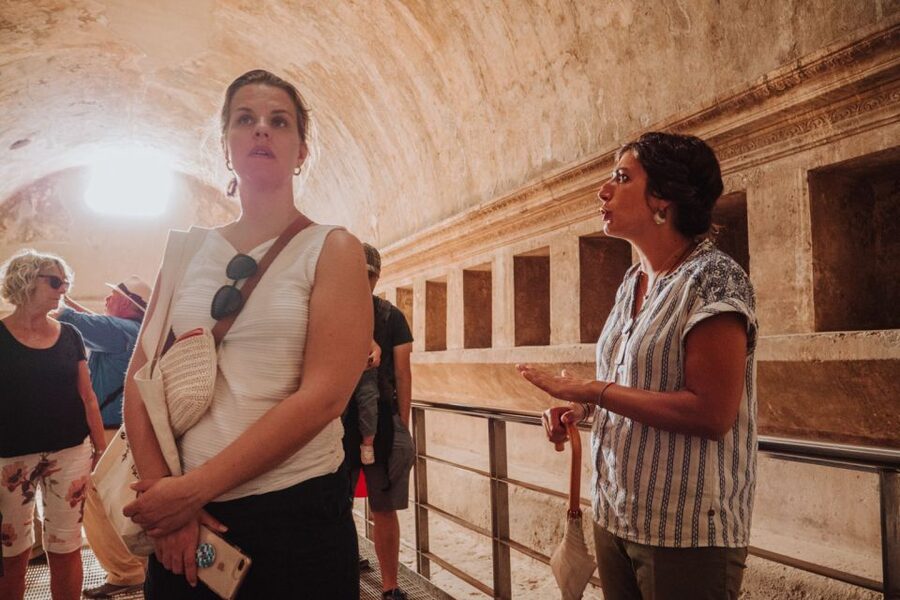
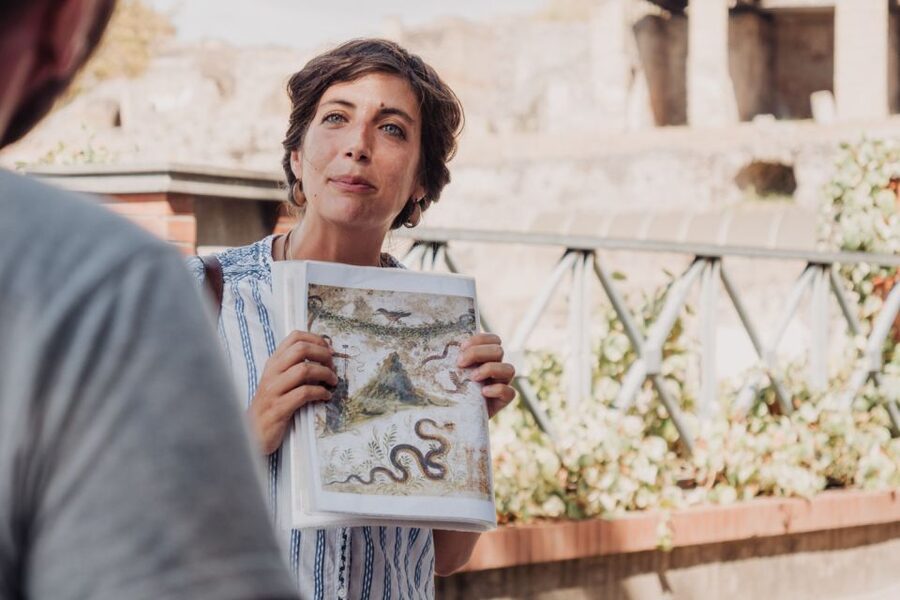
The guide is the heart of this experience. The tour is in English, and headsets are provided for all participants. That matters in busy ruins, since you can hear the explanation without standing shoulder to shoulder with the guide.
Several guides have received particularly strong praise for combining technical knowledge with an easy manner. Michele, also referred to as Mikele in some accounts, is an archaeologist who explains daily life as well as the discoveries themselves. Raphael is described as entertaining and good at keeping the group moving at a comfortable pace. Diego is praised for covering the main areas without making the walk feel frantic.
Other named guides include Jasmine, Sergio, Gennaro, Giulia, Paolo, Mikel, and Alfredo. The individual guide depends on the departure date, but the pattern is clear: this tour is designed around live interpretation, not a silent walk with an audio device.
I especially value the way a good guide can compare the two sites. Pompeii shows urban planning and public life on a larger scale. Herculaneum offers closer views of homes and preserved objects. The eruption is easier to understand when you see both places rather than visiting Pompeii alone.
The guides also help separate established evidence from theory. That is useful at archaeological sites, where a confident-sounding explanation is not always the same as a proven fact. A guide who can explain both what researchers know and what they still debate adds real value.
Transport, timing, and the shared minibus
The minibus links Naples with both archaeological sites and returns you to the train station. This is not a private chauffeur service, so expect to share the vehicle with the rest of the group. The benefit is convenience: you do not need to manage local transport between Pompeii and Herculaneum.
The Naples traffic can be lively, but the driver is an important part of the day. Pasquale is one driver specifically praised for handling the roads and dealing with a mechanical problem professionally. You should still expect normal city traffic and a fairly full schedule.
The total duration is about 8.5 hours. The listed sequence is roughly:
- 70 minutes by train from Rome to Naples
- 30 minutes by minibus to Pompeii
- Two hours with the guide at Pompeii
- 30 minutes of free time
- 30 minutes by minibus to Herculaneum
- Two hours with the guide at Herculaneum
- 30 minutes back to Naples
- 70 minutes by train to Rome
That timetable explains both the tour’s strength and its weakness. It is remarkably efficient, but it leaves little room for delays, long meals, or independent wandering.
Is $222.77 a fair price?
At $222.77 per person, this is not a budget excursion. The price includes round-trip high-speed train tickets, entry to both sites, guided visits with an archaeologist, local minibus transport, and headsets.
The train alone is a meaningful part of the value. A cheaper bus-based day trip may take much longer, leaving you tired before you even reach the ruins. Here, the fast rail service turns a difficult independent day into a manageable one.
You are also paying for coordination. The operator connects the Rome train, Naples meeting point, minibus transfers, site admissions, two guided visits, and the return train. If you tried to arrange each part yourself, you might save money, but you would take on the risk of missed connections and poorly timed regional transport.
The price makes the most sense if your Rome visit does not include time in Campania and you strongly want to see both sites. It makes less sense if you prefer slow exploration, a long meal, or the freedom to spend half a day at one ruin.
Who should book this experience?
I would choose this for a first visit to Pompeii and Herculaneum when Rome is your base. It suits people who want historical context, efficient transport, and a guide who can explain archaeological evidence in plain English.
It is also a good fit for couples, families with older children, and visitors who do not want to plan the Naples area on their own. The two sites complement each other, so you get more than two versions of the same ruin.
You should think twice if you have limited mobility, use a wheelchair, or find long walks on uneven surfaces difficult. The tour is not recommended for people with mobility impairments, and both sites require substantial walking. It also runs rain or shine, so bring a raincoat if wet weather is possible.
Bring your passport or ID card. Do not bring luggage or large bags, and leave unsuitable footwear behind. Comfortable closed shoes are the practical choice.
Should you book the Pompeii and Herculaneum day trip?
Book it if you want to see both major archaeological sites from Rome and value expert explanation more than free time. The high-speed train is a smart choice, and the combination of Pompeii’s city scale with Herculaneum’s preserved homes gives you a fuller picture of the Vesuvius disaster.
Skip it if you want an unhurried Pompeii visit, a long lunch, or several hours for independent photography. For everyone else, the price is defensible because it covers the costly rail journey, admissions, local transfers, and two live guided tours in one tightly managed day.
FAQ
How long is the tour from Rome?
The activity lasts about 8.5 hours. The day includes train travel, minibus transfers, guided visits to Pompeii and Herculaneum, and the return to Roma Termini.
Where does the tour begin?
You begin at Roma Termini station. You use the provided high-speed train tickets to travel independently to Naples Central Station.
Where do I meet the guide in Naples?
Meet the guide in front of the STARHOTEL TERMINUS entrance, opposite Naples Central Station. Look for the guide holding an ASKOS TOURS sign.
How long does the train from Rome to Naples take?
The high-speed train takes about 70 minutes each way.
How much time is spent at Pompeii?
The guided visit at Pompeii lasts about two hours, followed by about 30 minutes of free time.
How much time is spent at Herculaneum?
The guided visit at Herculaneum lasts about two hours.
Are meals included?
No. Meals are not included. You have about 30 minutes of free time at Pompeii, which can be used for lunch or shopping.
Is the tour suitable for people with limited mobility?
No. The experience is not recommended for people with limited mobility or wheelchair users. It involves about one mile of walking at Pompeii and half a mile at Herculaneum, often over uneven surfaces.
Newest reviews from Rome
- ROME:Colosseum & Ancient Rome – private/small group TOUR★ 5.0 · 24 reviews
- Off the Beaten Track in Rome: Rione VI Parione Private Tour★ 5.0 · 24 reviews
- Rome: Best of Colosseum and Roman Forum Small Group Guided Tour★ 4.5 · 24 reviews
- Cinematic Photoshoot in Rome★ 5.0 · 24 reviews
- The Labyrinth of Rome between catacombs and ancient quarries★ 4.5 · 24 reviews
- Vatican and Trionfale Market Tour with Wine and Food Tasting★ 5.0 · 24 reviews
- private tour: Vatican Museums, Sistine Chapel, St. Peter’s Basilica★ 4.5 · 24 reviews
- Colosseum guided tour with Virtual Reality★ 5.0 · 24 reviews
Pompeii & Naples Day Trips, compared.

Pompeii, Amalfi Coast and Positano Day Trip from Rome
Read our review →
Pompeii and Mount Vesuvius Day Trip from Rome with Pizza Lunch
Read our review →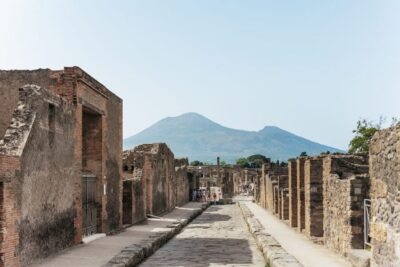
Pompeii Day Trip with Optional Vesuvius and Lunch
Read our review →
Pompeii Tour & Amalfi Coast Day Trip from Rome
Read our review →
Private Pompeii, Positano & Amalfi coast Tour from Rome
Read our review →
Rome to Pompeii Guided Tour with Wine & Lunch by High Speed Train
Read our review →Browse the lists this tour appears in