
Reviewed · HALF-DAY
From Rome: Ostia Antica Guided Half-Day Trip by Train
Ostia Antica gives you something central Rome cannot: a chance to walk through an entire Roman city without the usual crush of people. You follow the old Decumanus Maximus, pass taverns and warehouses, sit in an amphitheater, and see the public toilets where ordinary Romans handled very ordinary business.
I like two things especially. The short train ride keeps this outing easy, and the small group, limited to 12 people, lets you hear the guide and ask questions. I also like the focus on daily life rather than only emperors and monuments. The main drawback is simple: the site is large, open, and exposed, so you need good shoes, water, and protection from the sun.
In This Review
- Key points to know before booking
- Why Ostia Antica is worth your half-day
- Meeting at Piramide and riding the train
- Entering the archaeological park
- Walking the Decumanus Maximus
- The Baths of Neptune and their sea-god mosaic
- Sitting in the amphitheater
- The Forica and the human side of Rome
- A three-hour route with room to breathe
- Staying on for the beach or modern Ostia
- Is $58 a fair price?
- Who should book this Ostia Antica tour?
- Practical details that matter
- Should you book it?
- FAQ
- How long does the Ostia Antica tour last?
- Where does the tour meet in Rome?
- How do I recognize the meeting point?
- Is transportation from Rome included?
- Is the Ostia Antica entrance ticket included?
- What language is the guided tour in?
- How large is the group?
- Can I stay at Ostia Antica after the guided tour?
- Can I visit the beach after the tour?
- Is the tour suitable for wheelchair users or baby strollers?
Key points to know before booking
- A full Roman port city near Rome: Ostia Antica offers streets, apartments, baths, shops, temples, warehouses, theaters, and public facilities across a large archaeological park.
- A guide makes a real difference: Guides including Rob, Cat, Alberto, Laura, Caterina, and Roberto are praised for clear explanations, humor, vivid stories, and strong group management.
- A calm alternative to Pompeii: The ruins are often quiet, giving you room to study mosaics and buildings without large crowds.
- Three hours inside the ruins: The tour covers major highlights at a steady pace, with a toilet and snack break along the way.
- Easy to extend the day: After the guided visit, you can explore more of Ostia Antica, visit the museum if it is open, continue to modern Ostia, or go to the beach.
- Not suited to wheelchairs or strollers: Uneven archaeological paths and the size of the site make this a walking-heavy outing.
Why Ostia Antica is worth your half-day
Ostia was Rome’s ancient harbor town, founded in the 4th century BC. Its position near the mouth of the Tiber helped supply Rome with food, goods, building materials, and trade from across the Mediterranean.
The site is valuable because it shows how a working Roman city functioned. At the Colosseum, you see the grand public face of Rome. At Ostia, you see the back rooms: bakeries, toilets, bathhouses, storage buildings, rented apartments, restaurants, and commercial offices.
That everyday focus makes the ruins unusually readable. You are not simply looking at scattered columns. You are walking along an urban street, entering buildings, and seeing how public and private life fitted together.
Ostia was founded long before the Roman Empire, and the tour explains its rise through the Roman Republic and its later decline. At its height, the town was home to more than 100,000 people, a remarkable population for a port outside Rome.
The site is also a useful choice if you have already visited Pompeii. Several people who had seen Pompeii found Ostia equally compelling, and some preferred it because it is quieter and closer to Rome. The two places are not identical, but both let you picture Roman life through buildings that are still standing rather than through museum objects alone.
More Ostia Antica visits:
- Ancient Ostia Antica Semi-Private Day Trip from Rome by Train with Guide
★ 4.5 · 579 reviews - Horse Sanctuary & Trail Ride in Ostia Antica
★ 4.5 · 276 reviews - Ostia Antica Semi Private Tour from Rome
★ 5.0 · 238 reviews
Meeting at Piramide and riding the train
The tour begins at Cafe Piramide near the Piramide Metro Station on Rome’s Line B, the blue line. When you face the metro stop, the cafe is on your right, near the train tracks and the station exit. White umbrellas outside help identify it, and the guide carries a City Wonders sign.
Allow extra time to reach this meeting point if you are coming from Termini or another busy part of central Rome. One useful practical point is that you should look for the cafe immediately on the right as you face the station. The white umbrellas across the street can be distracting, and it is easy to walk toward the wrong place.
The guide distributes the return train tickets and explains the plan before the group leaves. The trip to Ostia takes about 15 minutes according to the itinerary, with the return journey listed at about 20 minutes. This is much easier than arranging a taxi or private transfer, and it keeps the cost at $58 per person.
The train ride is not the main attraction, but it is part of the tour’s good value. You get transport, the archaeological entry ticket, and a live English-speaking guide in one booking. The guide also keeps track of the group during the station changes, which is helpful when you are unfamiliar with Rome’s public transport system.
In the event of a public transport strike or another unexpected transport problem, a minibus is provided at no extra cost. Your return ticket is included, but the return trip after the guided visit is unescorted. The guide explains how to get back to Piramide.
Entering the archaeological park
From the Ostia station, the archaeological site is less than five minutes away on foot. That short walk is one reason this makes a practical half-day trip from Rome.
Ostia Antica is a large site, not a compact collection of ruins. A guide helps you spend your three hours well, choosing important buildings and explaining what you are seeing instead of leaving you to decode a broad field of walls and stones.
The ruins are unusually open and spacious. You can see long stretches of street, the remains of multi-story buildings, and broad areas of the old city. Several guides use images to show how structures may have looked in ancient times, a useful aid when you are standing in front of worn brickwork.
The pace matters here. The best guides keep the group moving without rushing. Alberto, Rob, Cat, Laura, and Caterina are repeatedly praised for combining clear explanations with humor and for stopping at the key sites. Rob is also noted for using small bits of acting and storytelling to make the ancient characters easier to picture.
Expect plenty of walking over uneven ground. Comfortable shoes are essential, and sports shoes are specifically recommended. The site is exposed, and one guide was praised for finding shade during a hot visit, but you should still bring water and sun protection.
Walking the Decumanus Maximus
The Decumanus Maximus is the main road through Ostia. Walking along it gives you the strongest sense of the city as a real place rather than an archaeological display.
Roman statues line parts of the route, and the street leads you past commercial buildings, taverns, warehouses, baths, apartments, and public spaces. This is where the guide’s explanation of daily routines becomes useful. You can learn how goods moved through the port, where people gathered, and how residents used shared facilities.
The setting also reveals the scale of Ostia. The remaining walls help you understand that many buildings rose higher than the ruins first suggest. You can see the ground plans of shops and homes, but also enough upper sections to picture a dense town with several floors.
This is one of the places where independent exploration can be frustrating on a first visit. Without context, a line of rooms can look like little more than old masonry. With a good guide, the same rooms become a bakery, a shop, a rented apartment, or a place connected to port commerce.
The group pauses at important spots, and you have opportunities to ask questions. Because the group is capped at 12, you are less likely to lose the guide’s voice in a crowd. That small size is a major part of the tour’s appeal.
More Rome tours worth comparing
- Rome to Pompeii Guided Tour with Wine & Lunch by High Speed Train
★ 5.0 · 1,379 reviews - Rome: Pompeii Tour with Wine and Lunch by High Speed Train
★ 4.8 · 485 reviews - Venice Day Trip from Rome by High-Speed Train with Happy Hour
★ 4.5 · 445 reviews - From Rome: Day Trip to Venice by High-Speed Train
★ 4.6 · 352 reviews
The Baths of Neptune and their sea-god mosaic
The Baths of Neptune are among the most memorable stops. Their large mosaic shows the sea god being drawn by a four-horse chariot, a dramatic image that survives with impressive detail.
Roman bathhouses were not just places to wash. They were social and public spaces, and the guide uses the remains to explain how Romans spent time, met others, and enjoyed elaborate facilities. The mosaic gives you an immediate visual connection to the building’s purpose and decoration.
Look down as you walk. Ostia’s mosaics are not limited to one famous panel. Black-and-white floor designs appear in several parts of the site, often helping identify the use or status of a room.
The baths are also a good example of why you should not race through Ostia with only a guidebook map. The architecture can be hard to read at first, while the patterns and images are easy to miss if you are focused only on walls and columns.
Sitting in the amphitheater
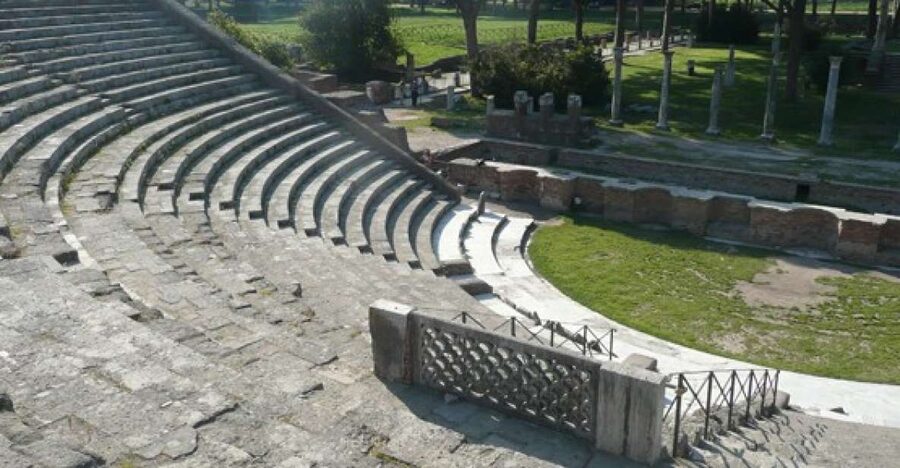
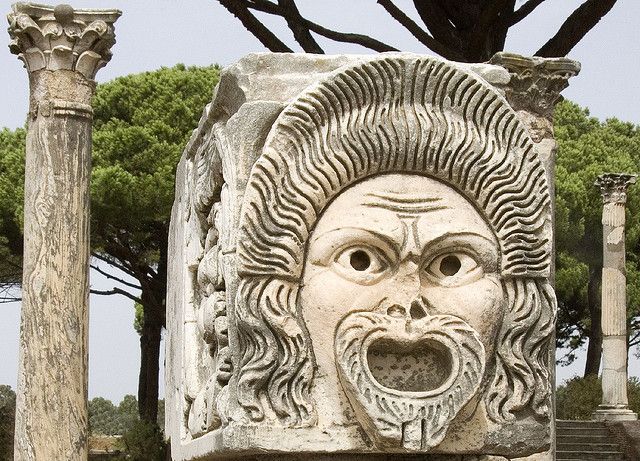
Ostia’s amphitheater was built in 12 BC and held about 3,500 spectators. You can take a place in the seating area and look across the performance space much as an ancient audience would have done.
It is a smaller theater than Rome’s biggest monuments, but that is part of its strength. You can understand the relationship between the stage, seating, and surrounding city without needing a diagram.
The guide helps turn the structure into a social scene. You can picture residents gathering for a performance, sharing news, and spending time in a public setting. The stop also breaks up the long street walk and gives you a chance to sit for a moment.
If you are visiting with older children or teenagers, this is likely to be one of the easiest places for them to grasp. The amphitheater has an obvious purpose, and the guide can connect the building to the public life of the town.
The Forica and the human side of Rome
The communal Forica is the tour’s funniest and most memorable stop for many people. It is a public washroom with a marble bench and 20 evenly spaced openings arranged along four walls of a large open room.
Yes, you can sit there. You may not want to linger, but doing so makes the ancient city feel less distant. The Forica reminds you that Roman civilization was not only temples, military power, and grand mosaics. It was also shared infrastructure and practical routines.
This stop is especially good because it grounds the tour in ordinary people. You hear about how citizens lived, worked, washed, traded, and used public buildings. That attention to regular life is one of the clearest reasons to choose Ostia over another grand-monument tour in Rome.
A three-hour route with room to breathe
The guided portion lasts about three hours. It is enough time to see the principal buildings without trying to cover every corner of the archaeological park.
You should not expect a complete survey of the entire site. Ostia is too large for that in one half-day, particularly when the guide stops to explain architecture, art, commerce, and social life. The tour selects major highlights, then leaves you with a sense of what to return to if you have more time.
A toilet break is included, along with time for a snack or drink at the on-site snack bar. This is useful because the site is large and the walk can be tiring, particularly during hot weather.
Some groups receive short periods to wander independently during the visit. At the end, the tour finishes inside the archaeological area, near the museum, rather than requiring an immediate departure. That arrangement gives you a chance to continue exploring on your own.
The museum can be an important add-on, but opening hours may vary. In winter, it has been reported to close around 1:30 PM, so check its hours and visit it first if you want to include it in an independent extension.
Staying on for the beach or modern Ostia
The scheduled service ends back at Piramide Metro Station at about 1:00 PM for people who return with the group. You are also free to remain at Ostia Antica after the guided portion.
You can use the afternoon to explore more of the archaeological park, visit the museum if open, or continue to modern Ostia. You can also head to a nearby beach, which makes the towel and beachwear suggestions practical rather than random packing advice.
This flexibility is a real advantage. If you want a clean four-hour history outing, return to Rome with the group. If you want a slower day, stay behind and make your own way back using the provided train ticket. The return journey is not escorted, so listen carefully to the guide’s instructions before separating.
The beach option works best for someone with extra time in Rome and a willingness to manage the afternoon independently. It is not part of the guided archaeological visit, so you should treat it as an optional extension, not a guaranteed beach excursion with a guide.
Is $58 a fair price?
At $58, this is not the cheapest way to visit Ostia Antica. You are paying for more than the train fare, though. The price includes the return train ticket, admission to the archaeological area, and a three-hour English-language guided visit in a group of no more than 12.
I think the value is strongest if this is your first visit. Ostia’s scale and worn remains can be difficult to interpret alone, and the guide gives meaning to buildings that otherwise may look like fragments. You also avoid the uncertainty of getting there, buying entry, and planning a sensible route yourself.
The value is less clear if you already know the site well or want to spend a full day wandering at your own pace. In that case, the fixed three-hour route may feel limiting, although you can stay afterward.
The strongest part of the price is the small group. A larger, cheaper group could make it hard to hear explanations or ask questions. Here, the size supports the conversational feel that many people want from a specialist archaeological visit.
Who should book this Ostia Antica tour?
I would choose this for anyone interested in Roman urban life, archaeology, architecture, trade, or the practical side of ancient society. It is also a smart choice if you have already seen the Colosseum, Roman Forum, and Pantheon and want a different view of Rome.
Families can enjoy it, especially when the guide uses stories, images, and humor. The three-hour walk is still a serious outing, so young children may tire, and baby strollers are not allowed.
You should be comfortable walking over uneven surfaces and standing outdoors for long periods. The experience is not suitable for wheelchair users, and the open site offers limited relief from hot weather.
I would not pick this if your Rome schedule is already packed and you dislike organized tours. The trip takes about four hours, plus any extra time you choose to spend at the site, and the archaeological park demands attention rather than a quick photo stop.
Practical details that matter
Meet at Cafe Piramide, not at the Ostia station. Look for the white umbrellas and the City Wonders sign.
Wear comfortable shoes or sports shoes. Bring water, a towel, beachwear, and sun protection if you may continue to the coast. A snack bar and toilet break are included in the visit.
The live tour is in English. Cancellation is free up to 24 hours before departure, and you can reserve now and pay later, which helps if your Rome plans are still changing.
The tour is operated by City Wonders Ltd. Guide assignments vary, but praised guides have included Rob, Cat, Alberto, Laura, Caterina, Roberto, Barbara, and Angellina Militello. The recurring strengths are clear delivery, strong site knowledge, humor, and careful attention to the group.
Should you book it?
Yes, if you want to understand how ordinary Romans lived and you prefer a quieter archaeological site to Rome’s packed headline attractions. The train ride is easy, the major sights fit neatly into a half-day, and a strong guide can make the difference between seeing old walls and understanding a functioning port city.
Book it with time to spare afterward if you want the museum, more independent exploration, modern Ostia, or the beach. Skip it only if walking on uneven ground is difficult, you need a stroller, or you want complete freedom from a set route.
For most first-time visitors, $58 is a fair price for the transport, entry, small group, and three hours of explanation. Ostia Antica is close to Rome, but it feels far enough from the city center to offer breathing room and a more personal look at Roman life.
FAQ
How long does the Ostia Antica tour last?
The experience lasts about four hours, including the train journeys and approximately three hours inside the archaeological site.
Where does the tour meet in Rome?
Meet at Cafe Piramide near the Piramide Metro Station on Line B. The cafe is on your right when facing the metro stop, near the train tracks and station exit.
How do I recognize the meeting point?
Look for the cafe with white umbrellas outside. The guide carries a City Wonders sign with the tour name.
Is transportation from Rome included?
Yes. A return train ticket from Rome to Ostia Antica is included. The guide accompanies you on the outbound journey, while the return trip after the tour is unescorted.
Is the Ostia Antica entrance ticket included?
Yes. Admission to the archaeological site is included in the tour price.
What language is the guided tour in?
The live guided tour is conducted in English.
How large is the group?
The tour is limited to 12 participants.
Can I stay at Ostia Antica after the guided tour?
Yes. You may remain at the archaeological site, explore modern Ostia, or continue to a nearby beach. You are responsible for your own return journey if you do not travel back with the guide.
Can I visit the beach after the tour?
Yes. The tour allows you to continue to a nearby beach after the archaeological visit. Bring a towel and beachwear if you plan to do so.
Is the tour suitable for wheelchair users or baby strollers?
No. The experience is not suitable for wheelchair users, and baby strollers are not allowed.
More 1-Day Tours in Rome
- From Rome: Pompeii, Amalfi Coast, and Sorrento Day Trip
★ 4.6 · 7,031 reviews - From Rome: Pompeii, Amalfi Coast and Positano Day Trip
★ 4.6 · 6,620 reviews - Pompeii, Amalfi Coast and Positano Day Trip from Rome
★ 4.5 · 6,250 reviews - Pompeii and Mount Vesuvius Day Trip from Rome with Pizza Lunch
★ 4.5 · 6,151 reviews
More Half-Day in Rome
- Hadrian’s Villa and Villa d’Este Half-Day Trip from Rome
★ 3.5 · 808 reviews - Rome Golf Cart Tour : Half-Day Private or Small Group Sightseeing
★ 5.0 · 528 reviews - Catacombs and Roman Countryside Half-Day Walking Tour
★ 4.5 · 411 reviews - From Rome: Half-Day Frascati Wine Tour with Farmhouse Lunch
★ 4.9 · 372 reviews
Newest reviews from Rome
- Rome: Vatican Museums & Sistine Chapel Skip-the-Line Ticket★ 4.4 · 148 reviews
- Shared Shuttle Transfer from Rome to Civitavecchia Port★ 5.0 · 148 reviews
- Rome: Crypts & Catacombs After Hours Tour with Bone Chapel★ 4.6 · 149 reviews
- Ghosts Legends and Mysteries of Rome Walking Tour★ 5.0 · 149 reviews
- Skip the Line: Vatican and Sistine Chapel with Guided Tour★ 4.0 · 149 reviews
- Pizza and Tiramisu Cooking Class in Rome, Piazza Navona★ 5.0 · 150 reviews
- Tivoli: Villa Gregoriana Entrance Ticket★ 4.7 · 150 reviews
- Rome: Borghese Gallery Skip-the-Line Entry and Guided Tour★ 4.7 · 150 reviews
Half-Day, compared.
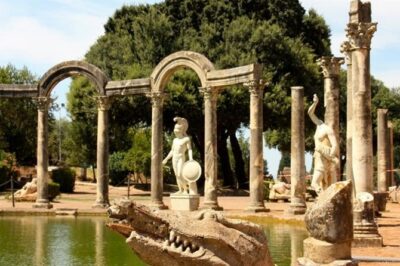
Hadrian’s Villa and Villa d’Este Half-Day Trip from Rome
Read our review →
Rome Golf Cart Tour : Half-Day Private or Small Group Sightseeing
Read our review →
Catacombs and Roman Countryside Half-Day Walking Tour
Read our review →
Half-Day Frascati Wine Tour with Farmhouse Lunch
Read our review →
Trastevere and Rome’s Jewish Ghetto Half-Day Walking Tour
Read our review →
Hadrian’s Villa and Villa d’Este Half-Day Tour
Read our review →Browse the lists this tour appears in