
Reviewed · E-BIKES
Highlights & Hidden Gems Tour with Top E-bike
Rome is easier to understand when you can connect its great sights in one moving story. This four-hour e-bike tour covers about 14 kilometers, linking the Colosseum, Trevi Fountain, Pantheon, Villa Borghese, and several quieter corners without asking you to make every connection on foot.
I like two things right away: the electric Cannondale bikes make Rome’s hills far less tiring, and the groups are limited to 10 people, so your guide has a fair chance to answer questions. Guides including Arina and Aaliyah have received especially warm praise for clear explanations and friendly leadership.
The main consideration is traffic and crowds. The route uses streets with limited traffic and some traffic-free sections, but central Rome is still central Rome. You should be comfortable on a bicycle, and this is a sightseeing ride, not a relaxed pedal through empty country lanes.
In This Review
- Why an e-bike works so well in Rome
- Key points to know
- Starting near the Colosseum
- Piazza Venezia and the layers of Rome
- Trevi Fountain and the Spanish Steps
- Piazza del Popolo and Villa Borghese
- Piazza Navona and the Pantheon
- The former Jewish Quarter and Teatro di Marcello
- The Capitol and Michelangelo’s square
- Small groups, guides, and the pace of the ride
- Traffic, safety, and practical comfort
- Is $102.84 a fair price?
- Who should book this Rome bike tour?
- FAQ
- How long does the e-bike tour last?
- How far do you cycle?
- Where does the tour start?
- Where does the tour finish?
- What is included in the price?
- Are entry tickets to the monuments included?
- Can children join the tour?
- How many people can join the group?
- Can I cancel for a full refund?
- Should you book it?
Why an e-bike works so well in Rome
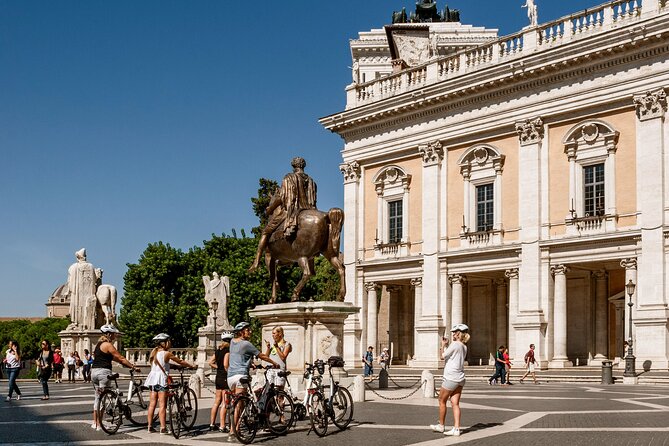
Rome’s historic center packs a remarkable number of landmarks into a fairly compact area, but the city is not flat. The ride includes hills around the Capitol and Villa Borghese, along with busy areas near major monuments. A quality e-bike matters here because it lets you save energy for looking, listening, and taking photographs.
The tour provides a top-quality Cannondale e-bike with anti-puncture tires, a helmet, a handlebar bag, and a water bottle. Helmets are required, and they are supplied without an extra charge.
The route is described as leisure difficulty for most riders. With a child seat or child extension, it becomes more like an intermediate ride. The company does not recommend it for anyone who lacks confidence on a bike, so be honest with yourself before booking.
Key points to know
- Four hours and 14 kilometers: You see a broad slice of central Rome without spending the entire day in the saddle.
- Small groups of up to 10: A compact group makes it easier to hear your guide and keep a steady pace.
- Cannondale e-bikes: Electric assistance takes much of the sting out of Rome’s hills.
- Morning or afternoon departures: The morning may be the better choice if you want fewer people and less street traffic.
- Major sights plus quieter corners: The route combines famous monuments with the former Jewish Quarter and Teatro di Marcello.
- Family equipment is available: Children ages 5 to 8 can use a child extension, while children 9 and older may ride a properly sized e-bike.
More bike days around Rome:
- Rome EBike Tour: Appian Way, Catacombs & Roman Aqueducts
★ 5.0 · 1,766 reviews - Rome: Top Highlights & Hidden Gems Tour by Cannondale E-Bike
★ 4.9 · 1,760 reviews - Rome: Appian Way, Catacombs, & Roman Aqueducts E-bike Tour
★ 4.9 · 1,421 reviews
Starting near the Colosseum
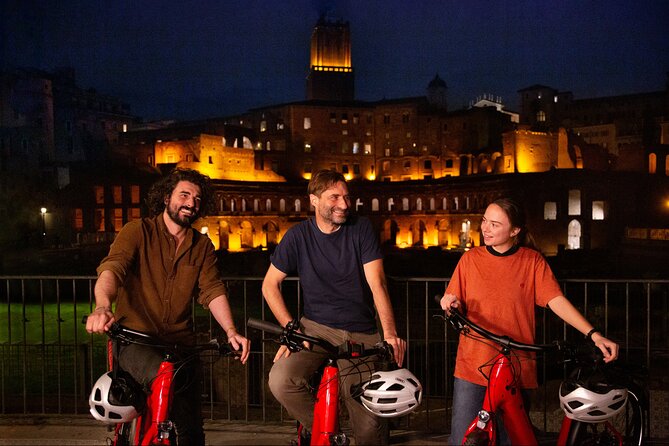
The meeting point is at Via Labicana 49, not far from the Colosseum. The tour begins and ends there, which keeps the logistics simple. You do not have to arrange a one-way transfer or figure out where to collect your luggage at the finish.
After helmet fitting and a bike check, the group heads toward Piazza del Colosseo. The first stop lasts about 10 minutes and gives you a fine view of the Colosseum from outside. Your guide uses the arena as the opening chapter in Rome’s roughly 2,000-year story.
This is an orientation stop, not a Colosseum visit. Admission inside is not included, and the tour does not replace a dedicated archaeological visit. That is not a problem if you plan to visit the Colosseum separately, but you should allow another half-day if going inside is important to you.
From there, the ride continues along Via dei Fori Imperiali, the broad avenue that cuts through the center of Ancient Rome. You stop for another 10 minutes, with the ruins of the Imperial Forums providing a powerful sense of scale.
The avenue is one of the route’s most useful stretches because it gives you a clear visual link between the Colosseum and the political heart of the ancient city. It can also be crowded, so your guide’s choice of stopping point and timing matters.
Piazza Venezia and the layers of Rome
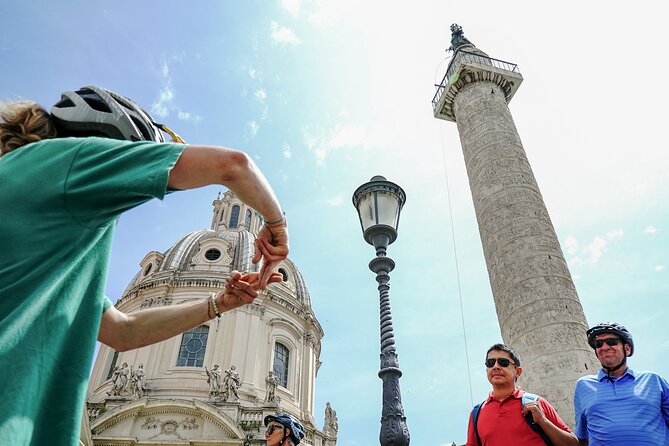
Piazza Venezia brings together several periods of Roman history in one short stop. In about 10 minutes, you see Trajan’s Column, the Vittoriano Monument, and Palazzo Venezia.
Trajan’s Column celebrates an ancient military campaign and is famous for its carved spiral scenes. The Vittoriano, with its bright white stone, belongs to a much later era and honors unified Italy. Palazzo Venezia adds another historical layer.
This is one of the better places to see how Rome places ancient, Renaissance, and modern monuments side by side. You will not have time for an extended look at each site, but the guide can give you a useful framework for returning later.
Trevi Fountain and the Spanish Steps
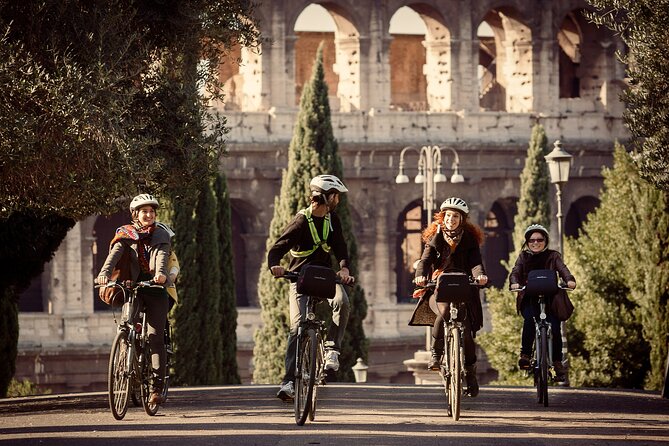
The ride then reaches the Trevi Fountain, where you spend about 10 minutes learning how this famous Baroque fountain came to be. The setting is tight, and crowds can make it hard to linger. Still, arriving by bike lets you make the stop without spending extra time navigating Rome’s web of streets on foot.
You should expect a photo stop and an explanation, not a long quiet pause beside the water. Keep your belongings secure in crowded areas, and listen closely for the meeting instructions before stepping away from the bikes.
At Piazza di Spagna, the group pauses for about five minutes to see the Spanish Steps rising toward Trinità dei Monti. The staircase is one of Rome’s best-known gathering places, but bicycle access is naturally limited around the steps themselves. Your guide will position the group for a quick look rather than a long exploration.
These two stops are brief by design. The tour is trying to show you the shape of Rome, not keep you at every monument for half an hour. If you want detailed art and architecture at Trevi Fountain or the Spanish Steps, return independently.
More Rome tours worth comparing
- Rome City Small Group Bike Tour with quality Cannondale EBike
★ 5.0 · 1,380 reviews - Rome by Night – Ebike Small Group Tour – Food and Wine (Option)
★ 5.0 · 1,275 reviews - Rome:Appian Way E-bike Tour with Catacombs, Aqueducts & Food
★ 4.9 · 1,210 reviews - Rome: E-Bike Night Tour with Food and Wine Tasting
★ 4.9 · 1,131 reviews
Piazza del Popolo and Villa Borghese
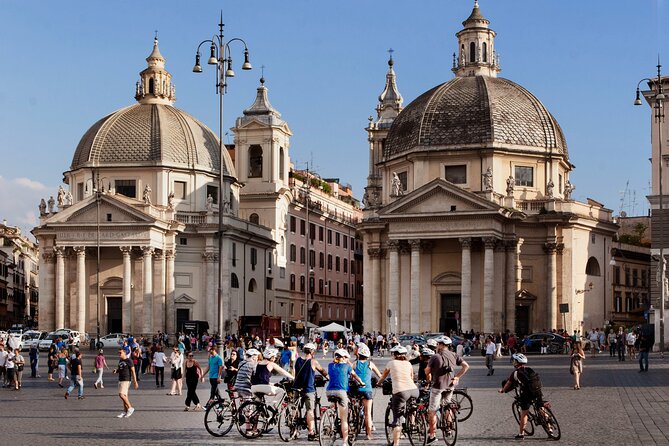
Piazza del Popolo marks the northern entrance to historic Rome. For centuries, visitors arriving along the Via Flaminia encountered this grand square first. The tour gives it about five minutes, enough to understand its role and take a few photographs.
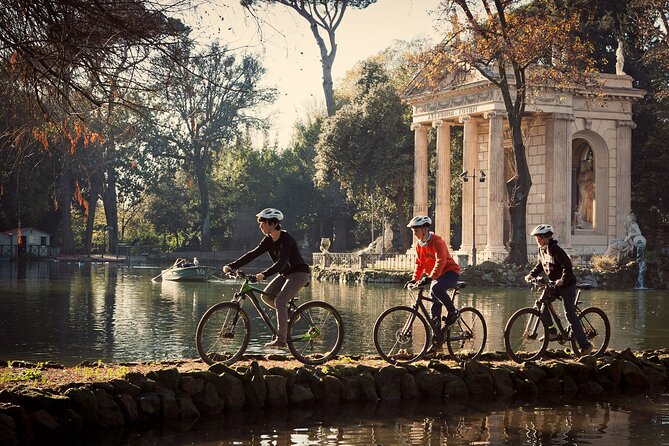
The ride then heads into Villa Borghese Gardens for about 15 minutes. This is one of the most welcome changes of pace on the route. After busy streets and crowded squares, the park offers room to breathe and a scenic view over Rome.
The park stop also shows why the e-bike is useful. Rome’s central sights are not all arranged on one level, and the ride through Villa Borghese adds a little height without turning the outing into a hard workout.
I would especially favor the morning departure if you want the calmest possible version of this section. One family chose the early option specifically to find fewer people and less traffic, and it also gave them a small-group feel. Conditions vary, but an early start is a sensible strategy in Rome.
Piazza Navona and the Pantheon
Piazza Navona is next, with around 10 minutes to cycle around the long, oblong square and see its central Baroque fountain from close range. The square’s shape reflects its earlier use as a Roman stadium, while the fountains and surrounding buildings give it a very different character today.
This is a strong guide-led stop because a few well-chosen facts can explain why the piazza looks so unusual. The short time also keeps the tour moving before the group reaches the Pantheon.
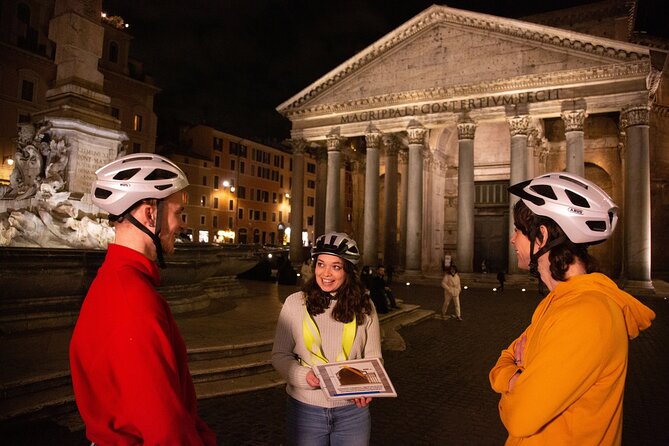
The Pantheon receives another 10-minute stop. From outside, you can appreciate its massive ancient structure and unusually complete survival. This is one of the most important buildings on the route, but again, the tour does not include a full interior visit.
If entering the Pantheon is a priority, check its separate visiting arrangements and plan time outside the bike tour. The ride gives you context and a useful first look, but it is not designed for detailed interior study.
The former Jewish Quarter and Teatro di Marcello
The route becomes less predictable when it reaches the former Jewish Quarter. This small neighborhood brings together archaeological, cultural, and religious traditions that are easy to miss if you only follow Rome’s headline sights.
The stop lasts about five minutes, so do not expect a full neighborhood walk. Its value is that it points you toward another side of Rome, one worth revisiting on foot when you have more time.
Nearby, Teatro di Marcello offers another quick look at ancient Roman construction. This theater later served as a model for the Colosseum, making it a useful comparison point. The site is less famous than the Colosseum but helps you see that Rome’s monumental architecture developed through earlier experiments.
These shorter stops are where the tour earns its title. You still see the major names, but the ride also gives you leads for exploring beyond the standard checklist.
The Capitol and Michelangelo’s square
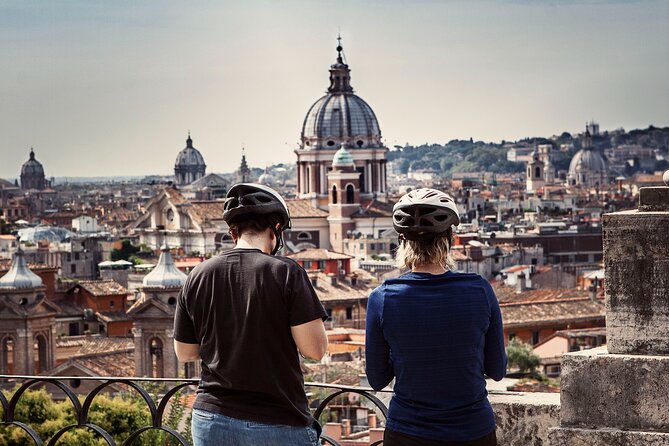
The final major stop is Piazza del Campidoglio, reached atop the Capitoline Hill. This is one of the most rewarding views on the route, looking across the Roman Forum from one of Rome’s historic hills.
The square itself was designed by Michelangelo in the 16th century. Its geometric layout and grand approach feel very different from the chaotic streets below. The tour allows about 10 minutes here, enough for the view and a concise explanation.
This is also where the bike’s electric assistance earns its keep. The ride up the Capitol is exactly the sort of short climb that can make a conventional bicycle tour feel harder than expected. On an e-bike, you can focus more on the view and less on the slope.
After the Capitol, the group returns to Via Labicana. The ride ends where it began, making it easy to continue to your hotel or another central sight.
Small groups, guides, and the pace of the ride
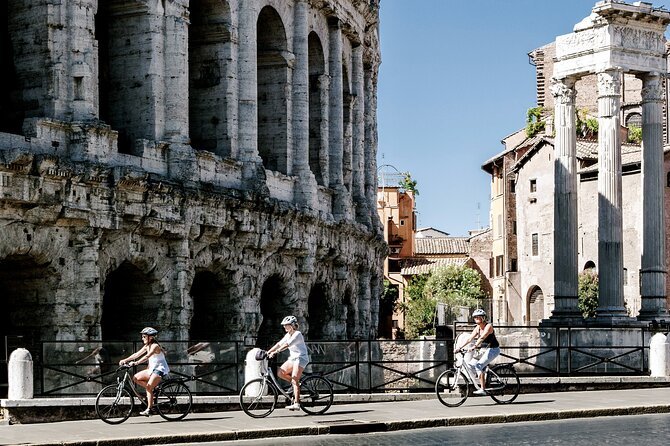
The maximum group size is 10, and that is a useful limit in a city where bicycles can quickly become awkward to manage. A smaller group also makes it easier to stay together at crossings and hear explanations during short stops.
Guides Arina and Aaliyah have both been singled out for making the ride enjoyable and informative. One family happened to have only four people on its morning departure, which made the outing feel almost private. You should not count on having a four-person group, but the 10-person maximum keeps the experience from becoming a procession.
The pace appears to suit people who want a broad introduction to Rome on their first day. You cover the key sights, learn the basic historical connections, and get a sense of which areas deserve a longer return visit.
The tradeoff is limited time at each monument. Most stops last between five and 10 minutes, with 15 minutes at Villa Borghese. If your ideal tour means standing quietly at one painting or building for a long time, choose a walking tour focused on fewer sites instead.
Traffic, safety, and practical comfort
The operator plans routes with limited traffic, including some sections with no traffic at all. That makes the tour safer and more relaxing than simply renting a bicycle and trying to find your own way through central Rome.
Still, limited traffic does not mean no traffic. One rider found the crowds and cars somewhat troublesome, although the overall route still worked well for seeing a lot of the city. You will need to follow your guide closely, stay alert, and feel comfortable braking and steering around other people.
The required helmet is provided. The anti-puncture tires add a practical layer of reassurance, while the handlebar bag gives you a place for small items. The supplied water bottle is useful during a four-hour outing, especially in warm weather.
The equipment has a weight limit of 300 pounds, or 136 kilograms. Children ages 5 to 8 can use a child extension, and children 9 and older can ride an appropriately sized e-bike on their own. The stated difficulty is leisure for most people, but it becomes intermediate with a child seat or extension.
Is $102.84 a fair price?
At $102.84 per person, this is not the cheapest way to see Rome. You are paying for four hours of guided sightseeing, an e-bike, safety equipment, a water bottle, and a route that connects more sites than most short walking tours can manage.
The value is strongest if you are visiting Rome for the first time, have limited days, or do not want to spend hours walking between monuments. You can cover the Colosseum area, Trevi Fountain, the Spanish Steps, Villa Borghese, Piazza Navona, the Pantheon, the former Jewish Quarter, and the Capitol in one organized outing.
The value is weaker if you already know central Rome well, dislike cycling near crowds, or prefer long visits inside museums and monuments. Remember that entry tickets are not included, and gratuities are optional.
The tour requires at least four participants. If fewer than four are booked, the company may cancel after confirmation and offer either another option or a full refund. That is worth keeping in mind when planning a tightly scheduled first day.
Free cancellation is available until 24 hours before the start time. Cancellations or changes made inside that window are not accepted for a refund.
Who should book this Rome bike tour?
I would choose this ride for a first full day in Rome, especially if you want a citywide orientation before deciding where to spend more time. It also suits active families, couples, and solo visitors who like learning while moving.
The morning departure is the smarter pick if you hope for lighter crowds and easier cycling conditions. The afternoon option works well if your arrival schedule makes an early start difficult, but busy central squares can feel more demanding later in the day.
I would skip it if you are not self-confident on a bicycle, need a very slow pace, or want interior visits at the Colosseum and Pantheon. This is an outside-focused overview with short stops, not a replacement for Rome’s major archaeological and museum tours.
FAQ
How long does the e-bike tour last?
The tour lasts approximately four hours.
How far do you cycle?
You cover approximately 8.5 miles, or 14 kilometers.
Where does the tour start?
The meeting point is Via Labicana 49, 00184 Rome, Italy.
Where does the tour finish?
The activity ends back at the meeting point on Via Labicana.
What is included in the price?
The tour includes a top-quality e-bike with anti-puncture tires, a professional guide, a helmet, a handlebar bag, and a water bottle.
Are entry tickets to the monuments included?
No. The itinerary lists free admission at the stops, and the tour does not include entrance tickets for interior visits.
Can children join the tour?
Yes. Children ages 5 to 8 can use a child extension, and children ages 9 and older can ride an appropriately sized e-bike independently.
How many people can join the group?
The tour has a maximum of 10 participants. A minimum of four participants applies, and the company may cancel if three or fewer people are booked.
Can I cancel for a full refund?
Yes. You can cancel at least 24 hours before the experience start time for a full refund. Cancellations or changes made less than 24 hours before the start time are not accepted for a refund.
Should you book it?
Book this tour if you want to get your bearings quickly, see Rome’s famous monuments from the outside, and reach several areas that would take much longer on foot. The e-bike takes care of the hills, while the small group keeps the ride personal.
Choose the morning departure if possible, wear comfortable clothes, and arrive ready to cycle in an active city. If you want a detailed visit inside the Colosseum, Pantheon, or other monuments, pair this ride with separate admission tours. Used that way, it makes a strong introduction to Rome rather than trying to be the whole Roman holiday.
Newest reviews from Rome
- Rome: Vatican Museums & Sistine Chapel Skip-the-Line Ticket★ 4.4 · 148 reviews
- Shared Shuttle Transfer from Rome to Civitavecchia Port★ 5.0 · 148 reviews
- Ghosts Legends and Mysteries of Rome Walking Tour★ 5.0 · 149 reviews
- Skip the Line: Vatican and Sistine Chapel with Guided Tour★ 4.0 · 149 reviews
- Rome: Crypts & Catacombs After Hours Tour with Bone Chapel★ 4.6 · 149 reviews
- Tivoli: Villa Gregoriana Entrance Ticket★ 4.7 · 150 reviews
- Pizza and Tiramisu Cooking Class in Rome, Piazza Navona★ 5.0 · 150 reviews
- Rome: Borghese Gallery Skip-the-Line Entry and Guided Tour★ 4.7 · 150 reviews
E-Bikes, compared.

Rome EBike Tour: Appian Way, Catacombs & Roman Aqueducts
Read our review →
Top Highlights & Hidden Gems Tour by Cannondale E-Bike
Read our review →
Appian Way, Catacombs, & Roman Aqueducts E-bike Tour
Read our review →
Rome City Small Group Bike Tour with quality Cannondale EBike
Read our review →
Rome by Night – Ebike Small Group Tour – Food and Wine (Option)
Read our review →
Appian Way E-bike Tour with Catacombs, Aqueducts & Food
Read our review →
Appian Way, Catacombs and Aqueducts Park Tour with Top E-Bike
Read our review →Browse the lists this tour appears in