
Reviewed · WALKING TOURS
Piazza del Popolo and Historical Sights Walking Tour in Rome
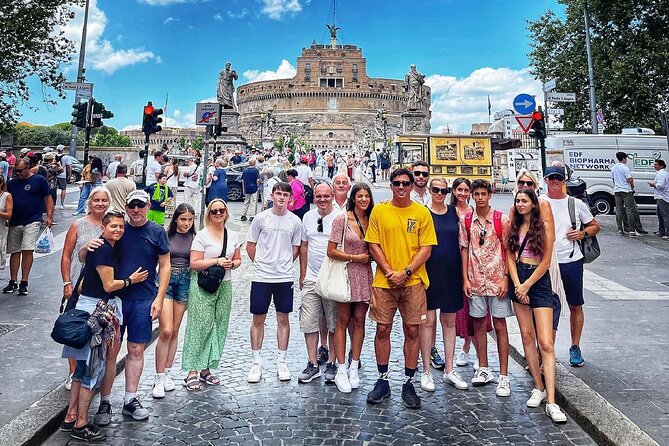
Rome’s long story unfolds especially well on this walk, which links Piazza del Popolo and the Pantheon with Renaissance lanes, imperial tombs, Bernini sculpture, and the Tiber. You finish outside Castel Sant’Angelo with St. Peter’s Basilica framed at the end of Via della Conciliazione.
I like two things here: the route gives you a useful first look at several major sights without the usual single-monument tunnel vision, and the small group limit of 15 people should make it easier to hear the guide and ask questions. Guides including Nick, Lucio, Lucho, Justin, and Claus are praised for clear explanations, good answers, and practical restaurant suggestions.
The main consideration is pace. You cover a lot of ground in two and a half hours, and most stops are outside views rather than interior visits. The advertised $4.23 is the booking fee for a tip-based tour, so you should plan to tip at the end.
In This Review
- Key points to know before you book
- Why this route works for a first look at Rome
- Porta del Popolo and Piazza del Popolo
- Augustus, the Borghese family, and Rome’s powerful streets
- Gelateria della Palma and a useful pause
- The Pantheon, where the route gathers force
- Piazza Navona and the Stadium of Domitian
- Via dei Coronari and the path of Renaissance pilgrims
- Ponte Sant’Angelo and the story of the angels
- Castel Sant’Angelo and the final view of St. Peter’s
- The guides and the small-group setting
- Price, tipping, and overall value
- Who should choose this walk
- Should you book Piazza del Popolo and Historical Sights Walking Tour?
- FAQ
- Where does the tour begin?
- Where does the tour end?
- How long does the walking tour last?
- What language is the tour offered in?
- How many people can join the tour?
- Is the $4.23 price the full cost?
- Is gelato included?
- Does the tour enter the Pantheon or Castel Sant’Angelo?
- Is the tour suitable for most people?
- Can I cancel for a refund?
Key points to know before you book
- A north-to-south route through central Rome: Begin at Porta del Popolo and finish near Castel Sant’Angelo, with the Pantheon and Piazza Navona along the way.
- A guide-led history lesson: Expect stories about emperors, Renaissance pilgrims, Bernini, Raphael, Mussolini-era planning, and the early Italian monarchy.
- A small group capped at 15: This is a more personal setup than a large flag-following tour.
- A gelato and bathroom pause: The stop is at Gelateria della Palma, which offers more than 150 flavors.
- A tip-based price: The $4.23 booking fee reserves your spot, but the tour is paid mainly through a tip at the end.
- A strong introduction to Rome: The route is particularly useful at the start of a stay, when you want to get your bearings and collect ideas for later visits.
Why this route works for a first look at Rome
This is not a deep visit to one museum or archaeological site. It is a broad walking lesson in how Rome fits together. You move from the city gate at Piazza del Popolo through imperial, Renaissance, Baroque, and modern political landmarks before reaching the Vatican area.
That range is the tour’s real value. A guide can connect places that seem separate when you walk alone. The Mausoleum of Augustus becomes part of the story of imperial power. The Pantheon shifts from a photogenic ancient building to a place tied to Raphael and Italy’s first royals. Ponte Sant’Angelo becomes more than a bridge on the way to the castle.
I also like the informal feel described by the company. There are no promises of long interior visits or an elaborate production. Instead, you walk, stop, listen, ask questions, and keep moving. Guides such as Nick have been praised for adding context about buildings and for answering questions beyond the basic script. That matters in Rome, where the best detail is often found in the explanation rather than on the sign in front of you.
More ancient sites near Rome:
- Rome in a Day Tour with Vatican, Colosseum and Historic Center
★ 4.5 · 1,042 reviews - Rome Food Tour in the Historic Centre with 8+ Food Tastings
★ 5.0 · 1,000 reviews - Rome: Forbidden History Walking Tour & Pub Crawl with Drinks
★ 4.9 · 688 reviews
Porta del Popolo and Piazza del Popolo
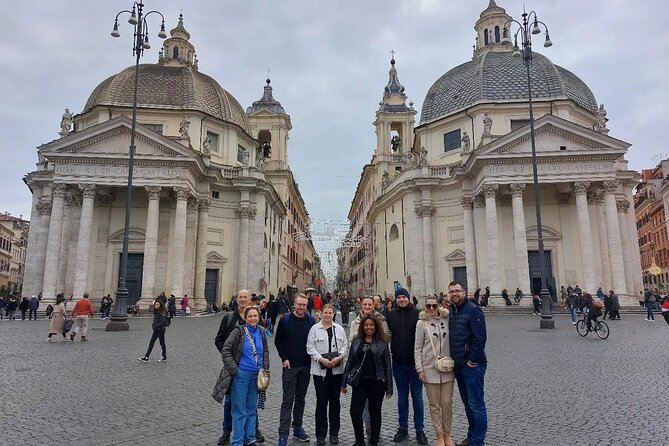
The meeting point is Piazza del Popolo, at the northern edge of Rome’s historic center. The tour begins at Porta del Popolo, also called Porta Flaminia, with about 10 minutes devoted to the gate and the start of the walk.
This is a sensible starting place. The gate once marked a major entrance to Rome, and the piazza gives you an immediate lesson in urban design. Your guide introduces the space before leading you toward its famous center, where an obelisk brought from Egypt under Ramses II shares the scene with Rome’s later Christian architecture.
The stop at Piazza del Popolo lasts about 15 minutes. You learn about the twin churches associated with Bernini and see how the piazza was shaped as a grand entrance and gathering space.
Do not expect an extended architectural study. The tour has many stops ahead, so the guide must keep the story moving. Still, this opening is useful because it gives you a clear sense of Rome as a city built in layers. Ancient Egyptian, imperial Roman, Renaissance, and Baroque elements all occupy the same view.
Augustus, the Borghese family, and Rome’s powerful streets
The walk then passes the Mausoleum of Augustus, the tomb of Octavian Augustus, Rome’s first emperor and the founder of the Julio-Claudian line. The scheduled stop is about 15 minutes.
The value here is the context. Augustus helped shape the Roman imperial system, and his tomb gives the political story a physical place. Since the itinerary passes by the mausoleum rather than offering an interior visit, treat this as an outdoor explanation and photo stop.
Next comes Palazzo Borghese, a 16th-century palace tied to the powerful Borghese family. The stop lasts about 10 minutes. The family’s name appears often in Rome, and seeing their palace helps explain how noble families shaped streets, churches, collections, and public life.
This section should appeal to you if you enjoy the connections between politics and architecture. It is less satisfying if you want to enter every building. The tour is designed to help you understand what you are seeing, not provide a ticket to each site.
Gelateria della Palma and a useful pause
After the palaces, the group stops at Gelateria della Palma for about 15 minutes. The shop is known for more than 150 ice cream flavors, and the pause also provides a bathroom break.
The stop breaks up the walking at a good point. Two and a half hours on Roman streets can feel long, especially in warm weather, so a short pause has practical value. You can choose a flavor, use the facilities, and regroup before the Pantheon.
One point needs to be clear: the booking information lists the reservation fee and tip-based format, but it does not say that gelato is included. Plan to buy your own treat if you want one.
The large flavor selection may be fun, but do not let it turn into a long tasting session. The group has a schedule, and the Pantheon is the next major stop.
More walking tours in Rome:
- Rome: Trastevere & Campo de Fiori Street Food Walking Tour
★ 4.9 · 2,768 reviews - Rome: Paranormal Night Walking Tour & Secret Backstreets
★ 4.9 · 1,921 reviews - Rome by Night Walking Tour – Legends & Criminal Stories
★ 4.5 · 1,003 reviews - Rome: Guided City Center Evening Sightseeing Walking Tour
★ 4.4 · 953 reviews
The Pantheon, where the route gathers force
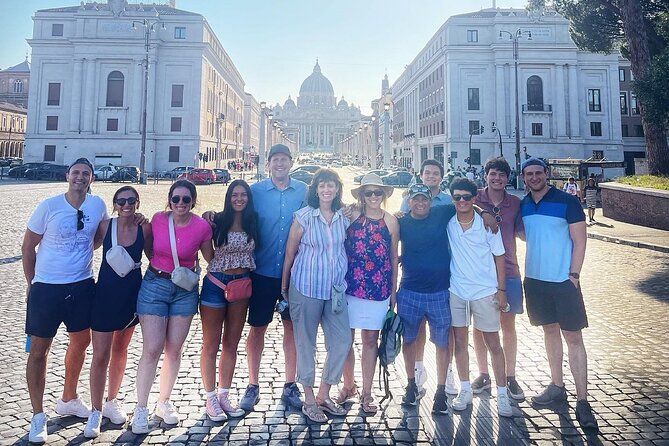
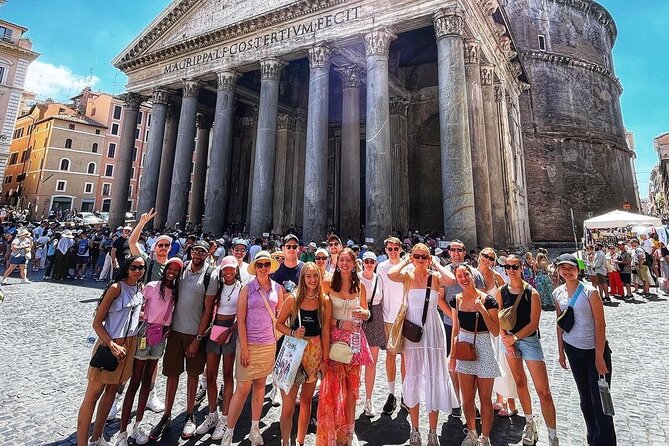
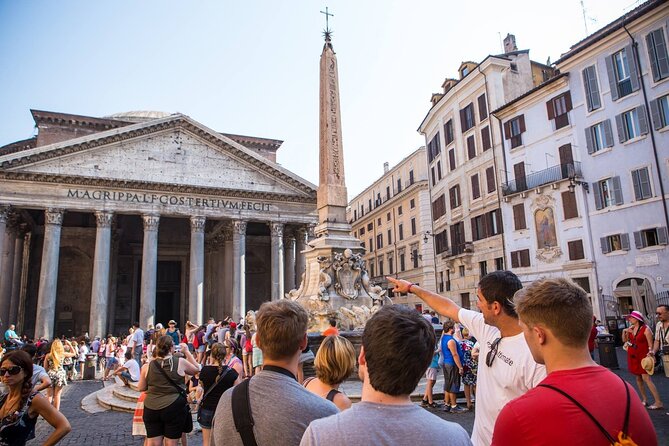
The Pantheon receives about 15 minutes and is one of the walk’s main landmarks. Your guide introduces the building as the Temple of All the Gods and explains its connection to Raphael and the first Italian royals, whose remains are associated with the site.
Even from outside, the Pantheon rewards a guide’s explanation. Its plain exterior can hide how unusual the building is, and Rome’s habit of placing ancient remains in the middle of modern streets can be hard to grasp without some background.
The short timing is both a strength and a limit. You get a focused explanation without losing half the afternoon, but this is not a full Pantheon visit. If you want to study the interior at length, return on your own after the tour. This walk gives you the story and the location, then carries you onward.
I would pay close attention to questions here. The Pantheon touches several subjects at once: Roman religion, imperial building, later Christian use, art, and the formation of modern Italy. The guide’s ability to answer follow-up questions is one of the most valuable parts of this kind of tour.
Piazza Navona and the Stadium of Domitian
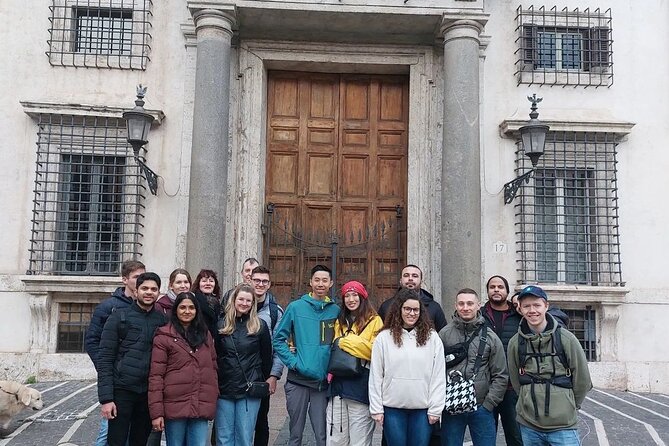
The route continues to Piazza Navona for about 20 minutes. The piazza is still shaped by the Stadium of Domitian, an ancient sports venue, and that outline explains the long, open form you see today.
This is a good place to learn how an ancient structure can guide a later city. Rome often does not preserve the past in a neat museum setting. Instead, old foundations and shapes remain under streets, homes, churches, and public squares.
Piazza Navona can be crowded and full of visual distractions. A guide helps you focus on the shape of the square and its earlier purpose instead of simply taking a fountain photo and moving on. The time here is longer than at some earlier stops, which gives the group room to discuss the site.
Still, keep your expectations realistic. The tour does not list an interior visit or a detailed study of every fountain and church. It is a guided overview, with enough information to make a later solo visit more rewarding.
Via dei Coronari and the path of Renaissance pilgrims
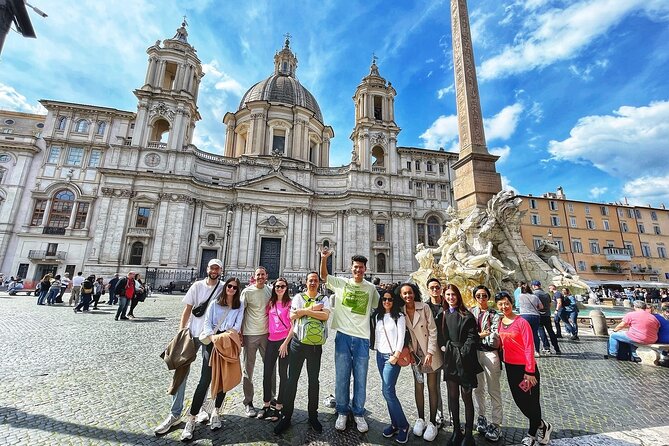
After Piazza Navona, you walk along Via dei Coronari for about 15 minutes. The street is described as largely unchanged from the Renaissance and linked to the route taken by original pilgrims.
This is one of the more distinctive parts of the walk. Major piazzas are easy to find on a map, but a street such as Via dei Coronari shows how people moved between important religious and civic places. The lane gives the tour a more human scale after the broad spaces of Piazza del Popolo and Piazza Navona.
You also get a break from the major monument checklist. Look around as you walk, but stay with the group. Historic lanes can be narrow, and the guide’s explanation may come while the group is in motion.
The route’s mix of famous and less obvious places is a major reason to choose it. Guides have been praised for pointing out sites that are not usually covered on a bus ride or a one-site tour. That is exactly the sort of detail that can change how you walk around Rome afterward.
Ponte Sant’Angelo and the story of the angels
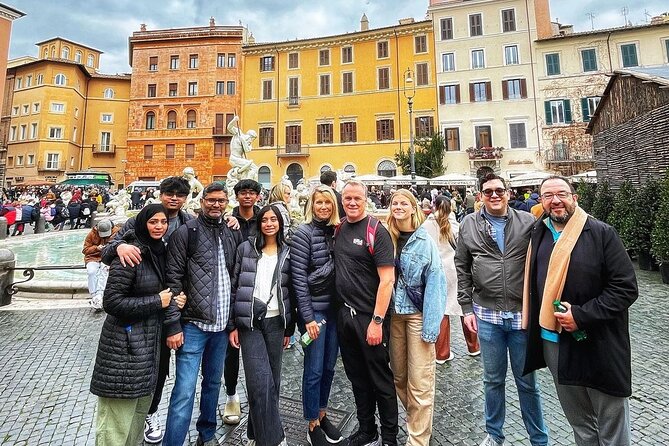
The tour reaches St. Angelo Bridge, or Ponte Sant’Angelo, for about 15 minutes. The bridge crosses the Tiber and is known for its angels, whose imagery tells the story of Christ’s martyrdom.
This is a strong visual pause. The bridge leads directly toward Castel Sant’Angelo, so the approach has a clear sense of direction. Your guide can explain the religious meaning of the sculptures and the bridge’s role in the route toward the Vatican.
The stop also shows how Rome uses symbolic decoration to shape a journey. You are not only crossing a river. You are moving through a designed religious approach, one that connects the city center with the Vatican district.
The bridge is also a practical place to watch your footing and keep close to the group. The tour is walking-based, and there is no claim that the route is designed for every mobility level. The additional information says most people can participate, service animals are allowed, and the route is near public transportation.
Castel Sant’Angelo and the final view of St. Peter’s
The walk crosses the Tiber and pauses by Castel Sant’Angelo for about five minutes. The building began as the mausoleum of Emperor Hadrian, intended to hold the emperor’s ashes, and later became the medieval fortress we recognize today.
Five minutes is enough for an introduction, not a castle tour. If Castel Sant’Angelo interests you, note that this experience ends outside rather than taking you through its rooms. That is an important distinction for anyone hoping to visit the interior.
The final 15 minutes take place around Via della Conciliazione, the broad approach to St. Peter’s Basilica. The route ends outside Castel Sant’Angelo with a view toward St. Peter’s and a brief introduction to the Vatican. The avenue was shaped by Mussolini-era architects, giving the ending a modern political layer after all the ancient and Renaissance material.
This closing view is well chosen. You finish with a landmark you may want to visit next, and you are left near the Vatican area rather than back at the starting point. The stated end point is Piazza Pia, outside the castle.
The guides and the small-group setting
The tour is offered in English and has a maximum of 15 people. That is small enough for a guide to manage questions without turning every stop into a struggle to hear.
Several guides are named in the experience material. Justin is praised for handling questions with ease. Nick is repeatedly described as engaging, clear, and strong at placing 2,500 years of Roman history into context. Lucio and Lucho are associated with relaxed, friendly walks, while Claus is noted for explaining architecture as well as history.
You should not assume you will receive a particular guide unless the booking process confirms it. But the range of comments suggests that the company’s strength is its people. The best guide for this route will make the connections for you, explain what you are looking at, and adjust to the questions coming from the group.
The relaxed tone may suit you if you dislike tours built around flags, signs, and rigid performance. It may be less suitable if you prefer a formal lecture or a private guide who can set the pace entirely around your interests.
Price, tipping, and overall value
The advertised price is $4.23 per person, but this is not the full fixed cost of a standard paid tour. It is the booking fee for your place, and the experience is tip-based at the end.
That makes the value hard to compare using the headline price alone. You are paying a small amount to reserve a two-and-a-half-hour introduction, then deciding on an appropriate tip based on the service you receive. Since no suggested tip is provided here, you should budget for one rather than treating the tour as a $4.23 activity.
For the route covered, the format can be excellent value. You see ten locations, hear the stories behind them, and get practical suggestions from guides. Nick, in particular, has provided dining advice that helped a family with two people requiring gluten-free meals find better options at reasonable prices. That sort of advice can be worth as much as another monument explanation.
The tradeoff is that admission tickets are not part of the experience. The listed stops are outdoor introductions, and the gelato is not stated to be included. Think of this as a city orientation walk, not an all-access sightseeing package.
Who should choose this walk
I would choose this tour early in a Rome stay. The route gives you a working map of the center and ends near St. Peter’s, so you can use the information to plan later visits to the Pantheon, Castel Sant’Angelo, the Vatican area, and other nearby sights.
It is also a good fit for solo visitors who want company without a huge group, families with older children who can manage a two-and-a-half-hour walk, and repeat visitors who want a different set of connections. One family used it with an 8-year-old, but the information does not provide a formal minimum age or a child-specific pace.
You should think twice if you need a seated experience, want extensive interior access, or dislike tip-based pricing. The tour moves between many stops, and most of the value comes from listening while standing or walking.
Booking is popular enough that the experience is often reserved about 50 days in advance. Free cancellation is available up to 24 hours before the start time for a full refund. Changes or cancellations inside that window are not accepted for a refund.
Should you book Piazza del Popolo and Historical Sights Walking Tour?
Book it if you want a low-cost, guide-led introduction to central Rome that joins famous sights with streets and stories you could easily miss alone. The strongest reasons are the manageable group size, the broad route, and guides such as Nick, Lucio, Justin, Lucho, and Claus, who bring strong historical and architectural knowledge to the walk.
Skip it if your main goal is to enter monuments and spend long periods inside them. For most people, though, this is a smart first-day choice: arrive at Piazza del Popolo, walk through the city’s layers, finish with St. Peter’s in view, and leave with a better sense of where to return.
FAQ
Where does the tour begin?
The tour begins at Piazza del Popolo in Rome, at Porta del Popolo, also known as Porta Flaminia.
Where does the tour end?
It ends at Piazza Pia, outside Castel Sant’Angelo, with a view of St. Peter’s Basilica along Via della Conciliazione.
How long does the walking tour last?
The tour lasts approximately 2 hours and 30 minutes.
What language is the tour offered in?
The tour is offered in English.
How many people can join the tour?
The group has a maximum of 15 people.
Is the $4.23 price the full cost?
The $4.23 is the booking fee for your place. The tour is tip-based, so you should plan to tip the guide at the end.
Is gelato included?
The route includes a stop at Gelateria della Palma, but the provided information does not state that gelato is included in the price.
Does the tour enter the Pantheon or Castel Sant’Angelo?
The information describes stops and introductions at these sites, but it does not include admission tickets or promise interior visits.
Is the tour suitable for most people?
The additional information says most people can participate. Service animals are allowed, and the route is near public transportation.
Can I cancel for a refund?
You can cancel at least 24 hours before the start time for a full refund. Cancellations or changes made less than 24 hours before the start time are not accepted for a refund.
Newest reviews from Rome
- ROME:Colosseum & Ancient Rome – private/small group TOUR★ 5.0 · 24 reviews
- Off the Beaten Track in Rome: Rione VI Parione Private Tour★ 5.0 · 24 reviews
- Cinematic Photoshoot in Rome★ 5.0 · 24 reviews
- Rome: Best of Colosseum and Roman Forum Small Group Guided Tour★ 4.5 · 24 reviews
- The Labyrinth of Rome between catacombs and ancient quarries★ 4.5 · 24 reviews
- Vatican and Trionfale Market Tour with Wine and Food Tasting★ 5.0 · 24 reviews
- private tour: Vatican Museums, Sistine Chapel, St. Peter’s Basilica★ 4.5 · 24 reviews
- Colosseum guided tour with Virtual Reality★ 5.0 · 24 reviews
Walking Tours, compared.
Trastevere & Campo de Fiori Street Food Walking Tour
Read our review →
Paranormal Night Walking Tour & Secret Backstreets
Read our review →
Rome by Night Walking Tour – Legends & Criminal Stories
Read our review →
Guided City Center Evening Sightseeing Walking Tour
Read our review →
Best of Rome Walking Tour including Trevi Fountain
Read our review →

Forbidden History Walking Tour & Pub Crawl with Drinks
Read our review →
Guided Small Group Walking Tour of City Highlights
Read our review →Browse the lists this tour appears in