
Reviewed · CITY TOURS
Private Tour – City Center
Rome’s historic center is at its best on foot, and this private tour strings together many of Rome’s essential sights in two and a half hours. You move from the Spanish Steps to the Trevi Fountain, Pantheon, Caravaggio’s church, and Piazza Navona without spending time arranging transport between them.
I like the private format, which gives you room to ask questions and adjust the pace. I also like the route’s mix of famous monuments, ancient ruins, churches, art, and everyday Roman squares. The main drawback is that the tour covers a lot of ground quickly, so you get a strong introduction rather than a slow, detailed visit to every site.
In This Review
- Key points to know before booking
- A smart first walk through central Rome
- Meeting at the Spanish Steps
- Trevi Fountain and the coin tradition
- Piazza di Pietra and Emperor Hadrian
- Sant’Ignazio’s painted illusion
- Entering the Pantheon
- Caravaggio inside Saint Louis of the French
- Piazza Navona and Bernini’s fountains
- What the private format changes
- Walking, timing, and practical comfort
- Who will get the most from this Rome tour
- Cancellation and booking flexibility
- Should you book this private city-center walk?
- FAQ
- How long is the private Rome city-center tour?
- What time does the tour start?
- Where does the tour begin?
- Where does the tour end?
- Which attractions are included?
- Is this a private activity?
- Is the tour offered in English?
- Is hotel pickup or private transportation included?
Key points to know before booking
- See seven major sights in about two and a half hours, ending at Piazza Navona.
- Meet at the Barcaccia Fountain in Piazza di Spagna for a convenient central start.
- Walk with only your own group and a dedicated guide, rather than joining a large sightseeing crowd.
- Enter the Pantheon and several churches, with Caravaggio’s paintings and Rome’s famous illusionistic Baroque art along the way.
- Guides Martina and Vincent are named in the feedback, with special praise for their humor, clear explanations, and personal attention.
- The $139.13 per-person price makes most sense for couples or small groups who value flexibility and conversation.
A smart first walk through central Rome
This tour is built for orientation. You begin in Piazza di Spagna, walk through the Trevi district and the old city center, then finish at Piazza Navona. The route is compact enough to manage in one afternoon, yet it gives you a taste of several different Roman eras.
You will see Baroque fountains, an ancient temple, an imperial-era monument, decorated churches, and paintings by Caravaggio. That variety is the real strength here. Instead of spending the whole afternoon on one archaeological site, you get a quick lesson in how Rome layers old and new on the same streets.
The tour starts at 2:30 pm. That timing gives you a useful afternoon activity, especially if you want to keep your morning open for another major sight. It also means you should arrive ready to walk, since hotel pickup and private transportation are not included.
Because this is a private activity, your group is the only group participating. That matters in Rome, where a question about a fountain or painting can easily lead to a better understanding of the whole city. The guide can explain local customs, respond to your interests, and keep the pace suited to your group rather than a fixed crowd.
More Rome tours worth comparing
- Rome by Golf Cart Private Tour: Beyond the Landmarks
★ 5.0 · 4,361 reviews - Early Morning Vatican, Sistine, St. Peter’s Semi or Private Tour
★ 5.0 · 3,779 reviews - Rome on a Golf Cart Semi-Private Tour Max 6 with Private Option
★ 5.0 · 2,502 reviews
Meeting at the Spanish Steps
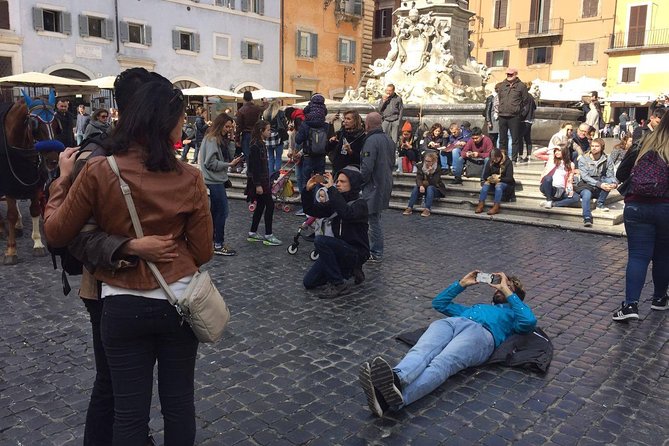
The meeting point is the Fontana della Barcaccia in Piazza di Spagna. This is a central and easy-to-recognize place to begin, with the Spanish Steps rising behind it and the surrounding area filled with major shopping streets and historic buildings.
Your first stop is the Spanish Steps, one of Rome’s best-known Baroque monuments. The scheduled stop is about 15 minutes, so expect an introduction to the architecture, the square, and the role the area plays as a social meeting point.
I like starting here because it immediately places you in the middle of Rome’s public life. You are not beginning at a remote museum or a quiet archaeological corner. You start with a famous gathering place, then move into the city’s older streets.
The short stop also signals the character of the tour. You will have time to understand what you are seeing and ask questions, but this is not designed for long photography sessions or extended independent exploration at each location.
Trevi Fountain and the coin tradition
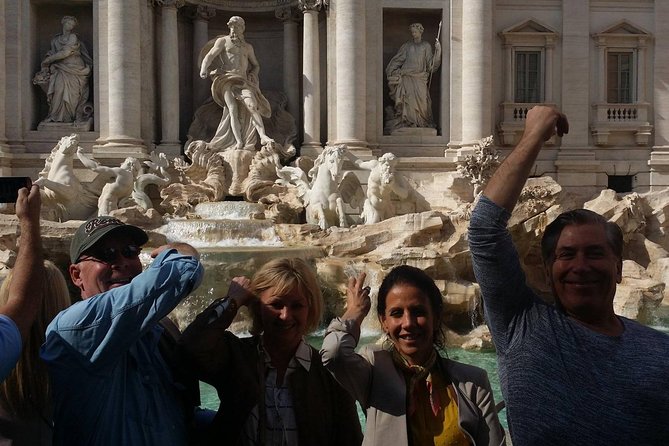
From Piazza di Spagna, the route continues to the Fontana di Trevi. The fountain receives about 20 minutes, enough to take in its theatrical design and hear the story behind the coin toss.
At the center, Oceanus rises among waves, horses, and Tritons. The guide can connect the fountain’s grand Baroque design with the familiar custom of throwing a coin to return to Rome. It is a small ritual, but it gives the stop a personal touch after the formal architecture of the Spanish Steps.
The Trevi Fountain is one of those places where the setting can feel bigger than expected. You are in a city street, then suddenly facing a monumental wall of stone and water. Your guide’s commentary helps keep the visit from becoming only a quick photograph.
The planned 20 minutes is useful for a first look, though you should not expect a quiet or private encounter with the fountain. This is one of Rome’s most famous public sights, and the tour does not promise a special viewing area or extended free time.
Piazza di Pietra and Emperor Hadrian
The walk then passes through Piazza di Pietra, where the ancient Temple of Hadrian forms the backdrop. The stop is listed at about five minutes, making it more of a focused orientation point than a full visit.
That brief pause is still valuable. Rome often reveals its ancient past in fragments, built into ordinary streets and squares. Here, the columns of an imperial temple sit within the modern city, giving you a clear example of how Roman ruins remain part of daily urban life.
The guide can place Emperor Hadrian in the wider story of the Roman Empire and explain what you are looking at before you continue. If you want a long archaeological explanation or time to study every column, this will feel short. If you want to understand the route’s many layers, it works well.
A completely different way to spend the day in Rome:
- Vatican: Museums & Sistine Chapel Entrance Ticket
★ 4.5 · 144,003 reviews - Vatican Museums & Sistine Chapel Tour with Optional Basilica
★ 4.3 · 67,413 reviews - Vatican Museums, Sistine Chapel & St Peter’s Basilica Guided Tour
★ 4.5 · 39,149 reviews - Rome: Colosseum, Palatine Hill and Roman Forum Guided Tour
★ 4.8 · 32,814 reviews
Sant’Ignazio’s painted illusion
One of the most unusual stops is the Church of Sant’Ignazio di Loyola. The visit lasts about 25 minutes and focuses on the church’s Baroque interior, including its illusionistic dome, decorated ceiling, and the tomb of Pope Gregory XV.
The painted dome is the clever detail to watch for. The church uses perspective to create the impression of architectural space where the structure does not appear as you might expect. It is the kind of Roman artwork that rewards a guide’s explanation because the effect can be easy to miss if you simply walk in and look up.
I especially like this stop because it gives the tour a pause from fountains and open squares. You move into a church where painting, architecture, faith, and visual trickery work together. It also shows why a private guide can add value: you can ask how the illusion works instead of treating the ceiling as just another ornate surface.
The tour lists admission as free, while tickets are included in the overall experience. Still, church access can depend on the site’s operating conditions, so keep your schedule flexible rather than treating every minute as guaranteed independent time.
Entering the Pantheon
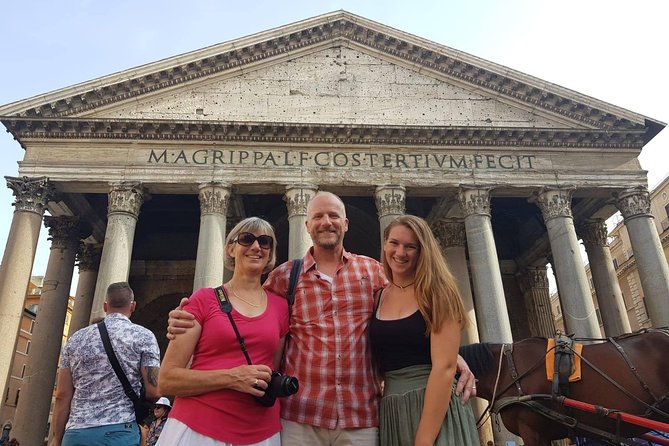
The Pantheon receives about 25 minutes and is the most substantial ancient monument on the route. You enter one of the best-preserved buildings from ancient Rome and learn about its engineering, legends, and the tomb of the painter Raphael.
The building’s great achievement is the sense of space created by its dome and central opening. A guide can help you notice how the Romans solved practical engineering problems while also giving the structure symbolic meaning.
The Pantheon is more than an ancient shell. Its continued use and later history give it a different feel from an isolated ruin. The tomb of Raphael adds a human connection, linking the ancient monument to one of Italy’s best-known artists.
Twenty-five minutes is enough for a guided introduction, but not for a long, quiet study of every feature. If the Pantheon is your top priority, you may want to return independently later. On this tour, its value comes from seeing it as one important chapter in a larger walk through Rome.
Caravaggio inside Saint Louis of the French
The Church of Saint Louis of the French is the artistic high point for many people. The scheduled visit lasts about 20 minutes, and the reason is clear: the church contains three of Caravaggio’s most famous paintings.
This stop gives you a concentrated look at the painter’s bold use of light, shadow, and human emotion. You do not need to be an art specialist to appreciate the impact. The paintings are in a working church, not separated from their original religious setting inside a large museum.
The guide’s role is especially useful here. Caravaggio is not simply a name to recognize and photograph. His work changed the feel of religious painting, and the church provides a direct way to see why his style remains so important.
I would pay close attention to the guide’s explanation rather than rushing from one painting to the next. The tour’s schedule is limited, and the church’s three works deserve focused attention. If you already know Caravaggio, this adds context. If you do not, it is an efficient introduction to one of Rome’s most important artists.
Piazza Navona and Bernini’s fountains
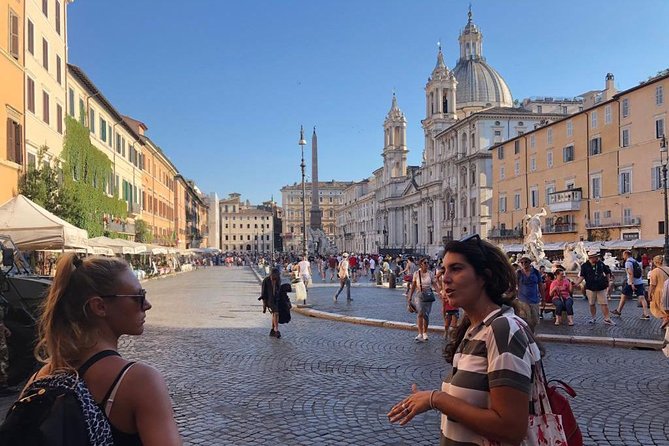
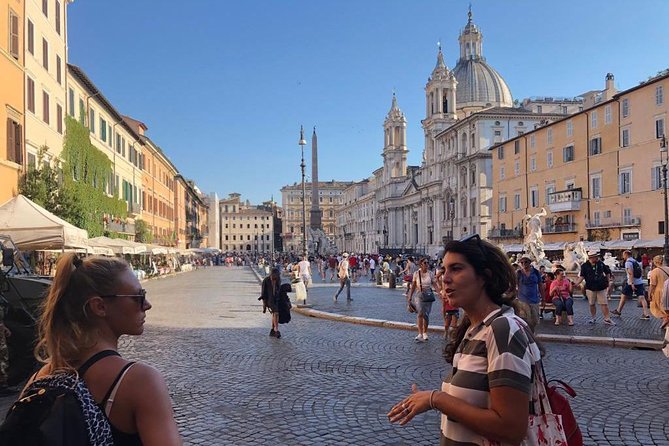
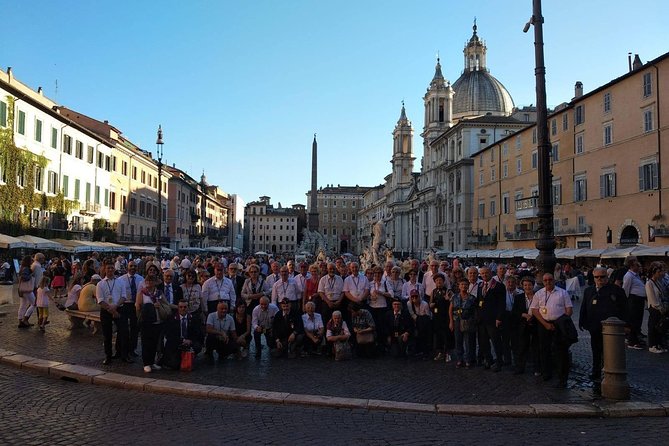
The final stop is Piazza Navona, where the tour ends after about 20 minutes. The square follows the footprint of an ancient Roman stadium, and its present design is one of the clearest expressions of Rome’s Baroque style.
The Church of Sant’Agnese in Agone anchors the square, while the Fountain of the Four Rivers provides its grand centerpiece. The fountain represents four major rivers through sculpted figures, and the guide can explain the symbolism and the rivalry often associated with Rome’s Baroque artists.
Ending here is practical. Piazza Navona is a natural place to continue your afternoon, with two taxi stations close to the end point. You can also use the square as a base for your next plan, though this tour does not include a ride onward.
I like the finish because it brings together the route’s main themes: ancient foundations, dramatic Baroque design, religious art, and Rome’s public squares. You end with a major landmark rather than a quiet side street or a transport stop.
What the private format changes
A private tour is not automatically better than a group tour, but here it fits the route well. Seven stops in roughly 150 minutes require a clear pace, and your guide can adjust explanations without waiting for a bus full of people.
The private setup also helps if your group has mixed interests. One person may want more Roman engineering, another may care about Caravaggio, and someone else may want local customs explained. The feedback specifically highlights Martina’s ability to make history fun and to discuss local customs, while Vincent is praised for enthusiasm and broad command of the sites.
Those details matter because the route itself is familiar. Many companies can point out the Spanish Steps and Trevi Fountain. The difference comes from how well the guide connects the sights and responds to you.
The tradeoff is price. At $139.13 per person, this is not the cheapest way to see central Rome. The value improves for a couple or small group that would otherwise pay for several separate guided visits. It is less compelling if you prefer to walk alone, read your own guidebook, or spend a long time inside one monument.
Group discounts are available, which may make the per-person cost more attractive for a larger private party. You should compare the final total for your group, since the main benefit is the dedicated guide and the ability to ask questions throughout the walk.
Walking, timing, and practical comfort
The experience requires a moderate level of physical fitness. You will be walking through central Rome for about two and a half hours, moving between outdoor squares, streets, churches, and monuments. No private transport is included, so comfortable walking shoes are a sensible choice.
The schedule is fairly brisk. The route gives you 15 minutes at the Spanish Steps, 20 at Trevi Fountain, five at Piazza di Pietra, 25 in Sant’Ignazio, 25 at the Pantheon, 20 at Saint Louis of the French, and 20 in Piazza Navona.
Those times are approximate, but they show the tour’s priorities. The Pantheon and Sant’Ignazio receive more attention than the ancient temple columns, while the final square gets enough time for a clear explanation and a look around.
You should treat this as a highlights walk, not a day of leisurely museum visits. It is best for getting your bearings, learning the city’s basic story, and deciding which places deserve a return visit.
The start time is fixed at 2:30 pm. Confirmation arrives when you book, and the meeting point is near public transportation. Since there is no hotel pickup, plan your route to Piazza di Spagna before the start time and allow room for Rome’s busy central streets.
Who will get the most from this Rome tour
I would recommend this experience to first-time visitors who want a clear introduction without committing a full day to sightseeing. It also suits couples and families who prefer private conversation to a large group format.
Art lovers should pay special attention to the two churches. Sant’Ignazio offers a lesson in Baroque illusion, while Saint Louis of the French gives you three major Caravaggio paintings in one place.
History-minded visitors will appreciate the shift from the Temple of Hadrian to the Pantheon and the ancient stadium footprint beneath Piazza Navona. You are constantly moving between periods, which makes the city easier to understand as a whole.
The tour may be less suitable if you have limited mobility, need frequent long breaks, or want extensive time at each landmark. The published requirement is a moderate fitness level, and the route is designed to keep moving.
It is also not the right choice if you need hotel transportation. You must reach Piazza di Spagna yourself, and you are responsible for arranging your own way onward from Piazza Navona.
Cancellation and booking flexibility
Free cancellation is available if you cancel at least 24 hours before the 2:30 pm start time. Cancellations made less than 24 hours before the experience are not refunded, and changes inside that period are not accepted.
That policy is fairly manageable if you finalize your plans early. This tour is booked, on average, 148 days in advance, so reserving ahead may be sensible during a busy Rome visit. The activity is offered in English, and confirmation is received at booking.
Should you book this private city-center walk?
Book it if you want a well-paced first look at central Rome, especially with a partner, family, or small group that will make use of private guide time. The route covers the city’s famous fountains and squares but also adds the Pantheon, Caravaggio, Sant’Ignazio, and the Temple of Hadrian.
I see the strongest value in the guide, not in transportation or special access. Martina and Vincent are singled out for humor, enthusiasm, clear explanations, conversation, and help with local customs. That personal exchange is what can turn a familiar sightseeing route into a useful introduction.
Skip it if your priority is spending an hour or more at each monument, traveling from your hotel by private vehicle, or keeping costs as low as possible. For everyone else, this is a focused way to meet Rome in one afternoon, with enough substance to help you plan what to see next.
FAQ
How long is the private Rome city-center tour?
The tour lasts approximately 2 hours and 30 minutes.
What time does the tour start?
The start time is 2:30 pm.
Where does the tour begin?
The meeting point is at the Fontana della Barcaccia in Piazza di Spagna, Rome.
Where does the tour end?
The tour ends in Piazza Navona. Two taxi stations are close to the end point.
Which attractions are included?
The route includes the Spanish Steps, Trevi Fountain, Piazza di Pietra and the Temple of Hadrian, the Church of Sant’Ignazio di Loyola, the Pantheon, the Church of Saint Louis of the French, and Piazza Navona.
Is this a private activity?
Yes. Only your group participates in the private tour.
Is the tour offered in English?
Yes. The tour is offered in English.
Is hotel pickup or private transportation included?
No. Hotel pickup, hotel drop-off, and private transportation are not included.
Newest reviews from Rome
- Rome: Vatican Museums & Sistine Chapel Skip-the-Line Ticket★ 4.4 · 148 reviews
- Shared Shuttle Transfer from Rome to Civitavecchia Port★ 5.0 · 148 reviews
- Rome: Crypts & Catacombs After Hours Tour with Bone Chapel★ 4.6 · 149 reviews
- Ghosts Legends and Mysteries of Rome Walking Tour★ 5.0 · 149 reviews
- Skip the Line: Vatican and Sistine Chapel with Guided Tour★ 4.0 · 149 reviews
- Tivoli: Villa Gregoriana Entrance Ticket★ 4.7 · 150 reviews
- Pizza and Tiramisu Cooking Class in Rome, Piazza Navona★ 5.0 · 150 reviews
- Appian Way E-bike Tour with Gourmet Picnic and Catacombs★ 4.5 · 150 reviews
City Tours, compared.

Fettuccine Pasta Cooking Class in Rome’s City Center
Read our review →
Vatican Museums & Sistine Chapel Entry Ticket
Read our review →
Rome City Small Group Bike Tour with quality Cannondale EBike
Read our review →
Rome Highlights City Tour by Golf Cart with Gelato
Read our review →
Imperial City Tour by Golf Cart with Optional Transfer
Read our review →
Guided City Center Evening Sightseeing Walking Tour
Read our review →
Golf Cart Small-Group Guided Tour: Rome City Highlights
Read our review →
Browse the lists this tour appears in