

Reviewed · GLADIATOR EXPERIENCES
Roman Gladiator School: Learn How to Become a Gladiator
Rome’s Gladiator School turns ancient Roman history into a hands-on two-hour lesson. You’ll handle replica weapons, put on a tunic and leather gloves, learn sword moves with a wooden rudis, and finish with a mock battle in an arena near the Appian Way. It is history you can act out, not just read about.
I love the mix of a small museum tour and active training, and I like that instructors from the Historic Group of Rome bring real enthusiasm to the lesson. Guides including Mirkos, Patricio, Ivan, and Flama have been praised for making the session funny, clear, and welcoming. The main drawback is the location: it is outside the old city walls, and finding the entrance can take patience.
In This Review
- Key points to know before booking
- From Roman artifacts to your first sword lesson
- Getting dressed as a Roman fighter
- Learning sword and shield technique
- The arena battle and optional tournament
- Why the small-group format matters
- Reaching Via Appia Antica 18
- Is $108.16 a fair price?
- Who will enjoy Gladiator School most?
- How to plan the best visit
- Should you book this Roman gladiator lesson?
- FAQ
- Where does the Gladiator School experience take place?
- How long does the experience last?
- What does the class include?
- What clothing and equipment are provided?
- Is the museum included?
- What is the minimum age?
- Can adults take part?
- Can friends or relatives watch?
- How many people can join a class?
- What happens if I need to cancel?
Key points to know before booking
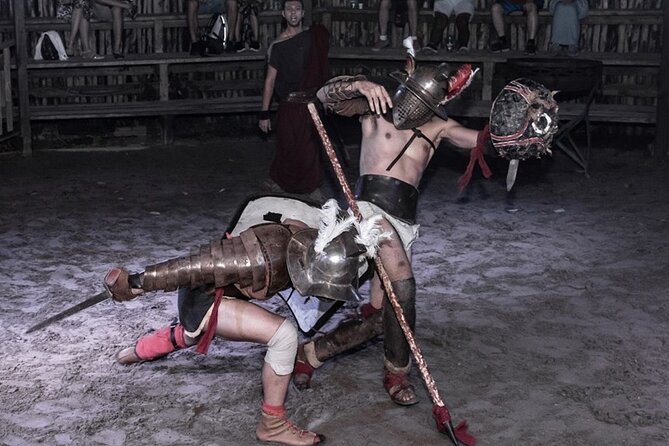
- The museum comes first: See gladiator armor, helmets, weapons, shields, and Roman military displays before training begins.
- You get the full costume: A belt, tunic, leather gloves, and training sword are provided for the lesson.
- The arena battle is the big finish: Learn basic offense and defense, then take part in friendly matches or an optional tournament.
- Small groups help: The class is capped at 15 people, and some time slots may have only one or two families.
- It works best for families: Children from age six can participate, while parents and other relatives may watch from the platform.
- Plan the journey carefully: The school is at Via Appia Antica 18, with bus, taxi, and walking options, but the final driveway can be easy to miss.
From Roman artifacts to your first sword lesson

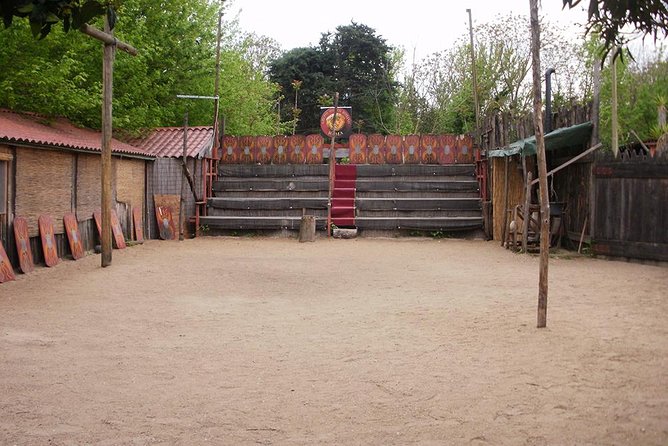
The class begins at the Gladiator School of Rome, a specialist site devoted to reenacting Roman life and combat. It is located on the Appian Way, not beside the Colosseum itself. That setting gives the activity a more open, old-Rome feel, but it also means you need to allow extra time to get there.
Before you train, you enter the school’s museum. This is not a long museum visit, but it gives the activity useful context. You can see gladiator weapons, helmets, armor, shields, uniforms, and displays about Roman soldiers and fighters. Some sessions include the chance to handle or try on pieces of the gear, which makes the following lesson easier to understand.
I especially like this order. If you went to the Colosseum the day before, as many families do, the museum gives your children a practical link between the stone arena they saw and the people who once fought in it. Instead of beginning with random swordplay, the instructor explains what Roman fighters wore and how their equipment affected the way they moved.
The guides are part of the Historic Group of Rome, and their role is more than calling out instructions. Instructors such as Ivan and Patricio have been singled out for explaining Roman soldiers and gladiators in a lively way, while Flama is known for mixing historical explanation with comic physical demonstrations. The tone is playful, but the lesson still has an educational backbone.
More gladiator experiences in Rome:
- Rome: Colosseum Tour with Access to the Gladiator Arena
★ 4.3 · 6,690 reviews - Gladiator’s Gate: Special Access Colosseum Tour with Arena Floor
★ 4.5 · 4,037 reviews - Rome: Gladiator’s Gate and Arena Special Colosseum Access
★ 4.7 · 796 reviews
Getting dressed as a Roman fighter
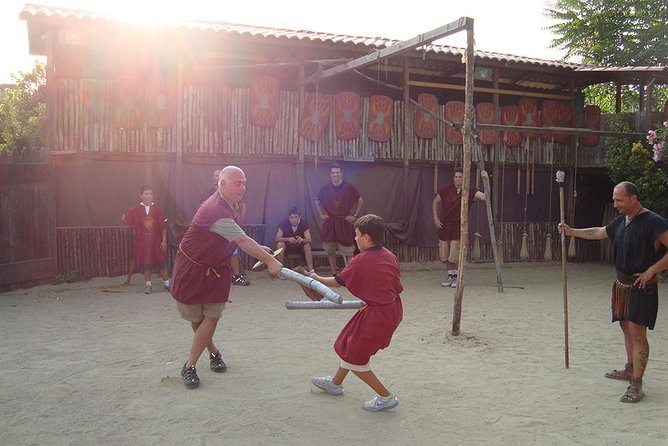
After the museum portion, you put on the clothing supplied for the session. The basic outfit includes a traditional belt, tunic, leather gloves, and a training sword called a rudis. You do not need to bring your own equipment, and the clothing hire is included for the length of the lesson.
This costume change is a small part of the class, but it matters. Children who may have drifted during a lecture often become focused once they are dressed for the part. Adults can join in too, although the activity has a clear family focus. The equipment is there to support supervised practice, not to recreate a dangerous fight.
Bring comfortable clothes and shoes underneath the costume. You will take part in warm-ups, agility work, basic combat drills, and arena matches. The outdoor setting can also mean mosquitoes, especially in warmer months. Bug spray is one of the most practical things to pack.
Learning sword and shield technique
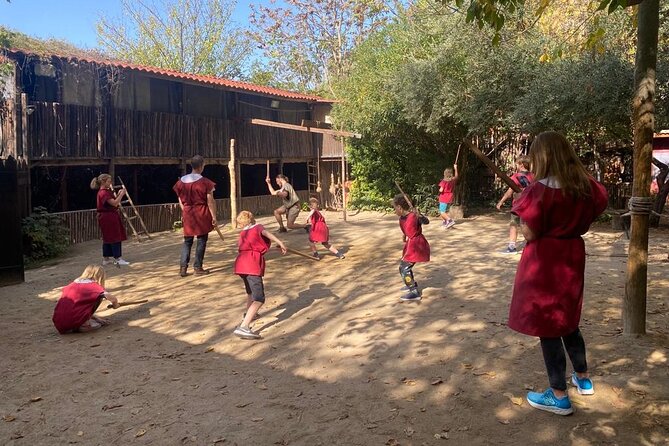
Training starts with warm-ups and simple exercises. You learn how to hold the sword, how to move, and how to use basic offense and defense. Depending on the instructor and group, the session can also include agility exercises, an obstacle course, and a mental game to help you think like a gladiator.
The teaching is designed for beginners. You do not need fencing experience or a background in Roman history. The instructor demonstrates each movement and then helps the group repeat it. That personal attention is one reason the maximum group size of 15 works well, and smaller groups can feel almost private.
You will practice with wooden weapons rather than real blades. The lesson is theatrical and controlled, but it is still physical. Children should be able to follow instructions and handle friendly contact. One important caution comes from the age range: although the minimum age is six, very young children may find the mock fighting uncomfortable. Some children have become upset when matches felt too physical.
I would use your judgment here. Confident children who enjoy active play will likely get the most from it. If your child dislikes pretend combat, loud excitement, or physical competition, the museum and viewing platform may be a better fit than taking part in every drill.
The arena battle and optional tournament
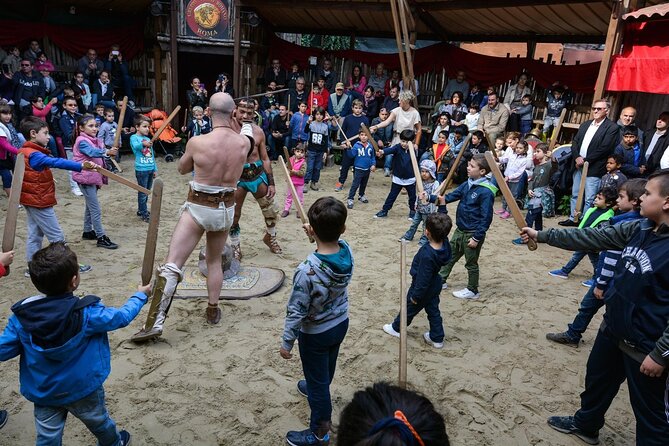
The session reaches its most memorable point in the arena. After practicing the basic moves, you face other members of the group in staged matches with swords and shields. The fights are meant to be friendly and humorous, with the instructor keeping the action moving and helping participants remember what they learned.
Families often enjoy this part because everyone has a role. Children can fight children, adults can join their family, and friends or relatives who do not have a ticket can watch from the viewing platform. The atmosphere is less about winning than about seeing the skills used in a short, lively performance.
You may also take part in an optional tournament, with a prize for the winner. You do not have to compete. If your group includes different ages or comfort levels, that choice helps keep the activity flexible.
At the end, every participant receives a certificate of accomplishment. It is a simple souvenir, but it gives children something tangible to take home after the costume photos and arena battle. For a child who has spent the morning looking at Roman ruins, the certificate can become the part of the day they talk about most.
A completely different way to spend the day in Rome:
- Vatican: Museums & Sistine Chapel Entrance Ticket
★ 4.5 · 144,003 reviews - Vatican Museums & Sistine Chapel Tour with Optional Basilica
★ 4.3 · 67,413 reviews - Vatican Museums, Sistine Chapel & St Peter’s Basilica Guided Tour
★ 4.5 · 39,149 reviews - Rome: Colosseum, Palatine Hill and Roman Forum Guided Tour
★ 4.8 · 32,814 reviews
Why the small-group format matters

The class allows up to 15 people, which is modest compared with many city activities. That limit gives the instructor a chance to correct sword positions, explain movements again, and keep an eye on the younger participants.
The difference is even clearer in quieter seasons or early morning time slots. Some sessions have had only one family or two adults, giving the instructor plenty of time for questions and individual help. If you prefer a more personal class, an early booking and an off-season visit may improve your chances of a smaller group, though group size can vary.
The class is offered in English, and the instructors combine explanation with demonstration. That helps when you are learning a physical movement. You can watch the action instead of relying only on verbal instructions.
Friends and family may watch from the platform, making this a useful option if not everyone in your party wants to participate. A parent can observe a child, take pictures, and still share the occasion without paying for a lesson ticket.
Reaching Via Appia Antica 18
The meeting point is Via Appia Antica 18, 00179 Roma. The school is close to the Colosseum by subject matter, but not by city-center convenience. It sits outside the old Roman walls on the Appian Way, and the walk from the Colosseum can take about 45 minutes.
Bus 118 is one stated public transport option along Via Appia. Taxis are another choice, though taxi fares can add to the cost. If you walk from the Colosseum, allow extra time and use a reliable map. The school can be at the end of a long driveway rather than directly where a map pin seems to place it, so do not arrive at the last minute.
This is the main logistical weakness of the experience. The class itself lasts about two hours, but the door-to-door outing takes longer once you add the journey. I would schedule it as a half-day plan rather than trying to squeeze it between two timed central Rome attractions.
There are few proper food options nearby. Eat before you go, especially if children are participating. A drink is listed among the inclusions, but at least one booking experience reported that no drink was provided, so I would carry water and confirm the current arrangement before setting out.
Is $108.16 a fair price?
At about $108.16 per person, this is not a low-cost museum visit. The price covers the two-hour class, instructor-led training, costume and weapon hire, the museum, and a certificate. For a family that wants a special activity rather than another sightseeing walk, that package can offer good value.
The calculation changes if only one person in your group wants to participate. A parent can watch from the platform, but the full value is strongest when several family members join the training. Group discounts may help larger parties, and the small-group setup adds value if you care about individual attention.
You are also paying for the setting, the instructor’s presentation, and the chance to connect your Rome sightseeing with a physical activity. It is not a substitute for seeing the Colosseum itself. Think of it as a companion experience that gives the arena and its fighters a human scale.
The class is recommended by 93 percent of participants and has a 4.7 rating from 1,477 reviews. Those figures suggest a dependable experience, but they do not remove the two real concerns: transportation and the possibility that very young children may find the combat too physical.
Who will enjoy Gladiator School most?

This is one of Rome’s better family activities for children who like costumes, games, and movement. Seven-year-olds have enjoyed the warm-ups, and older children, including an 11-year-old and a 14-year-old, have found the arena training memorable. Teenagers can also enjoy it if they are willing to play along rather than expecting serious martial arts instruction.
Adults are welcome and can make the class fun, particularly in a small group. A pair of adults once had an early session with only their own group and found the museum, armor, sword practice, and obstacle work engaging. Still, the teaching style is aimed at families and children. Adults seeking formal historical fencing instruction should choose a specialist course instead.
The activity may also suit families with children who need a more active way to connect with history. Staff have worked successfully with autistic children, but each child is different. If your child is sensitive to noise, touch, costumes, or pretend fighting, contact the provider before booking and consider having a parent observe first.
You should skip it if you want a quiet, detailed museum visit or a polished stage show. The museum is relatively brief, and the main purpose is participation. It is noisy, playful, and physical by design.
How to plan the best visit
Book ahead if your dates are fixed. The experience is booked on average 52 days in advance, and the small capacity can make popular times less flexible.
Choose a time that leaves room for transport delays. I would not pair a tight morning Colosseum entry with a Gladiator School class unless you have carefully planned the connection. The school ends back at its meeting point, so you also need to arrange your return to central Rome.
Wear comfortable shoes and clothes, carry water, and bring mosquito repellent. Eat before arriving, since the area does not offer many substantial food choices. A mobile ticket is accepted, and confirmation is sent at booking.
The minimum age is six, and most people can participate. The lesson is offered in English. Free cancellation is available up to 24 hours before the start time, with a full refund, but late cancellations and changes are not accepted.
Should you book this Roman gladiator lesson?
Book it if you want a memorable family activity that connects Roman history with movement, costumes, and a mock arena battle. The museum adds useful context, the instructors bring humor and historical detail, and the small groups allow more help than a standard city tour.
Think twice if your schedule is tight, your group dislikes physical play, or the $108.16 price is hard to justify for a two-hour activity. The location takes planning, and younger children may not enjoy the fighting as much as older kids.
For families with children from six upward, especially those who already enjoy swords, role-play, or the Colosseum, this is a strong choice. Plan the ride, pack repellent and water, and treat it as a stand-alone outing. That is the best way to get full value from your time at the Gladiator School of Rome.
FAQ
Where does the Gladiator School experience take place?
The class takes place at the Gladiator School of Rome at Via Appia Antica 18, 00179 Roma RM, Italy.
How long does the experience last?
The lesson lasts approximately two hours, and the activity ends back at the meeting point.
What does the class include?
It includes a two-hour Roman gladiator lesson, instruction from members of the Historic Group of Rome, a drink, the gladiator clothing and weapons used during the class, museum admission, and a certificate of accomplishment.
What clothing and equipment are provided?
You receive a traditional belt, tunic, leather gloves, and a training sword called a rudis. The class also uses training weapons and shields.
Is the museum included?
Yes. Admission to the Gladiator School of Rome Museum is included in the experience.
What is the minimum age?
The minimum age is six years old.
Can adults take part?
Yes. Adults can participate, although the activity has a strong family and children’s focus.
Can friends or relatives watch?
Yes. Friends and family members may watch the lesson from the viewing platform.
How many people can join a class?
The maximum group size is 15 participants.
What happens if I need to cancel?
You can cancel at least 24 hours before the local start time for a full refund. Cancellations or changes made less than 24 hours before the start time are not accepted.
Newest reviews from Rome
- Rome: Vatican Museums & Sistine Chapel Skip-the-Line Ticket★ 4.4 · 148 reviews
- Shared Shuttle Transfer from Rome to Civitavecchia Port★ 5.0 · 148 reviews
- Rome: Crypts & Catacombs After Hours Tour with Bone Chapel★ 4.6 · 149 reviews
- Ghosts Legends and Mysteries of Rome Walking Tour★ 5.0 · 149 reviews
- Skip the Line: Vatican and Sistine Chapel with Guided Tour★ 4.0 · 149 reviews
- Tivoli: Villa Gregoriana Entrance Ticket★ 4.7 · 150 reviews
- Pizza and Tiramisu Cooking Class in Rome, Piazza Navona★ 5.0 · 150 reviews
- Rome: Borghese Gallery Skip-the-Line Entry and Guided Tour★ 4.7 · 150 reviews
Gladiator Experiences, compared.
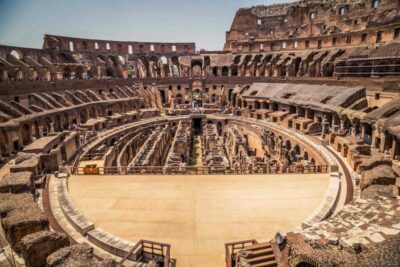
Colosseum Tour with Access to the Gladiator Arena
Read our review →
Gladiator’s Gate: Special Access Colosseum Tour with Arena Floor
Read our review →
Gladiator’s Gate and Arena Special Colosseum Access
Read our review →Colosseum Gladiator’s Arena and Roman Forum Group Tour
Read our review →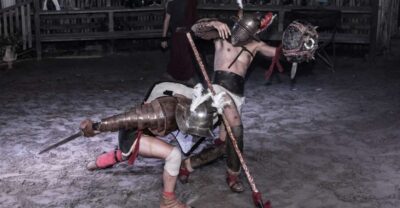
Colosseum Gladiator’s Arena and Ancient Rome VIP Guided Tour
Read our review →
Colosseum Gladiator’s Arena and Roman Forum Tour
Read our review →Browse the lists this tour appears in