
Reviewed · CATACOMBS & CRYPTS
Rome: Bone Crypts Express – Tour in ENGLISH with tickets
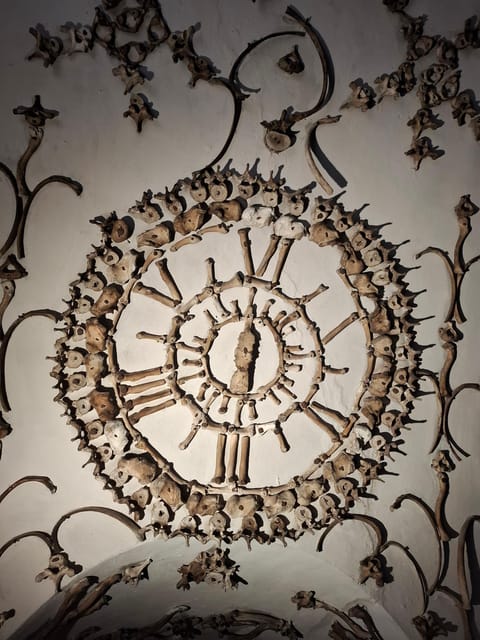
Rome’s Capuchin Crypts are not a dusty underground curiosity. They are six carefully arranged chapels decorated with the bones of nearly 4,000 Capuchin monks. Pelvises form arches, skulls frame walls, and an hourglass quietly reminds you that time wins every argument. It is macabre, but also strangely orderly and reflective.
I like two things here: the small group of no more than 10 people, which makes it easier to hear and ask questions, and the guide-led storytelling about the Franciscan and Capuchin orders. Guides such as Mike, Heather, Alessandra, and Angela have been praised for mixing facts, warmth, and humor. The main drawback is price: at $35, you are paying for a short visit to one site, so this works best if the crypts genuinely interest you.
In This Review
- Key points to know before booking
- Meeting at Piazza Barberini beside the Triton Fountain
- The Capuchin Museum explains the people behind the bones
- Six chapels, six different ways to face mortality
- A sacred site that requires respectful behavior
- What the English guide adds to a one-hour visit
- Why skip-the-line entry matters here
- Is $35 a fair price for the Capuchin Crypts?
- Who will appreciate this unusual Rome experience?
- Practical advice before you go
- Should you book the Bone Crypts Express Tour?
- FAQ
- Where does the Capuchin Crypts tour meet?
- How long does the tour last?
- Is the tour conducted in English?
- How large is the group?
- What does the ticket include?
- What should I wear to enter the crypts?
- Can children, pregnant women, or wheelchair users join?
Key points to know before booking
- Six chapels use the bones of nearly 4,000 Capuchin monks, arranged into symbols, patterns, and religious decorations.
- The tour begins at Piazza Barberini, in front of the Triton Fountain, then walks to the Capuchin Museum.
- English guides lead a group limited to 10 people, with guides including Mike, Heather, Alessandra, and Angela.
- The visit lasts about one hour, or approximately 70 minutes according to the stated route.
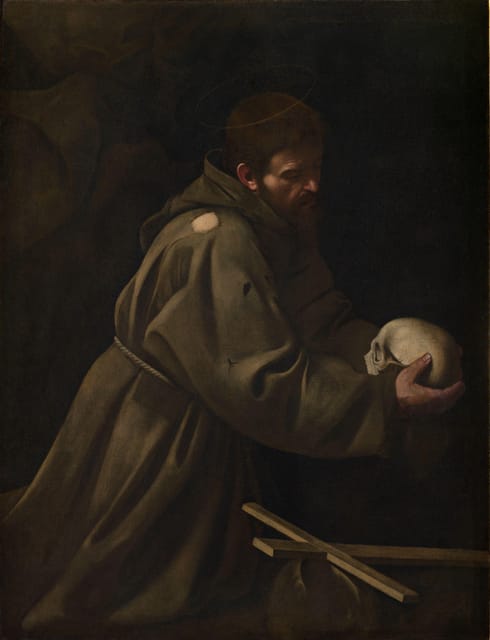
- Caravaggio’s art is part of the story, adding a major Roman art connection to the crypt visit.
- Modest clothing is required: shoulders and knees must be covered, and shorts or skirts are not permitted, although cargo shorts are accepted.
Meeting at Piazza Barberini beside the Triton Fountain
Your meeting point is in central Rome, at Piazza Barberini, directly in front of the Triton Fountain. This is a useful location because you can reach it without arranging a hotel transfer, and the tour returns to the same square.
Arrive ready to walk a short distance to the Capuchin Museum. The meeting point is described as the face side of the fountain, so look for your English-speaking guide there rather than waiting at a nearby café or metro entrance. Guides have sometimes contacted participants directly to prevent confusion, which is helpful in a busy city square.
The group is limited to 10 participants. I consider that a real advantage at a site where the mood calls for quiet attention. A large crowd would make it harder to hear the explanation and easier to feel hurried through the rooms.
The tour is offered in English only, and a strong level of English is recommended. That matters here because the visit depends on explanation. Without the background about the orders, burial rules, and religious symbols, you would mainly see bones arranged in elaborate patterns.
More catacomb and crypt visits from Rome:
- Rome: Crypts and Catacombs Underground Tour with Transfers
★ 4.6 · 5,341 reviews - The Original Roman Crypts and Catacombs Tour with Transfers
★ 4.5 · 4,896 reviews - Rome: Catacombs of St. Callixtus Entry Ticket & Guided Tour
★ 4.6 · 3,037 reviews
The Capuchin Museum explains the people behind the bones
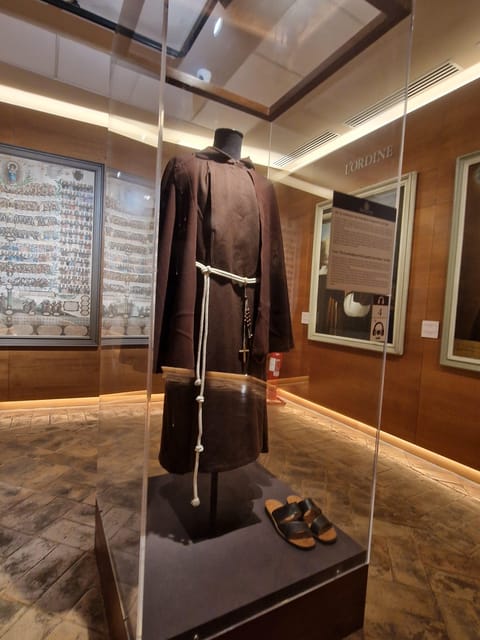
Before reaching the crypts, the tour sets the scene in the Capuchin Museum. You learn about the Franciscan Order and the Capuchin branch that created this unusual burial place.
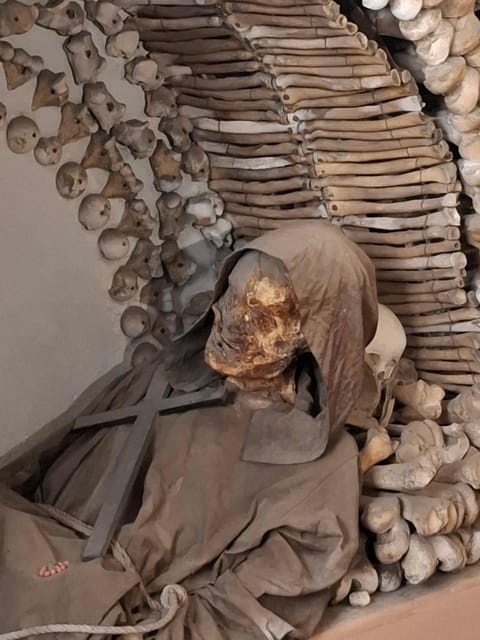
This introduction gives the crypts a human and religious context. The remains are not presented simply as a shock attraction. They belonged to friars who lived within a strict religious tradition, and the arrangements reflect ideas about death, humility, faith, and the short span of earthly life.
You also hear why the remains were moved from an older friary near the Trevi Fountain. Capuchin burial laws played an important role in the creation of the present cemetery. That detail helps explain why the crypt exists at all, rather than leaving you with the impression that someone randomly decorated a cellar with bones.
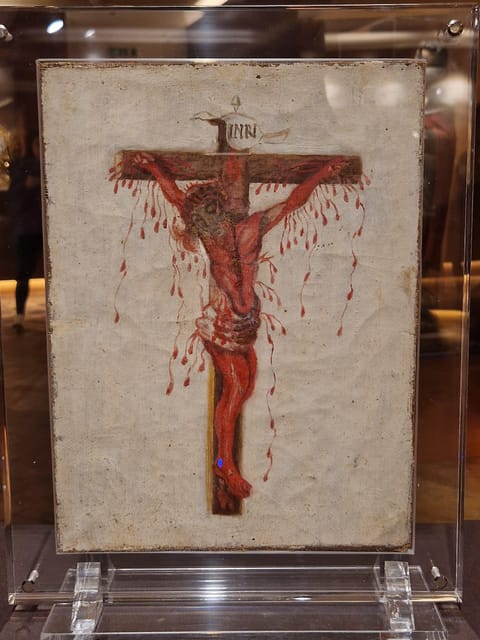
The museum section also connects the visit to Caravaggio, one of Rome’s most important Baroque artists. The tour presents him as a rebellious and difficult figure, sometimes described as a bad boy of Rome, while also explaining his artistic importance. This is a welcome addition because it links the crypts to the wider artistic life of the city.
The Caravaggio material is not a substitute for visiting his major paintings elsewhere in Rome, but it gives this short tour extra range. You receive religious history, burial customs, and art in one compact route.
Six chapels, six different ways to face mortality
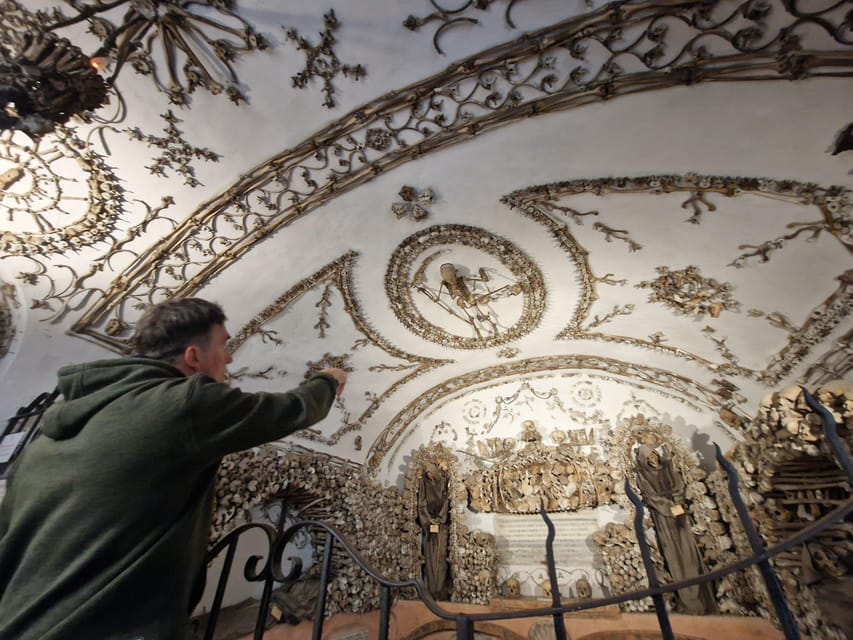
The crypts contain six chapels, each with its own arrangement and mood. You do not simply walk into one room filled with bones. The designs change from chapel to chapel, and the guide explains the symbols and patterns as you proceed.
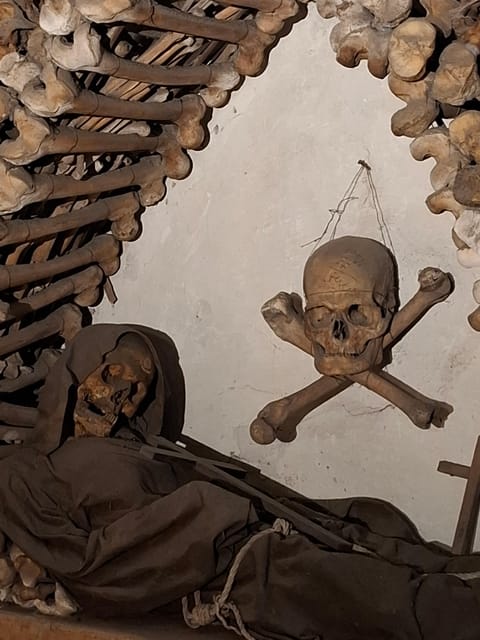
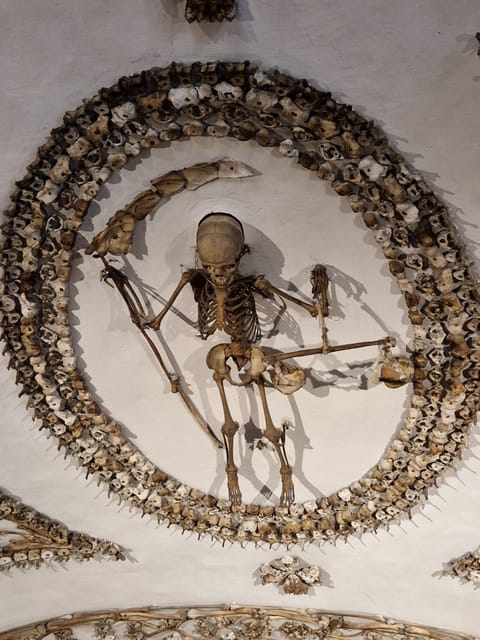
The Crypt of the Three Skeletons makes an immediate impression. Skeletons appear as a clear reminder of the people beneath the robes and decorations. The presentation is direct, but the setting remains religious rather than theatrical.
The Crypt of the Leg Bones and Thigh Bones uses long bones as its main visual element. Their repeated shapes create a pattern that is both unsettling and surprisingly controlled. This is one of the moments when the site’s unusual balance becomes clear: the bones are real human remains, yet they have been arranged with deliberate visual order.
In the Crypt of Pelvises, friars are represented through arches made from pelvic bones. The arrangement has a solemn, almost architectural quality. You may find yourself looking first at the design, then remembering what each piece actually is.
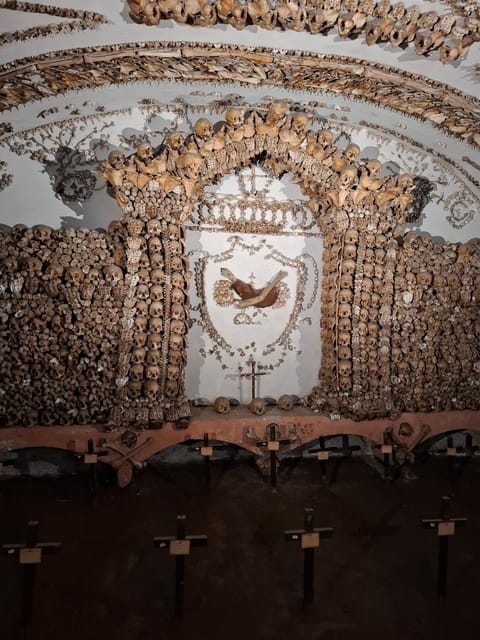
The Crypt of the Skulls is perhaps the most recognizable room. Skulls form much of its visual language, and an hourglass adds a plain message about passing time. It is a familiar symbol, but here it carries more weight because it appears among actual human remains.
Crosses set into the floor mark the final resting places of seven monks. These are easy to overlook if you focus only on the walls, so listen for the guide’s explanation. They add a quieter note to the visit and remind you that the crypt is still a burial ground, not merely a display.
The stated material also refers to altars and Christian symbols made from human remains. Those symbols matter because they show how the Capuchins connected physical death with religious belief. The result can feel disturbing, but it is intended to prompt thought about mortality and eternity.
A sacred site that requires respectful behavior
The Capuchin Crypts are a holy place, and the rules are not optional. Your shoulders and knees must be covered. Shorts and skirts are not allowed, although cargo shorts are specifically accepted.
Wear comfortable clothes. The tour is short, but you will be walking from Piazza Barberini to the museum and moving through several rooms. Wheelchair users cannot take this tour, and it is not suitable for children under 10 or pregnant women.
You should also prepare for a serious atmosphere. Guides may use light humor to make the material easier to approach, and that can work well. Several guides, including Mike, Heather, and Angela, have been praised for being warm, funny, and engaging while keeping the subject clear. Still, this is not a place for loud behavior or casual photography assumptions.
The crypts may surprise you in another way. They are not necessarily the far-below-ground catacombs many people imagine. One participant expected the remains to be deep underground but found them closer to ground level, arranged in a series of rooms. If you are booking because you want a long subterranean adventure, adjust your expectations. This is a compact chapel complex, not an extended tunnel system.
More Rome tours worth comparing
- Vatican: Museums & Sistine Chapel Entrance Ticket
★ 4.5 · 144,003 reviews - Rome:Hop-On Hop-Off Panoramic Open Bus Ticket 3 Circuits x 1
★ 4.0 · 15,405 reviews - Vatican Museums & Sistine Chapel Skip-the-Line Entry Ticket
★ 4.4 · 13,838 reviews - Rome: Vatican Museums & Sistine Chapel Skip-The-Line Ticket
★ 4.2 · 11,708 reviews
What the English guide adds to a one-hour visit
A self-guided visit could show you the bones, but the guide gives them meaning. The strongest part of this tour is the explanation of how the Capuchin Order lived, how its burial practices worked, and why the remains were arranged in this particular way.
Mike is repeatedly singled out for clear storytelling, factual explanations, and a good sense of humor. Alessandra has been described as warm, helpful, punctual, and engaging, while Heather is praised for making the subject informative without allowing the atmosphere to become too uncomfortable. Angela has also led visitors back to the crypts after an earlier encounter with her guiding.
These names do not guarantee which person you will receive. The important point is the guiding style the tour aims for: direct historical information, room for questions, and enough humor to help you handle the subject without making the visit feel disrespectful.
You can ask questions about the crypts, the orders, or related parts of your time in Rome. Mike, in particular, has helped with practical suggestions about food and getting around the city. That kind of informal local advice can be useful, especially early in your stay.
The tour is conducted in English by a mother-tongue English guide. Since there is no included audio guide listed, the live guide is the main source of interpretation. The crypt itself may use audio material in certain sections, but you should not assume a personal audio device is included with your booking.
Why skip-the-line entry matters here
Skip-the-line access is one of the practical benefits. The crypts are a small site, so an unexpected wait can take up a large part of your visit. With an advertised duration of one hour, even 20 minutes in a ticket queue would be a poor use of your morning or afternoon.
The short format also makes this easy to place between larger Rome sights. You can meet at Piazza Barberini, visit the museum and crypts, and return to the same square without giving up half a day.
Still, skip-the-line entry does not turn this into a major-length tour. The route is listed as one hour, with an itinerary duration of about 70 minutes. You should see it as a focused visit, not as a full afternoon program.
That short length can be a strength if your schedule is crowded. It can be a weakness if you prefer slow museum visits or want extensive time for independent reflection. The crypts are visually intense, and some people may be ready to leave after an hour anyway.
Is $35 a fair price for the Capuchin Crypts?
The cost is $35 per person. That is reasonable if you value a small group, skip-the-line access, and a live English guide who adds substantial historical context.
The value is less obvious if you judge the ticket only by the number of rooms. You are visiting one compact site, and the tour does not include food, hotel pickup, or a wider Rome sightseeing route. One participant felt the price was high because the crypts were the only attraction included, even while considering the visit worthwhile.
I would book it for the interpretation rather than the entrance alone. The crypts can be seen quickly, but the story of the Capuchins, the relocation from the old friary near Trevi, the burial laws, and the Caravaggio connection make the hour more useful.
A small group also helps justify the price. Ten people is far more manageable than a large procession, especially in quiet chapels. You can hear the guide and ask a question without turning the visit into a public speech.
Free cancellation up to 24 hours before the start gives you some flexibility, and you can reserve now and pay later. Check the available starting times before building the tour into a tight schedule.
Who will appreciate this unusual Rome experience?
I would recommend the Capuchin Crypts to adults interested in religious history, Baroque Rome, burial customs, or the darker side of European art. You do not need to be fascinated by the macabre, but you should be comfortable seeing real human bones used as religious decoration.
The experience suits you especially well if you want:
- A short activity between larger Rome visits
- A small English-speaking group
- A guide who explains meaning rather than simply pointing out objects
- A site that feels different from the Colosseum, Vatican Museums, and Trevi Fountain
- A thoughtful look at faith, death, and the way religious communities remember their dead
I would not choose it for young children. The formal rule excludes children under 10, and even older children may find the subject unsettling. It is also unsuitable for pregnant women and wheelchair users.
If you want a classic archaeological catacomb tour with long underground passages, this may not match your idea. The remains are arranged in chapels that can be close to ground level, and the full visit is compact.
Practical advice before you go
Dress modestly from the start. You do not want to spend the morning finding a way to cover your shoulders or knees before entering a sacred site.
Arrive at Piazza Barberini with enough time to locate the Triton Fountain and identify the guide. The meeting point is central, but Rome’s squares can be confusing if you arrive at the last second.
Use the hour well by listening for the small details. Ask about the seven monks marked by crosses in the floor, the old friary near the Trevi Fountain, and the meaning of the hourglass. These details help turn a strange visual stop into a coherent visit.
Keep your expectations focused. This is not a broad tour of Rome, and it does not include a meal, transport, or hotel service. It is a carefully contained visit to six chapels, with the guide’s explanation doing much of the work.
Should you book the Bone Crypts Express Tour?
Book it if you want an unusual, serious, and highly specific Rome sight, and if a good English guide matters to you. The combination of six bone-decorated chapels, Capuchin history, Christian symbols, and Caravaggio makes the hour more substantial than a quick look at a strange underground room.
Skip it if human remains make you uncomfortable, if you need wheelchair access, or if you are looking for a long catacomb journey. At $35, the tour is not the cheapest way to fill an hour, but the small group and strong storytelling make it a fair choice for the right audience.
For me, the deciding factor is interest. If the Capuchins, Caravaggio, and the rituals surrounding death catch your attention, this is one of Rome’s most distinctive short tours. If not, spend the money on a site with more rooms and a longer visit.
FAQ
Where does the Capuchin Crypts tour meet?
The guide meets you in Piazza Barberini, in front of the Triton Fountain, on the face side of the fountain.
How long does the tour last?
The tour is advertised as one hour. The stated route gives an approximate duration of 70 minutes.
Is the tour conducted in English?
Yes. The experience includes a live English-speaking guide, and a strong level of English is recommended.
How large is the group?
The tour uses a small group limited to 10 participants.
What does the ticket include?
It includes an expert English-speaking guide, skip-the-line entry to the Capuchin Crypts, information about Caravaggio’s art, and a visit to six chapels decorated with bones.
What should I wear to enter the crypts?
Your shoulders and knees must be covered because the crypts are a holy site. Shorts and skirts are not allowed, although cargo shorts are accepted. Comfortable clothing is recommended.
Can children, pregnant women, or wheelchair users join?
Children under 10, pregnant women, and wheelchair users are not suitable for this activity.
Newest reviews from Rome
- ROME:Colosseum & Ancient Rome – private/small group TOUR★ 5.0 · 24 reviews
- Off the Beaten Track in Rome: Rione VI Parione Private Tour★ 5.0 · 24 reviews
- Cinematic Photoshoot in Rome★ 5.0 · 24 reviews
- Rome: Best of Colosseum and Roman Forum Small Group Guided Tour★ 4.5 · 24 reviews
- The Labyrinth of Rome between catacombs and ancient quarries★ 4.5 · 24 reviews
- Vatican and Trionfale Market Tour with Wine and Food Tasting★ 5.0 · 24 reviews
- private tour: Vatican Museums, Sistine Chapel, St. Peter’s Basilica★ 4.5 · 24 reviews
- Colosseum guided tour with Virtual Reality★ 5.0 · 24 reviews
Catacombs & Crypts, compared.

Crypts and Catacombs Underground Tour with Transfers
Read our review →
The Original Roman Crypts and Catacombs Tour with Transfers
Read our review →
Catacombs of St. Callixtus Entry Ticket & Guided Tour
Read our review →


Rome EBike Tour: Appian Way, Catacombs & Roman Aqueducts
Read our review →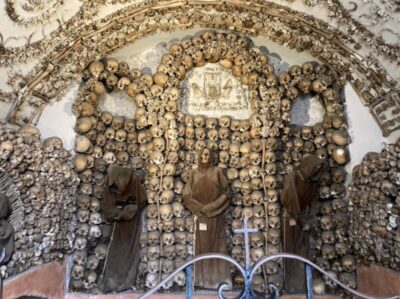
Catacombs and Capuchin Crypt Guided Tour with Transfer
Read our review →
St. Peter’s Basilica Priority Access Tour with Dome & Crypt
Read our review →Browse the lists this tour appears in