
Reviewed · UNDERGROUND ROME TOURS
Rome: Guided Underground Tour
Rome’s ancient city is not only above street level. This three-hour tour takes you from Christian catacombs outside the center to the remains of the Stadium of Domitian beneath Piazza Navona, with a minibus transfer between the sites. You’ll see burial tunnels, marble fragments, brickwork, and a Roman stadium hidden below one of Rome’s most famous squares.
I like two things here: the included return transfer saves you from working out transport to the catacombs, and the two underground sites tell very different stories. The catacombs explain early Christian burial customs, while Navona Underground shows how Roman public life shaped the piazza above. The main caution is timing. This is really two separate visits, and an afternoon start may leave too little time for the Navona site before it closes.
In This Review
- Key points before you book
- Why Rome’s underground tells a different story
- Meeting at Piazza Venezia
- Inside the catacombs: burial, worship, and limited space
- The Stadium of Domitian beneath Piazza Navona
- The timing problem you should take seriously
- What the $79 price really covers
- Who will enjoy this underground Rome tour
- Small details that make the visit better
- Should you book it?
- FAQ
- Where does the tour meet?
- How long does the activity last?
- Is transport to the catacombs included?
- Is hotel pickup included?
- Is the catacomb visit guided?
- Is Navona Underground guided by a person?
- What should I wear?
- Is the tour suitable for wheelchair users?
- Can I cancel the booking?
Key points before you book
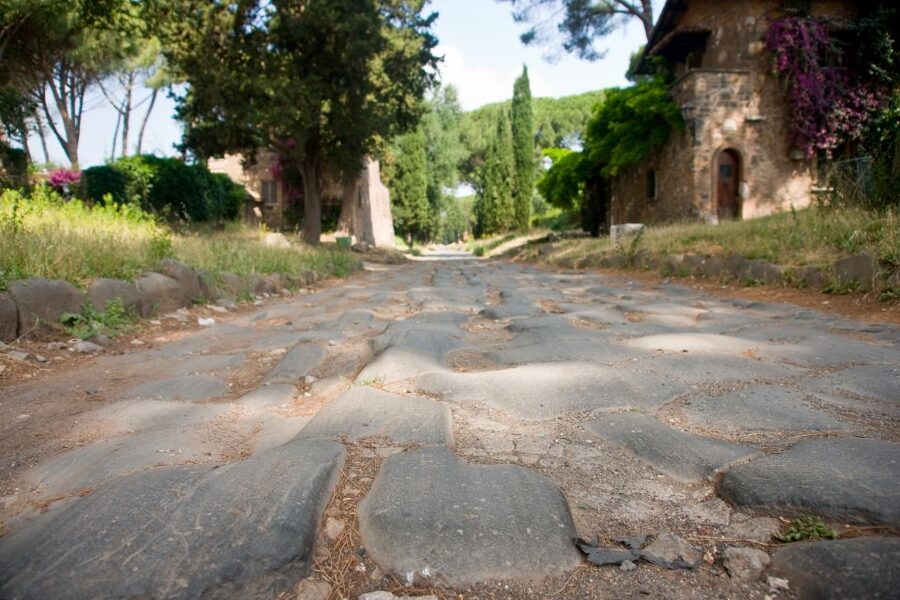
- Burial tunnels from the second century: Learn how limited land for graves led to extensive underground networks used by early Christians.
- A guided sacred site: You cannot walk through the catacombs independently, and the catacomb visit requires an official guide.
- Five meters below Piazza Navona: Navona Underground reveals parts of the former Stadium of Domitian beneath the modern square.
- Artifacts and Roman building materials: See travertine blocks, brickwork, marble columns, sculpture fragments, and a Pentelic marble torso.
- Minibus transport from Piazza Venezia: The return transfer is useful because the catacombs are away from Rome’s central monuments.
- A self-guided second stop: The Stadium of Domitian visit comes with an audio guide, not a live guide.
Why Rome’s underground tells a different story
Rome can feel like an open-air museum, but the most revealing clues are sometimes below your feet. Above ground, Piazza Navona is all fountains, cafés, and Baroque façades. Below it, you find the footprint of an ancient stadium and evidence of how the city changed over centuries.
The catacombs offer another kind of story. They were created partly because burial land was scarce in the second century. Instead of spreading graves across valuable ground, communities cut galleries into the earth. These passages later became places connected with early Christian worship and burial.
I like the contrast between the two sites. The catacombs are quiet, narrow, and sacred. Navona Underground is more architectural and archaeological, with displays that help you picture the stadium that once occupied this part of Rome. Together, the visits show religion, engineering, burial customs, public entertainment, and urban change in one compact outing.
The experience costs $79 per person. That is not a bargain-basement Rome activity, but the price includes the catacomb admission, two underground-site tickets, the return minibus, a multilingual catacomb tour, and an audio guide for the Stadium of Domitian. The value depends heavily on using both parts. If you miss Navona Underground, you lose an important portion of what you paid for.
More underground Rome tours:
- Colosseum: Underground and Ancient Rome Tour
★ 4.7 · 12,691 reviews - Rome: Crypts and Catacombs Underground Tour with Transfers
★ 4.6 · 5,341 reviews - Expert Guided Tour of Colosseum Arena OR Underground, and Forum
★ 4.5 · 5,041 reviews
Meeting at Piazza Venezia
The tour begins at Touristation Colosseo and Foro Romano, at Piazza d’Aracoeli 16 beside Piazza Venezia. When you face the Vittorio Emanuele II monument, look to the right-hand side. The office is near a small fountain.
This is a practical central meeting point, close to major sights and easy to pair with a day around the Roman Forum, Capitoline Hill, or the monument itself. You need to arrive ready to leave by minibus. Hotel pickup and drop-off are not included, so you must make your own way to the office.
The transfer is one of the tour’s strongest practical features. The catacombs are not part of the compact historic center, and reaching them on your own takes extra planning. The minibus removes that problem and brings you back to the starting point after the catacomb visit.
The ride also gives you a quick look at parts of Rome you might otherwise miss. One account describes the driver pointing out places of interest on the way and sharing information about the city. Do not treat this as a sightseeing bus tour, but the journey can add useful context before you reach the underground site.
Inside the catacombs: burial, worship, and limited space
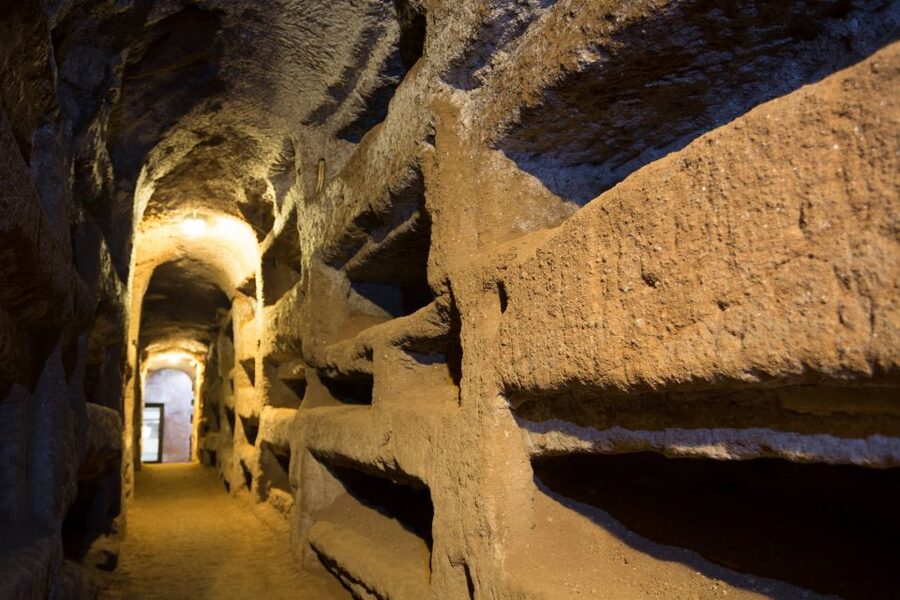
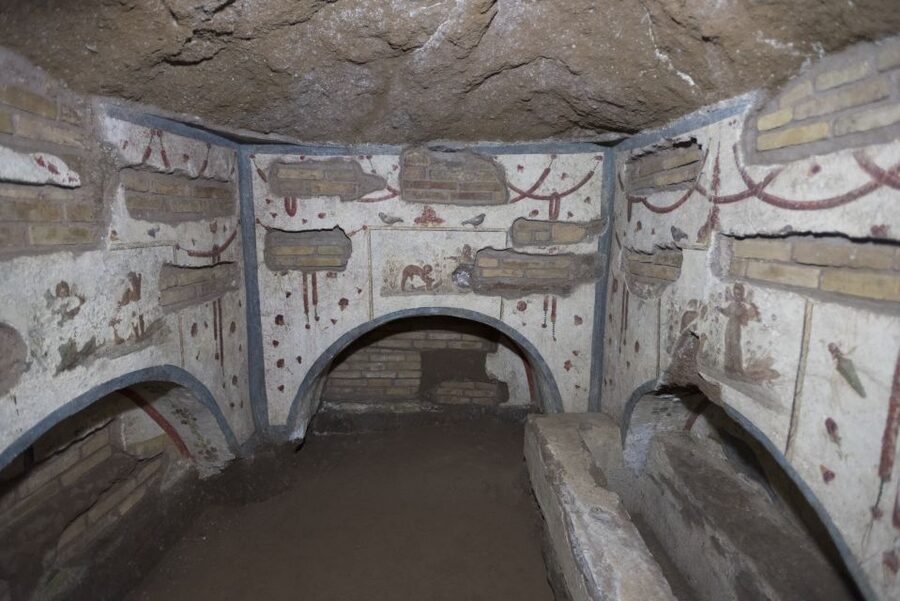
At the catacombs, the local guide leads the group through part of the underground network. The full system extends for almost 20 kilometers across about 15 hectares, but only a small section is open for this visit. Even that accessible section gives you a clear sense of the scale and effort involved.
You’ll learn how the catacombs answered a practical problem: Rome needed burial space, and land above ground was limited. The galleries were cut into the earth, creating layers of burial niches and passages. This was not simply a maze built for mystery. It was a working response to the city’s lack of room.
The site is also sacred. The tour explains its connection to martyrs, popes, and hundreds of Christians. You should approach it as a religious place as well as an archaeological one. The guide is required because of the delicate surroundings, and independent wandering is not allowed.
The tunnels can feel cold, so bring a light jacket even during Rome’s warmer months. You must cover your shoulders and thighs, and short skirts are not permitted. Comfortable clothing is sensible, but modest clothing matters more here than fashion.
The quality of the catacomb portion may depend on the group and guide. A smaller, well-managed group can make the narrow passages and explanations much easier to appreciate. One experience with a large group and a guide whose English was difficult to follow was much less satisfying. You should keep that possibility in mind, particularly if clear spoken English is important to you.
The live catacomb tour is offered in Italian, English, French, Spanish, and German. The information is most useful when you can hear it clearly, so stay close enough to the guide to follow the explanation. There may be little room to reposition yourself once the group is moving through the galleries.
The Stadium of Domitian beneath Piazza Navona
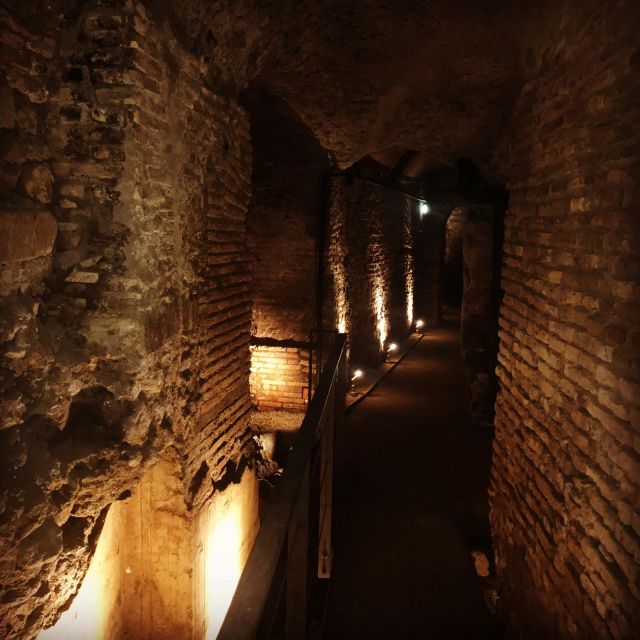
The second half takes you to Navona Underground, about five meters below street level. This site reveals the remains of the Stadium of Domitian, the only stadium in ancient Rome built from masonry according to the supplied description.
The modern piazza follows the shape of the old stadium, which gives your visit above ground a new meaning. Once you know that the long oval layout reflects an ancient sports venue, Piazza Navona becomes more than a pretty place for fountains and restaurants. The underground visit helps connect the present square with its Roman purpose.
The displays use unpublished photographs, three-dimensional reconstructions, videos, and information panels. These tools matter because the surviving remains alone can be hard to read. A reconstruction can show how the stadium developed, how spectators may have used it, and how Roman sports influenced the design.
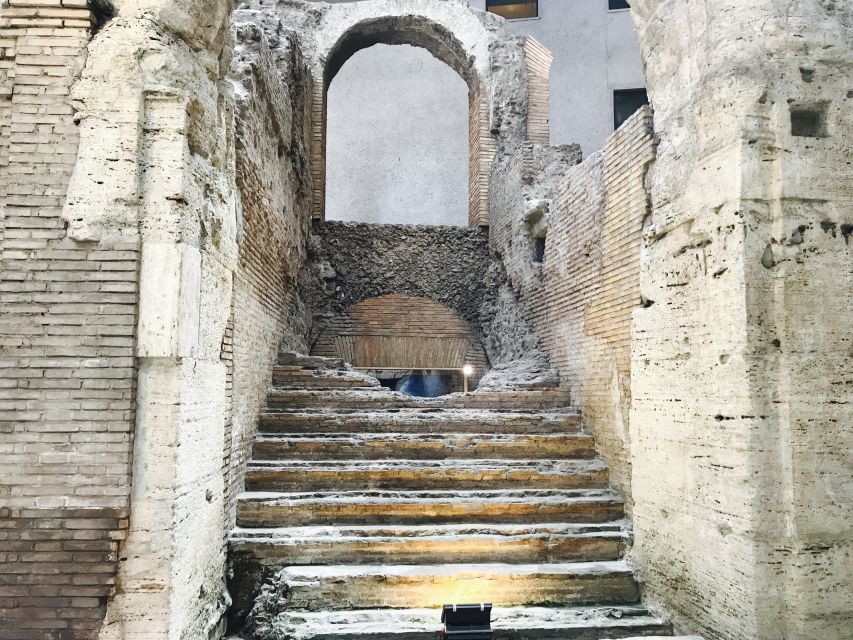
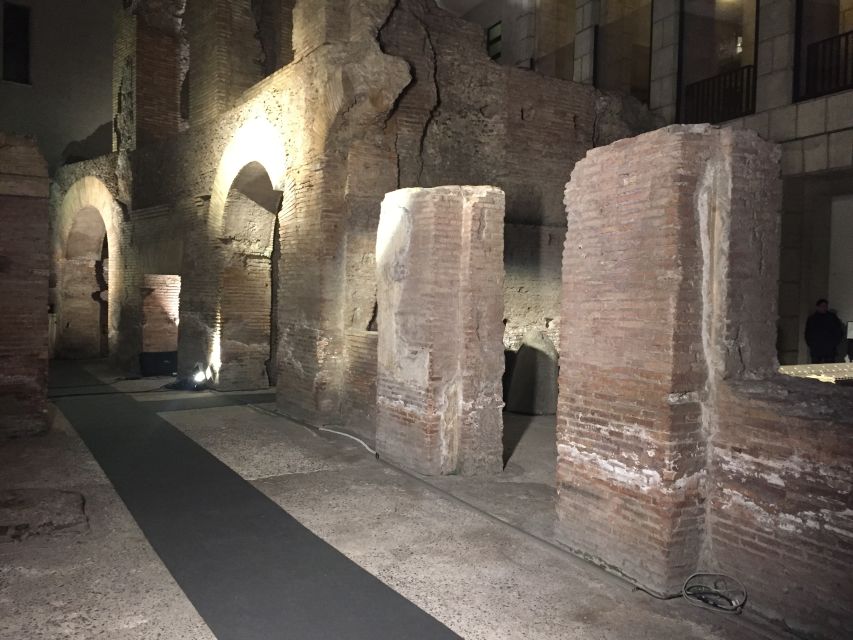
Look closely at the building materials. The tour points out travertine blocks, brickwork, and marble columns around the main entrances. These details give you something concrete to study. Instead of seeing only old walls, you can compare the materials and construction methods used in different parts of the stadium.
You’ll also see objects recovered during archaeological excavations. The collection includes sculpture fragments and a torso made from Pentelic marble, stone quarried at Penteli. These pieces help show the decorative side of the complex, not just its structural remains.
Unlike the catacombs, Navona Underground does not include a live guide. You receive an audio guide in English, Italian, Spanish, French, German, Russian, and Portuguese. This gives you more control over your pace, but it also means you must manage the visit yourself. If you prefer to ask questions as you go, this section may feel less personal.
The audio guide is a good match for the displays. You can pause at the photographs, reconstructions, videos, and artifacts rather than trying to keep up with a moving group. Plan your time carefully, though. The catacombs and Navona Underground operate as separate visits, and the timing between them is not as foolproof as the single three-hour duration may suggest.
More Rome tours worth comparing
- Vatican Museums, Sistine Chapel & St Peter’s Basilica Guided Tour
★ 4.5 · 39,149 reviews - Rome: Colosseum, Palatine Hill and Roman Forum Guided Tour
★ 4.8 · 32,814 reviews - Rome: Guided Tour of Colosseum, Roman Forum & Palatine Hill
★ 4.7 · 27,897 reviews - Rome: Colosseum & Forum with Audio Guide App -Optional Arena
★ 4.2 · 24,770 reviews
The timing problem you should take seriously
The advertised duration is three hours, but the schedule can be tricky because the activity has two distinct components. You first meet in central Rome, take the minibus to the catacombs, complete the guided visit, and return to the city center. You then need to reach Navona Underground and complete that visit within its opening hours.
An afternoon booking can create a real problem. If the minibus returns after the second site has closed, you may receive only the catacomb portion even though the booking covers both. This is especially important if your time in Rome is limited or if this is your final day.
My practical advice is simple: choose the earliest available start time. Before booking, check the exact starting time and confirm that the return transfer leaves enough time for Navona Underground. Do not assume that the three-hour label guarantees three uninterrupted hours across both locations.
You also need to understand the transfer arrangement. The minibus returns you to the central departure area, but hotel pickup and drop-off are not included. The meeting point is Piazza d’Aracoeli, not your accommodation, so allow time to reach it at the beginning and after the tour.
What the $79 price really covers
At $79, this is best viewed as a transport-and-admission package rather than one traditional guided walk. The catacomb ticket, the catacomb guide, return transfer, two underground admissions, and Stadium of Domitian audio guide are all included.
The transfer is particularly valuable if you do not want to navigate Rome’s transport system to the catacombs. It also gives the outing a clear structure. You meet in the center, travel together, visit the catacombs, return, and continue with the underground stadium.
The price is less attractive if you mainly want a live guide throughout. The catacomb section has a guide, but Navona Underground is self-guided by audio. Food and drinks are also excluded, so plan a snack or meal separately.
The experience has an overall rating of 3.7 from 91 reviews, which reflects a mixed result rather than a sure bet. The best outcomes come from a smooth morning schedule, a clear catacomb guide, and enough time for both archaeological sites. The weakest outcomes involve oversized groups, hard-to-follow commentary, or confusion about getting to the second site.
Who will enjoy this underground Rome tour
I would recommend this for you if you have already seen Rome’s major above-ground monuments and want a different angle on the city. It suits anyone interested in early Christianity, ancient burial practices, Roman building methods, and the way modern streets sit over ancient structures.
It is also useful for independent visitors who like a structured outing but do not want a full-day coach tour. The minibus handles the awkward part of reaching the catacombs, while the audio guide lets you move at your own pace at Navona Underground.
The tour is not suitable for wheelchair users or people with mobility impairments. Narrow underground passages, stairs, and uneven conditions make the physical demands important to consider. It is also a poor choice if you have claustrophobia.
Families should think about age and comfort. The subject matter concerns burial and sacred spaces, and the passages may feel enclosed. The information is substantial, so children who enjoy archaeology and Roman history are more likely to appreciate it than children looking for an active attraction.
The catacombs are not an ideal choice for anyone who wants to wander freely or photograph every corner at leisure. The required guide and protected setting mean you follow the group’s route and instructions.
Small details that make the visit better
Wear shoes suited to uneven underground surfaces and bring a light jacket. The catacombs can be cold, even when Rome is hot.
Dress with covered shoulders and thighs from the start. That saves you from having to adjust clothing at a sacred site, and short skirts are specifically not allowed.
Choose a morning departure whenever possible. This is the single most important scheduling tip because the return from the catacombs may leave little time for the second stop later in the day.
At the meeting point, use the Vittorio Emanuele II monument as your landmark. Face it, look right, and find the Touristation office near the small fountain.
Listen carefully to the transfer instructions. The catacomb visit and Navona Underground are separate experiences, and the second location does not include a live guide. You need to know where to go and when.
If you have a language preference, select a suitable live-guide language for the catacombs. The available languages are English, Italian, French, Spanish, and German. The Stadium of Domitian audio guide adds Russian and Portuguese.
Should you book it?
Book this tour if you want two contrasting underground sites, prefer included transport to the catacombs, and can take an early start. The catacombs provide the stronger sense of sacred place, while Navona Underground adds valuable context to one of Rome’s best-known squares.
I would not book it for a late afternoon, a wheelchair user, someone uneasy in enclosed passages, or anyone who needs a live guide at both stops. I would also avoid it if your schedule cannot absorb the risk of missing the second visit.
For the right person, $79 is fair because it combines transport, admissions, and guided interpretation in one outing. Just protect the value of your ticket by checking the timing carefully and making sure you can complete both parts.
FAQ
Where does the tour meet?
Meet at Touristation Colosseo and Foro Romano, at Piazza d’Aracoeli 16 beside Piazza Venezia. When facing the Vittorio Emanuele II monument, the office is on the right, near a small fountain.
How long does the activity last?
The stated duration is three hours. Starting times vary, so you need to check availability when booking.
Is transport to the catacombs included?
Yes. The experience includes VIP return transport by minibus between the city center and the catacombs.
Is hotel pickup included?
No. You must travel to the meeting point at Piazza d’Aracoeli, and hotel pickup and drop-off are not included.
Is the catacomb visit guided?
Yes. A guide is required inside the catacombs, and the guided visit is available in Italian, English, French, Spanish, and German.
Is Navona Underground guided by a person?
No live guide is included for Navona Underground. You receive an audio guide for the Stadium of Domitian in English, Italian, Spanish, French, German, Russian, or Portuguese.
What should I wear?
Cover your shoulders and thighs because the catacombs are sacred places. Short skirts are not allowed, and a light jacket is recommended because it can be cold underground.
Is the tour suitable for wheelchair users?
No. The activity is not suitable for wheelchair users or people with mobility impairments.
Can I cancel the booking?
You can cancel up to 24 hours in advance for a full refund. The reserve-now-and-pay-later option lets you book without paying immediately.
Newest reviews from Rome
- ROME:Colosseum & Ancient Rome – private/small group TOUR★ 5.0 · 24 reviews
- Off the Beaten Track in Rome: Rione VI Parione Private Tour★ 5.0 · 24 reviews
- Cinematic Photoshoot in Rome★ 5.0 · 24 reviews
- Rome: Best of Colosseum and Roman Forum Small Group Guided Tour★ 4.5 · 24 reviews
- The Labyrinth of Rome between catacombs and ancient quarries★ 4.5 · 24 reviews
- Vatican and Trionfale Market Tour with Wine and Food Tasting★ 5.0 · 24 reviews
- private tour: Vatican Museums, Sistine Chapel, St. Peter’s Basilica★ 4.5 · 24 reviews
- Colosseum guided tour with Virtual Reality★ 5.0 · 24 reviews
Underground Rome Tours, compared.
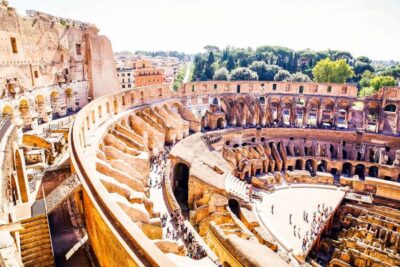
Colosseum: Underground and Ancient Rome Tour
Read our review →
Crypts and Catacombs Underground Tour with Transfers
Read our review →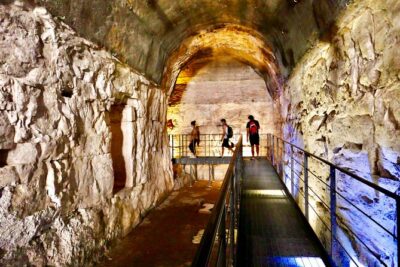
Expert Guided Tour of Colosseum Arena OR Underground, and Forum
Read our review →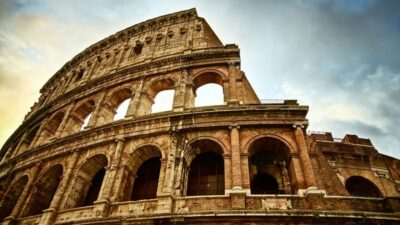
Colosseum Underground Small Group Guided Tour
Read our review →
St. Peter’s Basilica, Dome Climb, and Underground Tour
Read our review →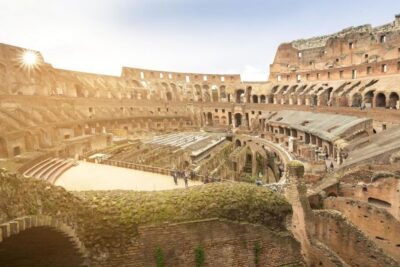
Colosseum Underground & Ancient Rome Guided Tour
Read our review →
Browse the lists this tour appears in