
Reviewed · CYCLING TOURS
Rome Highlights Bike tour
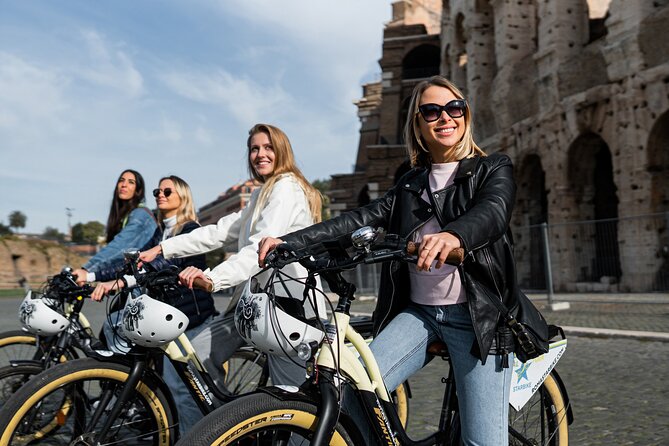
Rome’s ancient center can feel like a giant puzzle of ruins, churches, roads, and grand squares. This three-hour e-bike tour gives you a useful map of the city while carrying you from the Colosseum area to the Pantheon, Piazza Navona, Trastevere, Circus Maximus, and Capitoline Hill.
I like two things in particular: the electric assistance makes Rome’s hills and heat much easier, and the 3D reconstructions help you picture buildings that now survive only as broken columns and foundations. Guides such as Sara, Fabrizio, Stefano, Daniela, and Costanza have also been praised for lively explanations and good English.
The main caution is traffic. You must know how to ride a bike well, and Rome’s roads can bring close calls, especially for less confident riders. Allow extra time for fitting bikes and helmets, since a late departure can shorten the final part of the route.
In This Review
- Key points to know
- Why an e-bike works so well in central Rome
- Starting near the Colosseum and Arch of Constantine
- Piazza Venezia and Trajan’s monumental column
- The Pantheon, where the roof does the talking
- Baroque Rome at Piazza Navona and Campo de’ Fiori
- Crossing the Tiber into Trastevere
- Circus Maximus and the Capitoline Hill
- How the 3D viewers change the ruins
- Family suitability and riding demands
- What the $78.64 price buys you
- Timing, preparation, and small practical matters
- Should you book the Rome Highlights Bike Tour?
- FAQ
- How long is the Rome Highlights Bike Tour?
- What time does the tour start?
- Where does the tour begin?
- Where does the tour end?
- What language is the tour offered in?
- What is included in the price?
- Are child seats available?
- Can children aged 6 to 10 ride their own bikes?
- How many people can join the tour?
- Do I need to be an experienced cyclist?
- Is there a weight limit?
- Is admission to the listed stops included?
- Can I cancel for a full refund?
Key points to know
- Ancient Rome with a modern boost: The e-bike takes the strain out of hills and long stretches between major sights.
- 3D viewers make ruins easier to understand: You can see how selected Roman monuments looked when newly built.
- A compact route covers many districts: The ride links the Colosseum, Imperial Forums, Pantheon, Piazza Navona, Trastevere, Circus Maximus, and Capitoline Hill.
- Small groups keep the ride manageable: The maximum group size is 12 people.
- Families have several options: Child seats are available up to 25 kilograms, and children aged 6 to 10 may use a trailer bike if they are under 143 centimeters tall.
- Good timing matters: The tour begins at 10:00 a.m., but you should arrive ready to ride and bring water, sunscreen, and a helmet.
Why an e-bike works so well in central Rome
Rome rewards slow exploration, but its major sights are spread across a surprisingly wide area. Walking from the Colosseum to the Pantheon, then across to Trastevere and Circus Maximus, takes time and energy. A bus gives you less contact with the city, while a car is poorly suited to narrow streets and restricted areas.
The e-bike offers a useful middle ground. You still move at street level, but you cover much more ground than you could on foot. The electric assistance is especially helpful on Rome’s inclines and in warm weather. You control the power level rather than working through frequent gear changes, which makes the ride fairly simple for an experienced cyclist.
This is not a gentle sightseeing bus with occasional photo stops. You ride through city traffic, stop at landmarks, listen to the guide, and then get back on the bike. That active rhythm keeps the tour moving, but it also means you need to pay attention.
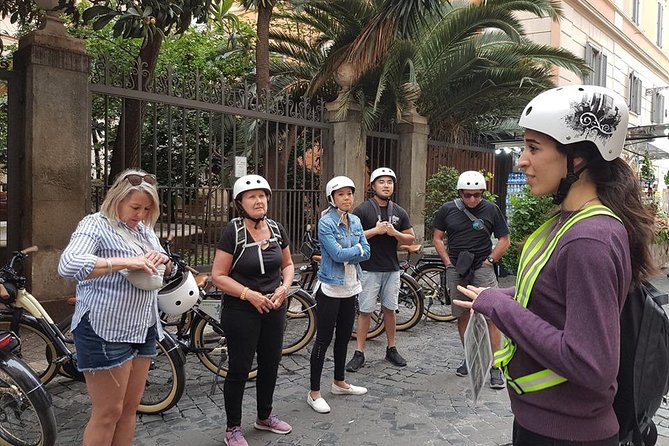
The group is limited to 12 people. That is small enough for a guide to keep an eye on the group, and some outings include a second staff member riding behind everyone. Still, Rome is Rome. You should be comfortable braking, turning, starting again, and following instructions around cars, scooters, pedestrians, and uneven streets.
More bike days around Rome:
- Rome EBike Tour: Appian Way, Catacombs & Roman Aqueducts
★ 5.0 · 1,766 reviews - Rome: Top Highlights & Hidden Gems Tour by Cannondale E-Bike
★ 4.9 · 1,760 reviews - Rome: Appian Way, Catacombs, & Roman Aqueducts E-bike Tour
★ 4.9 · 1,421 reviews
Starting near the Colosseum and Arch of Constantine
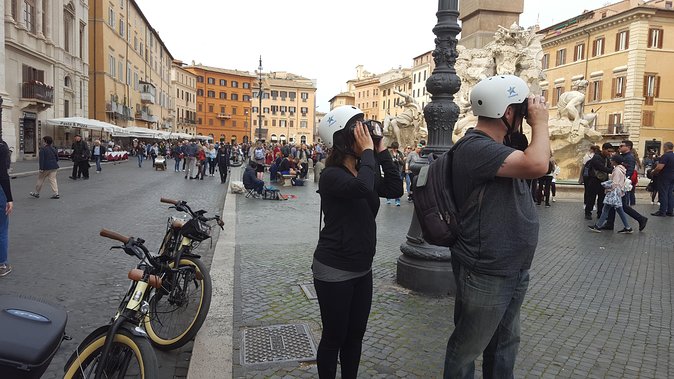
The meeting point is at Via dei SS. Quattro, 58, near the Colosseum. The activity begins at 10:00 a.m. and returns to the same location.
The opening stop is the Arch of Constantine, set between the Colosseum and Palatine Hill. Built in the fourth century, it commemorates Constantine’s victory over Maxentius at the Battle of the Milvian Bridge. It is one of three ancient Roman triumphal arches that remain intact.
This is a smart first stop because it places you inside the story of imperial Rome at once. The arch also gives your guide a chance to explain how Roman monuments were reused and how later generations viewed the city’s ruins. You receive about 15 minutes here, with no separate admission charge.
The route then reaches the Imperial Forums. This broad historic road runs past the remains of forums connected with Trajan, Augustus, Nerva, and Julius Caesar. From a bike, you can take in the long sweep of ruins without spending the whole morning walking between them.
The road can be busy, so this part also sets the tone for the ride. Keep your eyes up, leave space between bikes, and follow the guide rather than stopping suddenly for photographs.
Piazza Venezia and Trajan’s monumental column
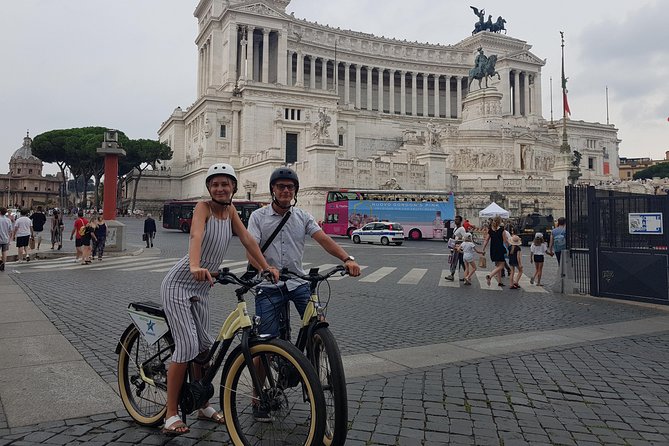
Piazza Venezia is one of Rome’s great traffic circles and civic spaces. It sits at the foot of Capitoline Hill and is dominated by the Vittoriano, the large white monument dedicated to Vittorio Emanuele II, the first king of unified Italy.
The monument can look almost too grand beside the older Roman ruins, but that contrast is part of the point. In a few minutes, your guide can connect ancient imperial power with the modern Italian state. You stop for around 15 minutes, giving you time to look up at the monument and get your bearings.
Next comes Trajan’s Forum, the largest and final imperial forum built in ancient Rome. Its centerpiece is Trajan’s Column, covered with roughly 2,500 carved figures showing scenes from the emperor’s wars against the Dacians.
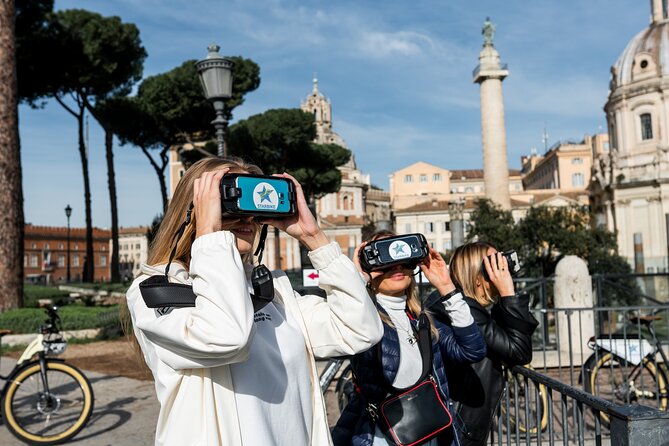
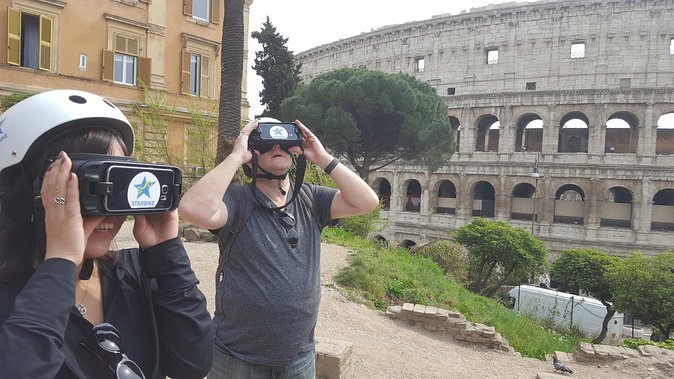
The 3D viewer is especially useful at places like this. Ruins often require imagination. A column base or fragment of wall does not instantly tell you how the original complex worked. A reconstruction gives you a clearer sense of scale, decoration, and purpose. That visual aid is one of the tour’s most distinctive features.
The headset is not the whole experience, though. The guide’s explanation matters just as much. Strong guides have included Sara, who teaches English and was praised for her clear, energetic storytelling, and Fabrizio, who has an archaeology background. The quality of the tour depends partly on who leads your group, but the format gives a good guide plenty to work with.
The Pantheon, where the roof does the talking
The Pantheon is one of the most remarkable buildings in Rome. Agrippa began the original structure in the first century BC, and the building you see today reflects later rebuilding. Its huge dome remains the world’s largest unreinforced concrete dome.
You stop for about 15 minutes. That is enough for a focused explanation and an exterior look, but it is not a long interior visit. If entering the Pantheon is a top priority, check the arrangements carefully before booking, since the listed stop does not promise an admission visit.
The building is best understood by looking at the relationship between the simple entrance and the vast dome behind it. The oculus at the top lets in natural light and makes the interior feel both engineered and strangely open. A guide can help you notice details that are easy to miss when you are simply passing through Rome’s crowded center.
The bike is parked while you listen. As with the other stops, the tour is designed to give you context without turning each sight into a full museum visit. You get an overview, a story, and a route that links the monument to the rest of the city.
A completely different way to spend the day in Rome:
- Vatican: Museums & Sistine Chapel Entrance Ticket
★ 4.5 · 144,003 reviews - Vatican Museums & Sistine Chapel Tour with Optional Basilica
★ 4.3 · 67,413 reviews - Vatican Museums, Sistine Chapel & St Peter’s Basilica Guided Tour
★ 4.5 · 39,149 reviews - Rome: Colosseum, Palatine Hill and Roman Forum Guided Tour
★ 4.8 · 32,814 reviews
Baroque Rome at Piazza Navona and Campo de’ Fiori
Piazza Navona brings you into a different Rome. The square follows the outline of the ancient Stadium of Domitian and later became one of the finest public spaces of Baroque Rome.
Bernini, Borromini, and Giacomo della Porta all contributed works connected with the square. The result is a place where fountains, churches, façades, and open space compete for your attention. A 15-minute stop lets your guide explain the artists and the square’s older Roman shape.
Campo de’ Fiori is nearby and has a more everyday feel. Its name means field of flowers, recalling the meadow that occupied the area in the Middle Ages. Today, the square hosts a daily market selling fruit and flowers, with bars and terraces filling the area in the evening.
This part of the ride helps balance the ancient monuments. Rome is not only a collection of archaeological sites. It is also a living city where market stalls, café tables, churches, and traffic occupy spaces shaped by centuries of change.
You may want to return to Campo de’ Fiori later if you enjoy markets or outdoor dining. The tour gives you a quick look rather than time for shopping or a meal.
Crossing the Tiber into Trastevere
The route crosses the Tiber to Trastevere, one of Rome’s most atmospheric neighborhoods. The name comes from the Latin Trans Tiberium, meaning beyond the Tiber.
Here, the character changes again. Narrow lanes and medieval houses replace the grand scale of Piazza Venezia and the Imperial Forums. You ride through a neighborhood known for its evening bars and restaurants, though the daytime view is quieter and better suited to moving through the streets by bike.
Trastevere is a good reason to choose this tour over a route that stays only among the major monuments. You get a glimpse of Rome’s smaller scale, where the interest comes from alleys, worn façades, and the way the streets bend rather than from one famous object.
Do not expect a long neighborhood walk. The stop is part of a moving city tour, so you see Trastevere from the saddle. If you want to study churches, eat, or browse shops here, mark the area for a later visit.
Circus Maximus and the Capitoline Hill
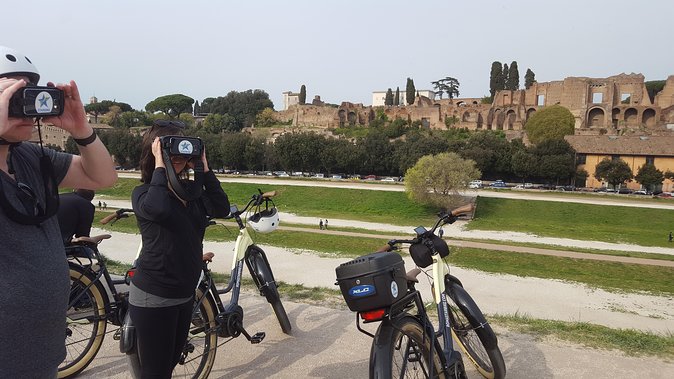
Circus Maximus lies between the Aventine and Palatine hills. Ancient Romans used this enormous venue for chariot races, and its capacity is traditionally given as more than 250,000 spectators. Fires damaged it several times, and it was reinforced during the Roman imperial period.
Today, the site is a broad public park. The lack of standing walls can make it hard to picture the original stadium, which is exactly where the 3D material can help. A reconstruction gives the open space a sense of its former scale and shows why this was one of Rome’s most important public venues.
The final major stop is Piazza del Campidoglio on Capitoline Hill, one of Rome’s seven hills and a key political center. Michelangelo shaped the square’s design, and from here you can look toward the Roman Forum.
This is a strong ending because it brings together several layers of the city. You have seen imperial forums, medieval lanes, Baroque art, and modern national monuments. From the Capitoline, the Roman Forum becomes a broad historical scene rather than a set of isolated stones.
The listed stops generally receive around 15 minutes each, but the actual pace can vary. A late start, a slower group, or a participant needing to leave at a fixed time may mean one stop is shortened or skipped. If you have an important afternoon booking, leave a generous buffer after the scheduled return.
How the 3D viewers change the ruins
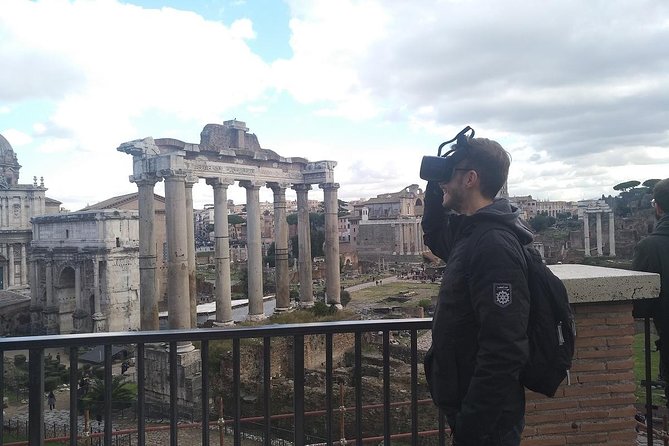
The 3D viewers are not a small decorative extra. They answer a real problem in Rome: many ancient sites are impressive but incomplete.
At Trajan’s Forum, the technology can help you picture the carved column in its original setting. At Circus Maximus, it can make the enormous open park easier to read as an ancient racetrack. Around the Colosseum and Imperial Forums, a reconstruction can show how much decoration and building once filled spaces that now appear fragmented.
The effect is strongest when the guide uses the image at the right moment and explains what you are seeing. It is less useful if you are eager to keep riding or if the bright midday sun makes the headset uncomfortable. Some children have found the goggles exciting, while others prefer the movement of the bikes.
I would treat the 3D segment as a useful history lesson, not the main event. The best parts of the tour come from the combination of riding, stopping, looking, and hearing a good explanation.
Family suitability and riding demands
Families can use child seats for children up to 25 kilograms. Children aged 6 to 10 may be eligible for the reduced child option only if they are under 143 centimeters tall, since they use a trailer bike rather than riding a bike alone.
That arrangement makes the route possible for younger children, but you should think carefully about your family’s cycling habits. Every participant needs to handle a bike confidently, and the adult riders still need to manage city traffic. One family found the e-bikes a good way to keep children interested between major monuments, while another noted that children were more eager to ride than to spend time with the 3D viewers.
The maximum rider weight is 120 kilograms, or 265 pounds. Helmets, mobile phone holders, and handlebar holders are included. I would use the helmet, especially since the route includes traffic and a fall is possible. One rider reported an accident early in the outing, while other participants praised the guides for safe navigation and group control.
The bikes have generally been described as smooth and easy to operate. Still, inspect your bike before leaving. If the front wheel, brakes, or steering feel wrong, tell the staff immediately and ask for a replacement.
What the $78.64 price buys you
At $78.64 per person, this is not the cheapest way to see Rome. You are paying for the bike, electric assistance, helmet, guide, 3D viewers, equipment, and a tightly planned route through several parts of the center.
The value improves if you have only a short time in Rome or want an orientation early in your stay. In three hours, you reach far more than you could comfortably cover on foot, and the route helps you decide where to return for a longer visit.
The price is less appealing if you already know the city well, dislike cycling near traffic, or want extended time inside individual monuments. The tour gives you outside views and short stops. It does not replace a dedicated Colosseum, Roman Forum, Pantheon, or Vatican visit.
I see it as a practical introduction rather than a full archaeological tour. The best value comes from the combination of transport and interpretation. You are not simply renting an e-bike, and you are not sitting passively on a bus.
Timing, preparation, and small practical matters
The tour is offered in English and uses a mobile ticket. Confirmation arrives at booking, and the meeting point is near public transportation. The activity returns to Via dei SS. Quattro, 58.
Wear clothing that lets you move freely. Rome can be hot, and the ride includes open areas with little shade. Bring water and sunscreen. Rome’s public drinking fountains can be useful, but you need a bottle to take advantage of them.
Arrive prepared to get fitted for the bike and helmet. The equipment process can delay departure, so do not schedule a major attraction immediately after the tour. The tour is listed at about three hours, but an actual return can vary.
Free cancellation is available up to 24 hours before the start time. Changes or cancellations made inside that window are not accepted for a refund.
Should you book the Rome Highlights Bike Tour?
I would book this tour if you want a lively first look at Rome and already feel comfortable riding a bike. It is especially useful at the start of a visit, when you need a city map in your head and want to identify the places worth revisiting.
It suits families with confident adult cyclists, couples who want more ground covered than walking allows, and history fans who enjoy seeing ruins brought back through images. Guides such as Sara, Fabrizio, Stefano, Daniela, and Costanza have shown how much a warm, well-prepared guide can add.
I would skip it if you are nervous in traffic, need a slow pace, or want long indoor visits. For everyone else, the e-bike provides a smart way to connect Rome’s far-flung highlights, while the 3D viewers give the ancient ruins a little help from the present.
FAQ
How long is the Rome Highlights Bike Tour?
The tour lasts approximately three hours.
What time does the tour start?
The listed start time is 10:00 a.m.
Where does the tour begin?
It begins at Via dei SS. Quattro, 58, 00184 Roma RM, Italy.
Where does the tour end?
The activity ends back at the same meeting point.
What language is the tour offered in?
The tour is offered in English.
What is included in the price?
The price includes a high-quality e-bike, 3D viewers, a helmet, a mobile phone holder, and a handlebar holder.
Are child seats available?
Yes. A child seat is available for children up to 25 kilograms.
Can children aged 6 to 10 ride their own bikes?
The child rate for ages 6 to 10 applies only to children under 143 centimeters tall. These children use a trailer bike rather than riding a bike alone.
How many people can join the tour?
The maximum group size is 12 participants.
Do I need to be an experienced cyclist?
Yes. You must know how to ride a bike well because the route includes Rome’s city traffic.
Is there a weight limit?
Yes. The maximum weight is 120 kilograms, or 265 pounds.
Is admission to the listed stops included?
The listed stops show no separate admission ticket charge. The experience is primarily an outdoor sightseeing ride, so you should not assume that entry into every monument is part of the tour.
Can I cancel for a full refund?
Yes. You can cancel at least 24 hours before the local start time for a full refund. Cancellations or changes made less than 24 hours before the start time are not accepted for a refund.
Newest reviews from Rome
- Rome: Vatican Museums & Sistine Chapel Skip-the-Line Ticket★ 4.4 · 148 reviews
- Shared Shuttle Transfer from Rome to Civitavecchia Port★ 5.0 · 148 reviews
- Rome: Crypts & Catacombs After Hours Tour with Bone Chapel★ 4.6 · 149 reviews
- Ghosts Legends and Mysteries of Rome Walking Tour★ 5.0 · 149 reviews
- Skip the Line: Vatican and Sistine Chapel with Guided Tour★ 4.0 · 149 reviews
- Tivoli: Villa Gregoriana Entrance Ticket★ 4.7 · 150 reviews
- Pizza and Tiramisu Cooking Class in Rome, Piazza Navona★ 5.0 · 150 reviews
- Rome: Borghese Gallery Skip-the-Line Entry and Guided Tour★ 4.7 · 150 reviews
Cycling Tours, compared.

Rome EBike Tour: Appian Way, Catacombs & Roman Aqueducts
Read our review →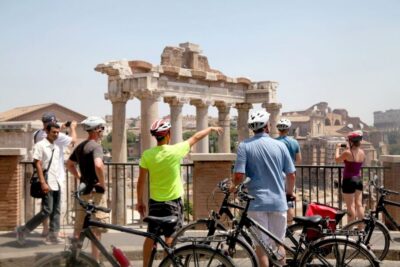
Top Highlights & Hidden Gems Tour by Cannondale E-Bike
Read our review →
Appian Way, Catacombs, & Roman Aqueducts E-bike Tour
Read our review →
Rome City Small Group Bike Tour with quality Cannondale EBike
Read our review →
Rome by Night – Ebike Small Group Tour – Food and Wine (Option)
Read our review →
Appian Way E-bike Tour with Catacombs, Aqueducts & Food
Read our review →
Appian Way Aqueducts Bike Tour (Catacombs & Lunch Option)
Read our review →Browse the lists this tour appears in