
Reviewed · TREVI FOUNTAIN & PANTHEON WALKS
Rome Private Walking Tour including Pantheon access
Rome’s great sights unfold in a remarkably compact walk here, from the Flaminio Obelisk and Piazza del Popolo to the Pantheon and Castel Sant’Angelo. You get ancient monuments, Baroque fountains, grand churches, fashion streets, and lively squares in one three-hour outing.
I like the private format, since your guide can answer questions and adjust the pace for your group. I also like the route’s balance: the Spanish Steps and Trevi Fountain provide Rome’s famous postcard moments, while churches such as Sant’Ignazio and Santa Maria dei Miracoli add the sort of detail you could easily miss alone.
The main consideration is the amount of ground covered. You see 12 stops in about three hours, so this is a fast orientation walk rather than a slow, in-depth visit to every monument. Also, the experience is advertised with Pantheon access, while the itinerary marks the Pantheon admission ticket as not included, so confirm exactly what your booking covers.
In This Review
- Key points at a glance
- Why this route works as a Rome introduction
- Starting beneath the Flaminio Obelisk
- Twin churches and the shape of Piazza del Popolo
- Via del Corso and Via dei Condotti
- The Spanish Steps and the Trevi Fountain
- Sant’Ignazio and Rome’s theatrical churches
- Piazza Navona and the former stadium
- The Pantheon: clarify what access includes
- Ending at Castel Sant’Angelo
- What $161.77 per person buys you
- Walking demands and who will enjoy it
- The guide makes the difference
- Should you book the Rome private walking tour?
- FAQ
- How long is the Rome private walking tour?
- What language is the tour offered in?
- Where does the tour start?
- Where does the tour end?
- Is this a private tour?
- Is admission to the Pantheon included?
- Can I cancel for a full refund?
Key points at a glance
- A strong first-day route: Start at Piazza del Popolo and finish near Castel Sant’Angelo, covering many central sights while helping you understand Rome’s layout.
- Private guiding with named guides: Valerio receives especially strong praise for his explanations and personal help, while Serena is noted for her clear background on churches and monuments.
- Twelve stops in three hours: Expect a brisk walking tour with short visits, exterior viewing, and commentary rather than long museum-style stops.
- The Pantheon is the central payoff: This former Roman temple, now a Catholic church, is the most important indoor highlight connected with the tour.
- Useful personal help: Valerio has walked some groups toward their next tour or hotel, a thoughtful extra when the official route ends.
- A practical value question: At $161.77 per person, the price makes the most sense for a private group that values a dedicated guide and a broad introduction to Rome.
Why this route works as a Rome introduction
Rome can feel confusing at first. The city’s important sights are close together, but the route between them is not always obvious. This walk links several central areas in a logical direction, beginning in the north at Piazza del Popolo and ending west of the historic center at Castel Sant’Angelo.
You move through public squares, shopping streets, churches, fountains, and ancient monuments. That variety matters. Instead of seeing Rome as a series of isolated photo stops, you begin to understand how the city’s older roads and public spaces fit together.
The private format is the biggest advantage. You are not sharing the guide with a large crowd, and the experience is offered in English. Guides Valerio and Serena are specifically identified in the feedback, with Valerio praised for answering questions, explaining geography and culture, and sometimes extending help after the scheduled walk.
At the same time, you should set your expectations correctly. Three hours is enough to see a lot, but not enough to study every church, enter every building, or linger at each square. Think of this as a guided orientation with selected stops, not a full archaeological tour.
More Trevi and Pantheon walks:
- Rome: Pantheon Timeless Marvel Guided Tour with Entry Ticket
★ 4.9 · 4,002 reviews - Rome: Pantheon Priority Entry Ticket & Audio Guide App
★ 4.1 · 3,234 reviews - Enjoy Spritz and Pasta Making in Piazza Navona
★ 5.0 · 1,681 reviews
Starting beneath the Flaminio Obelisk
The meeting point is the Flaminio Obelisk in Piazza del Popolo. The obelisk is one of Rome’s 13 ancient obelisks, rising about 24 meters on its own and reaching roughly 36.5 meters with its base and cross.
That is a fitting place to begin. Piazza del Popolo is one of Rome’s grand urban spaces, and the obelisk gives you an immediate reminder that Egyptian monuments were reused and repositioned by Roman rulers and later popes. The listed stop is brief, about five minutes, so you will likely receive a quick explanation and time to get oriented rather than a long lesson.
The square itself is free to visit. Bring your bearings here: note the broad shape of the piazza, the churches, and the roads leading into the center. Your route then moves through two neighboring churches before continuing along Via del Corso.
Twin churches and the shape of Piazza del Popolo
Santa Maria dei Miracoli and Santa Maria in Montesanto sit near the edge of Piazza del Popolo and help frame the approach to the square. Santa Maria dei Miracoli has a circular plan, an octagonal cupola, and an elegant bell tower associated with Girolamo Theodoli. It was begun in 1675 and finished in 1681.
Santa Maria in Montesanto replaced an earlier church at the beginning of Via del Babuino and was occupied by Carmelite monks. The two churches are easy to treat as background scenery, but they are worth your attention because they give this part of Rome its formal Baroque character.
Each stop is listed at about 10 minutes, and admission is not included for either church. Do not assume that the tour includes a full interior visit. Your guide can explain the buildings and point out their main features, but the exact access may depend on opening conditions and your booking.
Piazza del Popolo gets another short stop, also about 10 minutes. Its modern Italian name means People’s Square, though the older name is connected with poplar trees. It is a broad, open space in a city better known for tight lanes and small piazzas, so it provides an excellent contrast.
Via del Corso and Via dei Condotti
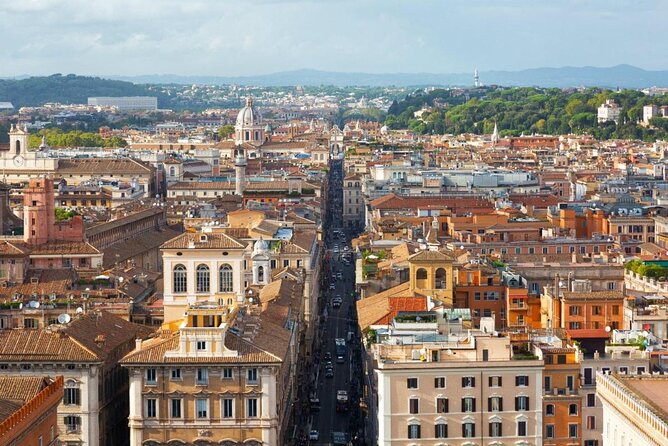
From the square, the route follows Via del Corso, one of the main streets through Rome’s historic center. It is roughly 1.5 kilometers long and about 10 meters wide, unusually straight compared with the narrow, twisting streets nearby.
The Corso is useful for orientation. It connects the Piazza del Popolo area with the heart of the historic center, and walking it helps you see how Rome’s major districts relate to one another. The stop lasts about 15 minutes, so you will not cover every part of the street with detailed commentary.
Next comes Via dei Condotti, Rome’s famous luxury shopping street. Major fashion and jewelry names line the road, but its most interesting cultural detail may be Caffè Greco, established at number 86 in 1760. The café is described as perhaps Rome’s most famous, and its long presence gives the street more character than a simple list of designer shops suggests.
I would treat this as a quick cultural stop, not a shopping tour. The listed time is about 10 minutes, and there is no admission charge. If you want to browse stores or sit at the café, you will need extra time beyond the tour.
More walking tours in Rome:
- Rome: Trastevere & Campo de Fiori Street Food Walking Tour
★ 4.9 · 2,768 reviews - Rome: Paranormal Night Walking Tour & Secret Backstreets
★ 4.9 · 1,921 reviews - Rome by Night Walking Tour – Legends & Criminal Stories
★ 4.5 · 1,003 reviews - Rome: Guided City Center Evening Sightseeing Walking Tour
★ 4.4 · 953 reviews
The Spanish Steps and the Trevi Fountain
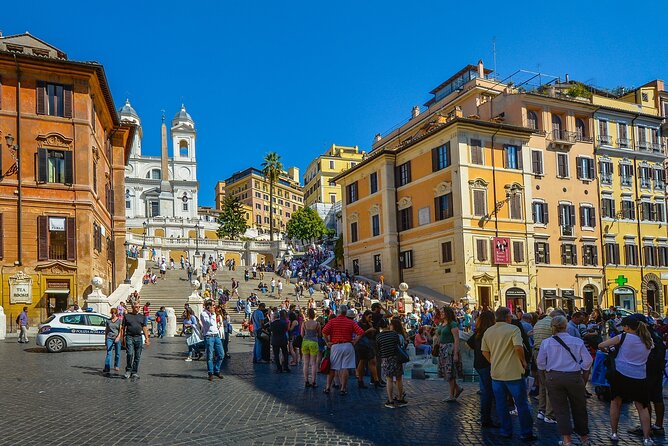
The Spanish Steps are among Rome’s most recognizable sights. They climb between Piazza di Spagna below and Piazza Trinità dei Monti above, where the church of Trinità dei Monti dominates the view.
The stop is listed at 15 minutes. That gives you time to see the staircase, understand its position in the city, and take photographs, but not much time to linger. The steps can be crowded, so your guide’s value here is partly practical: you get a clear explanation without having to work out the setting on your own.
The Trevi Fountain receives a longer stop of about 20 minutes. Designed by Nicola Salvi and completed by Giuseppe Pannini and others, it is about 26.3 meters high and 49.15 meters wide. Those numbers help explain why the fountain feels so overpowering when you approach it in the narrow Trevi district.
The familiar coin-toss tradition is part of the experience. You can make your wish, take in the Baroque scene, and then move on without spending time planning the visit yourself. The fountain is free to see, but this is one place where a private guide cannot remove the crowds or create a quiet moment. Keep your valuables secure and follow the guide’s advice about where to pause.
Sant’Ignazio and Rome’s theatrical churches
Chiesa di Sant’Ignazio di Loyola is a particularly good stop for travelers who enjoy church interiors and Baroque design. Built between 1626 and 1650, it is dedicated to Ignatius of Loyola, founder of the Society of Jesus.
The listed visit lasts about 20 minutes and carries no admission charge. That is enough time for your guide to explain the church’s role and point out its visual details. The tour information does not specify which areas you enter or whether services might affect access, so treat the church visit as subject to local conditions.
This stop also breaks up the outdoor walking. Rome’s piazzas and fountains are essential, but a church gives you a chance to step into a different setting and see how religious art shaped the city’s public identity.
Piazza Navona and the former stadium
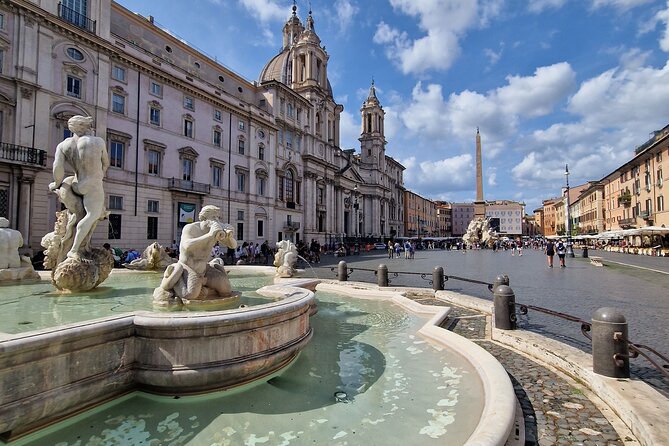
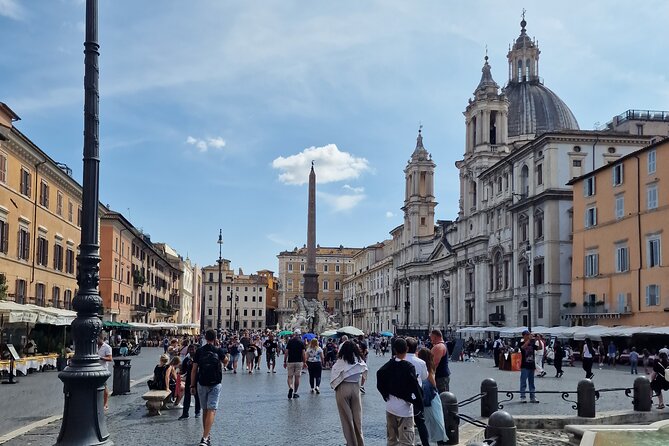
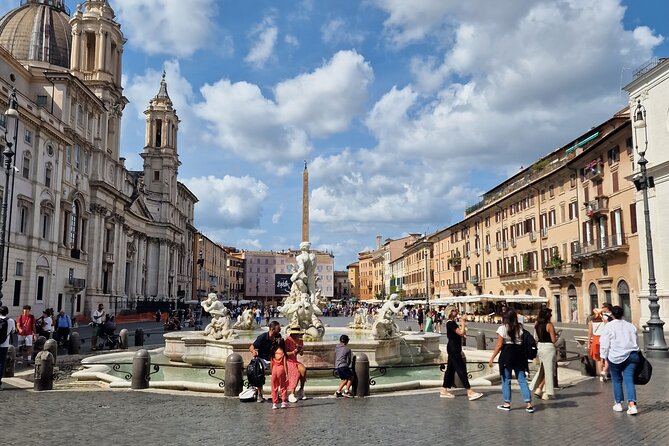
Piazza Navona follows the shape of the Stadium of Domitian, built in the first century AD. That underlying footprint is what makes the square feel so long and unusual compared with Rome’s more compact piazzas.
You have about 20 minutes here. I would use the time to look beyond the open space itself and notice its stadium-like form. Your guide can connect the present square with the ancient structure beneath it, which is much easier to understand when someone points out the shape on the ground.
Piazza Navona is one of the route’s best places to pause and absorb Rome’s layered past. You are not simply looking at a pretty square. You are standing in a public space whose basic form reaches back to imperial Rome and whose later life became tied to churches, fountains, and civic activity.
The Pantheon: clarify what access includes
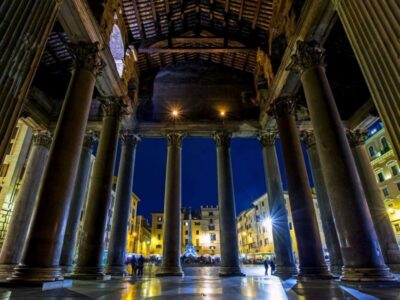
The Pantheon is the tour’s featured monument and the stop most likely to stay with you. Its name comes from Greek words meaning temple of all the gods. It began as a Roman temple and has served as the Catholic Basilica of Santa Maria ad Martyres, or St. Mary and the Martyrs, since 609 AD.
The scheduled stop is about 20 minutes. That is a reasonable amount of time for a focused visit, especially if your guide explains the building’s purpose and later use. The Pantheon’s importance comes from this unusual continuity: an ancient Roman structure remains an active Catholic church.
Pay close attention to the ticket wording when you book. The experience title says Pantheon access, but the detailed itinerary lists the Pantheon admission ticket as not included. That could mean you receive guided access but pay an entrance fee separately, or it could reflect a booking detail that needs clarification. Ask before paying if entering the Pantheon is essential to your plans.
This is also the point where the value of the guide matters most. A quick look at the Pantheon is easy to arrange on your own, but a good explanation can turn the building from a famous photo stop into a clear lesson in Rome’s changing religious and political life.
Ending at Castel Sant’Angelo
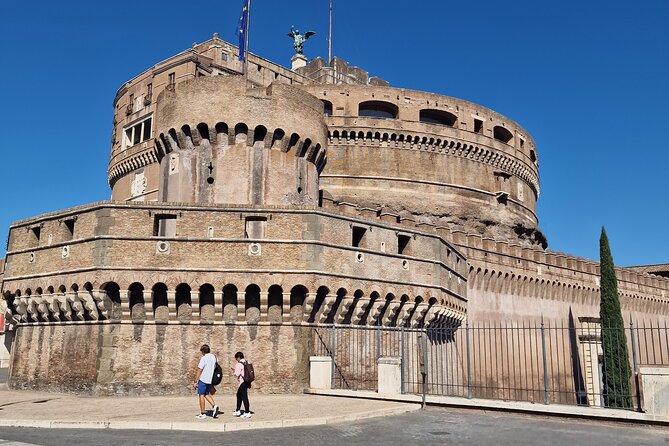
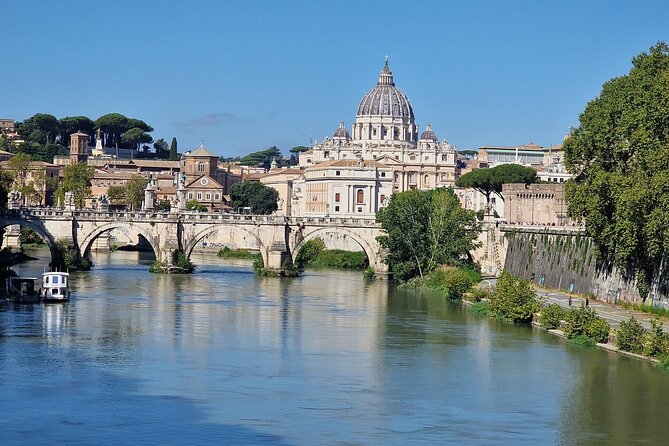
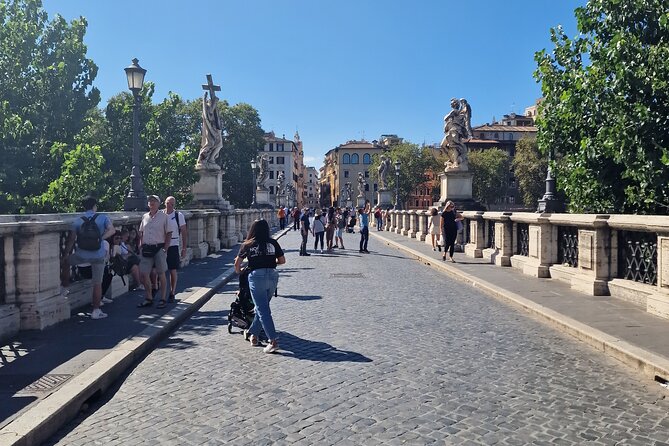
The official endpoint is Castel Sant’Angelo, at Lungotevere Castello 50. The route allocates about 25 minutes to this final stop, the longest time on the itinerary.
Castel Sant’Angelo began as a mausoleum commissioned by Emperor Hadrian for himself and his family. It later became a papal fortress and castle, and it now operates as a museum. The building was once the tallest structure in Rome, a useful detail that helps explain its commanding position beside the river.
The itinerary lists admission as free, so you should not assume the tour takes you inside the museum. The guide can explain the building and show you its exterior, while a separate museum visit would require additional time and should be confirmed independently.
Ending here is practical. Castel Sant’Angelo is a major landmark and a clear point on the map, rather than an arbitrary street corner. Valerio has also walked some groups toward their next tour or hotel after the scheduled route. That extra help is not something you should count on as part of the formal duration, but it can be useful if your next appointment is nearby.
What $161.77 per person buys you
The listed price is $161.77 per person. For a private three-hour walk, that is a substantial outlay, particularly for one or two people. The value improves when several people share the booking or when a group discount applies.
You are paying for a dedicated English-speaking guide, not for a long list of included admissions. Most stops are public spaces or exterior views, and the two church stops and Pantheon have admission details that are not included or need clarification. The price is therefore easiest to justify if you want interpretation, questions answered, and a route shaped around your group rather than the lowest possible cost.
I would compare it with the cost of separate audio guides, taxis between sights, and the time spent planning the route. That comparison will favor the private tour for first-time visitors who want help understanding Rome quickly. It will favor independent sightseeing for repeat visitors, confident walkers, or anyone mainly interested in entering several monuments at their own pace.
The fact that the experience is often booked about 70 days ahead suggests that you should reserve early if your schedule is fixed. Free cancellation is available up to 24 hours before the start time, with a full refund. Changes or cancellations inside that window are not accepted for a refund.
Walking demands and who will enjoy it
You cover a lot of central Rome on foot. The tour is listed as approximately three hours, and the stop times alone add up to that length, so the walking between locations is built into a brisk schedule.
Most participants can take part, and the activity is near public transportation. Service animals are allowed. Still, the route includes city streets, squares, and the Spanish Steps, so anyone concerned about stairs, standing, or walking distance should ask the provider for current route details before booking.
I think this works best for:
- First-time visitors who want to get their bearings quickly.
- Families or small groups who prefer a private guide.
- People with limited time in Rome.
- Couples or friends who want history, churches, fountains, and major squares in one outing.
- Visitors who value personal recommendations after the formal tour.
It is less suitable if you want long interior visits, a slow photography walk, or a tour focused on one period of Roman history. The route is broad by design.
The guide makes the difference
Valerio is the guide most often connected with the strongest praise in the available feedback. His strengths are described as clear explanations of history, geography, archaeology, and culture, along with a friendly manner and willingness to answer questions.
That combination matters on a route this busy. Anyone can point toward the Spanish Steps or Trevi Fountain. The better guide helps you understand why the streets, churches, and squares are arranged as they are, then gives you useful suggestions for the rest of your time in Rome.
Serena also receives specific praise for explaining the history around the churches and different sites. Since the guide assigned to your group may vary, you should not book on the assumption that Valerio will lead your walk. Still, the named guide feedback gives you a useful sense of the service style to expect.
One practical strength is the willingness to help beyond the formal tour. Valerio has walked some groups toward a hotel or the starting point of another tour. Consider that a pleasant extra, not a guaranteed service, and leave enough time between bookings in case the walk finishes at its scheduled end.
Should you book the Rome private walking tour?
Book it if you want a fast, guided introduction to central Rome and prefer a private experience over a large group. The route covers an impressive range of sights, and the combination of Valerio or Serena’s explanations, flexible questions, and a clear north-to-west path can save you planning time on your first day.
Before booking, confirm the Pantheon admission arrangement and decide if the $161.77 per-person price works for your group size. If you want to enter several monuments or spend long periods inside them, this walk will feel too quick. If you want to see the city’s major public spaces, understand the connections between them, and finish near Castel Sant’Angelo, it is a useful and well-focused choice.
FAQ
How long is the Rome private walking tour?
The tour lasts approximately three hours.
What language is the tour offered in?
The tour is offered in English.
Where does the tour start?
It starts at the Flaminio Obelisk in Piazza del Popolo, at Piazza del Popolo 21, Rome.
Where does the tour end?
It ends at Castel Sant’Angelo, at Lungotevere Castello 50, Rome.
Is this a private tour?
Yes. Only your group participates in the activity.
Is admission to the Pantheon included?
The experience is titled as including Pantheon access, but the detailed information lists the Pantheon admission ticket as not included. Confirm the exact ticket arrangement before booking.
Can I cancel for a full refund?
Yes. You can cancel at least 24 hours before the experience start time for a full refund. Cancellations or changes made less than 24 hours in advance are not accepted for a refund.
Newest reviews from Rome
- ROME:Colosseum & Ancient Rome – private/small group TOUR★ 5.0 · 24 reviews
- Off the Beaten Track in Rome: Rione VI Parione Private Tour★ 5.0 · 24 reviews
- Cinematic Photoshoot in Rome★ 5.0 · 24 reviews
- Rome: Best of Colosseum and Roman Forum Small Group Guided Tour★ 4.5 · 24 reviews
- The Labyrinth of Rome between catacombs and ancient quarries★ 4.5 · 24 reviews
- Vatican and Trionfale Market Tour with Wine and Food Tasting★ 5.0 · 24 reviews
- private tour: Vatican Museums, Sistine Chapel, St. Peter’s Basilica★ 4.5 · 24 reviews
- Colosseum guided tour with Virtual Reality★ 5.0 · 24 reviews
Trevi Fountain & Pantheon Walks, compared.
Pantheon Timeless Marvel Guided Tour with Entry Ticket
Read our review →
Pantheon Priority Entry Ticket & Audio Guide App
Read our review →
Enjoy Spritz and Pasta Making in Piazza Navona
Read our review →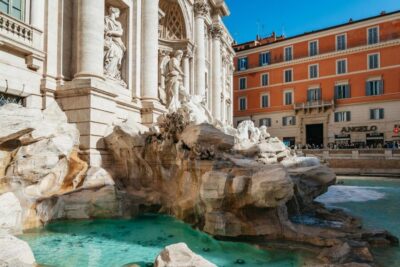
Pantheon Elite Guided Tour – Rome’s Iconic Ancient Temple
Read our review →
Pasta & Tiramisu Cooking Class near the Spanish Steps
Read our review →
Traditional Pizza Cooking Class near Piazza Navona
Read our review →
Rome’s Iconic Temple: Pantheon Audio Guided Tour with Fast Access
Read our review →Browse the lists this tour appears in