
Reviewed · WALKING TOURS
Rome: Relics from the Passion of the Christ Walking Tour
Rome’s most moving Christian pilgrimage route is not centered on one grand monument. It links five churches and a set of sacred objects tied to Jesus’ final days, including the Scala Sancta, a thorn, a nail, and wood said to come from the Cross. The final stop, Basilica of the Holy Cross in Jerusalem, gives the tour its strongest spiritual focus.
I like the small group of up to 10 and the time built in for prayer, rather than treating the relics as quick photo stops. I also like the guides’ range of religious and Roman knowledge. Paul, Daniel, Tom, and Tim are singled out for clear explanations, warmth, and the ability to answer questions. The main caution is simple: this is a real walking tour, and one participant felt the final relic display deserved more time.
In This Review
- Key points to know before booking
- Why this Rome pilgrimage route feels different
- Santa Maria Maggiore and the manger wood
- Santa Prassede and the pillar of scourging
- The Scala Sancta and the icon above the Holy Steps
- San Giovanni in Laterano, Rome’s cathedral
- The Basilica of the Holy Cross in Jerusalem
- What the guides add to the experience
- Walking, clothing, and practical planning
- Is $96.29 a fair price?
- Who should book this tour?
- Should you book Rome’s Passion relics tour?
- FAQ
- How long does the tour last?
- Where does the tour meet?
- Where does the tour end?
- What is included in the price?
- What should I wear?
- Is the tour suitable for people with limited mobility?
Key points to know before booking
- Five important churches in three hours: The route links Santa Maria Maggiore, Santa Prassede, the Scala Sancta, San Giovanni in Laterano, and the Basilica of the Holy Cross.
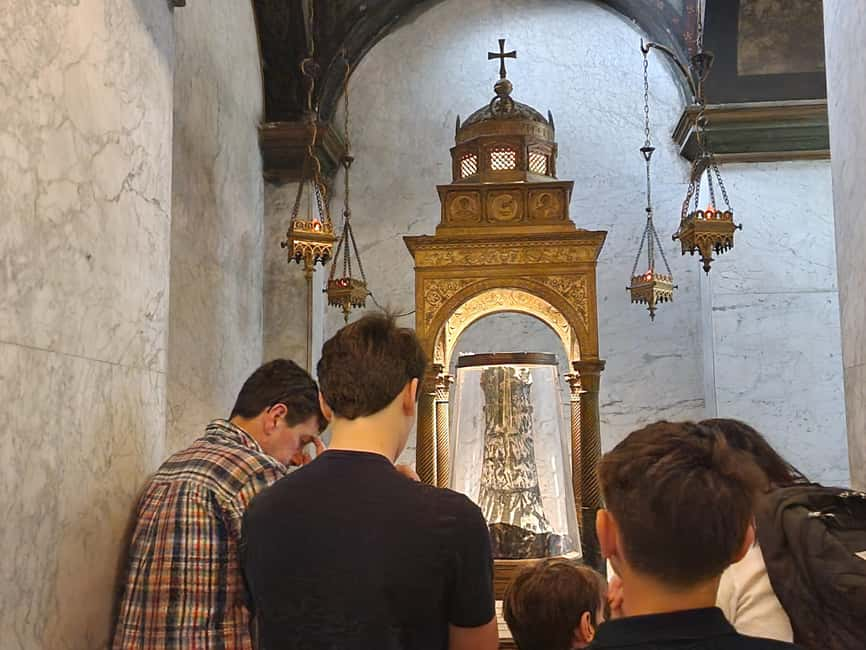
- Relics connected with the Passion: You see a nail, two thorns, a piece of the Cross, and a small board bearing the words Jesus the Nazarene king of the Jews.
- Guides bring the story together: Paul, Daniel, Tom, and Tim have been praised for explaining both Catholic tradition and Roman history in clear, engaging terms.
- A prayerful final stop: The Holy Cross Basilica provides time for quiet reflection and prayer.
- Dress and walking matter: Cover your shoulders and knees, wear good shoes, and plan for outdoor walking in all weather.
- Good value for pilgrims: At $96.29, the price includes entry to each site and a live English-speaking guide, but not food, drinks, or transport to the meeting point.
Why this Rome pilgrimage route feels different
Many Rome church tours focus on painting, architecture, or famous names. This one follows a particular thread: objects associated with Jesus’ trial, torture, Crucifixion, and burial. The route also shows how Christian worship took shape in Rome after the empire moved from persecuting the faith to embracing it.
That change is central to the experience. The relics were mostly brought from Jerusalem by St. Helena, the mother of Emperor Constantine, in the fourth century. You are not simply moving from one church to another. You are following the way later Roman Christians preserved, displayed, and prayed with objects connected to the Passion.
The tour is best suited to a Christian pilgrim, a Catholic visitor, or anyone interested in the overlap between belief, art, and Roman history. You do not need to treat every relic as an article of faith to appreciate the setting. The churches themselves are remarkable, and the guide helps explain why these objects have mattered to generations of worshippers.
The pace is brisk. Five churches in three hours leaves little room for lingering at every altar or mosaic. Still, the group size helps. With no more than 10 participants, you have a better chance to hear the guide and ask questions than you would on a large coach tour.
More walking tours in Rome:
- Rome: Trastevere & Campo de Fiori Street Food Walking Tour
★ 4.9 · 2,768 reviews - Rome: Paranormal Night Walking Tour & Secret Backstreets
★ 4.9 · 1,921 reviews - Rome by Night Walking Tour – Legends & Criminal Stories
★ 4.5 · 1,003 reviews
Santa Maria Maggiore and the manger wood
Meet at the fountain in the piazza in front of Santa Maria Maggiore. Look for the guide holding an orange sign with a lion’s head, and arrive 15 minutes early. The tour departs on time, so this is not the place to gamble on a late coffee.
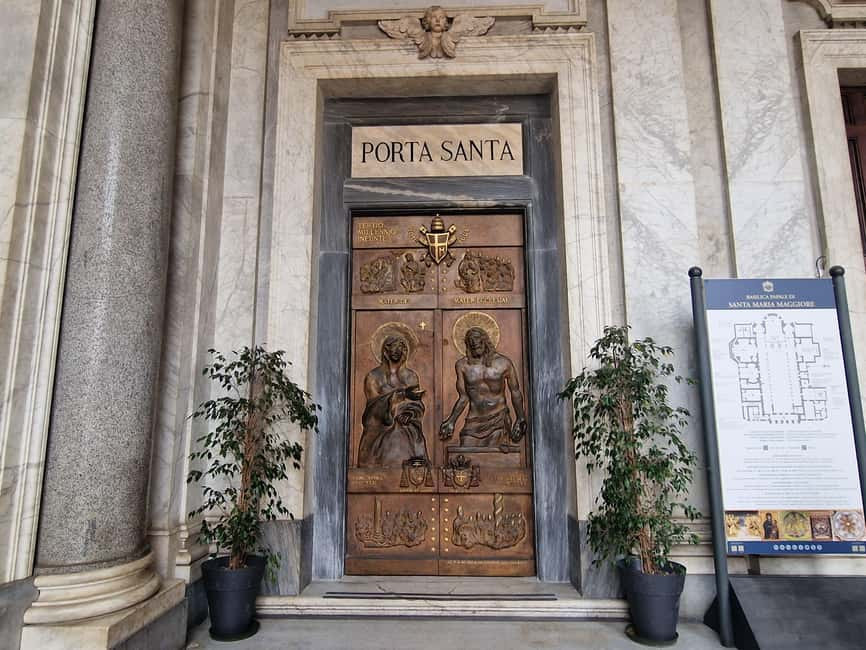
Santa Maria Maggiore is one of Rome’s oldest churches dedicated to Mary, known here as Theotokos, or Mother of God. The building has been shaped by many periods of Italian art, which makes it an excellent first stop. You get the church’s grand architectural and artistic setting before turning to the more intimate objects tied to Jesus’ life.
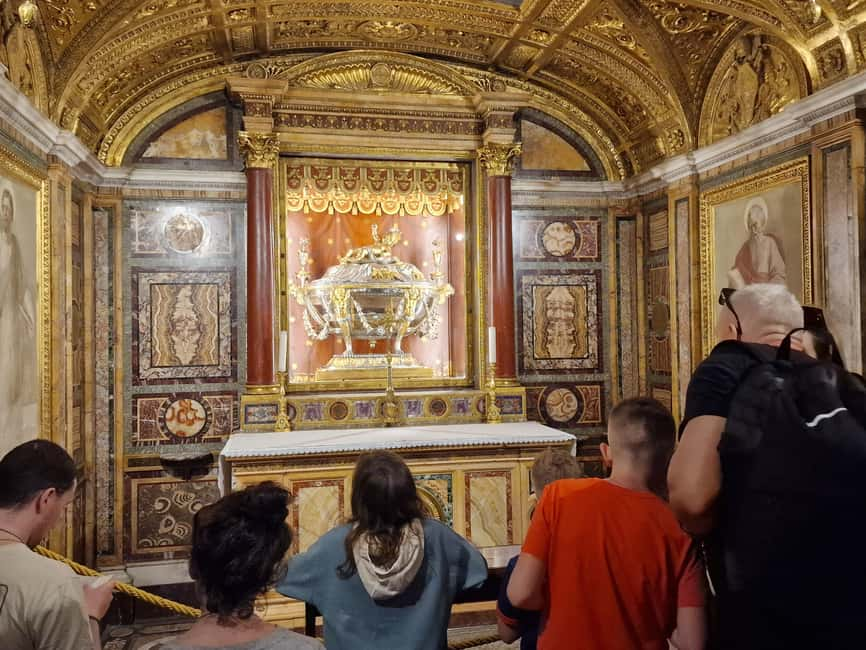
Beneath the main altar is wood associated with the manger where the infant Jesus lay. The church also contains the body of Gian Lorenzo Bernini, the major Baroque artist whose work shaped Rome’s visual identity. Those two details make the basilica a useful introduction to the tour’s mix of devotion, art, and physical remains.
Your guide leads the visit rather than leaving you to decode the church alone. That matters here because Santa Maria Maggiore can feel overwhelming. There is a great deal to see, and a clear explanation helps you focus on the objects and images relevant to the pilgrimage.
Santa Prassede and the pillar of scourging
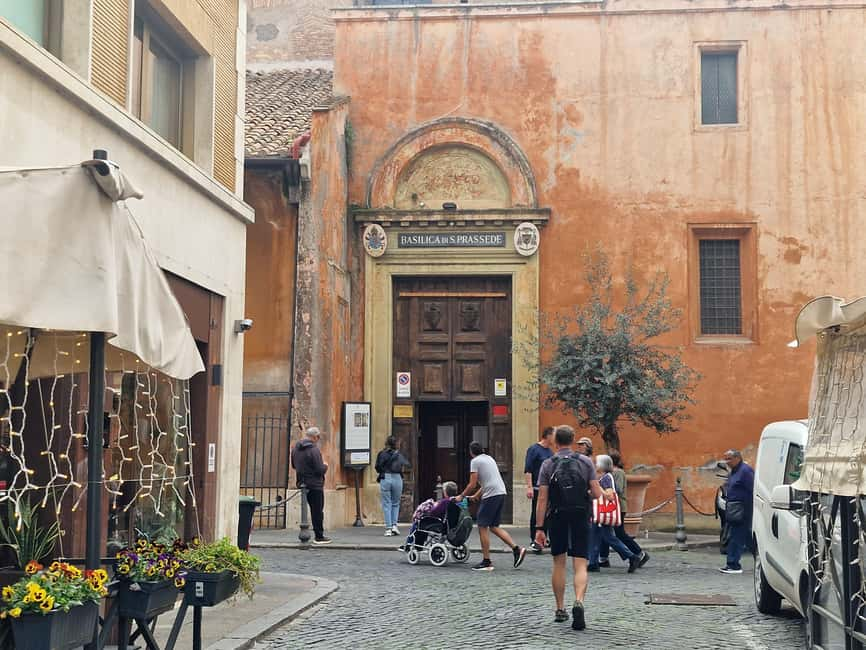
The short walk to Santa Prassede changes the mood. This church is less imposing than Santa Maria Maggiore, but its ninth-century mosaics are a major reason to come inside. Their glittering surfaces and strong colors give the church a distinctly early medieval character.
The key object here is a stone pillar associated with the scourging of Jesus. It was brought from the Praetorium in Jerusalem to Rome in the 13th century. For a pilgrim, this is a direct link to the physical suffering described in the Passion narratives.
This stop rewards careful listening. The pillar is not presented in isolation. The guide places it within the story of Roman rule, Jerusalem, and the later movement of sacred objects to Rome. That wider setting helps you understand why a relatively small object can carry such weight for worshippers.
Allow yourself a moment to look up at the mosaics as well. One possible weakness of a tightly timed route is that you may feel pulled between the artwork and the relic. If you are especially interested in medieval art, you may wish you had more time here.
The Scala Sancta and the icon above the Holy Steps
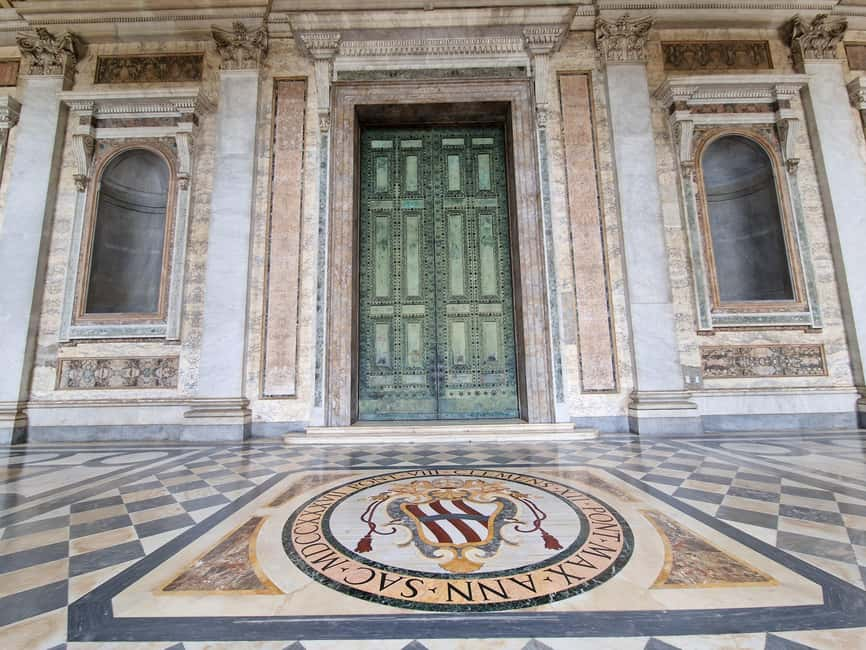
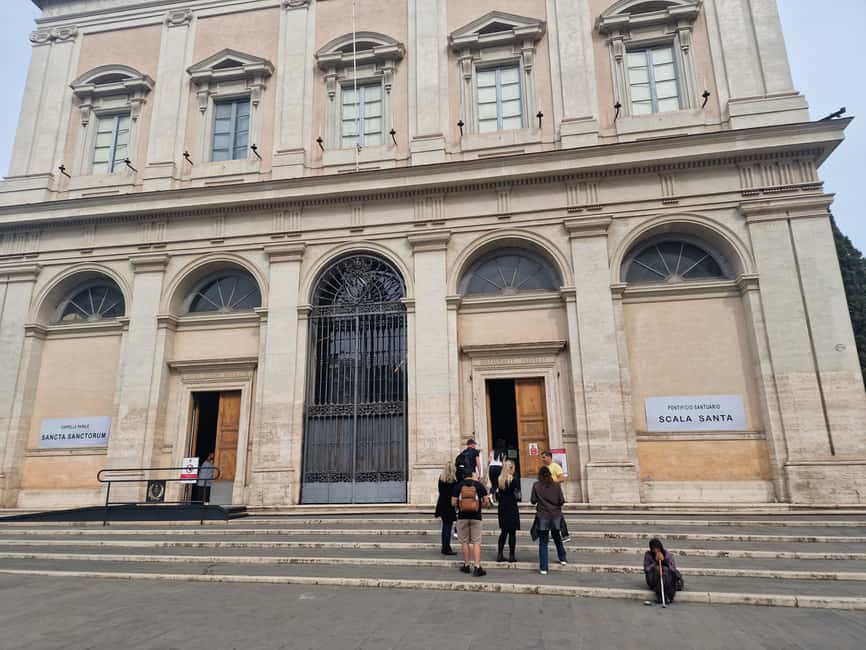
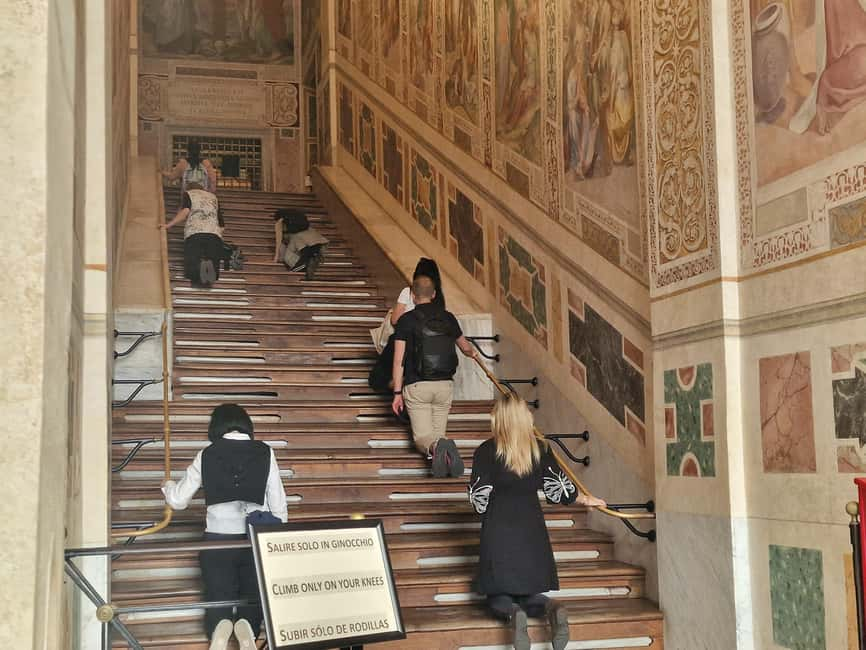
Next comes the Scala Sancta, or Holy Steps, traditionally identified as the stairs Jesus climbed while being judged by Pontius Pilate. St. Helena is said to have brought them to Rome in the fourth century.
The traditional pilgrimage practice is to climb the steps on your knees. This tour does not allow enough time for that full devotion, so you should not book it expecting an extended individual pilgrimage on the staircase. Instead, you receive an explanation of the steps and a look toward the Holy of Holies at the top.
There you can see an icon attributed to St. Luke, the Gospel writer. The sight adds another layer to the tour’s focus on objects that connect the written story of Christ with places and things preserved by the Church.
This is one of the stops where expectations matter. You are being guided through a larger route, not given unlimited time for private prayer at each site. If your main goal is to climb the Scala Sancta slowly on your knees, a separate visit may suit you better. If you want the steps placed within a broader sequence of Passion relics, this guided format makes sense.
A completely different way to spend the day in Rome:
- Vatican: Museums & Sistine Chapel Entrance Ticket
★ 4.5 · 144,003 reviews - Vatican Museums & Sistine Chapel Tour with Optional Basilica
★ 4.3 · 67,413 reviews - Vatican Museums, Sistine Chapel & St Peter’s Basilica Guided Tour
★ 4.5 · 39,149 reviews - Rome: Colosseum, Palatine Hill and Roman Forum Guided Tour
★ 4.8 · 32,814 reviews
San Giovanni in Laterano, Rome’s cathedral
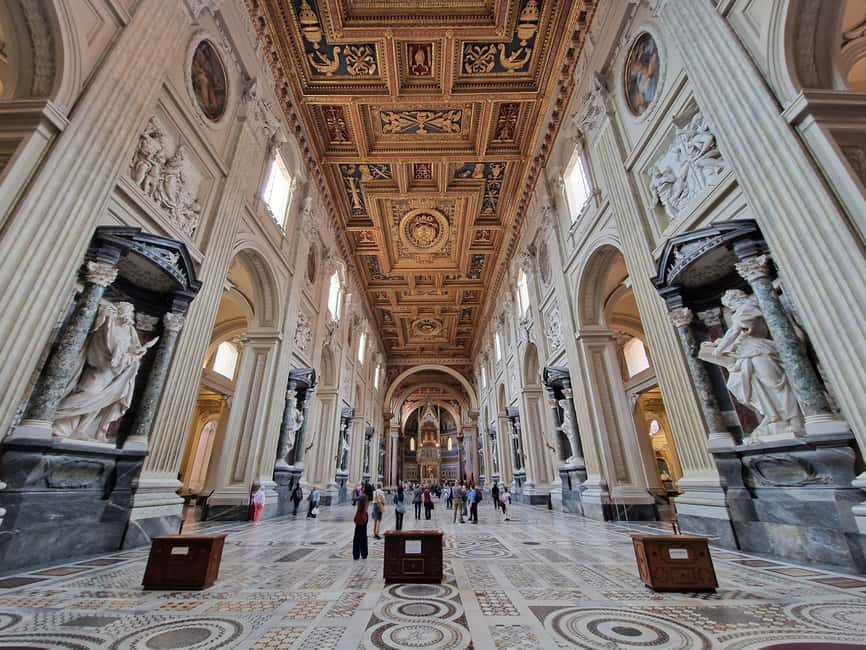
The walk continues to the Basilica of Saint John Lateran, or San Giovanni in Laterano, the Cathedral of Rome. This is an important change in emphasis. Here, the church’s architectural design, mosaic program, and role in Roman Catholic life take center stage.
The guide explains Borromini’s design and the symbolism within the mosaics. That context is valuable because a church this large can otherwise become a blur of marble, chapels, and decoration. You will have a clearer idea of how the building communicates its religious purpose.
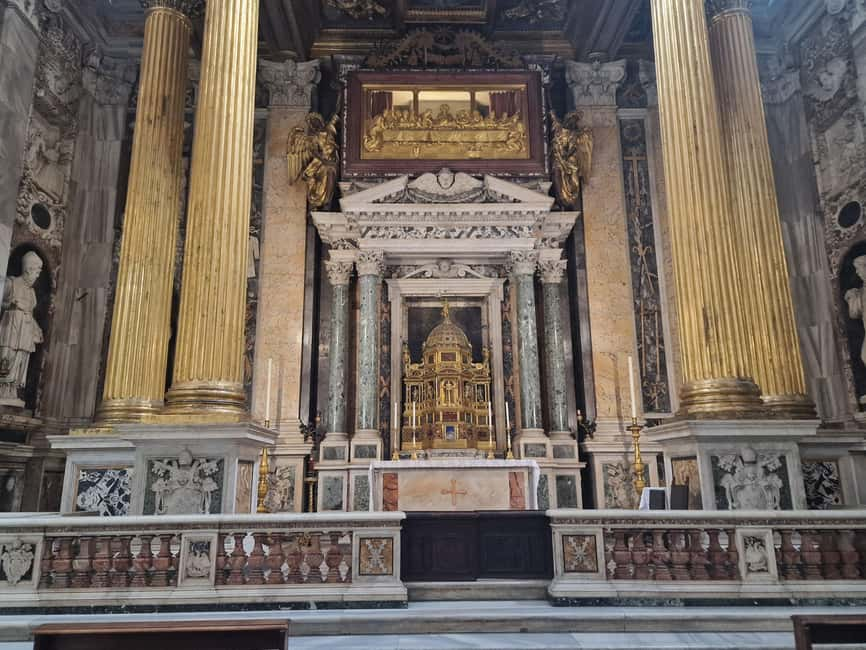
Above the high altar is the place associated with the skulls of Saints Peter and Paul. The tour does not treat this as a random curiosity. It connects the relics to the authority and identity of Rome’s cathedral.
I especially like the way this stop broadens the experience. The tour is not only about objects linked to Jesus. It also shows how the early Christian story, the apostles, Roman architecture, and Catholic tradition meet in one building.
The drawback is time. San Giovanni in Laterano deserves a long visit on its own, and three hours for the whole route means the guide must keep the group moving.
The Basilica of the Holy Cross in Jerusalem
The final church is the Basilica of the Holy Cross in Jerusalem, built on earth brought from Calvary in the fourth century. This is the emotional center of the route and the place where the individual relics come together.
Inside, you see objects associated with several moments in the story of Jesus’ Passion and death:
- Fragments connected with the Holy Sepulcher
- A piece associated with the Cave of Bethlehem
- A nail from the Crucifixion
- Two thorns associated with the Crown of Thorns
- A small walnut board bearing the words Jesus the Nazarene king of the Jews
- Wood associated with the Cross
The display is not large in the way a museum collection is large. Its importance comes from the objects’ religious meaning and from the setting in which they are preserved. You receive time to reflect and pray, which gives the final stop a different pace from the walking between churches.
You should keep your expectations realistic. The schedule may not provide a long private visit with every relic. One participant felt the Basilica of the Holy Cross received less time than it deserved, and I can understand that concern. Since this is the stated climax, many people will want to linger here.
Still, ending at the Holy Cross Basilica gives the tour a clear shape. You begin with the wood of the manger and finish with the wood of the Cross. The route moves from Christ’s birth to his death, with Roman churches providing the setting.
What the guides add to the experience
The guide can make or break a religious tour, particularly one that covers several churches and centuries of tradition in only three hours. The strongest reports point to guides who explain rather than preach, welcome questions, and connect religious details with Roman and world history.
Paul has been praised for his grasp of Catholic, Italian, Roman, and wider world history, as well as for his personal manner. Daniel is described as clear and engaging, with a gift for helping you picture the events being discussed. Tom is noted for covering a wide range of subjects and for creating a warm, reflective atmosphere. Tim has been praised for making the session accessible even to teenagers.
You may not receive one of these particular guides, but their described approach gives you a useful sense of the tour’s character. Expect an English-language guide with a strong religious focus and room for questions.
This is also a good option if someone in your party walks slowly. Paul, in particular, has been praised for accommodating a slower pace. Even so, tell the operator about mobility concerns before booking. The tour is listed as wheelchair accessible, but the instructions clearly describe it as a walking tour and suggest a golf cart option for people with limited mobility.
Walking, clothing, and practical planning
The tour starts and ends at the fountain in front of Santa Maria Maggiore. Transport to the meeting point and between the churches is not included, so you walk the route with the group.
Wear comfortable shoes. Rome’s historic center can be tiring underfoot, and the schedule includes several churches rather than one indoor site. Bring water, sunscreen, a hat, and an umbrella because the tour operates in all weather unless authorities close a site for safety.
Church clothing is not optional. Your shoulders and knees must be covered, so avoid shorts, short skirts, and sleeveless shirts. In warm weather, pack a light cover for your shoulders. In colder months, dress warmly, since part of the experience takes place outdoors.
Food and drinks are not included. Three hours is short enough that you can eat before or after, but carry water. Bring photo identification as well, since proof of identity may be requested.
The order can change if a church closes unexpectedly or holds a special event. Temporary exhibitions and special events may also carry separate exclusions. These are normal conditions for a church-based tour, but they are worth knowing before you pay.
Is $96.29 a fair price?
At $96.29 per person, this is not a bargain walking tour. The price makes more sense if you value the guide and the included admission to all five sites, especially when the religious meaning of the objects is central to your visit.
You are paying for a focused route that would be difficult to organize smoothly on your own. You would need to research the churches, understand their opening arrangements, connect the sites on foot, and work out which relics are displayed where. A good guide also gives you the historical links that a simple visit cannot provide.
The value is weaker if you want a slow art tour or lots of free time. You cover a great deal of ground, and each church has more to offer than the schedule can include. The price is strongest for a pilgrim who wants one structured morning or afternoon devoted to the Passion.
Free cancellation up to 24 hours before the start and the option to reserve now and pay later reduce the financial risk. Check the starting time carefully, arrive early, and do not assume a late arrival can be accommodated.
Who should book this tour?
Book it if you want:
- A Christian pilgrimage centered on Passion relics
- A small group rather than a large organized crowd
- An English-speaking guide who can explain Catholic and Roman context
- A route that includes major churches and less familiar sacred sites
- Time for prayer at the final basilica
- A concentrated introduction to relics connected with Jerusalem and the Crucifixion
Think twice if you want to explore each church at your own pace, climb the Holy Steps on your knees, or spend a long time at the final relic display. You should also choose the golf cart option if walking between the sites will be difficult.
Should you book Rome’s Passion relics tour?
I would book this tour if the religious meaning of Rome is a main reason for your visit. Its greatest strength is the way it connects separate churches into one story, from the manger wood at Santa Maria Maggiore to the Cross relics at the Basilica of the Holy Cross.
The experience works best when you arrive prepared for prayer, history, and walking, not for a museum-style inspection of every object. The churches are extraordinary, the route is purposeful, and guides such as Paul, Daniel, Tom, and Tim bring the subject to life with warmth and strong command of the material.
If the Holy Cross relics are your top priority, ask about the time available at that final stop before booking. For most Christian pilgrims, though, the combination of relics, basilicas, mosaics, and thoughtful guidance makes this a meaningful use of three hours in Rome.
FAQ
How long does the tour last?
The walking tour lasts three hours. Starting times vary, so check availability when booking.
Where does the tour meet?
Meet at the fountain in the piazza in front of the entrance to Santa Maria Maggiore. The guide will hold an orange sign with a lion’s head.
Where does the tour end?
The activity ends back at the original meeting point.
What is included in the price?
Entry to each site and an expert local guide are included. Food, drinks, and transport to and from the tour are not included.
What should I wear?
Wear comfortable shoes and clothing that covers your shoulders and knees. Shorts, short skirts, and sleeveless shirts are not allowed inside the churches.
Is the tour suitable for people with limited mobility?
The tour is listed as wheelchair accessible, but it is a walking tour. If you have limited mobility, the instructions recommend booking the golf cart option.
Newest reviews from Rome
- Off the Beaten Track in Rome: Rione VI Parione Private Tour★ 5.0 · 24 reviews
- ROME:Colosseum & Ancient Rome – private/small group TOUR★ 5.0 · 24 reviews
- Cinematic Photoshoot in Rome★ 5.0 · 24 reviews
- Rome: Best of Colosseum and Roman Forum Small Group Guided Tour★ 4.5 · 24 reviews
- The Labyrinth of Rome between catacombs and ancient quarries★ 4.5 · 24 reviews
- Vatican and Trionfale Market Tour with Wine and Food Tasting★ 5.0 · 24 reviews
- private tour: Vatican Museums, Sistine Chapel, St. Peter’s Basilica★ 4.5 · 24 reviews
- Colosseum guided tour with Virtual Reality★ 5.0 · 24 reviews
Walking Tours, compared.
Trastevere & Campo de Fiori Street Food Walking Tour
Read our review →
Paranormal Night Walking Tour & Secret Backstreets
Read our review →
Rome by Night Walking Tour – Legends & Criminal Stories
Read our review →
Guided City Center Evening Sightseeing Walking Tour
Read our review →
Best of Rome Walking Tour including Trevi Fountain
Read our review →

Forbidden History Walking Tour & Pub Crawl with Drinks
Read our review →
Guided Small Group Walking Tour of City Highlights
Read our review →Browse the lists this tour appears in