
Reviewed · TOURS
Rome: Small-Group Tour of Caracalla Baths and Circus Maximus
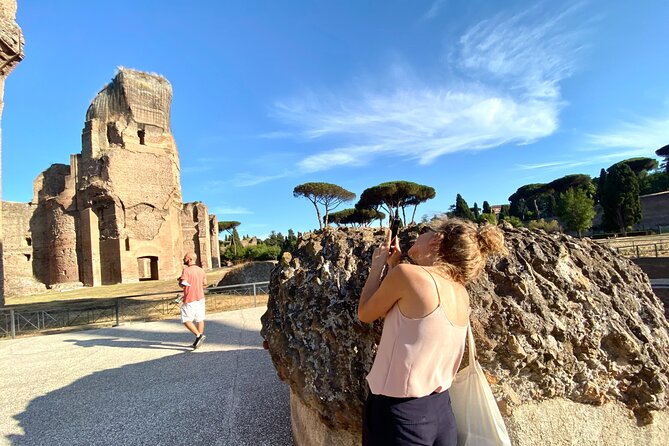
The Caracalla Baths are Rome’s great crowd escape: enormous brick walls, surviving mosaics, and a scale that is hard to grasp until you walk inside. A local archaeologist guide explains how this ancient public spa worked, from heated floors to the daily routine of Romans in the third century.
I like the small maximum of 10, which makes it easier to hear questions and follow the guide through the ruins. I also like the prebooked admission and provided headphones, especially when the guide is explaining details across a large open site. The main caution is simple: Circus Maximus gets only about 30 minutes, and the tour views it from outside the railings rather than taking you into the site.
In This Review
- Key points to know before booking
- Why the Caracalla Baths deserve your time
- Following a Roman day through the thermal complex
- Circus Maximus in a short, open-air stop
- What a small group changes at an ancient site
- Walking, meeting point, and timing
- Weather and cancellation details that matter
- Who will get the most from this tour
- Is $78.64 a fair price?
- Should you book the Caracalla Baths and Circus Maximus tour?
- FAQ
- How long does the tour last?
- What language is the tour offered in?
- Is admission to the Baths of Caracalla included?
- Is admission to Circus Maximus included?
- Where does the tour start?
- Where does the tour end?
- How large is the group?
- Are headphones provided?
- Can I cancel for a full refund?
Key points to know before booking
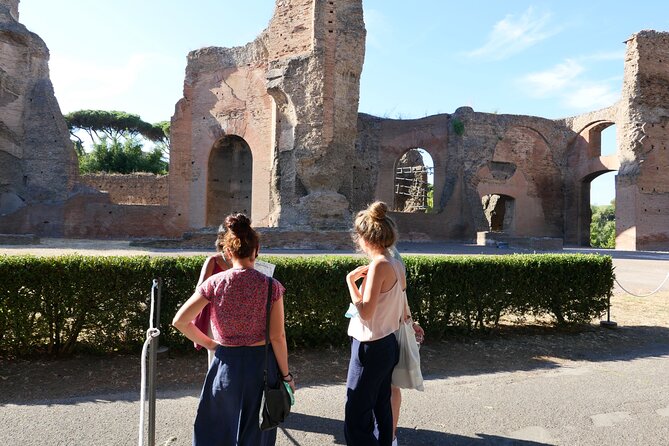
- Caracalla gets the real attention: Plan on roughly one hour inside the baths, compared with about 30 minutes at Circus Maximus.
- The guide adds the value: Local archaeologists such as Lars, Sara, Sam, and Gabriel have led tours praised for clear stories and detailed explanations.
- The group stays small: The maximum is 10 people, a useful size for asking questions and staying near the guide.
- The baths are far less crowded than Rome’s headline sights: You get a calmer look at one of Imperial Rome’s largest surviving complexes.
- Circus Maximus is an outside viewing stop: You hear about races, games, and Rome’s early myths, but admission to the Circus itself is not included.
- Wear good shoes: The tour involves a moderate amount of walking over an archaeological site.
Why the Caracalla Baths deserve your time
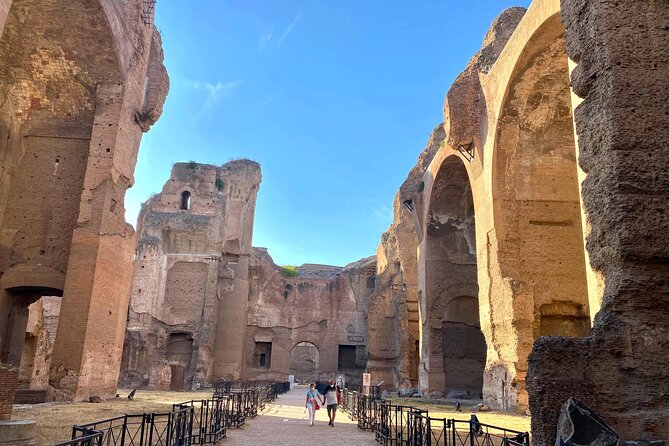
Rome can make you choose between famous and worthwhile. The Colosseum, Forum, and Pantheon deserve their place, but they also draw the biggest crowds. The Baths of Caracalla offer something different: a huge ancient complex where the size, layout, and everyday purpose of Roman public life come into view without the same pressure of a packed landmark.
The baths were built around the early third century AD, with the complex dating to the reign of Emperor Caracalla. At its height, this was not simply a place to wash. It was a broad public center for exercise, bathing, social life, and the care of body and mind.
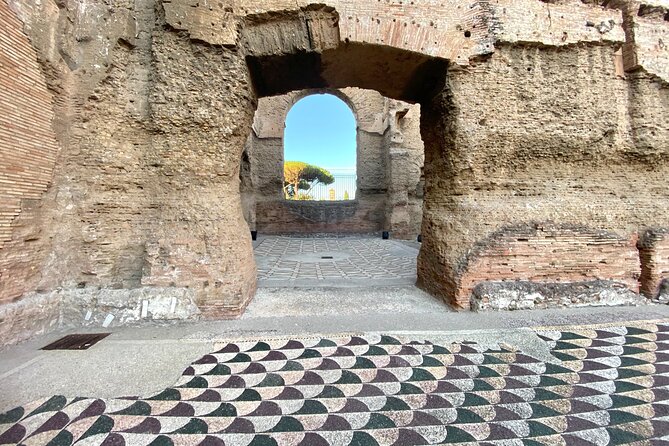
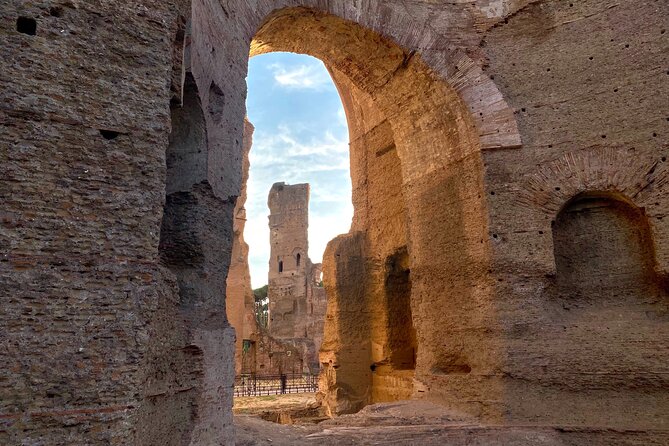
I find that scale is the first surprise. You see partial walls from outside, but once you enter, the monumental rooms make more sense. Even as ruins, the structure shows how much engineering, labor, and planning went into Roman public buildings.
A guide helps you read what remains. Without context, a broken wall can be just a broken wall. With an explanation of the room sequence, heating system, and mosaics, the site becomes a working complex rather than a collection of fragments.
Tours travellers often pair with this one in Rome:
- Vatican: Museums & Sistine Chapel Entrance Ticket
★ 4.5 · 144,003 reviews - Vatican Museums & Sistine Chapel Tour with Optional Basilica
★ 4.3 · 67,413 reviews - Vatican Museums, Sistine Chapel & St Peter’s Basilica Guided Tour
★ 4.5 · 39,149 reviews
Following a Roman day through the thermal complex
The tour spends about an hour at the Baths of Caracalla, and that balance is right. This is the part worth lingering over, since the grounds contain enough surviving architecture and detail to reward a slower visit.
Your guide describes the typical path through the baths and the different temperatures used in the complex. The Roman bathing routine was organized around hot, warm, and cool spaces, with the building itself doing much of the work.
One of the most useful explanations concerns the underfloor heating system. Hot air moved beneath raised floors and through parts of the walls, allowing workers to control the temperature in different rooms. It was labor-intensive, requiring fuel, maintenance, and a steady supply of workers to keep the system running.
This detail gives you a better sense of the baths as a machine. The impressive walls were only part of the achievement. The Romans also had to manage water, heat, fuel, drainage, and the movement of large numbers of people through the building.
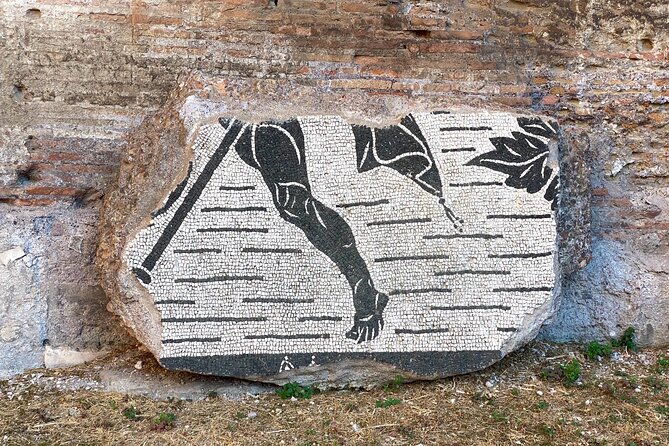
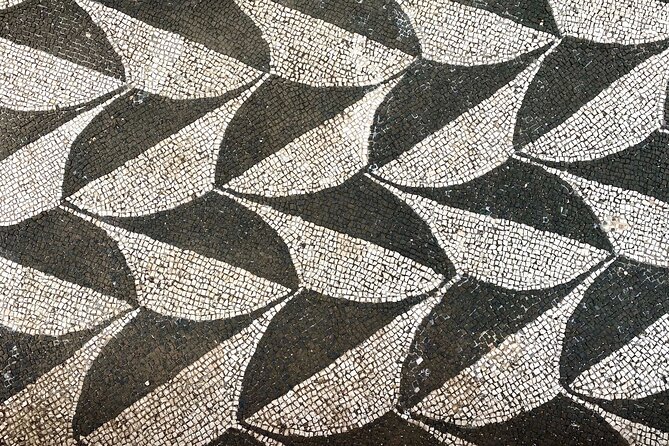
Look down as you walk. The geometric mosaics are among the most rewarding details at the site. They show how decoration was built into a place used by ordinary Romans as well as the elite. Some of the largest mosaics visible today are reconstructions, so you should not expect every decorated surface to be original.
That distinction matters if you arrive expecting a perfectly preserved ancient interior. The baths are remarkably intact in their overall form, but they are still ruins. Some walls are incomplete, and some major decorative features have been recreated. The reward is not a flawless building. It is the chance to understand the building’s original size and purpose.
Guides have different strengths. Lars has been praised for a relaxed style that makes questions easy, while Gabriel, described as a doctor in archaeology, has led especially detailed explanations of the baths and Circus Maximus. Sara and Sam have also been singled out for clear, engaging tours. The specific guide assigned to your departure can vary, but the experience depends heavily on how well that person connects the remaining architecture to daily life.
Circus Maximus in a short, open-air stop
After the baths, the tour turns to Circus Maximus. The walk between the two locations is part of the experience, and the sites are close to several other major Roman sights. The Circus stop lasts about 30 minutes.
This is where you need to set expectations carefully. You do not enter the Circus Maximus as part of this experience. The guide discusses the site from outside the railings, pointing out the broad area where the ancient racecourse once hosted chariot races and public games.
The setting can be hard to read at first. The Circus is now an open stretch of ground, and much of the ancient structure is no longer visible. The guide’s role is to supply the missing scale and noise: the races, the crowds, and the large public celebrations known as the Roman Ludi.
You also hear about the site’s early connection to Rome’s foundation myths and gods. That takes the story beyond racing and into the older, partly legendary period before Rome became the Imperial capital familiar from history books.
For some people, this is a useful introduction. For others, 30 minutes outside the railings will feel too brief, especially if they hoped to explore the Circus directly. One visitor considered this the weak point of the tour and wished there were more time inside the site. That is a fair criticism, but it is also a reason to view the Circus portion as a compact historical orientation rather than a full visit.
The tour’s center of gravity is clearly the baths. If your main interest is Circus Maximus, this is not the best format. If you want a guided visit to Caracalla with a short explanation of the Circus along the way, the division works well.
What a small group changes at an ancient site
The group limit is 10 people, and that matters more at Caracalla than it might at a small indoor museum. The ruins are spread out, and the guide may be several steps away while explaining a wall, mosaic, or heating feature.
Headphones are included and sterilized before use. They let you hear the commentary without standing shoulder to shoulder with the guide. This is especially useful when the group is spread across a large room or when other visitors are nearby.
A small group also leaves room for questions. Guides such as Lars have been praised for a friendly, relaxed approach, while Sara and Sam have been described as engaging and easy to follow. Another guide, Manola, was noted for explaining each section of the baths and the services offered there.
The experience can sometimes become nearly private if the departure has very few bookings. Some groups have consisted of only two people or a single family. That can make the $78.64 price feel more reasonable, since you are paying for direct attention rather than simply joining a large crowd.
The tradeoff is that the price is not low for a 90-minute activity. You are paying for the guide, the entrance ticket to Caracalla, the headphones, and on-site assistance. If you are comfortable reading site signs or using an audio guide, you may prefer to visit independently. If you want the ruins explained in real time, particularly the engineering and room functions, the guided format offers more than admission alone.
A completely different way to spend the day in Rome:
- Rome: Colosseum, Palatine Hill and Roman Forum Guided Tour
★ 4.8 · 32,814 reviews - Rome: Guided Tour of Colosseum, Roman Forum & Palatine Hill
★ 4.7 · 27,897 reviews - Rome: Colosseum & Forum with Audio Guide App -Optional Arena
★ 4.2 · 24,770 reviews - Rome: Colosseum, Roman Forum and Palatine Hill Guided Tour
★ 4.5 · 23,903 reviews
Walking, meeting point, and timing
The meeting point is at Viale Aventino 3, 00153 Rome. The tour ends inside the Baths of Caracalla at Viale delle Terme di Caracalla, so you can continue looking around on your own after the guided portion.
That ending is useful. You are not rushed straight out after the explanation, and you can spend more time with parts of the site that caught your attention. Since the tour itself is approximately 1 hour and 30 minutes, allow extra time if you want to explore the baths independently afterward.
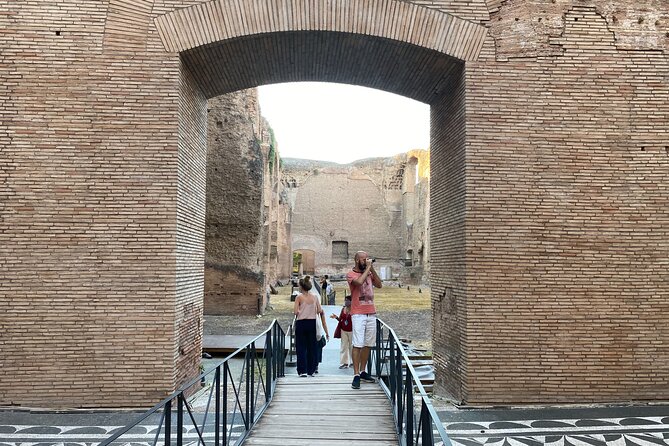
There is a moderate amount of walking. Wear comfortable shoes, since this is an archaeological site rather than a smooth museum floor. The experience is near public transportation, and most people can take part. Service animals are allowed.
Travelers younger than 18 must bring a valid document or other proof of identification. Hotel pickup and drop-off are not included, so you need to reach the start point yourself.
The tour is offered in English. Headphones are supplied so you can follow the guide clearly, but one person found the guide difficult to understand. If spoken English is a concern for you, keep that possibility in mind. The small group makes it easier to ask for clarification, but guide accents and speaking styles can vary.
Weather and cancellation details that matter
This experience requires good weather. If the operator cancels because of poor conditions, you are offered another date or a full refund.
The standard cancellation rule allows a full refund if you cancel at least 24 hours before the local start time. Cancellations or changes made less than 24 hours in advance are not refunded.
Rain can create a gray area. The tour may continue in wet weather if the sites remain open and the guide is present. If you decide not to attend because the forecast looks unsafe, do not assume that the tour has been canceled. Wait for official word from the operator, since a no-show may not qualify for a refund.
This is an outdoor experience at two open archaeological locations, so check the forecast before booking. Bring suitable clothing and shoes, but remember that the provider decides if conditions require cancellation.
Who will get the most from this tour
I would choose this tour if you have already seen Rome’s famous center and want a quieter site with strong architectural remains. It is also a good first stop for anyone curious about how Roman public life worked beyond emperors and battles.
History-minded visitors will get the most from the explanations of heating, room functions, mosaics, and Roman bathing customs. The tour also suits families and couples who prefer a short activity with a clear focus rather than a full morning of sightseeing.
It may not suit you if you want a long tour, extensive time at Circus Maximus, or a fully intact ancient interior. The baths are huge, but they are ruins, and the tour lasts only 90 minutes. If you want to study every wall and mosaic, plan to remain inside after the guide finishes.
The experience can also work well for repeat visitors. One guide-led group included people who had been to Rome before but had never visited the baths. That is exactly the site’s appeal: you can return to Rome and still find a major ancient monument that feels less familiar.
Is $78.64 a fair price?
At $78.64 per person, this is not a bargain admission ticket. It is a short guided experience with entry included, rather than a full-day archaeology tour.
I think the value depends on how much explanation you want. The entrance fee gets you into the baths, but the guide helps you understand why the building was designed as it was and how Romans moved through it. The headphones, small group, and prebooked admission also remove a few common points of friction.
The value is strongest when the group is small and the guide is a good storyteller. It is weaker if you already know Roman architecture well or would be satisfied with signs and an audio guide. The Circus Maximus stop does not add a second admission ticket, since it is viewed from outside, so the price is mainly paying for the Caracalla visit and professional guidance.
Because the tour is often booked well ahead, sometimes around 46 days in advance, it makes sense to reserve early if the timing matters to you. Just check the weather and cancellation terms before committing.
Should you book the Caracalla Baths and Circus Maximus tour?
Book it if you want the Baths of Caracalla explained by a local archaeology guide, prefer a calm small group, and like the idea of seeing a major Roman site without the crowds around the Colosseum. The ancient heating system, massive rooms, and mosaics give the tour real substance.
Skip it if Circus Maximus is your main goal, since that part is short and viewed from outside. You might also choose an independent visit if you are happy with signs or an audio guide.
For most people, the smart way to judge this experience is to treat it as a Caracalla Baths tour with a concise Circus Maximus lesson attached. Set that expectation, wear good shoes, and leave time afterward to keep exploring the baths on your own.
FAQ
How long does the tour last?
The tour lasts approximately 1 hour and 30 minutes, with about one hour at the Baths of Caracalla and 30 minutes at Circus Maximus.
What language is the tour offered in?
The tour is offered in English.
Is admission to the Baths of Caracalla included?
Yes. Entrance fees to the Baths of Caracalla are included in the price.
Is admission to Circus Maximus included?
The Circus Maximus portion is viewed from outside the railings, and no admission ticket is included for that stop.
Where does the tour start?
The meeting point is Viale Aventino 3, 00153 Rome, Italy.
Where does the tour end?
The tour ends inside the Baths of Caracalla at Viale delle Terme di Caracalla. You can continue exploring the baths independently after the guided visit.
How large is the group?
The tour has a maximum of 10 travelers.
Are headphones provided?
Yes. Sterilized headsets are provided so you can hear the guide clearly during the tour.
Can I cancel for a full refund?
You can cancel for a full refund at least 24 hours before the experience start time. Changes or cancellations made less than 24 hours in advance are not refunded. If the provider cancels because of poor weather, you are offered another date or a full refund.
Newest reviews from Rome
- Fiumicino Airport Arrivals Private Transfer Free with private half day tour of Rome★ 5.0 · 23 reviews
- Full Day Tour of Rome★ 5.0 · 23 reviews
- Private Tour – Palazzo Barberini★ 5.0 · 23 reviews
- From Rome: Private Day-Tour of Tuscany★ 4.3 · 23 reviews
- Rome at the Sunset; Navona, Trevi Fountain, Pantheon and more★ 5.0 · 23 reviews
- Rome: Wonders of Ancient Rome at Dusk★ 4.8 · 23 reviews
- Private Golf Cart Twilight Tour Rome★ 4.5 · 23 reviews
- Rome Key Sights Golf Cart Tour | Private & Groups★ 5.0 · 23 reviews
Tours, compared.
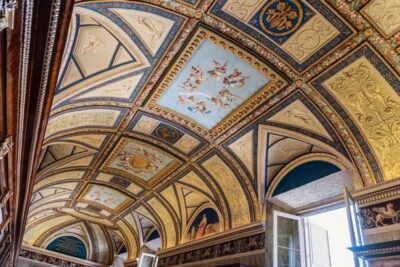
Vatican Museums & Sistine Chapel Tour with Optional Basilica
Read our review →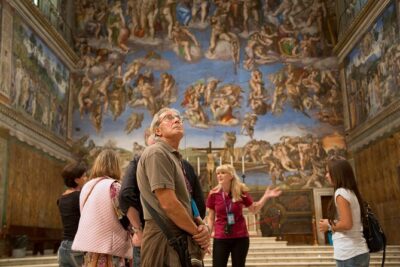
Vatican Museums, Sistine Chapel & St Peter’s Basilica Guided Tour
Read our review →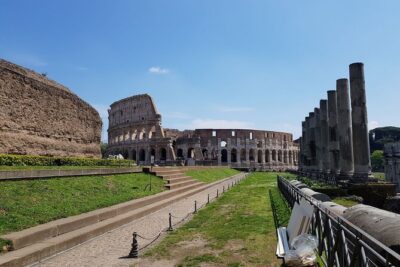
Colosseum, Palatine Hill and Roman Forum Guided Tour
Read our review →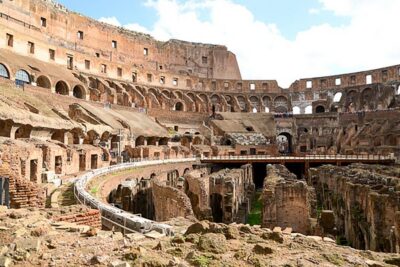
Guided Tour of Colosseum, Roman Forum & Palatine Hill
Read our review →
Colosseum, Roman Forum and Palatine Hill Guided Tour
Read our review →
Vatican Museums, Sistine Chapel & Basilica Tour
Read our review →
Colosseum, Forum & Palatine Hill Tour & Optional Arena
Read our review →