
Reviewed · ROMAN FORUM & PALATINE HILL
Rome: Trajan Markets Experience with Multimedia Video
Trajan Markets gives you a close look at the commercial heart of Imperial Rome, with curved brick buildings, layered ruins, and a setting that once handled trade, meetings, and daily business. I like the striking semicircular architecture and the way the visit connects the markets with Caesar’s, Augustus’, Nerva’s, and Peace Forums. The main drawback is that much of the complex can be seen from the street, so the ticket office and included video need to add real value.
I also like the Fori Imperiali Museum, where ancient artifacts and amphorae help explain how goods moved through the Roman world. The 25-minute film is useful before you walk among the ruins, though this is not a guided tour, and one visitor reported a slow, confusing ticket exchange at the Touristation office.
In This Review
- Key points to know before you book
- Why Trajan Markets matter in the story of Rome
- Start with the 25-minute Ancient Rome film
- Walk through Trajan Markets and its curved brick buildings
- Follow the Imperial Forums from Caesar to the Templum Pacis
- Look for the seventeenth-century cistern
- See the Fori Imperiali Museum’s artifacts and amphorae
- How the smartphone audio guide changes the visit
- Getting to Piazza d’Aracoeli 16
- Is $37 a fair price for this Roman archaeology visit?
- Who will enjoy this experience most?
- Book it if you want context, not just a street view
- FAQ
- Where is the meeting point?
- How long is the multimedia video?
- What does the ticket include?
- Is this a guided tour?
- What should I bring?
- Are large bags allowed?
- Can wheelchair users take part?
Key points to know before you book
- The semicircular Trajan Markets are the visual star, with several levels of ancient commercial buildings.
- A 25-minute Ancient Rome film shows reconstructions of major monuments before your site visit.
- More than 170 audio-guide points let you explore the city through your smartphone.
- Four Imperial forums are included in the experience: Caesar’s, Augustus’, Nerva’s, and the Templum Pacis.
- The Fori Imperiali Museum adds artifacts and amphorae to the outdoor ruins.
- The $37 price makes the most sense if you plan to use the video, app, museum, and full archaeological access.
Why Trajan Markets matter in the story of Rome
Many visitors come to Rome looking for emperors, temples, and grand monuments. Trajan Markets adds something more ordinary and more revealing: the business of keeping a huge city supplied.
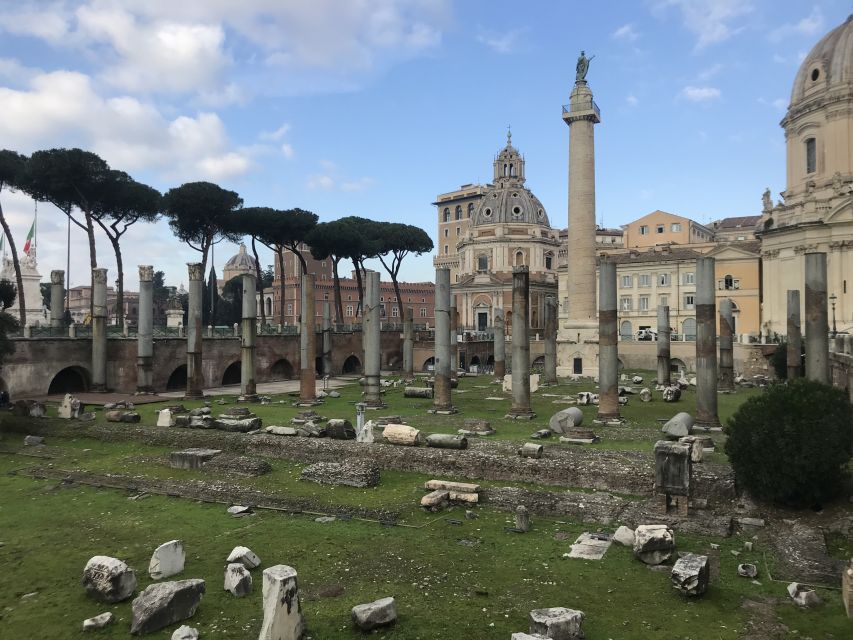
The complex was once a commercial center during the Roman Imperial Age. It was not simply a row of shops in the modern sense. The area connected with the Imperial Forums, where people traded, met, conducted business, and moved through the political center of Rome.
That makes this visit useful if you want more than a collection of broken columns. The ruins show how public life and commerce worked side by side. As you walk through the market buildings, you can think about the practical side of the empire: storage, movement of goods, craft work, and the daily dealings that supported Rome’s grand public monuments.
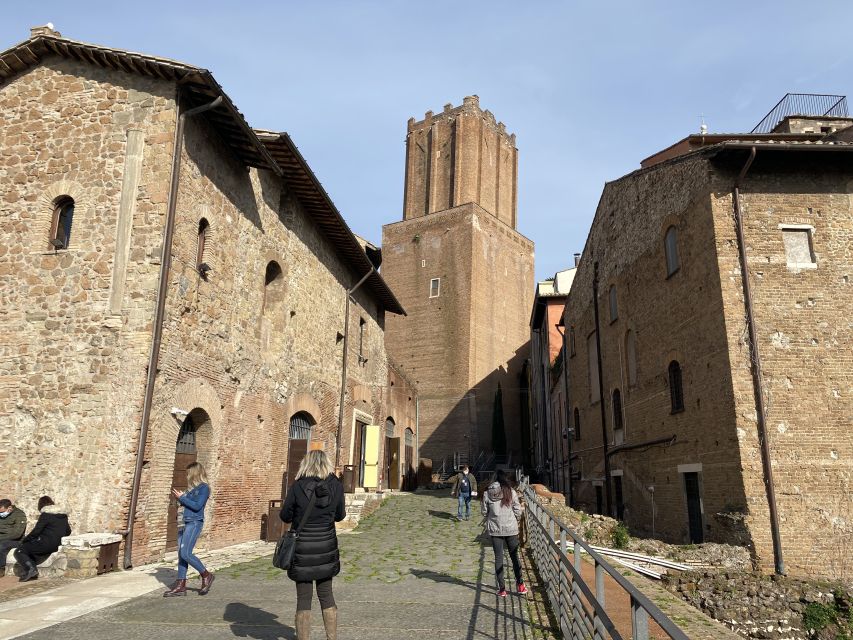
The complex is also valuable because it shows how Rome changed over time. The ruins are not frozen in one period. A seventeenth-century cistern remains in the area, a small but telling detail. It shows that the site continued to serve new purposes centuries after the Imperial Age.
More Roman Forum and Palatine Hill visits:
- Rome: Colosseum, Palatine Hill and Roman Forum Guided Tour
★ 4.8 · 32,814 reviews - Rome: Guided Tour of Colosseum, Roman Forum & Palatine Hill
★ 4.7 · 27,897 reviews - Rome: Colosseum, Roman Forum and Palatine Hill Guided Tour
★ 4.5 · 23,903 reviews
Start with the 25-minute Ancient Rome film
Your visit begins with a multimedia presentation lasting about 25 minutes. It uses reconstructions of Rome’s major monuments to help you picture the city as it may have looked during its Imperial period.
This is a smart first step because the archaeological area can be hard to read at ground level. You may see fragments of walls, foundations, arches, and paving without immediately understanding the original shape of the city. A reconstruction gives you a mental map before you begin looking at the surviving remains.
I would pay close attention to the relationship between the forums and the Trajan Markets. The film is not just a general introduction to Rome. Its value lies in giving you a sense of the buildings, spaces, and monuments that once filled this part of the city.
The video is also a practical help for first-time visitors who have not spent much time with Roman archaeology. You do not need to arrive with a detailed knowledge of emperors or ancient architecture. The presentation gives you a starting point, then the outdoor visit lets you compare the reconstructed city with what remains.
Still, keep your expectations in check. This is a presentation, not a live historian-led talk. If you want detailed answers about construction techniques, politics, or individual artifacts, you will need to use the audio guide or do extra reading.
Walk through Trajan Markets and its curved brick buildings
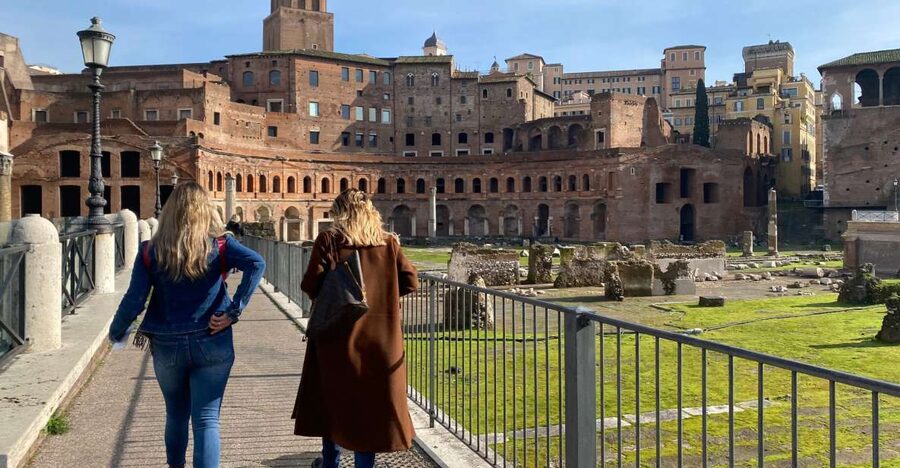
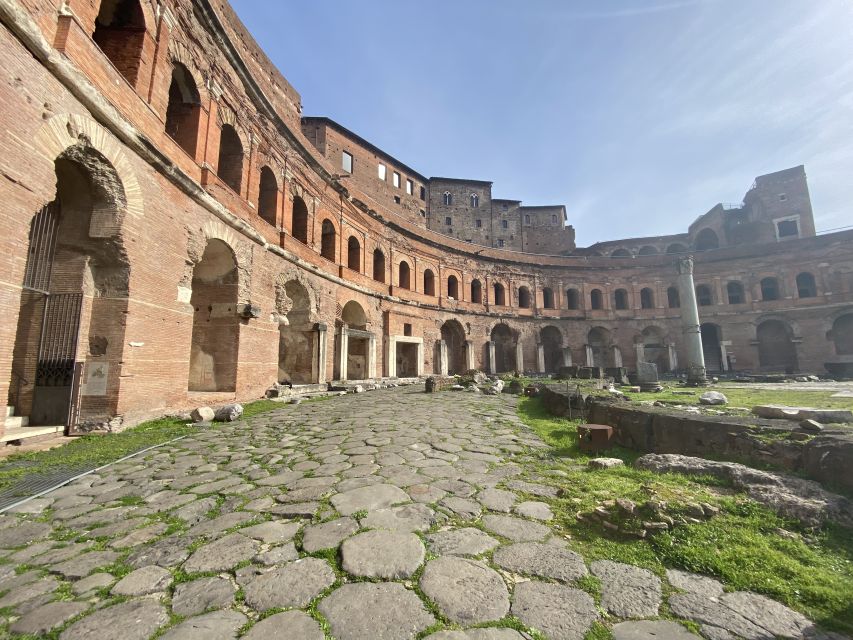
The Trajan Markets archaeological complex is the main attraction. Its semicircular form is one of the most memorable features of the visit, and it gives the site a different feel from the open forum ruins nearby.
The curved design follows the slope of the Quirinal Hill. The result is a layered architectural complex rather than a single flat plaza. You can see how Roman builders used the terrain and created a large urban center with multiple levels and rooms.
The markets are a good place to think about scale. Ancient Rome was not just made up of temples and triumphal monuments. It was also a city of shops, storage areas, offices, workshops, and meeting spaces. The Trajan Markets make that working city easier to imagine.
Take your time with the brickwork and the arrangement of the rooms. The architecture may look plain beside the marble fragments of the forums, but the brick construction is part of the appeal. It gives you a direct look at the practical buildings that helped the city function.
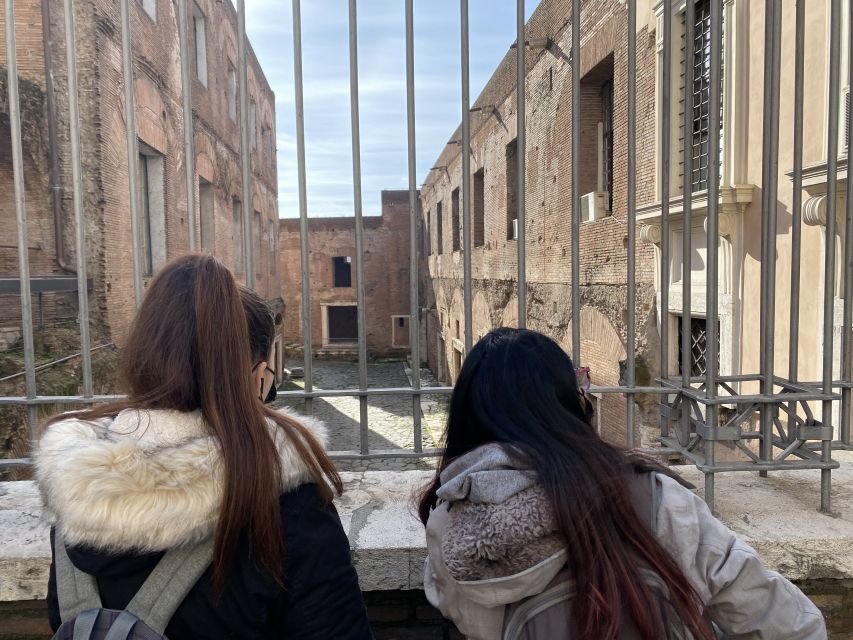
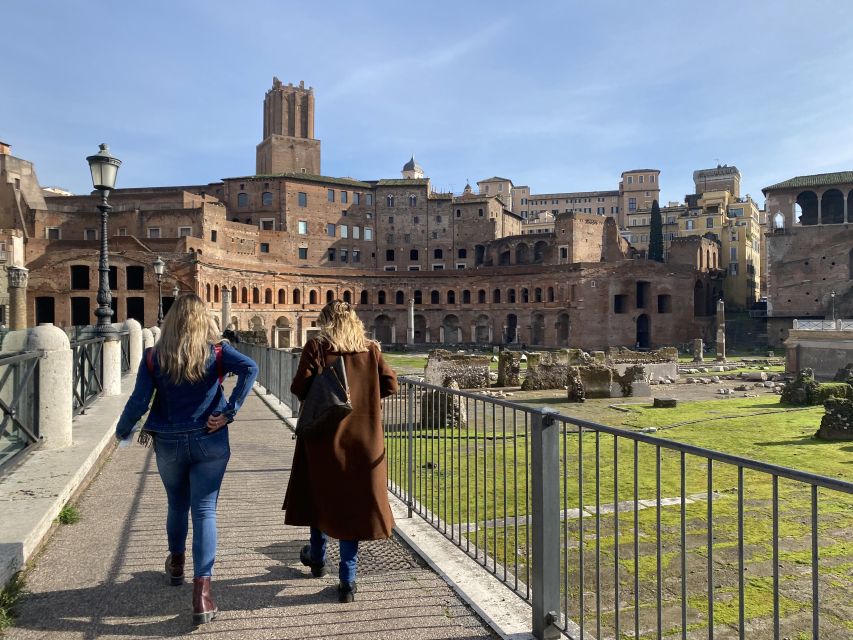
One important consideration: a good portion of the complex can be viewed from the street. That does not make the interior visit pointless, but it does mean the paid experience works best for visitors who want to get closer to the archaeology, see the museum, watch the film, and use the audio guide. If you only want a quick photograph of the curved exterior, you may feel the $37 price is high.
Follow the Imperial Forums from Caesar to the Templum Pacis
The experience includes access to several important forums. Each one helps show how Rome expanded and how emperors used architecture to shape the center of the city.
Caesar’s Forum is linked with Julius Caesar and the early development of the Imperial Forums. It helps set the stage for the larger building projects that followed. The forum was part of a growing effort to create formal public spaces in an already crowded city.
Augustus’ Forum reflects the political message of Augustus and the importance of presenting imperial power through architecture. As you move through this part of the area, the buildings and ruins are not just remains of old structures. They were carefully designed public statements.
Nerva’s Forum shows the continued development of the forum district under another emperor. The sequence of forums helps you see that this was not one project built all at once. The center of Rome changed as successive rulers added their own spaces and monuments.
The Templum Pacis, or Temple of Peace, adds another chapter to the site. The name itself points to the way Roman rulers attached political meaning to monumental construction. The audio guide can help you keep these different forums straight, since the ruins can otherwise blur together.
I recommend pausing between each area instead of racing to collect photographs. Look for changes in layout, surviving walls, and the way later construction affected the ancient remains. The attraction here is the overall evolution of the city, not one perfectly preserved building.
A completely different way to spend the day in Rome:
- Vatican: Museums & Sistine Chapel Entrance Ticket
★ 4.5 · 144,003 reviews - Vatican Museums & Sistine Chapel Tour with Optional Basilica
★ 4.3 · 67,413 reviews - Vatican Museums, Sistine Chapel & St Peter’s Basilica Guided Tour
★ 4.5 · 39,149 reviews - Rome: Colosseum & Forum with Audio Guide App -Optional Arena
★ 4.2 · 24,770 reviews
Look for the seventeenth-century cistern
The cistern is easy to overlook because it does not have the fame of a forum or market building. Yet it may be one of the most useful details for understanding the site.
A seventeenth-century cistern shows that the area remained part of Rome’s working urban fabric long after the Imperial period. People reused old spaces, adapted structures, and gave the land new functions. Rome’s archaeology often works this way: one period sits on top of another.
This detail also keeps the visit from becoming too tidy. You are not seeing a pure Roman site untouched by later centuries. You are seeing a place that changed with the city.
Use the audio guide to put the cistern into context. The smartphone app has more than 170 points of interest, so you can listen to explanations as you move around the city. That number is useful, but it also suggests a possible problem: you may receive more information than you want in one visit.
You do not need to listen to every point. Pick the locations that interest you most, and keep the rest available for later. The app is best treated as a flexible reference tool rather than a lecture you must complete from start to finish.
See the Fori Imperiali Museum’s artifacts and amphorae
After the outdoor ruins, the Fori Imperiali Museum gives you a closer look at objects connected with ancient cultures and the Roman world. The collection includes amphorae, which are especially useful for understanding trade.
An amphora is not just a decorative pot. These containers were used to transport goods, and they help connect the market buildings with the larger systems of commerce that supported Rome. Seeing them after walking through Trajan Markets gives the visit a practical thread: buildings for trade, forums for public life, and objects that carried products across the ancient world.
The museum also broadens the visit beyond architecture. Ruins can show you space and structure, but artifacts can suggest how people used that space. The collection is not presented as a replacement for the archaeological complex. It works best as a companion to it.
I would allow enough time to look closely at the objects rather than treating the museum as a quick add-on. If ancient art and material culture interest you, this may be one of the strongest reasons to enter the site instead of viewing the exterior from Piazza Venezia.
The supplied information does not give a full item-by-item museum catalogue, so you should not book expecting a massive museum collection. Think of it as a focused indoor section that supports the story of the Imperial Forums and Roman trade.
How the smartphone audio guide changes the visit
This experience does not include a live guide. Instead, you download a city app with more than 170 points of interest and listen through your own phone.
That format gives you control. You can stop when you want, skip subjects that do not interest you, and explore at a pace that suits your energy. It is a better fit for independent visitors than for anyone who wants a guide leading a group from one monument to the next.
Bring headphones and a fully charged smartphone. These are not minor suggestions. Without headphones, the app will be awkward in a busy archaeological setting, and without power, you lose the main source of interpretation.
The app may also be useful beyond Trajan Markets because it includes points around Rome. The experience is valid for one day, so you can use the available material during that period, subject to the way the app is provided at booking.
Do not expect the same exchange as a personal tour. There is no guide whose explanation changes according to your questions. If you like independent sightseeing, that is a benefit. If you want a clear narrative with no need to manage your own phone, it is a limitation.
Getting to Piazza d’Aracoeli 16
You meet at the Touristation Aracoeli office at Piazza d’Aracoeli 16, near Piazza Venezia. Look for the orange Touristation flags and the fountain in front of the entrance.
This location is central, but allow time to find the exact office. A busy Roman piazza can make a meeting point feel less obvious than it looks on a map. Arriving with your phone charged and your booking information ready should make the handoff easier.
There is one practical warning about the ticket exchange. A visitor who had an afternoon visit was able to exchange the voucher in the morning and found no queue, which suggests some flexibility may be possible. Another visitor reported waiting at least 15 minutes while staff printed tickets and found the process confusing.
I would not build a tight schedule around the start time. Give yourself a cushion, especially if you have a timed reservation elsewhere. The office provides assistance at the meeting point, but the ticket process may not always be quick.
Large bags, luggage, drones, glass objects, sprays, alcohol, drugs, weapons, and sharp objects are not allowed. Pets are also excluded. Wear comfortable shoes, since the visit involves archaeological surfaces and walking between several areas.
Is $37 a fair price for this Roman archaeology visit?
At $37 per person, this is not the cheapest way to see the Imperial Forums. The value depends on how much of the package you use.
The ticket includes the 25-minute film, entry to Trajan Markets, entry to the Fori Imperiali Museum, the smartphone audio guide, and assistance at the meeting point. If you want a self-guided archaeological visit with visual orientation and museum access, those pieces work together reasonably well.
The price is less attractive if you only want to see the exterior. Since much of Trajan Markets can be viewed from the street, a visitor with limited interest in museums or audio commentary may prefer a simpler sightseeing plan.
I also would not compare this directly with a live guided tour. You are paying for access and interpretation tools, not a guide who walks beside you and answers questions. The attraction is flexibility, not personal service throughout the visit.
The overall rating is 4 out of 5 from 66 ratings, which fits the experience as described: strong architecture, useful museum content, and a good self-guided format, balanced by a ticket process that can be slow and a package that may feel padded if you do not want the video or app.
Who will enjoy this experience most?
I would choose this for an independent visitor who wants to understand how Rome functioned, not just photograph its most famous monuments.
It suits you especially well if:
- You enjoy archaeology but prefer exploring at your own pace.
- You want a short orientation film before walking through ruins.
- You like using an audio guide on your own phone.
- You are curious about Roman commerce, amphorae, and city planning.
- You want both outdoor ruins and a small museum visit.
- You have time to listen, pause, and compare different Imperial Forums.
Families with older children may also find the reconstruction film useful because it gives shape to ruins that can otherwise seem abstract. Younger children may have limited patience for the app, and the rules against large bags and pets matter when planning your day.
This experience is not suitable for wheelchair users, according to the supplied information. You should also avoid bringing luggage or large bags, which makes it a poor choice on the way to or from a hotel.
Book it if you want context, not just a street view
Book this experience if you want the full Trajan Markets package: the curved archaeological complex, a 25-minute visual introduction, the Imperial Forums, the museum, and a large bank of audio-guide material.
Skip it if you only want a quick look at the exterior or if you strongly prefer a live guide. The $37 cost makes sense when you use the included elements, but it is harder to justify if the video and app are not important to you.
The best approach is to arrive early, wear good shoes, bring headphones, and keep your schedule loose around the ticket office. With those precautions, Trajan Markets can give you a useful and unusually practical view of Rome, the city of shops, storage rooms, forums, and daily trade behind the marble monuments.
FAQ
Where is the meeting point?
Meet at the Touristation Aracoeli office at Piazza d’Aracoeli 16, near Piazza Venezia. Look for the orange Touristation flags and the fountain in front of the entrance.
How long is the multimedia video?
The Ancient Rome multimedia presentation lasts 25 minutes.
What does the ticket include?
It includes the 25-minute video presentation, Trajan Markets admission, Fori Imperiali Museum admission, a downloadable city app audio guide, and assistance at the meeting point.
Is this a guided tour?
No. A live guided tour is not included. You explore independently with the smartphone audio guide.
What should I bring?
Bring your passport or ID card, comfortable shoes, headphones, and a charged smartphone.
Are large bags allowed?
No. Luggage and large bags are not allowed, along with pets, drones, weapons or sharp objects, alcohol and drugs, sprays or aerosols, and glass objects.
Can wheelchair users take part?
The experience is not suitable for wheelchair users.
Newest reviews from Rome
- ROME:Colosseum & Ancient Rome – private/small group TOUR★ 5.0 · 24 reviews
- Off the Beaten Track in Rome: Rione VI Parione Private Tour★ 5.0 · 24 reviews
- Cinematic Photoshoot in Rome★ 5.0 · 24 reviews
- Rome: Best of Colosseum and Roman Forum Small Group Guided Tour★ 4.5 · 24 reviews
- The Labyrinth of Rome between catacombs and ancient quarries★ 4.5 · 24 reviews
- Vatican and Trionfale Market Tour with Wine and Food Tasting★ 5.0 · 24 reviews
- private tour: Vatican Museums, Sistine Chapel, St. Peter’s Basilica★ 4.5 · 24 reviews
- Colosseum guided tour with Virtual Reality★ 5.0 · 24 reviews
Roman Forum & Palatine Hill, compared.
Colosseum, Palatine Hill and Roman Forum Guided Tour
Read our review →
Guided Tour of Colosseum, Roman Forum & Palatine Hill
Read our review →
Colosseum, Roman Forum and Palatine Hill Guided Tour
Read our review →
Colosseum, Forum & Palatine Hill Tour & Optional Arena
Read our review →
Colosseum, Palatine Hill & Roman Forum Guided Tour
Read our review →
Colosseum Arena, Palatine Hill & Forum Guided Tour
Read our review →
Colosseum, Roman Forum & Palatine Hill Guided Tour
Read our review →Colosseum, Roman Forum And Palatine Hill Guided Tour
Read our review →Browse the lists this tour appears in