
Reviewed · WALKING TOURS
Rome: Via Crucis Pilgrim 3-Hour Walking Tour
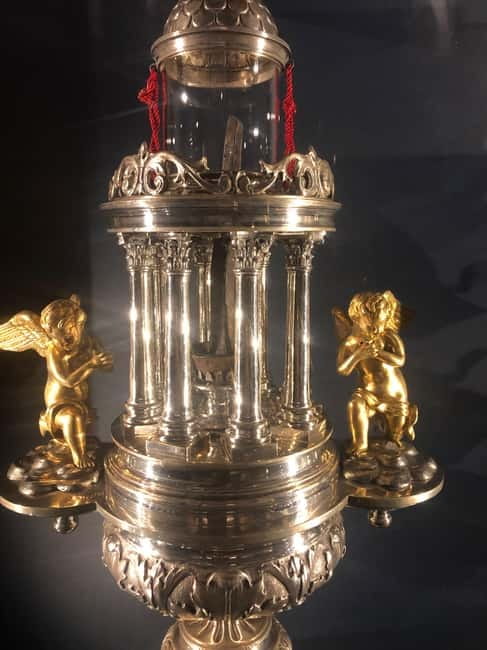
The most striking part of this Via Crucis pilgrimage is the concentration of Passion relics along one short route. You’ll see wood associated with the Cross, Holy Nails, thorns from the Crown, the Title of the Cross, the flogging pillar, and the steps traditionally linked with Jesus’ trial before Pontius Pilate.
I like two things right away: the small group, limited to five, keeps the visit personal, and the guides bring together Scripture, Church history, art, and Catholic theology rather than treating the basilicas as pretty rooms. Guides such as Tom also make time for prayer and questions, which gives the walk a calmer pace than a standard sightseeing tour.
The main consideration is that this is a devotional experience first, not a general Rome highlights tour. You’ll need modest clothing, steady walking ability, and an interest in Catholic tradition. One stop is not wheelchair-accessible, and the route includes churches where silence and proper dress matter.
In This Review
- Key points to know before you book
- Why this Rome pilgrimage feels different
- Santa Maria Maggiore and the first sacred objects
- Santa Prassede and Rome’s early Christian memory
- Saint Alphonsus and the devotional side of Rome
- The Holy Stairs and the route to Pontius Pilate
- St John Lateran, Rome’s cathedral
- Holy Cross in Jerusalem and the final homily
- What the guides add to the experience
- Price, pace, and who gets good value
- Should you book the Via Crucis Pilgrim Tour?
- FAQ
- How long is the Via Crucis Pilgrim Tour?
- How far do you walk?
- Where does the tour begin?
- Does the front of Santa Maria Maggiore face Via Cavour?
- Where does the tour finish?
- Is the tour offered in English?
- How large is the group?
- Is the tour wheelchair-accessible?
- Can I climb the Holy Stairs on my knees during the tour?
- What should I wear?
- Are transport and tips included?
- Are headsets provided?
- Can I request a homily?
- Can I cancel for a full refund?
Key points to know before you book
- Passion relics in one compact route: See objects traditionally connected with Christ’s final hours, including wood from the Cross, Holy Nails, thorns, and the Title of the Cross.
- Two of Rome’s four Major Basilicas: Visit Santa Maria Maggiore and St John Lateran, with Holy Doors connected to the Jubilee Year.
- A guide who teaches and leaves room for prayer: Tom is praised for his Church history, warm presentation, and careful explanations.
- About 2 to 3 kilometers on foot: The distance is manageable for many people, but the churches and steps require good mobility.
- A genuine pilgrimage tone: The tour ends at the Basilica of the Holy Cross in Jerusalem, with a homily available on request.
- Best for traditional Catholic pilgrims: Non-Catholics interested in Christian history can learn much, but the language and purpose are openly devotional.
Why this Rome pilgrimage feels different
Rome offers endless tours about emperors, fountains, and Renaissance artists. This walk takes another road. It follows the Christian story through churches that hold relics, images, tombs, and traditions tied to the earliest centuries of the faith.
The route is called the Via Crucis, or Way of the Cross. In Jerusalem, that phrase brings to mind the path toward Calvary. In Rome, the experience is less about reconstructing one exact street route and more about following a chain of places connected to the Passion and the early Church.
That distinction matters. You are not walking through a staged reenactment, and you should not expect a museum-style display with long rows of labels. Instead, you move through active places of worship, where a guide explains what you are seeing and why it matters to Catholic believers.
The small group size is a real advantage. With no more than five participants, you can ask questions without holding up a large crowd. A guide such as Tom can adjust the pace, explain a detail in a mosaic, or allow a quiet moment when a relic calls for reflection.
The tone is serious but not stiff. The strongest guide feedback points to clear teaching, humor when suitable, compassion, and respect for prayer. Families have also found the storytelling accessible to children from about eight years old through the teen years, though the religious focus may not hold every child’s attention for three hours.
More walking tours in Rome:
- Rome: Trastevere & Campo de Fiori Street Food Walking Tour
★ 4.9 · 2,768 reviews - Rome: Paranormal Night Walking Tour & Secret Backstreets
★ 4.9 · 1,921 reviews - Rome by Night Walking Tour – Legends & Criminal Stories
★ 4.5 · 1,003 reviews
Santa Maria Maggiore and the first sacred objects
Begin at the fountain in front of the main entrance to the Papal Basilica of Santa Maria Maggiore. Be careful here: the main façade faces Piazza Santa Maria Maggiore, not Via Cavour. That small detail can save you from circling the basilica at the start.
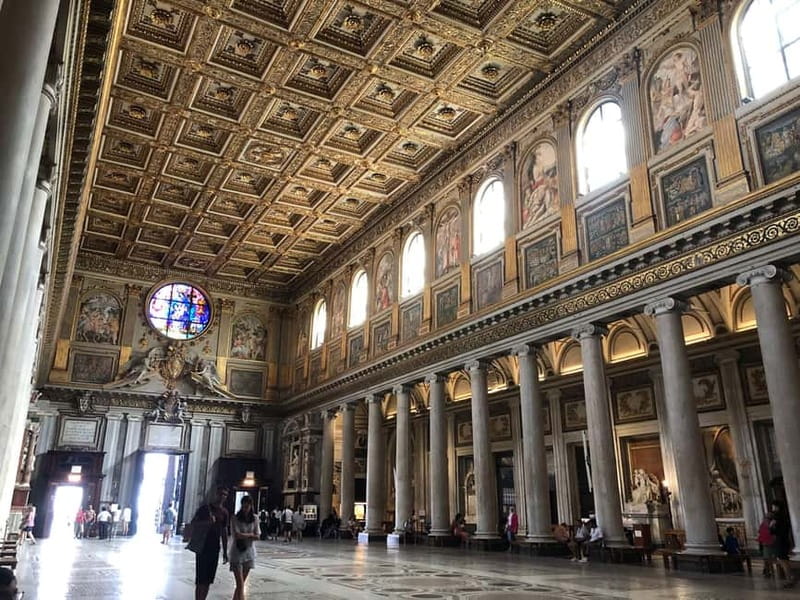
Inside, allow about an hour for the guided visit. Santa Maria Maggiore is one of Rome’s four Major Basilicas, and it is also one of the locations of a Holy Door associated with the 2025 Jubilee Year.
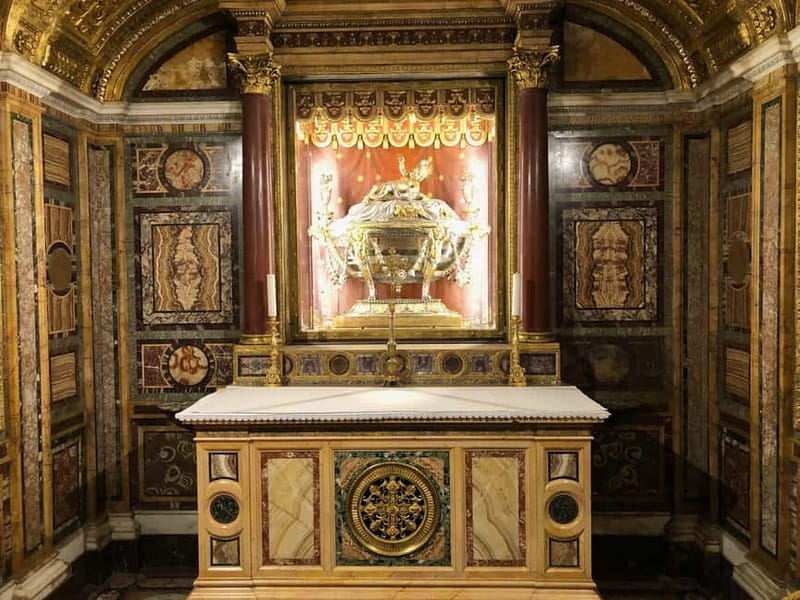
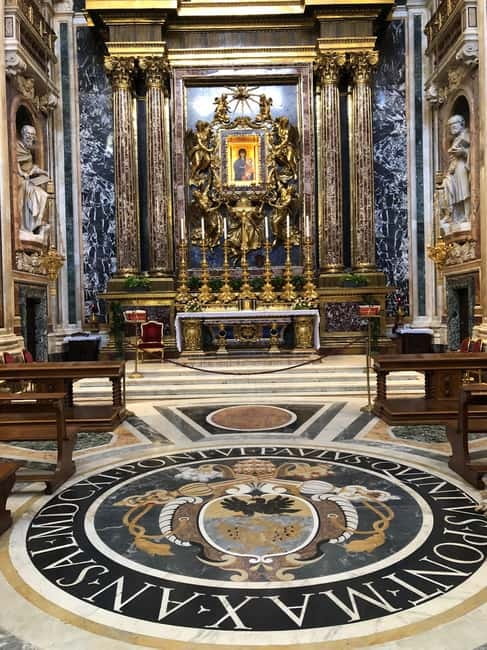
The focus here includes wood from the crib of the Nativity and the Salus Populi Romani, an ancient Marian icon traditionally associated with St Luke the Evangelist. You’ll stand close to the image, rather than simply hearing about it from across a crowded square.
This opening stop sets the tone for the entire walk. The emphasis is not only on Passion relics. It also places Christ’s final hours within the larger Christian story, from the Nativity through the growth of the Church.
The basilica’s scale and decoration can feel overwhelming if you are left to explore alone. A good guide gives you a way into the building, pointing out symbolism and explaining why particular objects have drawn pilgrims for centuries. I would pay close attention to the transitions between art, Scripture, and tradition. That is where this tour offers more than a quick church visit.
Santa Prassede and Rome’s early Christian memory
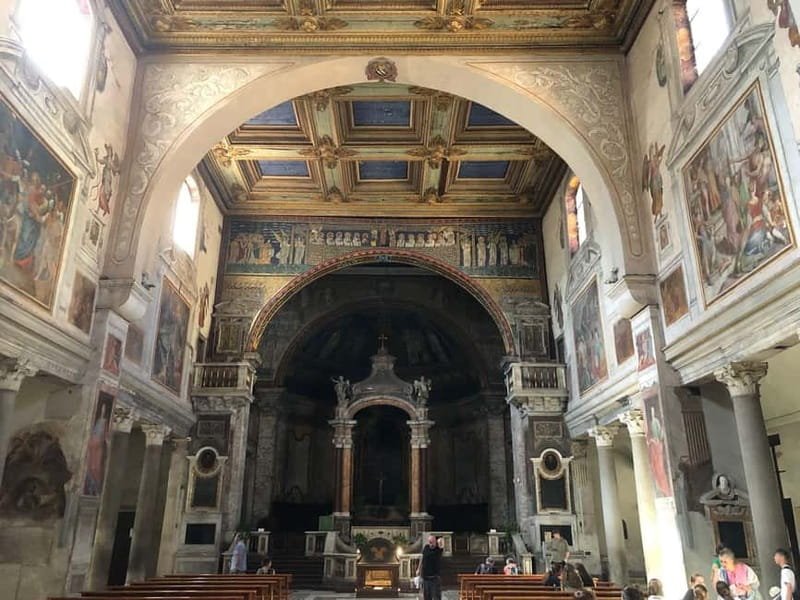
The next stop is Santa Prassede, with roughly 20 minutes set aside for a guided look. This church is one of the places where the walk moves away from Rome’s standard sightseeing circuit.
You may see mosaics filled with Christian symbols, along with papal tombs and traces of the struggles faced by early Christians. The tour places these details within the story of a small, persecuted community surviving in a hostile pagan world.
Twenty minutes is not enough for an exhaustive visit. That is both a limit and a benefit. You will not have time to study every corner, but the guide can focus your attention on the parts that connect to the pilgrimage theme.
If you enjoy visual detail, listen closely here. Rome’s churches often communicate through gestures, colors, halos, animals, inscriptions, and biblical scenes. Without explanation, those details can blur together. With a strong guide, they become part of the story.
Saint Alphonsus and the devotional side of Rome
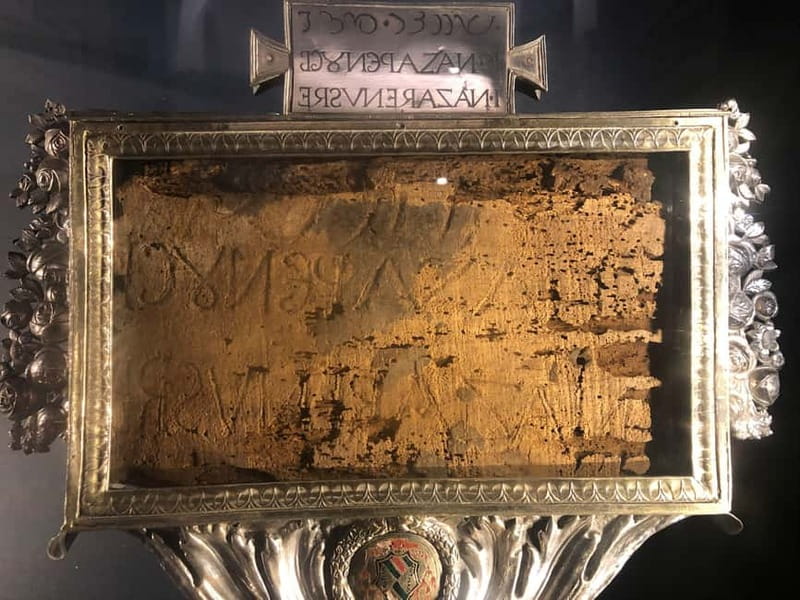
The Church of Saint Alphonsus Maria de Liguori provides another stop along the route. The supplied schedule does not assign a fixed time here, so the length of this visit can depend on the day and the group.
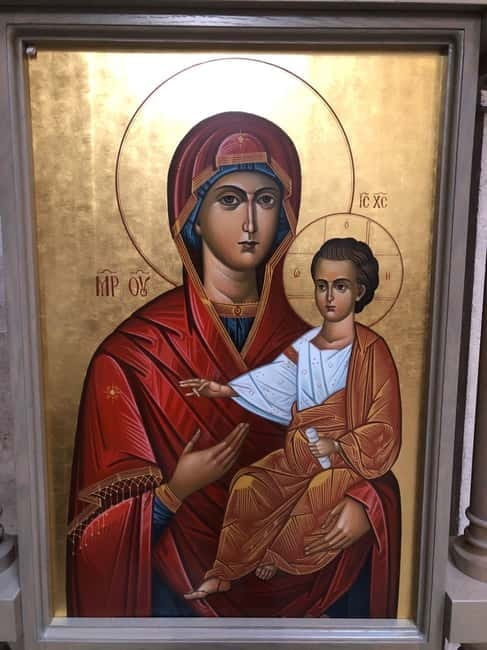
This is also where you encounter Our Lady of Perpetual Help, known as Our Lady of Perpetual Succour or Our Lady of the Passion. The image is among the world’s best-known Marian icons, and the guide explains its place in Catholic devotion.
This stop will appeal most to Catholics who already have some connection with Marian prayer. If you are approaching the tour as a nonreligious visitor, the icon may be more useful as a lesson in Christian devotion and image-making than as an object of personal veneration.
That is a fair way to approach the whole experience. You do not need to share every belief to understand why a relic or icon matters. But you should be comfortable entering a tour where prayer, reverence, and tradition are part of the activity rather than background decoration.
More Rome tours worth comparing
- Jewish Ghetto and Synagogues with Jewish Roman Guide 3 Hours
★ 5.0 · 907 reviews - Rome: Private Customizable 3-Hour Golf Cart City Tour
★ 5.0 · 229 reviews - Private: 3 hours ETuk Tour in Rome
★ 5.0 · 190 reviews - Rome Vespa Small Group Sightseeing Tour, 3 Hour Experience
★ 5.0 · 189 reviews
The Holy Stairs and the route to Pontius Pilate
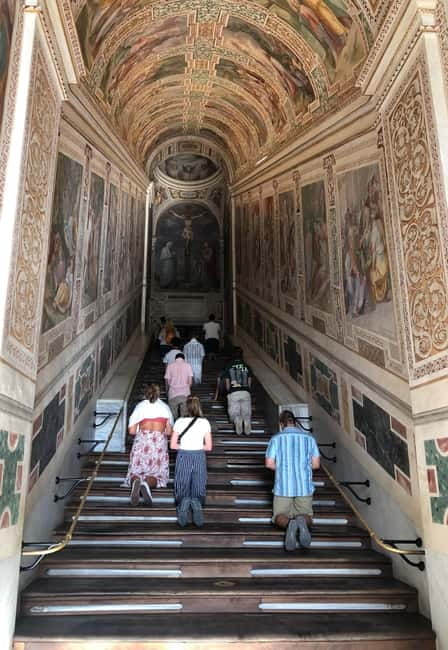
The Scala Sancta, or Holy Stairs, is the emotional center of the walk. Catholic tradition identifies these steps as the ones Jesus climbed on his way to the praetorium of Pontius Pilate, where he was condemned to death.
The staircase is also connected with the Holy of Holies, an inner sanctum traditionally entered only by the Pope. Another icon here is said to have been started by St Luke and completed by angels.
Many pilgrims climb the stairs on their knees. That custom takes about 45 minutes, so it is not included in this three-hour tour. If you want to take part, plan a separate visit and do not expect the group to wait.
This practical warning is important. The tour lets you see the Scala Sancta and understand its meaning, but it is not designed as a long private prayer session at every location. You will have opportunities for reflection, and the guide is attentive to that need, but the group still has several basilicas to reach.
The stairs also create an accessibility concern. The experience is not suitable for wheelchair users or people with mobility impairments, and one location cannot be reached by wheelchair. Ask before booking if you have any concern about stairs, walking, or standing.
St John Lateran, Rome’s cathedral
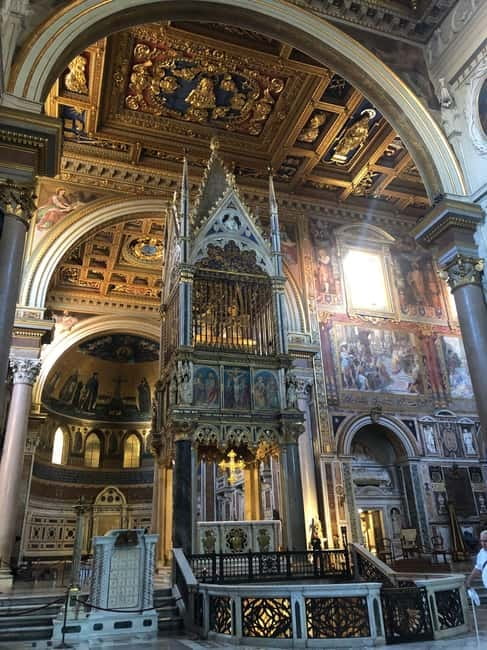
From the Holy Stairs, the route continues to the Basilica of San Giovanni in Laterano, or St John Lateran. The guided visit lasts about 30 minutes.
This is the cathedral of Rome and the oldest and most important of the city’s four Major Basilicas. It is also described as the Mother Church of the World, a title that reflects its central place in Catholic tradition.
The basilica holds the skulls traditionally identified as those of Saints Peter and Paul. These apostles are presented as pillars of the Church, so this stop links the Passion story to the Church that developed after the Resurrection.
You will also hear about the Holy Sponge, traditionally associated with the object used to give Christ drink while he hung on the Cross. Like the other relics, its meaning is tied to long-held Christian tradition and devotion.
Thirty minutes works well here if the guide keeps the visit focused. St John Lateran is large and full of details, and you could easily spend much longer examining its art and chapels. The point of this walk is not to cover everything. It is to connect selected objects and places into one coherent pilgrimage.
Holy Cross in Jerusalem and the final homily
The final destination is the Basilica of the Holy Cross in Jerusalem, or Santa Croce in Gerusalemme. The church sits near the ancient Aurelian Wall, which once enclosed Rome’s historic center.
The basilica is the natural place to finish because it holds relics associated with the Passion. The walk’s emphasis on the Cross, the nails, the thorns, the Title, and the other objects comes together here.
Your guide may conclude with a homily if you request one. That option is worth considering if you are making this walk as a formal pilgrimage, especially during a Jubilee visit. It gives the experience a clear spiritual ending instead of simply stopping after the last explanation.
The basilica is about a 10-minute walk from the nearest metro station. Transport to the starting point and onward travel after the finish are not included, so allow time to find your way back to your hotel or next stop. The activity information also says the experience ends back at the meeting point, while the route description identifies Santa Croce as the final stop. Confirm the day’s ending arrangements with Crucis Tours before setting a tight appointment afterward.
What the guides add to the experience
The guide is the key part of this tour. The churches and relics are important, but much of their value depends on how clearly someone explains the links between them.
Tom receives especially strong praise for his command of Church history, engaging presentation, patience with questions, and respect for sacred spaces. He is also described as taking care to let people sit when possible and allowing time for prayer and reflection.
That combination is unusual. Some religious tours rush from relic to relic, while some academic tours avoid personal devotion altogether. Here, you can expect both historical explanation and an openly Catholic point of view.
The tour is in English. Groups of seven or more receive radio headsets, but this experience is limited to five participants, so headsets may not be needed. A useful tip is to install WhatsApp before you arrive. The meeting point is a large public area, and real-time contact can help if you have trouble locating the guide.
One practical weakness deserves attention. Finding the guide at Santa Maria Maggiore may not be effortless because the square is busy with visitors, church staff, and other guides. Arrive early, wait at the fountain in front of the main entrance, and keep your phone available. If the meeting point seems unclear, contact the operator rather than assuming the tour has left.
Price, pace, and who gets good value
The price is $107.62 per person for three hours. That is not a bargain-priced church walk, but the value depends on what you want from Rome.
You are paying for a specialist guide, a very small group, access to several important basilicas, and a carefully connected religious theme. You are not paying for transport, food, or a long list of unrelated monuments.
For a Catholic pilgrim, the cost can make sense. A guide who can explain the relics, the Holy Doors, the early Church, Catholic symbolism, and the customs surrounding the Holy Stairs offers something difficult to reproduce with a guidebook.
For a general tourist who wants Rome’s major sights, the value is weaker. You will not visit the Colosseum, Roman Forum, Trevi Fountain, or Vatican Museums. Choose this walk because of its sacred sites, not because it covers the famous Rome checklist.
The route covers about 2 to 3 kilometers in three hours. That is a slow walking pace, which is appropriate for church visits, explanations, and prayer. Still, you may spend time standing, entering security areas, and moving through churches, so comfortable shoes and modest clothing are wise.
Shorts and short skirts are not allowed. Dress for church visits rather than hot-weather sightseeing, and bring a layer if you are sensitive to cool interiors.
Free cancellation is available up to 24 hours before departure, and you can reserve while paying later. Rome’s liturgical calendar is crowded, so feast days and other events can force changes to the route. If that happens, the operator says you will be notified by email.
Should you book the Via Crucis Pilgrim Tour?
Book it if you want a focused Catholic pilgrimage, care about Passion relics, and prefer a small group with time for questions and prayer. It is especially well suited to traditional Catholics, families seeking a religious experience, and visitors coming to Rome during the Holy Year.
You can also enjoy it as a student of Christian art and history, but expect the guide to speak from a devout Catholic perspective. This is not a neutral museum lecture, and that is part of its purpose.
Skip it if you need step-free access, want a fast-paced overview of ancient Rome, or would rather spend three hours on secular landmarks. If you do book, arrive early at the fountain outside Santa Maria Maggiore, dress conservatively, download WhatsApp, and leave room in your day for the possibility of a route change.
For the right person, this is more than a list of churches. It is a compact walk through Rome’s living Catholic memory, ending with the relics and prayers that give the Via Crucis its meaning.
FAQ
How long is the Via Crucis Pilgrim Tour?
The tour lasts three hours.
How far do you walk?
The route covers approximately 2 to 3 kilometers on foot.
Where does the tour begin?
The meeting point is at the fountain in front of the main entrance to the Basilica of Santa Maria Maggiore in Piazza Santa Maria Maggiore.
Does the front of Santa Maria Maggiore face Via Cavour?
No. The front of the basilica faces Piazza Santa Maria Maggiore, not Via Cavour.
Where does the tour finish?
The route description identifies the Basilica of the Holy Cross in Jerusalem as the final stop. The activity information also says the experience ends back at the meeting point, so confirm the exact end arrangements with Crucis Tours before booking onward plans.
Is the tour offered in English?
Yes. The live tour guide speaks English.
How large is the group?
The group is limited to five participants.
Is the tour wheelchair-accessible?
No. The activity is not suitable for wheelchair users or people with mobility impairments, and one location is not wheelchair-accessible.
Can I climb the Holy Stairs on my knees during the tour?
No. The traditional climb takes about 45 minutes and is not part of the itinerary. You must arrange it separately.
What should I wear?
Shorts and short skirts are not allowed. Wear modest clothing suitable for Catholic churches.
Are transport and tips included?
Transport to the meeting point, transport from the end point, and a guide tip are not included.
Are headsets provided?
Radio headsets are provided for groups of seven or more. Since this activity is limited to five participants, headsets may not be necessary.
Can I request a homily?
Yes. A homily is available on request.
Can I cancel for a full refund?
Yes. You can cancel up to 24 hours in advance for a full refund.
Newest reviews from Rome
- ROME:Colosseum & Ancient Rome – private/small group TOUR★ 5.0 · 24 reviews
- Off the Beaten Track in Rome: Rione VI Parione Private Tour★ 5.0 · 24 reviews
- Cinematic Photoshoot in Rome★ 5.0 · 24 reviews
- Rome: Best of Colosseum and Roman Forum Small Group Guided Tour★ 4.5 · 24 reviews
- The Labyrinth of Rome between catacombs and ancient quarries★ 4.5 · 24 reviews
- Vatican and Trionfale Market Tour with Wine and Food Tasting★ 5.0 · 24 reviews
- private tour: Vatican Museums, Sistine Chapel, St. Peter’s Basilica★ 4.5 · 24 reviews
- Colosseum guided tour with Virtual Reality★ 5.0 · 24 reviews
Walking Tours, compared.
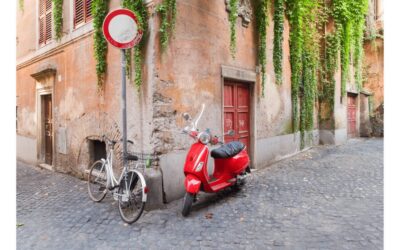
Trastevere & Campo de Fiori Street Food Walking Tour
Read our review →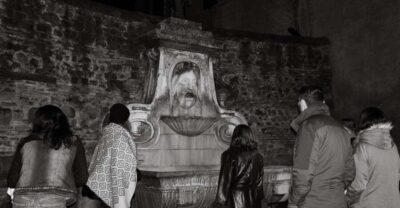
Paranormal Night Walking Tour & Secret Backstreets
Read our review →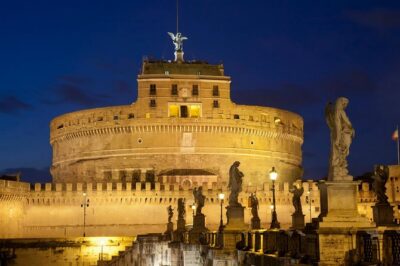
Rome by Night Walking Tour – Legends & Criminal Stories
Read our review →
Guided City Center Evening Sightseeing Walking Tour
Read our review →
Best of Rome Walking Tour including Trevi Fountain
Read our review →

Forbidden History Walking Tour & Pub Crawl with Drinks
Read our review →
Guided Small Group Walking Tour of City Highlights
Read our review →Browse the lists this tour appears in