
Reviewed · WALKING TOURS
Rome walking tour: Churches, Squares and Fountains
Rome’s best introduction may be a walk from Trajan’s Column to the Trevi Fountain, linking ancient ruins, Baroque fountains, busy squares, and the Jewish Ghetto in one clean route. You get the broad shape of central Rome without spending the morning inside a single museum.
I like the small group limit of 15 and the included radio headsets, which make it easier to hear the guide on busy streets. I also like the human touch reported by the guides Brian, Alessandra, and Suzanna, especially the effort to find shade on hot days and keep children engaged.
The trade-off is simple: this is a sightseeing walk, not a series of interior visits. The Pantheon and Trajan’s Market require separate admission if you want to go inside, and churches and other monuments are explained from outside.
In This Review
- Key points to know before booking
- Why this route works for a first look at Rome
- Trajan’s Column and the imperial city
- Trajan’s Market and the limits of an outside visit
- Piazza Venezia and the city’s grand crossroads
- The Jewish Ghetto, Rome’s quieter historic turn
- Campo de’ Fiori and the market hour
- Piazza Navona and Bernini’s fountain
- The Pantheon, seen from the outside
- Piazza di Pietra and the Temple of Hadrian
- Trevi Fountain, the busy finish
- Guides, group size, and the feel of the walk
- What the $42.17 price really covers
- Who should book this Rome walk
- Practical details worth knowing
- Should you book it?
- FAQ
- How long does the Rome walking tour last?
- What time does the tour start?
- Where does the tour begin?
- Where does the tour end?
- Is the tour offered in English?
- How many people can join the tour?
- Are radio headsets included?
- Are admission tickets included?
- Does the tour include transportation?
- What physical fitness level is required?
- How early should I arrive?
- Can I cancel for a full refund?
Key points to know before booking
- Trajan’s Column begins the story: You start among Rome’s imperial remains, with the famous spiral carving close at hand.
- The route links major sights efficiently: You’ll see Piazza Venezia, the Jewish Ghetto, Campo de’ Fiori, Piazza Navona, the Pantheon, the Temple of Hadrian, and Trevi Fountain.
- The group stays personal: A maximum of 15 people is small enough for questions and easier movement through central Rome.
- It is an outside-focused tour: No building entries are included, so plan separate visits to the Pantheon or Trajan’s Market.
- Hot-weather planning matters: The walk lasts about two and a half hours, and the route has open squares with little shade.
- You finish near Trevi Fountain: The ending gives you an easy next stop in one of Rome’s most popular areas.
Why this route works for a first look at Rome
Rome can feel scattered at first. Ancient forums sit beside busy roads, Renaissance palaces frame Baroque fountains, and a quiet Jewish neighborhood begins only a few minutes from a major traffic square. This tour gives those pieces a sensible order.
You begin at Foro Traiano, near Trajan’s Column, and walk toward the historic center. The route is not a march from one isolated sight to another. It connects the city’s layers as you go, which is the real value of a walking tour here.
At $42.17 per person, the price is reasonable if you want an overview with a guide rather than a self-guided stroll. The cost covers the guide and radio headsets, but not entry fees or private transport. You are paying mainly for interpretation, route planning, and the chance to ask questions as Rome unfolds around you.
The pace should suit anyone with moderate physical fitness. You will be on foot for roughly two and a half hours, with stops to hear explanations and look around. Wear comfortable shoes, carry water, and arrive 20 minutes early at the meeting point for a smooth departure at 10:00 a.m.
More walking tours in Rome:
- Rome: Trastevere & Campo de Fiori Street Food Walking Tour
★ 4.9 · 2,768 reviews - Rome: Paranormal Night Walking Tour & Secret Backstreets
★ 4.9 · 1,921 reviews - Rome by Night Walking Tour – Legends & Criminal Stories
★ 4.5 · 1,003 reviews
Trajan’s Column and the imperial city
The opening stop, Trajan’s Column, is one of the finest visual introductions to ancient Rome. Completed in AD 113, the freestanding column carries a spiral relief showing the wars between Rome and the Dacians.
You cannot read every scene from street level, but a guide can explain how the carving works as a continuous account of military campaigns. The column also helps you understand Rome’s habit of using monuments to project power. Its design later inspired victory columns in many other places.
The stop is scheduled for only about five minutes, so do not expect a long study of every carved figure. Still, it is an effective first chapter. You are standing beside a monument that is both artwork and political message, with the remains of the imperial forums nearby.
Trajan’s Market and the limits of an outside visit
Next comes Mercati di Traiano, commonly called Trajan’s Market. The sweeping brick complex is often described as the ancient world’s first shopping mall, though many modern scholars see its arcades mainly as administrative offices connected with Emperor Trajan’s government.
That distinction is useful. Rome’s ruins are often given simple labels, but the original buildings could serve several roles at once. Here, the guide can help you picture a working imperial complex rather than a row of ancient shops.
The tour spends about 10 minutes here, and admission is not included. The monuments are explained from outside, so you will need a separate ticket if you want to explore the museum and ruins indoors. I see this as a fair choice for a short orientation tour, but it matters if Trajan’s Market is high on your Rome wish list.
Piazza Venezia and the city’s grand crossroads
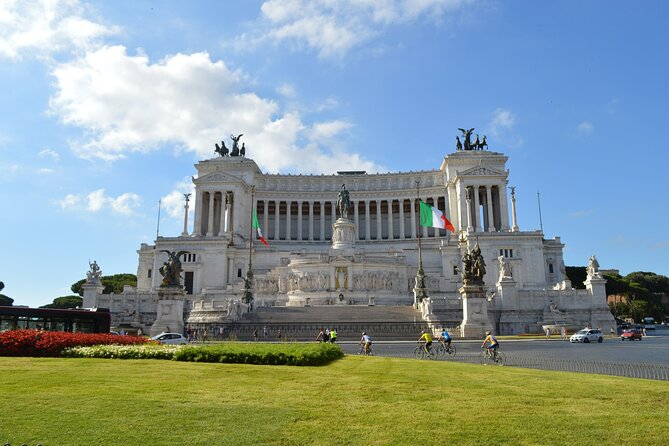
Piazza Venezia is a large, dramatic square dominated by the Victor Emmanuel II Monument and Palazzo Venezia. It is not the quietest place on the route, but it is an important point for understanding modern Rome as well as ancient Rome.
The square brings together major eras of the city. Ancient imperial ruins are close by, while the white monument recalls the creation of modern Italy. The guide’s explanation gives the buildings a setting that can be hard to grasp when you are simply passing through on foot or in a taxi.
You spend about 20 minutes here, enough time for an explanation and a look around. The noise and traffic are part of the experience, though they can make it harder to focus. The radio headsets help, especially when the group is standing near a busy street.
A completely different way to spend the day in Rome:
- Vatican: Museums & Sistine Chapel Entrance Ticket
★ 4.5 · 144,003 reviews - Vatican Museums & Sistine Chapel Tour with Optional Basilica
★ 4.3 · 67,413 reviews - Vatican Museums, Sistine Chapel & St Peter’s Basilica Guided Tour
★ 4.5 · 39,149 reviews - Rome: Colosseum, Palatine Hill and Roman Forum Guided Tour
★ 4.8 · 32,814 reviews
The Jewish Ghetto, Rome’s quieter historic turn
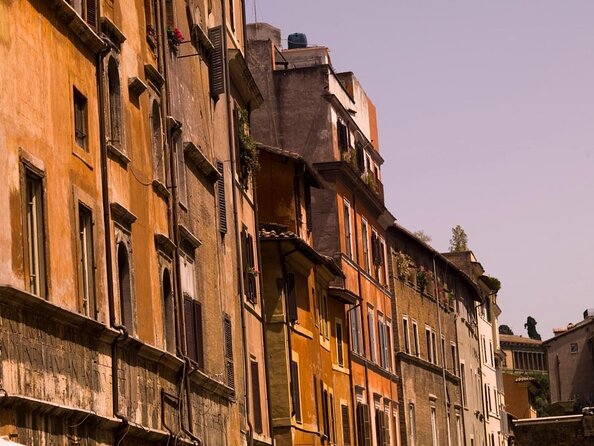
The walk then shifts mood in the old Jewish quarter between the Tiber and Piazza Venezia. Rome’s Jewish community is the oldest in Europe, and this neighborhood combines synagogues, churches, restaurants, and Roman buildings in a compact area.
This is one of the most useful parts of the route because it adds a side of Rome that many first-time sightseeing plans miss. The area is not presented only as a monument zone. It is also a neighborhood shaped by a long Jewish presence within the city.
The stop lasts around 20 minutes and costs nothing to visit from the street. You should listen closely here, since the value comes from the guide’s context rather than a single famous structure. The name old Jewish quarter can make the area sound like a museum, but the point is to understand it as part of Rome’s living center.
Campo de’ Fiori and the market hour
Campo de’ Fiori is known for its street market, and the tour allows about 10 minutes to see the stalls and browse. Depending on the day and timing, you might find food, souvenirs, and other market goods spread across the square.
This is a short stop, so it is not designed for a full shopping session. You will have time to get a feel for the square, but you may want to return later if you spot something worth buying. The market also gives the route a welcome break from monuments and formal piazzas.
Keep an eye on your belongings in crowded public areas, as you would anywhere in a busy city market. The guide’s presence helps keep the group together, but personal attention is still sensible.
Piazza Navona and Bernini’s fountain
Piazza Navona is one of Rome’s great Baroque spaces. Its long shape follows the footprint of an ancient stadium, a detail that makes the square easier to understand. Instead of seeing a random oval plaza, you can picture the sporting venue that once occupied this site.
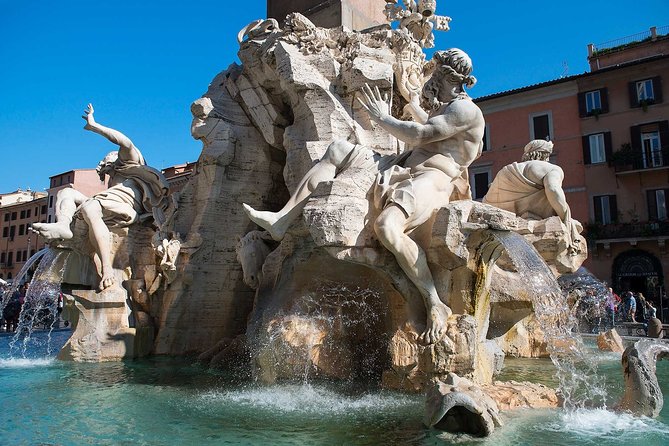
The main visual prize is Bernini’s Fountain of the Four Rivers. The Church of Sant’Agnese in Agone adds a strong architectural backdrop, and the combination of fountain, church, palace facades, artists, and restaurants makes this one of the most photogenic stops.
The tour spends about 15 minutes here. That is enough for a clear explanation, but not enough to sit, sketch, study every sculpture, or linger over a drink. If the square catches your attention, mark it for a return visit after the walk.
The Pantheon, seen from the outside
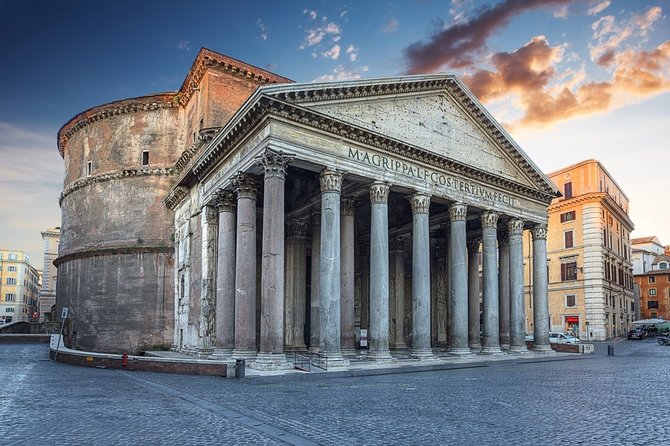
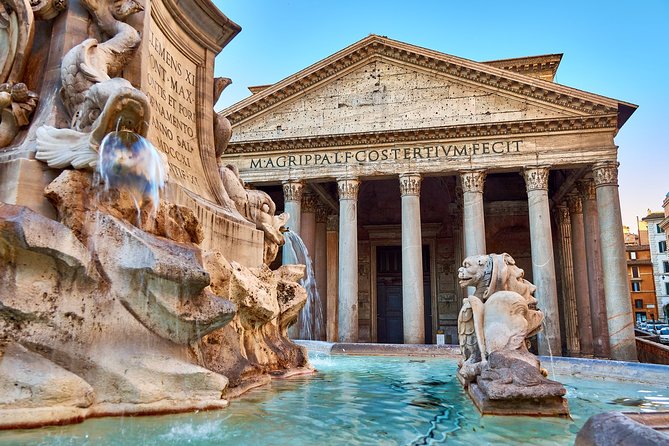
The Pantheon is the most important ancient building on this route. Originally built as a temple dedicated to all the gods, it became a church in the seventh century. That later use helped preserve the structure, which is why its basic form remains so powerful today.
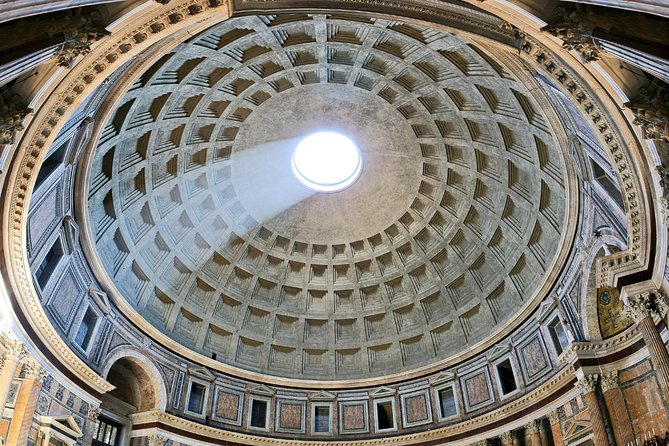
The building’s great achievement is not just its age. It is the way Roman engineering creates a vast interior beneath the famous dome. From outside, you can appreciate the columned portico and the building’s imposing scale, but the real spatial surprise comes inside.
The stop lasts about 15 minutes, and admission is not included. No entry into the Pantheon is part of this activity, so you should plan a separate visit if you want to see the dome and interior. This is the clearest limitation for anyone hoping for a full Pantheon tour.
Still, an outside explanation is valuable. You get the essential story and a chance to decide later if the interior deserves more of your time. For a compact walk, that keeps the group moving and the price lower.
Piazza di Pietra and the Temple of Hadrian
Piazza di Pietra offers a different kind of ancient sight. The remains of the Temple of Hadrian are built into the square, with its surviving columns giving you a direct look at how ancient structures became part of later Rome.
The stop takes about 10 minutes and is free from the outside. It is easy to walk past this place without realizing what you are seeing, especially when the square is busy with modern life. A guide provides the key link between the surviving columns and the emperor to whom the temple was dedicated.
This is a good example of why the tour format works. A guide can point out a monument that might otherwise become background scenery. You do not need a long visit, but you do need someone to identify the remains and explain their place in the city.
Trevi Fountain, the busy finish
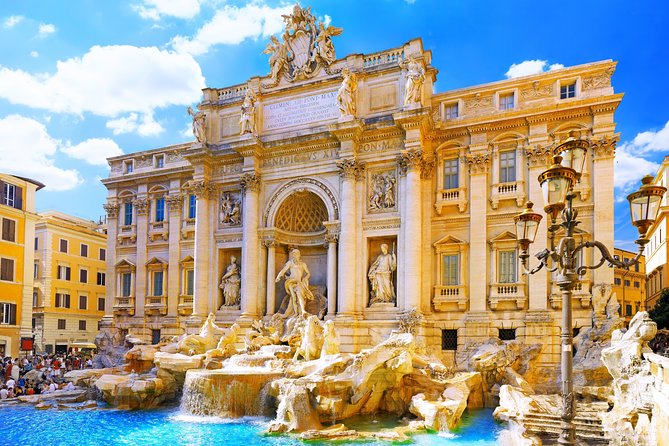
The final stop is the Trevi Fountain, where the tour ends in Piazza di Trevi. It is Rome’s largest Baroque fountain and one of the city’s most famous sights.
The fountain makes a strong ending because it is instantly recognizable and visually grand. After the ancient ruins, Jewish quarter, market, and Baroque squares, you arrive at a monument built for spectacle. The stop lasts about 15 minutes, which gives you time for the guide’s explanation and a look at the fountain.
Expect a crowded setting. The tour ends here rather than continuing to another sight, so you can stay in the square afterward if you want more photographs or a closer look. The end point also gives you a useful location for continuing your own visit to central Rome.
Guides, group size, and the feel of the walk
The experience is offered in English and uses radio headsets. That combination matters in Rome, where traffic, crowds, and wide squares can separate you from a guide’s voice. A cap of 15 people also makes the walk more manageable than a large city tour.
Brian is singled out for clear explanations, friendly manner, and care with shade during a hot day. Alessandra is described as especially good at keeping both children and adults involved, while Suzanna is praised for being attentive, energetic, and easy to follow.
Those details point to the kind of guiding this tour aims for: history explained in plain terms, pauses in sensible places, and room for some independent looking. One account also included a gelato stop after the formal tour, but that should not be treated as a guaranteed part of the scheduled experience.
The 10:00 a.m. start has both benefits and drawbacks. You get an early look at central Rome and finish around midday, but open squares can become hot. Shade was an active concern for the guides on warm days, and you should still bring water, sun protection, and a hat.
What the $42.17 price really covers
At $42.17, this is not a ticket package. It is a guided orientation walk. The price includes the guide and radio headsets, while private transport and monument admission are excluded.
I consider that good value if you want the city explained as you walk through it. You see nine important places in about two and a half hours, and you avoid spending time working out the route yourself. The group size also gives the price more weight than a very large walking tour.
The value is weaker if you want extended time inside the Pantheon or Trajan’s Market. You will need to pay for those separately and return on your own. The same applies to churches and other buildings, which are discussed from the exterior.
Who should book this Rome walk
I would choose this tour for a first or second day in Rome, especially if you want a clear introduction before visiting major interiors on your own. Families may appreciate the shorter format and the effort to keep children involved.
It also suits you if you prefer streets and public squares to a long museum visit. The route offers ancient monuments, religious architecture, neighborhood history, markets, fountains, and modern city life in one outing.
I would look elsewhere if your main goal is detailed archaeology, long interior visits, or a relaxed photography walk. The schedule is tight, with most stops lasting between five and 20 minutes. You will see a lot, but you must save your lingering for later.
Practical details worth knowing
The meeting point is Foro Traiano, 84, near Trajan’s Column. Arrive 20 minutes before the 10:00 a.m. start, since late arrival could interfere with the group’s departure.
The tour ends at Trevi Fountain in Piazza di Trevi. There is no private transportation, and the activity is conducted on foot. Public transportation is nearby at the meeting area.
Confirmation is provided when you book. Free cancellation is available up to 24 hours before the local start time for a full refund. Cancellations or changes made less than 24 hours before departure are not accepted for a refund.
Should you book it?
Book this walk if you want a well-paced overview of central Rome, a small group, and a guide who can connect ruins, squares, fountains, and neighborhoods into one story. The strongest parts are the route design, the personal group size, and the guides’ reported care with explanations, children, and hot weather.
Skip it if you want to enter every major building or spend an hour at each monument. For everyone else, $42.17 buys a useful first map of Rome, with the Trevi Fountain at the end and plenty of ideas for what to explore next.
FAQ
How long does the Rome walking tour last?
The tour lasts approximately 2 hours and 30 minutes.
What time does the tour start?
The tour starts at 10:00 a.m.
Where does the tour begin?
It begins at Foro Traiano, 84, 00187 Rome, near Trajan’s Column.
Where does the tour end?
The tour ends at Trevi Fountain in Piazza di Trevi.
Is the tour offered in English?
Yes. The experience is offered in English.
How many people can join the tour?
The group is limited to a maximum of 15 people.
Are radio headsets included?
Yes. A tour guide and radio headsets are included.
Are admission tickets included?
No. Admission is not included for Trajan’s Market or the Pantheon, and the monuments are explained from outside.
Does the tour include transportation?
No. Private transportation is not included. The experience is a walking tour.
What physical fitness level is required?
A moderate level of physical fitness is recommended because the tour takes place on foot.
How early should I arrive?
You should arrive at the meeting point 20 minutes before departure.
Can I cancel for a full refund?
Yes. You can cancel at least 24 hours before the local start time for a full refund. Less than 24 hours before departure, cancellations and changes are not accepted for a refund.
Newest reviews from Rome
- ROME:Colosseum & Ancient Rome – private/small group TOUR★ 5.0 · 24 reviews
- Off the Beaten Track in Rome: Rione VI Parione Private Tour★ 5.0 · 24 reviews
- Cinematic Photoshoot in Rome★ 5.0 · 24 reviews
- Rome: Best of Colosseum and Roman Forum Small Group Guided Tour★ 4.5 · 24 reviews
- The Labyrinth of Rome between catacombs and ancient quarries★ 4.5 · 24 reviews
- Vatican and Trionfale Market Tour with Wine and Food Tasting★ 5.0 · 24 reviews
- private tour: Vatican Museums, Sistine Chapel, St. Peter’s Basilica★ 4.5 · 24 reviews
- Colosseum guided tour with Virtual Reality★ 5.0 · 24 reviews
Walking Tours, compared.
Trastevere & Campo de Fiori Street Food Walking Tour
Read our review →
Paranormal Night Walking Tour & Secret Backstreets
Read our review →
Rome by Night Walking Tour – Legends & Criminal Stories
Read our review →
Guided City Center Evening Sightseeing Walking Tour
Read our review →
Best of Rome Walking Tour including Trevi Fountain
Read our review →

Forbidden History Walking Tour & Pub Crawl with Drinks
Read our review →
Guided Small Group Walking Tour of City Highlights
Read our review →Browse the lists this tour appears in