
Reviewed · CATACOMBS & CRYPTS
Small-Group Tour of Roman Catacombs & St. Clement’s Undergrounds
Rome’s most revealing stories are often below street level. This tour takes you from St. Clement’s Basilica, where one church sits over older Roman buildings and a Mithraic temple, to the Catacombs of Domitilla, where early Christians painted faith onto underground burial walls.
I like the small maximum of 10 people, which makes it easier to hear the guide and ask questions. I also like that transport between central Rome and the Appian Way is handled by a private air-conditioned minivan, saving you the trouble of arranging a taxi.
The main consideration is the setting. You will spend much of the tour underground, in cool, dim, enclosed spaces. It is not a good choice if you are uncomfortable in narrow passageways, and you must cover your knees and shoulders to enter the churches.
In This Review
- Key points to know before you book
- Why St. Clement’s Basilica is the heart of the tour
- The Appian Way transfer keeps the morning practical
- Entering the Catacombs of Domitilla
- How the two sites fit together
- Small-group size and guide quality
- Is $143.37 a fair price?
- What to wear and what to expect underground
- Timing, cancellations, and possible changes
- Who should book this underground Rome tour?
- Should you book it?
- FAQ
- How long does the tour last?
- Where does the tour start?
- Where does the tour end?
- Is transport included?
- Are entrance tickets included?
- What language is the tour offered in?
- How many people can join the tour?
- Are headsets provided?
- What should I wear?
- Is the tour suitable for people with claustrophobia?
- Can I cancel for a refund?
Key points to know before you book
- Three layers beneath St. Clement’s: See the modern basilica, a fourth-century church, Roman houses, and a well-preserved Mithraic temple below it.
- Domitilla’s early Christian art: Walk through burial galleries with wall paintings of biblical and mythological figures.
- Small English-speaking group: The tour has a maximum of 10 people, with sterilized headsets so you can follow the guide clearly.
- Private minivan on the Appian Way: The round trip to the catacombs takes about 30 minutes and is included in the price.
- A cool break from Rome’s heat: The underground sites offer welcome relief on a hot day, though you may want a light jacket.
- A history-focused half-day: The experience lasts about three hours and includes all entrance and transport fees.
Why St. Clement’s Basilica is the heart of the tour
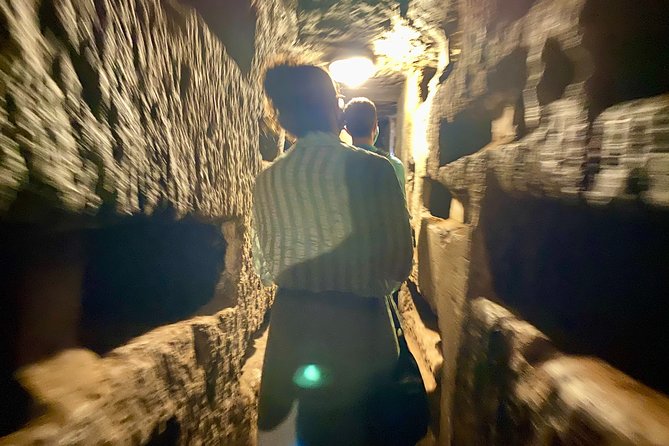
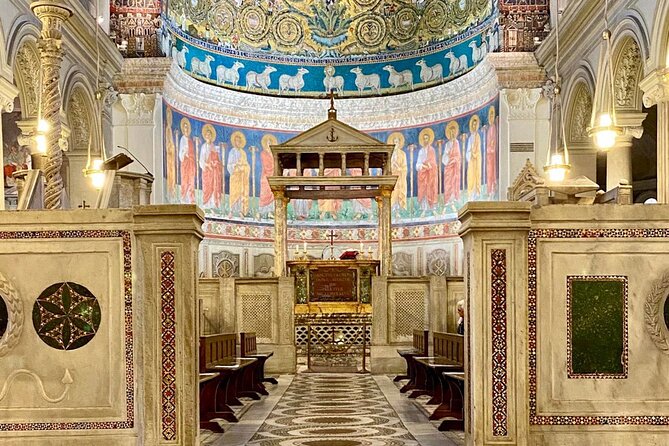
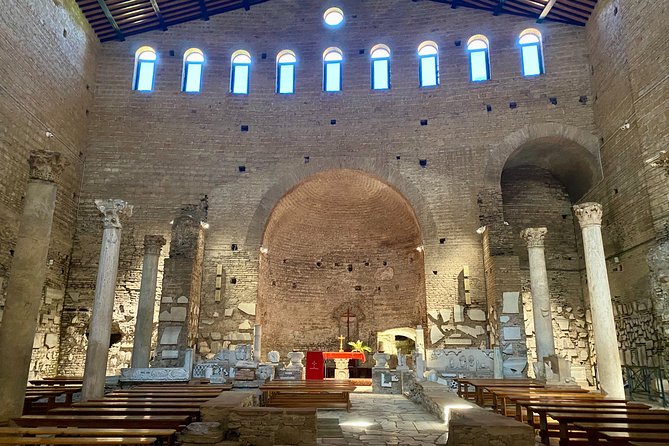
St. Clement’s is not simply an old church. It is a stack of Rome’s past, built one level over another. You begin near the present-day basilica, then go down through layers of construction until you are about 14 meters below ground.
That physical descent gives the history unusual force. Instead of looking at a model or reading a plaque, you can walk through the remains themselves and see how later builders used, altered, and covered earlier structures.
The lowest level contains one of Rome’s best-preserved Mithraic temples. Mithraism was a private religious cult practiced in the Roman Empire before Christianity became dominant. The temple’s enclosed design and ritual atmosphere help you understand how different religious practices once shared the city.
Your guide explains the pagan faith, its symbols, and its secretive character. This is where a good guide matters most. The rooms are not large, and the remains can be difficult to interpret on your own. Guides including Daniel, Erneste, Francesca, Paul, Samuele, Sara, and Chiara have been praised for making the sites understandable and answering questions clearly, though the guide assigned to your departure can vary.
Below the church, you may also see and touch water from an underground river. It is a small detail, but it makes the site feel less like a display and more like a living section of ancient Rome. The sound and presence of water add to the strange mood of the lowest level.
You then move upward to the remains of the fourth-century basilica. This church was built over an earlier house associated with the martyr Clement and below the present structure. Ancient frescoes cover parts of the walls, showing scenes connected with martyrs and Christian belief.
The paintings are not always easy to read at first glance. This is one reason I would choose a guided visit rather than simply entering on my own. Your guide can point out figures, explain the scenes, and show how the art reflects a period when Christian worship was moving from a persecuted faith toward an established religion.
The sequence is especially effective: pagan worship at the lowest level, an early Christian church above it, and the later basilica at street level. You are not just hearing that Rome was built in layers. You are walking through those layers in order.
More catacomb and crypt visits from Rome:
- Rome: Crypts and Catacombs Underground Tour with Transfers
★ 4.6 · 5,341 reviews - The Original Roman Crypts and Catacombs Tour with Transfers
★ 4.5 · 4,896 reviews - Rome: Catacombs of St. Callixtus Entry Ticket & Guided Tour
★ 4.6 · 3,037 reviews
The Appian Way transfer keeps the morning practical
After St. Clement’s, you board a comfortable, air-conditioned minivan for the trip to the Appian Way, or Via Appia Antica. The round trip takes about 30 minutes, depending on traffic.
This transfer is more useful than it may sound. The catacombs are outside the tight center of Rome, and handling the route yourself can add planning time to an already busy day. Here, transport and admission are bundled into one experience.
The minivan also gives the guide a chance to continue the explanation between sites. One particularly strong part of the tour is the connection between the ancient road, the burial grounds, and the growth of early Christianity. You are not being dropped at a second unrelated attraction. The two sites work together.
Allow some patience for Roman traffic. The vehicle is clean and well maintained, but delays are possible. The tour normally has reliable start and end times, yet one departure was affected by waiting and traffic. That is not unusual in Rome, but it is worth remembering if you have a train, museum booking, or dinner reservation immediately afterward.
Entering the Catacombs of Domitilla
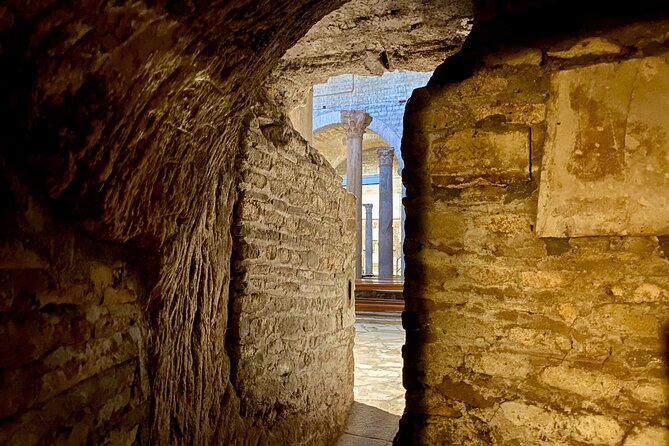
The Catacombs of Domitilla provide the tour’s second major setting. You descend about 16 meters below the surface and walk through the accessible part of a large underground burial system.
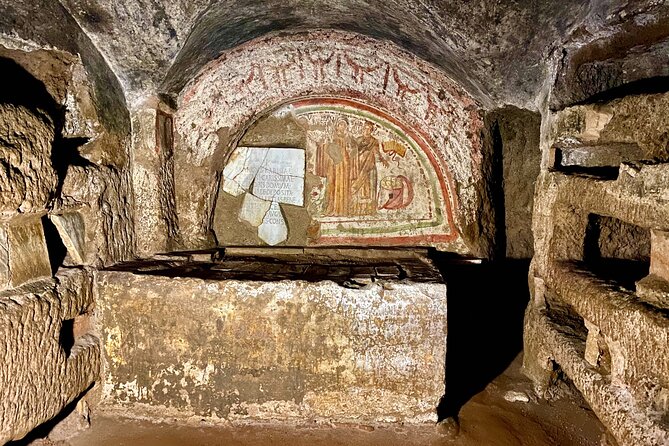
The passages lead through burial chambers and galleries. The focus is not on shock value. You are learning how people buried and remembered their dead, how families and communities used underground spaces, and how Christian images appeared alongside older Roman ideas.
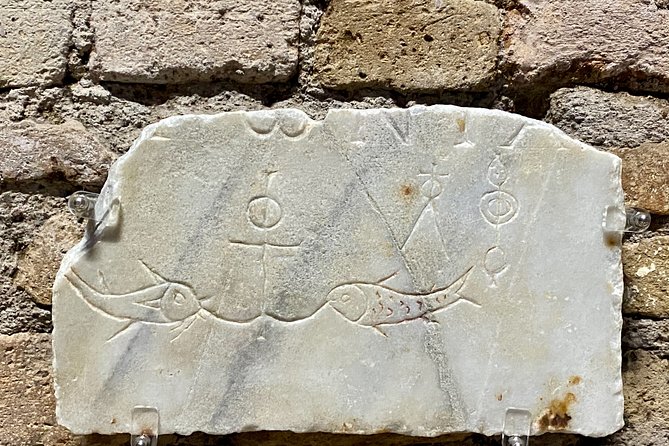
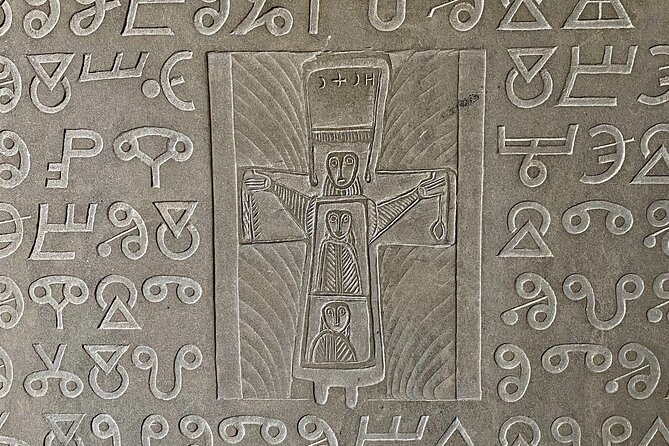
The wall paintings are a major reason to visit. You can expect scenes involving biblical figures as well as mythological subjects, showing a period when religious ideas were changing rather than switching overnight. The artwork gives you a direct way to see the movement from pagan customs to Christian belief.
Your guide provides the context that makes these rooms meaningful. Without explanation, the corridors may seem repetitive. With a strong guide, details in the paintings, burial areas, and chapel spaces become clues to how people worshipped, mourned, and expressed their identity.
The route finishes in a fourth-century underground basilica. This gives the catacomb visit a clear ending and links it back to St. Clement’s. At both sites, Christianity is presented not as an isolated story, but as part of Rome’s larger social and religious change.
The catacombs are cool, and a light jacket is sensible even during warm weather. The floor and underground route may require care, although the supplied information says most people can participate. If you have claustrophobia, choose a different activity.
How the two sites fit together
Some Rome tours give you a church and a catacomb as separate stops. This one is better understood as one lesson in changing belief and urban life.
At St. Clement’s, you see the city physically built over itself. At Domitilla, you see how people created burial spaces beneath the city and decorated them with images that reflected new religious ideas.
The first site is more architectural and layered. The second is more focused on burial, painting, and early Christian practice. That contrast keeps the three-hour visit moving.
I would give St. Clement’s slightly more time in your expectations. Its stacked levels are unusually easy to understand because you physically move through them. Several guides have also been singled out for explaining the frescoes and construction phases in a lively way. The catacombs are fascinating, but their long galleries can feel more subdued and less immediately dramatic.
The tour works best for people who want context rather than a quick photo stop. You will hear about ancient cults, Roman customs, martyrs, persecutions, art, and construction methods. Some guides take a clear position when explaining historical events, so you should expect interpretation rather than a purely neutral audio guide.
A completely different way to spend the day in Rome:
- Vatican: Museums & Sistine Chapel Entrance Ticket
★ 4.5 · 144,003 reviews - Vatican Museums & Sistine Chapel Tour with Optional Basilica
★ 4.3 · 67,413 reviews - Vatican Museums, Sistine Chapel & St Peter’s Basilica Guided Tour
★ 4.5 · 39,149 reviews - Rome: Colosseum, Palatine Hill and Roman Forum Guided Tour
★ 4.8 · 32,814 reviews
Small-group size and guide quality
A maximum of 10 people is a real benefit underground. Narrow rooms are easier to manage, and you are less likely to be stranded at the back of a large crowd.
Sterilized headsets are included. That matters in these spaces because voices can echo, and a guide often has to speak quietly around fragile remains or during church visits. A working headset lets you focus on the walls and paintings instead of trying to stand beside the guide at every moment.
The guide can make or break this experience. The strongest descriptions of the tour focus on guides who were expressive, organized, friendly, and able to answer detailed questions. Samuele, for example, was praised for adapting the explanation to an interest in painting and art. Another guide, Sara, was especially effective at showing why St. Clement’s three levels matter.
Do not assume a specific guide is guaranteed unless the operator confirms it. Daniel, Erneste, Francesca, Paul, Samuele, Sara, and Chiara have all led departures, but assignments can change.
The tour begins at Via Francesco Giambullari, 4, near public transportation. Arrive at least five minutes early. Hotel pickup and drop-off are not included, so plan your route to the meeting point before the day begins.
Is $143.37 a fair price?
At $143.37 per person, this is not a bargain-priced Rome walk. It is also not an unreasonable price for a three-hour guided experience that includes two admissions, minivan transport, headsets, and on-site assistance.
The value comes from what would be difficult to arrange efficiently on your own. You would need to reach the Appian Way, secure entry to the catacombs, understand the underground layout, and then make your way back toward central Rome. You would also lose much of the meaning of St. Clement’s without someone explaining how the levels connect.
The small group adds value, especially if you care about asking questions. If you are comfortable reading signs and prefer moving at your own pace, the price may feel high. If you want one organized visit with historical explanation and transport handled, it is easier to justify.
Group discounts are available, and the tour is offered in English. Food and drinks are not included, but the experience is only about three hours, so that omission is not a serious problem.
What to wear and what to expect underground
Church dress rules apply. Cover your knees and shoulders, even if Rome is hot above ground. A light jacket is also useful because both the catacombs and underground church areas can feel cool.
The tour is not recommended if you have claustrophobia. You will be below ground at both main sites, with enclosed galleries and limited natural light. Most people can participate, but the setting is worth taking seriously before you pay.
Comfortable clothing and sensible shoes are a good idea. The supplied information does not promise step-free access or describe every surface, so anyone with mobility concerns should confirm details with the operator before booking.
Luggage storage is included at the operator’s office for the duration of the tour. That can help if you are touring between hotel stays, though hotel transfer itself is not provided.
Timing, cancellations, and possible changes
The experience runs for about three hours and ends back at the meeting point. You should avoid scheduling a tight connection afterward, since Roman traffic or a delayed start can affect the timetable.
The operator may change the departure time if guide problems arise. One scheduled morning tour was moved to the afternoon, with communication provided in advance. If your Rome plans are rigid, leave some space around this booking.
Free cancellation is available up to 24 hours before the start time for a full refund. Changes or cancellations made less than 24 hours before the start are not accepted for a refund.
The tour can also be affected by poor weather or liturgical-calendar events. If the operator cancels for one of those reasons, you will be offered another date or a full refund.
Who should book this underground Rome tour?
I would choose this tour if you have already seen the Colosseum and major piazzas and want a quieter, more thoughtful side of Rome. It suits people interested in Roman religion, early Christianity, burial customs, architecture, and ancient art.
Families can enjoy it, especially if older children are curious about how cities change over time. The guide-led format helps younger visitors follow the story, though the dark and enclosed setting will not suit everyone.
This is also a good choice for first-time visitors who want an organized introduction to the Appian Way and catacombs without spending a full day outside the center. The minivan keeps the plan simple.
I would skip it if you dislike enclosed spaces, want lots of free time for photography, or prefer a broad sightseeing tour with outdoor views. The focus here is serious and historical, and most of the memorable moments happen below ground.
Should you book it?
Book it if layered Roman history and early Christian art sound more appealing than another crowded monument. St. Clement’s is the strongest reason to go, while Domitilla adds a moving look at burial and belief beneath the Appian Way.
The $143.37 price makes the most sense when you value a small group, a live English-speaking guide, included transport, and clear explanations. Arrive early, dress for church entry, bring a light jacket, and leave room in your schedule after the tour.
FAQ
How long does the tour last?
The tour lasts approximately three hours.
Where does the tour start?
The meeting point is Via Francesco Giambullari, 4, 00184 Rome, Italy.
Where does the tour end?
The activity ends back at the meeting point.
Is transport included?
Yes. Transport between St. Clement’s and the Appian Way catacombs is provided by private air-conditioned minivan, and all transport fees are included.
Are entrance tickets included?
Yes. Admission to St. Clement’s Basilica and the Catacombs of Domitilla is included.
What language is the tour offered in?
The tour is offered in English with a live professional guide.
How many people can join the tour?
The maximum group size is 10 participants.
Are headsets provided?
Yes. Sterilized headsets are included so you can hear the guide clearly.
What should I wear?
Your knees and shoulders must be covered to enter the churches.
Is the tour suitable for people with claustrophobia?
No. The tour is not recommended for people with claustrophobia because much of the experience takes place underground.
Can I cancel for a refund?
You can cancel at least 24 hours before the start time for a full refund. Cancellations or changes made less than 24 hours before the start are not accepted for a refund.
Newest reviews from Rome
- ROME:Colosseum & Ancient Rome – private/small group TOUR★ 5.0 · 24 reviews
- Off the Beaten Track in Rome: Rione VI Parione Private Tour★ 5.0 · 24 reviews
- Cinematic Photoshoot in Rome★ 5.0 · 24 reviews
- Rome: Best of Colosseum and Roman Forum Small Group Guided Tour★ 4.5 · 24 reviews
- The Labyrinth of Rome between catacombs and ancient quarries★ 4.5 · 24 reviews
- Vatican and Trionfale Market Tour with Wine and Food Tasting★ 5.0 · 24 reviews
- private tour: Vatican Museums, Sistine Chapel, St. Peter’s Basilica★ 4.5 · 24 reviews
- Colosseum guided tour with Virtual Reality★ 5.0 · 24 reviews
Catacombs & Crypts, compared.

Crypts and Catacombs Underground Tour with Transfers
Read our review →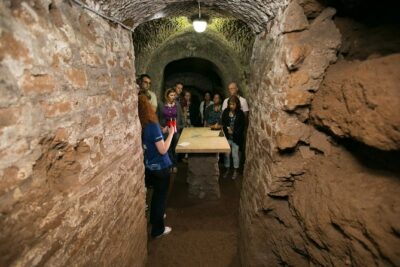
The Original Roman Crypts and Catacombs Tour with Transfers
Read our review →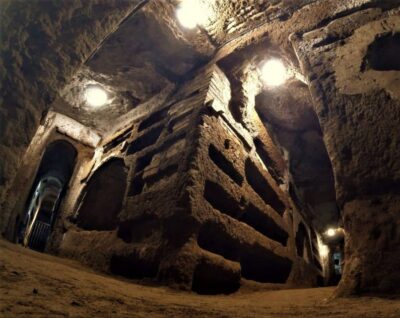
Catacombs of St. Callixtus Entry Ticket & Guided Tour
Read our review →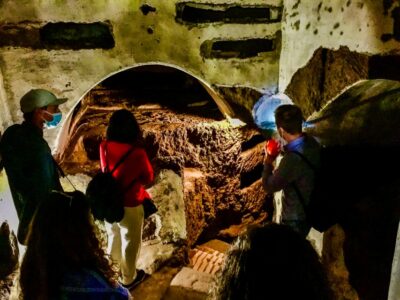


Rome EBike Tour: Appian Way, Catacombs & Roman Aqueducts
Read our review →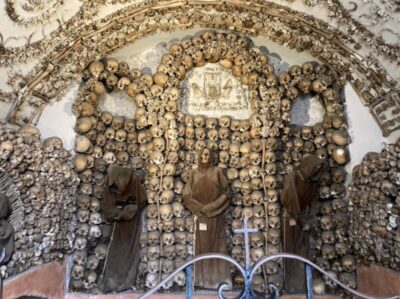
Catacombs and Capuchin Crypt Guided Tour with Transfer
Read our review →
St. Peter’s Basilica Priority Access Tour with Dome & Crypt
Read our review →Browse the lists this tour appears in