
Reviewed · ROMAN FORUM & PALATINE HILL
Small-Group Tour of Roman Forum & Palatine Hill
The most rewarding part of this tour is the way it turns scattered ruins into a story. In about 90 minutes, you move from the Arch of Constantine through the Roman Forum and up Palatine Hill, following the political, religious, and imperial heart of ancient Rome. The guide gives the stones a purpose, from the Vestal Virgins’ sacred fire to Julius Caesar’s final days.
I like the small-group format, which allows more room for questions than a large walking tour, and I like the included headset, especially when the Forum is noisy. Guides such as Francesca and Rosy have been praised for their warm, engaging approach. The main caution is simple: this tour does not enter Circus Maximus. You only view it from Palatine Hill, and the total visit is short for such a large archaeological area.
In This Review
- Key points before you book
- Why the Roman Forum is easier with a guide
- Vestal Virgins, sacred gardens, and everyday Roman belief
- Senate House, Basilica Julia, and the end of Caesar
- Castor and Pollux, Titus, and Rome’s public memory
- Basilica of Maxentius and the scale of imperial building
- Temple of Venus and Roma, with the best Colosseum view
- Palatine Hill, imperial homes, and the city’s founding legend
- What happens with Circus Maximus
- How small is the small group?
- Timing, heat, and getting inside
- Is $83.13 a fair price?
- Who should book this Roman Forum tour?
- Should you book it?
- FAQ
- How long does the tour last?
- What sites are included?
- Is the Colosseum included?
- Does the tour enter Circus Maximus?
- Can I stay after the guided tour ends?
- How large is the group?
- Is the tour offered in English?
- What should I bring for entry?
- Can I cancel for a refund?
Key points before you book
- Three major Roman sights in one visit: The route covers the Arch of Constantine, Roman Forum, and Palatine Hill.
- A 90-minute introduction: You get useful context without giving up half a day.
- Circus Maximus is viewed from above: It is not an included entrance or guided visit.
- Groups can reach 24 people: This is smaller than a big coach tour, but not an intimate private walk.
- Security can slow the start: Allow 5 to 30 minutes for mandatory checks, depending on the season.
- You can stay afterward: Once the official tour ends inside the Forum, you may remain in the archaeological area as long as you wish.
Why the Roman Forum is easier with a guide
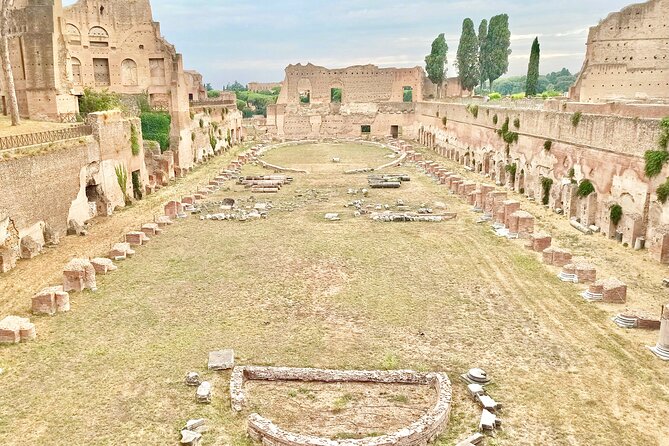
The Forum is one of Rome’s most important sites and one of its least readable at first glance. You see columns, broken walls, and fragments spread across a broad valley. Without context, it can feel like a pile of beautiful leftovers.
A guide helps you connect those fragments to the city that once stood here. This tour focuses on the Forum as the center of Roman public life, where religion, politics, law, and ceremony all met. That focus is useful because you are not simply looking at ruins. You are learning what each building did and why it mattered.
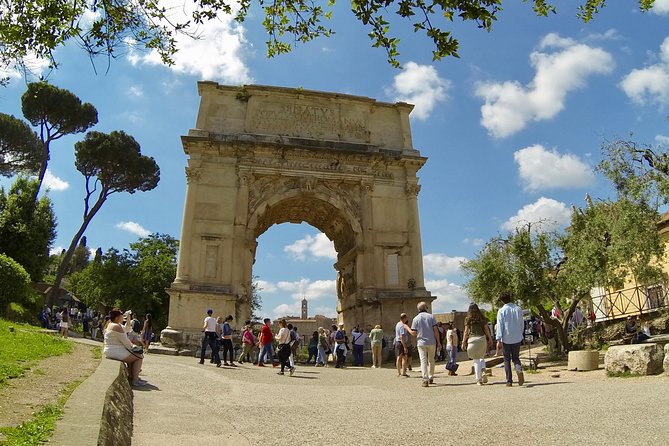
The route begins near the Arch of Constantine, a large triumphal arch built to celebrate the emperor’s victory. You spend only about five minutes here, so this is an introduction rather than a full study of the monument. Still, it gives you an immediate sense of scale and prepares you for the imperial setting ahead.
From there, you enter the Roman Forum. The included admission covers the Forum and Palatine Hill, while the Colosseum requires a separate ticket. That distinction matters. This is not a Colosseum tour with a quick look at the Forum. It is centered on the political and religious core of ancient Rome.
More Roman Forum and Palatine Hill visits:
- Rome: Colosseum, Palatine Hill and Roman Forum Guided Tour
★ 4.8 · 32,814 reviews - Rome: Guided Tour of Colosseum, Roman Forum & Palatine Hill
★ 4.7 · 27,897 reviews - Rome: Colosseum, Roman Forum and Palatine Hill Guided Tour
★ 4.5 · 23,903 reviews
Vestal Virgins, sacred gardens, and everyday Roman belief
One of the more memorable stops is the area connected with the Vestal Virgins. These priestesses tended the sacred fire of the goddess Vesta, and their gardens offer a rare glimpse into the religious life of Rome.
The small Temple of Vesta is especially useful for understanding how Roman faith worked. It was not only a matter of private belief. Public rituals, priesthoods, and sacred duties were tied to the safety and success of the state. Your guide explains that connection while pointing out the remains.
This is the kind of detail that can easily disappear when you explore alone. A temple ruin may look small, but its role in Roman society was large. The tour gives you that missing layer without asking you to read long plaques at every stop.
Senate House, Basilica Julia, and the end of Caesar
The tour then turns toward the Senate House, where Roman senators met to debate decisions that shaped the Republic and later the Empire. The building is tied to one of Rome’s most famous political episodes, the murder of Julius Caesar and the public reaction that followed.
The nearby Basilica Julia adds another side of Roman public life. A basilica in ancient Rome was not primarily a church. It was a public building used for business, legal matters, and official activity. Here, the guide also discusses the Roman penal system and how Roman law affected the later development of Christianity.
That pairing is one of the tour’s strengths. You are not given only emperor stories and military victories. You also hear about courts, punishment, religious practice, and the machinery of government. Those subjects help explain how Rome worked for ordinary people as well as rulers.
The official time listed for the Roman Forum is about 30 minutes, with another short stop at Basilica Julia. That is enough for a guided orientation, but it is not enough for every corner of the Forum. If you want to linger over every inscription, temple, and foundation, plan to stay after the tour ends.
Castor and Pollux, Titus, and Rome’s public memory
The Temple of Castor and Pollux is another important point along the route. Only parts of the structure remain, but its surviving columns are among the Forum’s most recognizable features. Your guide places the temple within Roman religious and civic life rather than treating it as a photo stop alone.
The Arch of Titus brings the story toward Rome’s military power. Its reliefs refer to the Roman sack of Jerusalem, and the monument shows how emperors used architecture to record victories. The arch also became a model for later triumphal monuments, including the Arc de Triomphe in Paris.
This is a useful lesson in how Rome’s visual language traveled far beyond the ancient city. The arch is not just an old gateway. It is political messaging carved in stone, designed to make conquest visible for generations.
The stop at the Arch of Titus lasts about five minutes. That brevity is worth noting. You will hear the central story and see the important details, but you should not expect a long examination of the reliefs.
A completely different way to spend the day in Rome:
- Vatican: Museums & Sistine Chapel Entrance Ticket
★ 4.5 · 144,003 reviews - Vatican Museums & Sistine Chapel Tour with Optional Basilica
★ 4.3 · 67,413 reviews - Vatican Museums, Sistine Chapel & St Peter’s Basilica Guided Tour
★ 4.5 · 39,149 reviews - Rome: Colosseum & Forum with Audio Guide App -Optional Arena
★ 4.2 · 24,770 reviews
Basilica of Maxentius and the scale of imperial building
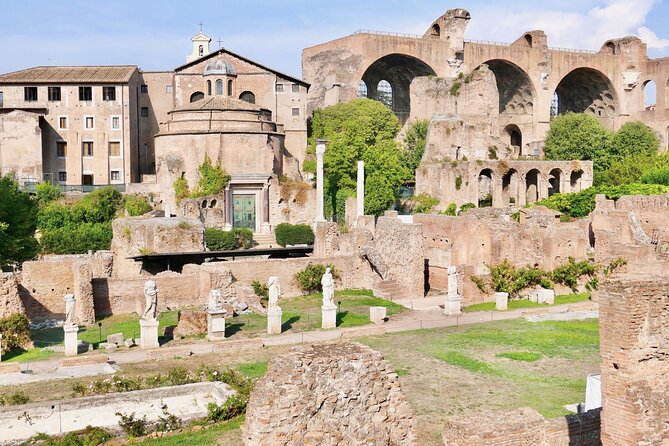
The ruins of the Basilica of Maxentius help you picture the size of imperial Rome. This was the largest building in the Forum, and its great surviving arches still give a sense of the engineering involved.
The guide also connects the basilica’s design to later buildings, including New York City’s former Penn Station. That comparison helps you understand how ancient Roman architecture continued to influence modern public spaces.
You spend roughly five minutes here. The stop is short, but the structure itself does much of the work. Even in ruin, the basilica shows how Rome used massive public buildings to project order, power, and wealth.
Temple of Venus and Roma, with the best Colosseum view
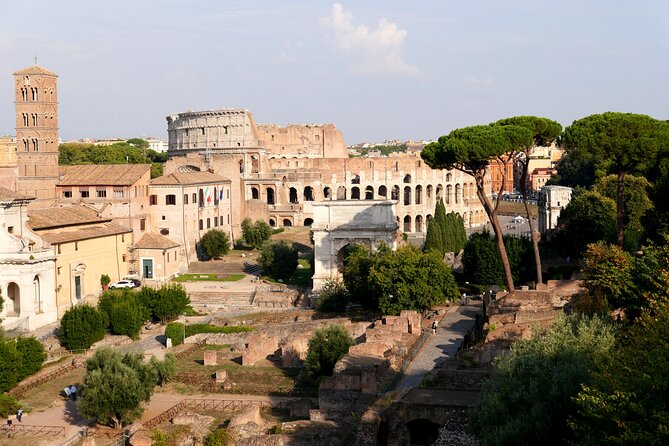
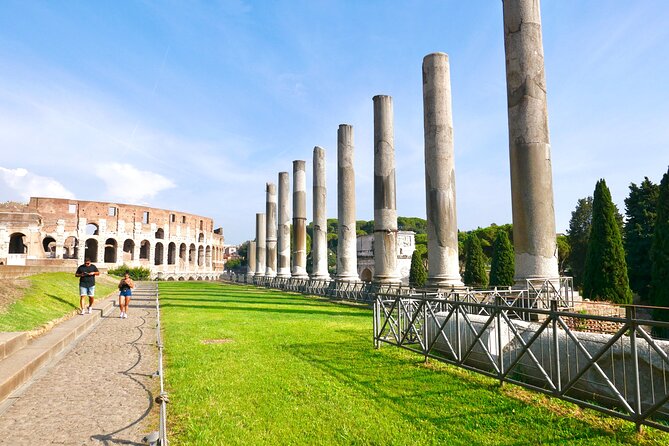
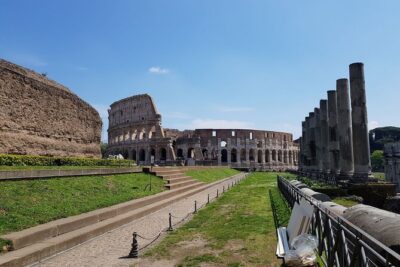
The Temple of Venus and Roma was the largest temple in ancient Rome. Its remains sit near the Colosseum and provide one of the strongest views of the famous amphitheater.
This is an excellent point for photographs, but it also gives you a better sense of how the monuments fit together. The Colosseum was not an isolated attraction. It belonged to a wider imperial zone filled with temples, ceremonial arches, public buildings, and political symbols.
The tour does not include entry to the Colosseum. If that is your main priority, you will need a separate ticket or a different experience. Still, the view from the Temple of Venus and Roma gives you a worthwhile outside perspective and helps place the Colosseum within ancient Rome.
Palatine Hill, imperial homes, and the city’s founding legend
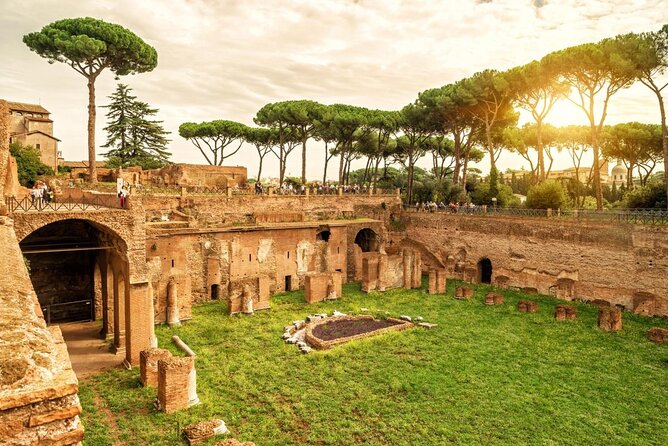
The final major section takes you up Palatine Hill, where Roman tradition places the story of Romulus and Remus and the founding of the city. The hill later became one of the most exclusive addresses in ancient Rome, home to emperors and their grand residences.
The walk takes about 35 minutes. Expect paths, slopes, and uneven archaeological ground, so comfortable shoes are important. A moderate amount of walking is involved, and the summer heat can make the climb feel harder than the schedule suggests.
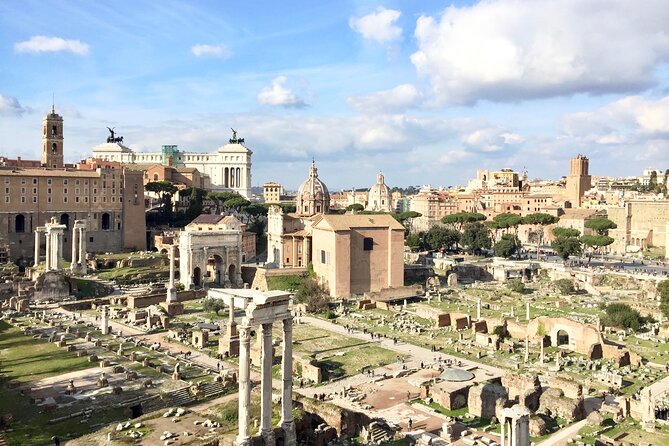
At the top, you get broad views across the Forum and toward the Colosseum. The elevation also helps you understand why the hill became associated with imperial power. From here, Rome’s rulers could look across the public spaces where their authority was displayed.
One important point: Palatine Hill is much larger than a quick lookout. A guide may lead you to the main views and key remains, but 35 minutes will not cover every section. The tour operator states that you may remain in the archaeological area after the official visit, so use that option if you want more time. The extra time is particularly valuable on Palatine Hill, where ruins can be easy to pass without explanation.
What happens with Circus Maximus
From Palatine Hill, you can look toward the Circus Maximus, the enormous venue associated with chariot races, public games, and mass entertainment. The guide uses the view to explain the role of Roman games and the old myths linked with the site.
The wording here matters. Circus Maximus is seen from Palatine Hill, but the tour does not enter the Circus or provide a separate Circus Maximus visit. One visitor expected a walk there and found the misunderstanding very disappointing, especially because that site was a personal priority.
If you want to stand inside Circus Maximus or take a dedicated tour with special equipment, this is not the right booking. Choose this experience for the Forum and Palatine Hill, and treat the Circus view as an added perspective rather than a third paid attraction.
How small is the small group?
The maximum group size is 24 people. That is more manageable than a large bus group, and the included sterilized headsets help you hear the guide clearly while walking through open ruins.
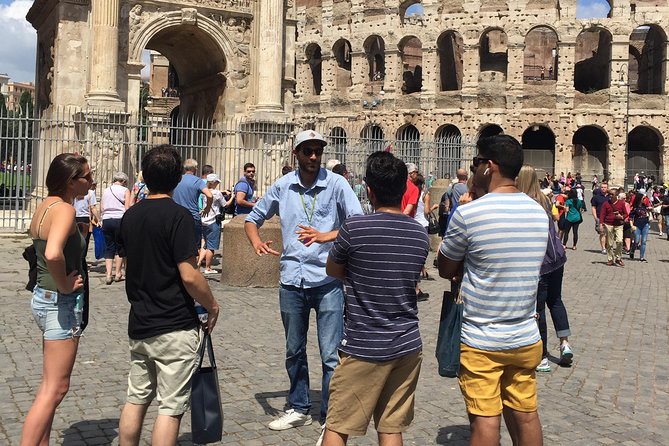
Still, 24 is not the same as a private tour or a group of six. Your experience may depend on where you are standing and how easy it is to keep close to the guide. Arrive at least 10 minutes early for the sign-up process and security check.
The strongest guide feedback highlights warmth, humor, and personal attention. Francesca has been praised for her friendly manner and engaging delivery. Rosy has also received praise for making the visit enjoyable and for providing useful ticket information. Another guide was credited with staying engaged during a hot day and remaining patient when entry took longer than expected.
The guide’s approach matters here. The Forum can be tiring and abstract, so a clear story and a bit of humor make a real difference. One guide also adjusted directions for a visitor with mobility problems, though the tour itself still includes uneven paths and uphill walking.
Timing, heat, and getting inside
The meeting point is at Piazza del Colosseo, 21, near the Colosseum. The tour ends inside the Roman Forum, not back at the starting point. That is helpful if you want to continue exploring, but you should not plan on returning to the Colosseum plaza immediately after the official walk.
Security checks are mandatory. The wait may be 5 to 30 minutes, depending on the season, so do not schedule a tight connection afterward. A delayed start can reduce the time spent moving through the ruins, though the guide may adjust when possible.
Bring comfortable shoes and be ready for sun and heat. Food and drinks are not included, and large backpacks and trolleys are not allowed inside. Your passport or valid identification must match the full name entered at booking, and each person must present the matching document for entry.
The experience is offered in English, with several possible tour times. Confirmation arrives at booking, and mobile tickets are accepted. The tour is near public transportation, but hotel pickup and drop-off are not included.
Is $83.13 a fair price?
At $83.13 per person, this is not the cheapest way to see the Forum and Palatine Hill. The price includes admission, a live guide, and a headset, which removes some of the hassle of arranging the visit yourself.
The value depends on how much help you want with the ruins. If you already know Roman history and prefer to set your own pace, you may find the short guided route limiting. You are paying for interpretation and organization, not simply access.
For a first visit, the price can make sense because the Forum is difficult to read without context. The guide connects religious sites, public buildings, law, military triumphs, and imperial power in a compact route. You can then stay in the archaeological area after the formal tour, which improves the value if you have time to explore alone.
The 96 percent recommendation rate and 4.7 rating suggest strong overall satisfaction, but the small number of ratings means you should still read the details of what is included. Most important, remember that the Colosseum and Circus Maximus entrance are not part of this price.
Who should book this Roman Forum tour?
I would choose this experience if you are visiting Rome for the first time, want a clear introduction to ancient Rome, and prefer a guide to explain what you are seeing. It also suits you if your schedule is tight and you want the Forum and Palatine Hill covered in one compact visit.
It is a good match for families and couples who want a structured walk rather than a self-guided visit. The short duration can help if you are fitting ancient Rome between other plans, though the heat and hills still require some stamina.
I would choose another experience if you want extensive time on Palatine Hill, a dedicated Circus Maximus visit, or entry to the Colosseum. You should also think twice if you dislike fixed routes or have difficulty with uneven ground and slopes.
Free cancellation is available up to 24 hours before the start time. That gives you some flexibility, but changes or cancellations inside that window are not accepted for a refund.
Should you book it?
Book this tour if you want the Roman Forum and Palatine Hill explained clearly in 90 minutes, with admission and an English-speaking guide handled for you. Its best features are the historical connections, the manageable route, and the chance to remain inside the Forum afterward.
Do not book it expecting the Circus Maximus to be a walking stop or the Colosseum to be included. Set those expectations correctly, arrive early with matching identification, wear practical shoes, and keep time afterward for the parts of Palatine Hill the guided route cannot cover. For a first look at ancient Rome, that makes this a useful and well-organized introduction.
FAQ
How long does the tour last?
The guided experience lasts approximately 1 hour and 30 minutes.
What sites are included?
The route includes the Arch of Constantine, Roman Forum, Basilica Julia, Basilica of Maxentius, Arch of Titus, Temple of Venus and Roma, and Palatine Hill.
Is the Colosseum included?
No. Entrance to the Colosseum is not included.
Does the tour enter Circus Maximus?
No. Circus Maximus is viewed from Palatine Hill. Entrance to Circus Maximus is not included.
Can I stay after the guided tour ends?
Yes. You can remain in the archaeological area as long as you wish after the official tour ends. The tour finishes inside the Roman Forum.
How large is the group?
The tour has a maximum of 24 participants.
Is the tour offered in English?
Yes. The experience is offered in English with a live professional guide.
What should I bring for entry?
Each person must bring a valid passport or identification document matching the full name provided at booking.
Can I cancel for a refund?
Yes. You can cancel at least 24 hours before the start time for a full refund. Cancellations or changes made less than 24 hours before the experience are not accepted for a refund.
Newest reviews from Rome
- ROME:Colosseum & Ancient Rome – private/small group TOUR★ 5.0 · 24 reviews
- Off the Beaten Track in Rome: Rione VI Parione Private Tour★ 5.0 · 24 reviews
- Cinematic Photoshoot in Rome★ 5.0 · 24 reviews
- Rome: Best of Colosseum and Roman Forum Small Group Guided Tour★ 4.5 · 24 reviews
- The Labyrinth of Rome between catacombs and ancient quarries★ 4.5 · 24 reviews
- Vatican and Trionfale Market Tour with Wine and Food Tasting★ 5.0 · 24 reviews
- private tour: Vatican Museums, Sistine Chapel, St. Peter’s Basilica★ 4.5 · 24 reviews
- Colosseum guided tour with Virtual Reality★ 5.0 · 24 reviews
Roman Forum & Palatine Hill, compared.
Colosseum, Palatine Hill and Roman Forum Guided Tour
Read our review →
Guided Tour of Colosseum, Roman Forum & Palatine Hill
Read our review →
Colosseum, Roman Forum and Palatine Hill Guided Tour
Read our review →
Colosseum, Forum & Palatine Hill Tour & Optional Arena
Read our review →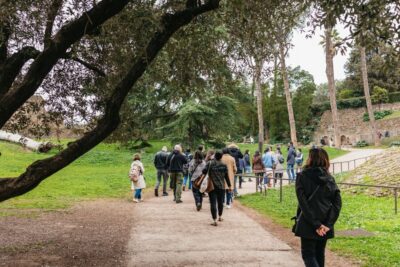
Colosseum, Palatine Hill & Roman Forum Guided Tour
Read our review →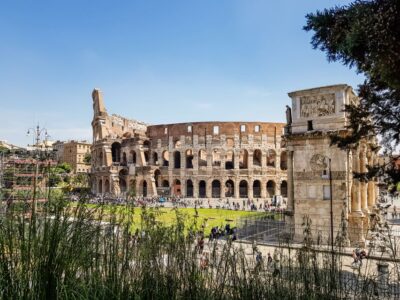
Colosseum Arena, Palatine Hill & Forum Guided Tour
Read our review →
Colosseum, Roman Forum & Palatine Hill Guided Tour
Read our review →Colosseum, Roman Forum And Palatine Hill Guided Tour
Read our review →Browse the lists this tour appears in