

Reviewed · TOURS
The ORIGINAL Fiat 500 3hour chauffeured tour
Rome is made for a small car, and this tour puts you in one of Italy’s most recognizable ones. The vintage Fiat 500 slips into narrow streets, pauses beside major monuments, and turns an ordinary sightseeing circuit into a very photogenic three hours.
I like the wide spread of stops, from the Baths of Caracalla and Circus Maximus to the Pyramid of Cestius and Monte Testaccio. I also like the personal touch: drivers such as Alex, Pier, and Marco are described as lively guides who explain the city, take photos with your camera, and adjust the route to your interests.
The main thing to consider is comfort and safety. These classic cars have no seat belts or airbags, the tour requires at least two people, and passengers over 100 kilograms, or 220 pounds, cannot take part. Hotel pickup is included only in certain areas outside Rome’s central restricted traffic zone.
In This Review
- Key points about the vintage Fiat 500 tour
- Why a tiny Fiat works so well in Rome
- Baths of Caracalla: Rome’s enormous spa complex
- Circus Maximus and the sound of ancient crowds
- The Aventine keyhole and the Orange Garden
- Trastevere in a car built for narrow lanes
- Janiculum Hill and Rome’s skyline
- The Pyramid of Cestius at Porta San Paolo
- The Colosseum photo stop
- Monte Testaccio, Rome’s hill of broken vessels
- What the $211.72 price really buys
- Pickup, meeting point, and practical limits
- Who will enjoy this Rome tour most
- Should you book the Fiat 500 tour?
- FAQ
- How long does the Fiat 500 tour last?
- Where does the tour start?
- Where does the tour end?
- Is hotel pickup included?
- Does the tour include entry to the Colosseum or other monuments?
- What languages are offered?
- Are there any passenger restrictions?
Key points about the vintage Fiat 500 tour
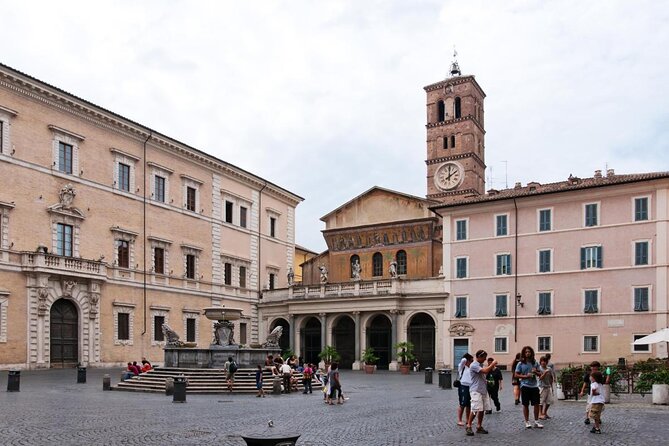
- Nine Roman stops in three hours: You see ancient baths, race tracks, churches, viewpoints, neighborhood streets, and famous monuments in one compact outing.
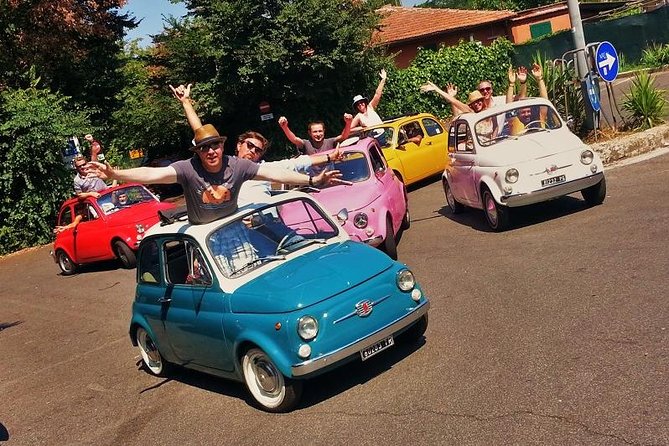
- A true Italian photo prop: The classic Fiat, including a much-praised pink car, becomes part of your holiday photographs.
- More than the usual postcard circuit: Monte Testaccio, Porta San Paolo, and the Aventine keyhole add unusual sights to the Colosseum and Trevi Fountain route.
- Drivers who do more than drive: Alex, Pier, Marco, and other guides provide history, local advice, photography, and route changes when possible.
- Coffee in Trastevere: The itinerary includes time for an espresso or cappuccino during a stop in one of Rome’s most atmospheric neighborhoods.
- A sightseeing ride, not an interior tour: Admission is not included because the stops are for viewing, explanations, and photographs from outside.
Why a tiny Fiat works so well in Rome
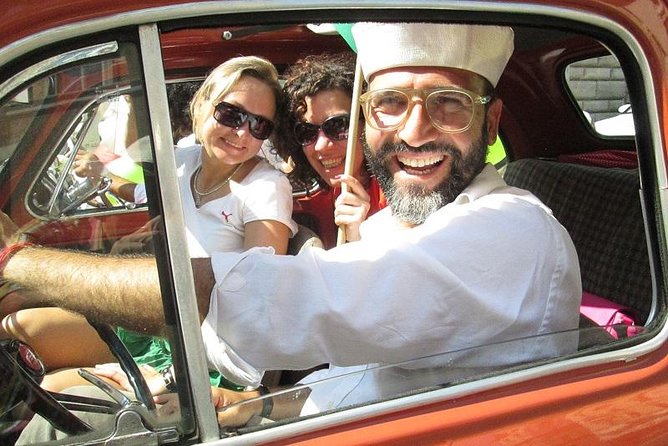
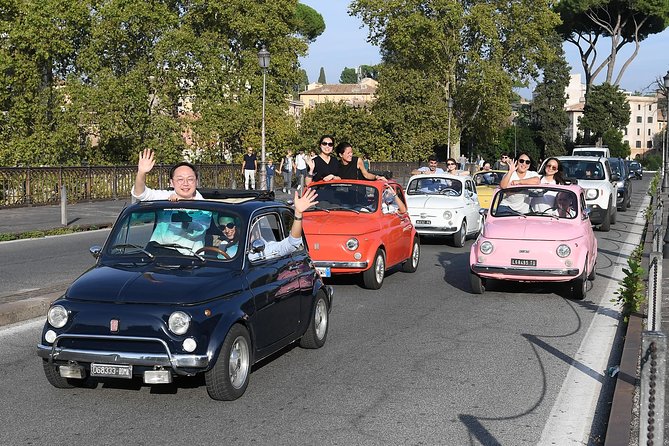
The Fiat 500 is not simply transportation here. It is part of the experience. Its small size suits Rome’s tight lanes, especially around Trastevere, where a larger vehicle would lose much of the charm. You will also attract attention. The car is colorful, old-fashioned, and conspicuous in the best possible way.
This is a good choice if you want to cover a lot of Rome without spending three hours on foot. You still get out to look around, but the car carries you between the sights and gives your legs a break. It also helps you connect places that feel far apart on a map, such as the Baths of Caracalla, Janiculum Hill, and Monte Testaccio.
The tour is guided in English. The drivers named in the praise for the experience include Alex, Pier, and Marco, with Alex receiving particular attention for his history stories, photography, easy manner, and willingness to tailor stops. Marco is described as a French-speaking guide who offered advice about pizza and carbonara. Your assigned driver may be different, but the experience clearly depends heavily on the individual behind the wheel.
You should think of this as a private-feeling chauffeured ride with planned stops, not a formal museum tour. The driver gives context, you take photos, and you see a lot from the street. It is especially useful during a first visit or a short stay.
Tours travellers often pair with this one in Rome:
- Vatican: Museums & Sistine Chapel Entrance Ticket
★ 4.5 · 144,003 reviews - Vatican Museums & Sistine Chapel Tour with Optional Basilica
★ 4.3 · 67,413 reviews - Vatican Museums, Sistine Chapel & St Peter’s Basilica Guided Tour
★ 4.5 · 39,149 reviews
Baths of Caracalla: Rome’s enormous spa complex
The first stop is the Terme di Caracalla, the ruins of one of ancient Rome’s largest bath complexes. The site covered an area compared with roughly 15 football pitches and offered much more than hot and cold baths.
Ancient bath culture included libraries, gyms, gardens, fountains, lecture rooms, and entertainment spaces. That makes this a useful early stop because it shows how Roman public life worked beyond the arena and forum. You can picture the complex as a huge social and leisure center, not just a place to wash.
You have about 20 minutes here, with no admission ticket included. That is enough for an introduction and photographs, but not a full archaeological visit. If the baths are high on your personal list, you will need a separate visit with more time.
Circus Maximus and the sound of ancient crowds
At Circus Maximus, the focus shifts from bathing to spectacle. This was the great chariot-racing track, built centuries before the Colosseum and large enough for enormous crowds. The tour places the site in the setting of the famous Ben-Hur-style races, though today the broad open space is much quieter.
The stop lasts about 20 minutes and is free. Modern concerts have also taken place here, including performances associated with the Rolling Stones, Roger Waters, and Bruce Springsteen. That link between ancient mass entertainment and modern concerts gives the empty track a little life.
Do not expect the same intact structures you see at the Colosseum. Much of Circus Maximus is an open area, so the value comes from scale and setting. Your driver’s explanation matters here, since the remaining ground alone does not tell the whole story.
The Aventine keyhole and the Orange Garden
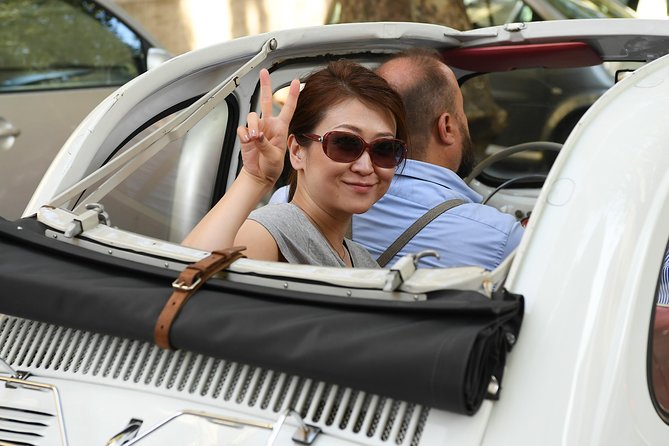
The Buco della Serratura, or keyhole viewpoint, is one of the tour’s most unusual photo stops. Through a carefully placed keyhole, you see the dome of St. Peter’s framed in the distance, with three countries appearing in line.
It is a quick, clever stop rather than a major monument visit. You will have around 20 minutes to look, take pictures, and photograph the Fiat nearby. The sight works best as a small surprise between larger ruins and viewpoints.
From there, Parco Savello, better known as the Garden of the Oranges, offers a broader look at Rome. The garden is also called the Garden of the Lovers, and its view toward St. Peter’s includes a striking optical effect that makes the dome appear unusually close.
This is one of the calmer moments in the tour. You get a chance to step away from traffic, enjoy a panoramic view, and see why the Aventine Hill is prized for romantic city scenes. The tour does not include a long garden visit, so treat it as a scenic pause rather than a leisurely stroll.
A completely different way to spend the day in Rome:
- Rome: Colosseum, Palatine Hill and Roman Forum Guided Tour
★ 4.8 · 32,814 reviews - Rome: Guided Tour of Colosseum, Roman Forum & Palatine Hill
★ 4.7 · 27,897 reviews - Rome: Colosseum & Forum with Audio Guide App -Optional Arena
★ 4.2 · 24,770 reviews - Rome: Colosseum, Roman Forum and Palatine Hill Guided Tour
★ 4.5 · 23,903 reviews
Trastevere in a car built for narrow lanes
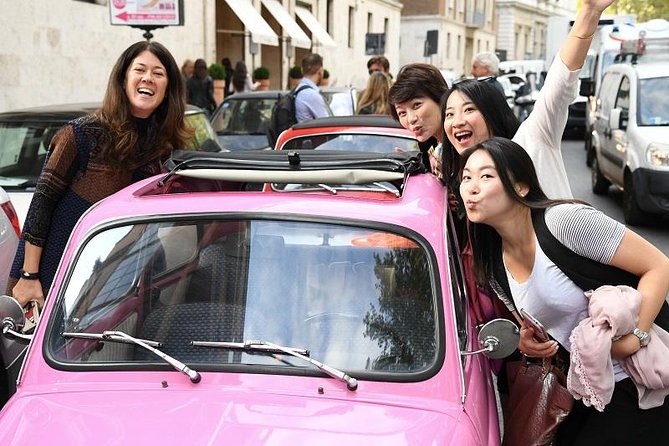
Trastevere is where the Fiat 500 earns its keep. The neighborhood’s small streets and old urban layout are much better suited to a tiny car than to a large sightseeing vehicle. You will pass through lanes where the vehicle itself becomes part of the show.
People may stop to take pictures of the car, and you may find yourself waving at onlookers. That playful attention is central to the mood. This is not a quiet, anonymous transfer from one monument to another. The ride has a light, theatrical quality.
The stop includes time for a double espresso or cappuccino. The exact café is not specified, so do not book this expecting a particular coffee shop. Still, a short coffee break helps divide the historical stops and gives you a taste of everyday Roman life.
The itinerary calls this possibly the best coffee you will ever have, which is clearly enthusiastic sales language. The practical point is simpler: you get a refreshment stop in Trastevere, and light refreshments are included in the tour.
Janiculum Hill and Rome’s skyline
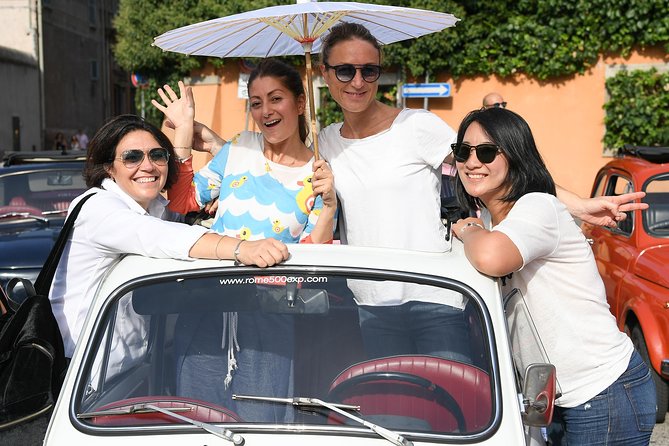
At Piazzale Giuseppe Garibaldi, on the Janiculum terrace, you get one of the strongest city views on the route. From here, you can look across Rome toward the Colosseum, Pantheon, Altare della Patria, and the city’s many church domes.
The view gives you a helpful sense of Rome’s shape. Instead of seeing each monument as a separate stop, you can understand how the historic center spreads across the hills and lower ground. The broad panorama also makes this a good place for photographs with the Fiat.
As with the other stops, you have roughly 20 minutes. Bring your camera and keep your expectations realistic: this is a viewpoint stop, not a long walk along the hill. The tour’s photo service is informal. Your driver will take pictures with your own camera, which is especially useful for couples or small groups who want everyone in the frame.
The Pyramid of Cestius at Porta San Paolo
Rome’s Pyramid of Cestius is one of the route’s best surprises. Built in 18 BCE as the tomb of Gaius Cestius, a wealthy Roman, it was modeled in the Egyptian style. The tour describes it as the fourth-largest ancient Egyptian pyramid, a striking claim that helps explain why this monument feels so unexpected in Rome.
The pyramid sits near Porta San Paolo, adding an ancient Egyptian note to a city usually associated with emperors, popes, and Baroque fountains. You will have around 20 minutes to see it from the stop and take photographs.
This is another place where a short explanation adds real value. Without context, it can look like an isolated stone structure beside a busy road. With the story of Cestius and Roman fascination with Egypt, it becomes a memorable piece of the city’s visual mix.
The Colosseum photo stop
The Colosseum is the route’s big-name stop. You pause in front of it for photographs and a short explanation of its role as the model for later stadiums. The building took only eight years to construct and helped set the pattern for arenas across the Roman world.
The tour does not include entry, an interior visit, or an archaeological guide inside the amphitheater. That is important when comparing the price with a Colosseum ticketed tour. You are paying for the chauffeured route, the guide, the car, the photo help, and the ability to see many parts of Rome, not for admission to the monument.
Still, the outside view has practical value. You can get a strong first look, take holiday photos, and return later for a full visit if you have time. The stop also works well for anyone who wants to avoid spending the whole day walking between the Colosseum and other distant sights.
Monte Testaccio, Rome’s hill of broken vessels
The Via Galvani stop introduces a less familiar side of Roman history. Monte Testaccio is an artificial hill made from broken terracotta vessels. These containers once carried olive oil, fish sauce, wine, and other goods.
Over many centuries, the discarded pieces formed a hill about 40 meters high and 700 meters around. The total is estimated at roughly 50 million vessels. That scale makes the place a useful reminder that ancient Rome was also a huge trading and supply center, not just a city of temples and emperors.
You have about 20 minutes here. The stop is more educational than scenic, though the oddness of an ancient pottery dump becoming a hill is exactly what makes it memorable. It also gives the route a welcome change from famous monuments.
What the $211.72 price really buys
At $211.72 per person, this is not a cheap way to get from one Roman sight to another. The value depends on how much you want the vintage car, a chauffeured route, guided commentary, and photographs.
For that price, you receive about three hours with a driver, hotel pickup and drop-off in eligible areas, light refreshments, and photo help using your camera. You also cover nine stops that would be difficult to connect efficiently on foot, especially if you are short on time.
The price makes more sense for couples, families, or small groups who care about the style of the outing. It is less compelling if your main goal is entering monuments or hearing a long scholarly lecture at each site. In that case, spend the money on admission-based tours and use Rome’s public transportation or taxis between sights.
The consistently high rating, with 100 percent of people recommending the experience and 142 five-star ratings listed, points to a strong match between the tour’s promise and its delivery. The praise centers on the guides’ friendliness, photography, route knowledge, and ability to customize the outing. Those are the features most likely to determine your satisfaction.
Pickup, meeting point, and practical limits
The listed starting point is Via Labicana 125 in Rome, and the activity ends back there. Hotel pickup and drop-off are included only when the hotel is outside the central ZTL, or restricted traffic zone. If your hotel is inside that zone, plan to reach the meeting point yourself.
Confirmation is normally issued at booking. A booking made within 12 hours of departure may require additional time for confirmation, subject to availability. Free cancellation is available until 24 hours before the start time. A cancellation inside that window is not refundable, and the operator may offer a new date or a full refund if the minimum number of people is not met.
Most people can participate, and service animals are allowed. The cars have no seat belts or airbags, so this is not the right choice if you need modern vehicle safety features. The maximum group size is 20, and at least two people must book together.
The weight limit is 100 kilograms, or 220 pounds, per passenger. This is worth checking before you pay, since the small cars have limited space and the restriction is explicit.
Who will enjoy this Rome tour most
I would choose this for a first-time visitor who wants a fast orientation and a memorable way to move around the city. It also suits couples looking for photographs, families who need a break from long walks, and people with only a short stay in Rome.
It works well for anyone who likes unusual details. The keyhole, Pyramid of Cestius, Monte Testaccio, and Aventine views give you more than a standard list of central monuments. You also get a look at Trastevere and Rome from its hills.
You may want something else if you need wheelchair access information, modern car safety equipment, interior monument visits, or a slow-paced archaeological tour. The supplied details confirm general participation for most people, but they do not provide specific vehicle accessibility information.
Should you book the Fiat 500 tour?
Book it if you want Rome to feel like a colorful road movie, complete with a tiny classic car, quick historic stops, coffee in Trastevere, and city views from the hills. It is particularly useful when you have limited time and want a broad introduction without walking between every sight.
Skip it if your priority is entering the Colosseum, Pantheon, or other monuments, since this experience focuses on exterior stops. Also skip it if the lack of seat belts and airbags is a deal breaker.
For the right person, the cost buys more than transport. It buys an entertaining route, personal guidance, memorable photographs, and a look at Rome that links famous sights with places many first-time visitors miss.
FAQ
How long does the Fiat 500 tour last?
The tour lasts approximately three hours.
Where does the tour start?
The listed meeting point is Via Labicana, 125, 00184 Rome, Italy.
Where does the tour end?
The activity ends back at the meeting point on Via Labicana.
Is hotel pickup included?
Hotel pickup and drop-off are included if your hotel is outside the central ZTL area. Pickup and drop-off are not included for hotels located inside the central ZTL.
Does the tour include entry to the Colosseum or other monuments?
No. The stops are for outdoor viewing, explanations, and photographs. Admission tickets are not included.
What languages are offered?
The tour is offered in English.
Are there any passenger restrictions?
A minimum of two people is required per booking, and the maximum is 20 people. Passengers weighing more than 100 kilograms, or 220 pounds, cannot participate. The cars also have no seat belts or airbags.
Newest reviews from Rome
- Fiumicino Airport Arrivals Private Transfer Free with private half day tour of Rome★ 5.0 · 23 reviews
- Full Day Tour of Rome★ 5.0 · 23 reviews
- Private Tour – Palazzo Barberini★ 5.0 · 23 reviews
- From Rome: Private Day-Tour of Tuscany★ 4.3 · 23 reviews
- Rome at the Sunset; Navona, Trevi Fountain, Pantheon and more★ 5.0 · 23 reviews
- Rome Key Sights Golf Cart Tour | Private & Groups★ 5.0 · 23 reviews
- Rome: Wonders of Ancient Rome at Dusk★ 4.8 · 23 reviews
- Private Golf Cart Twilight Tour Rome★ 4.5 · 23 reviews
Tours, compared.
Vatican Museums & Sistine Chapel Tour with Optional Basilica
Read our review →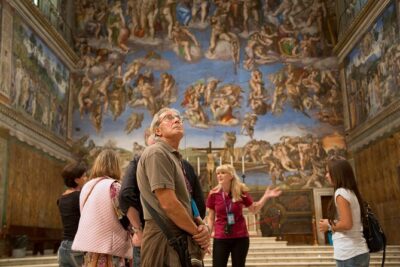
Vatican Museums, Sistine Chapel & St Peter’s Basilica Guided Tour
Read our review →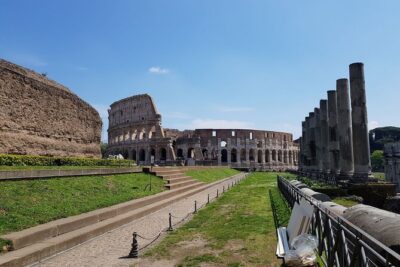
Colosseum, Palatine Hill and Roman Forum Guided Tour
Read our review →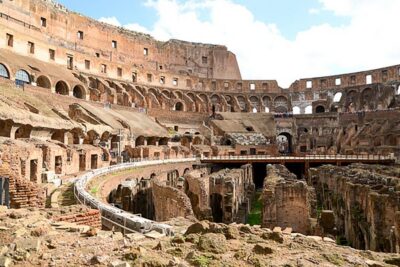
Guided Tour of Colosseum, Roman Forum & Palatine Hill
Read our review →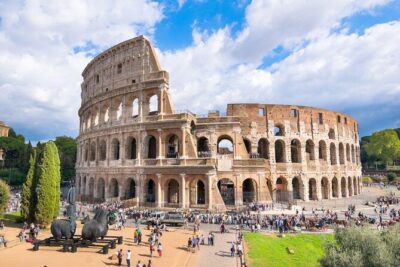
Colosseum, Roman Forum and Palatine Hill Guided Tour
Read our review →
Vatican Museums, Sistine Chapel & Basilica Tour
Read our review →
Colosseum, Forum & Palatine Hill Tour & Optional Arena
Read our review →