
Reviewed · APPIAN WAY TOURS
Ancient Appian Way PRIVATE Bike Tour
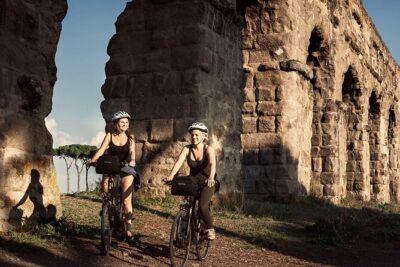
Rome’s ancient Appian Way is one of the best places in Rome to trade traffic and crowds for open fields, Roman ruins, and the towering remains of old aqueducts. This private e-bike tour covers a lot of ground, about 14 miles according to one family, while giving you a guide’s stories at each stop.
I like the private format, since your guide can adjust the pace and answer your questions. I also like the chance to ride through Caffarella Park and the Aqueduct Park, two places many first-time visitors miss. The catch is real city traffic at the start, plus cobblestones and off-road paths. You must already know how to ride a bike well.
In This Review
- Key points to know before you book
- Why the Appian Way makes a fine break from central Rome
- Porta San Sebastiano, where the old road begins
- Caffarella Park and the Nymphaeum of Egeria
- Aqueduct Park, the visual prize of the ride
- Villa dei Quintili and Santa Maria Nova
- Cecilia Metella’s tomb and the medieval Caetani complex
- The Circus of Maxentius and a vanished obelisk
- Ending at the Baths of Caracalla
- What the private guide adds
- Bikes, children, and physical demands
- Is $147.54 per person a fair price?
- Who should book this ride?
- My verdict on the Ancient Appian Way private bike tour
- FAQ
- How long does the Ancient Appian Way bike tour last?
- How much does the tour cost?
- Is this a private tour?
- What language is the tour offered in?
- Where does the tour start?
- Where does the tour end?
- What equipment is included?
- Are child seats available?
- Can children aged 6 to 10 receive a reduced price?
- Do I need to be an experienced cyclist?
- Does the e-bike have a throttle?
- How much city traffic is included?
- Can I cancel for a full refund?
Key points to know before you book
- Ancient roads and aqueducts: See the Appian Way, Cecilia Metella’s tomb, the Circus of Maxentius, and Roman waterworks in one half-day.
- About 14 miles by e-bike: The electric assist helps, but the bike has no throttle. You still need to pedal.
- Private English-speaking guide: Guides such as Valerio, Sara, Sarah, Claudio, Nico, Chris, Alex, Iman, and Marco have led highly praised rides.
- A strong family option: Child seats are available up to 25 kilograms, and children aged 6 to 10 may use a trailer bike if they are under 143 centimeters.
- Roughly 20 percent city riding: You share some busy roads with Rome traffic before reaching quieter parks and ancient paths.
- Good value for active sightseers: At $147.54 per person, the price pays for a private guide, bike, helmet, and a full half-day of sightseeing.
Why the Appian Way makes a fine break from central Rome
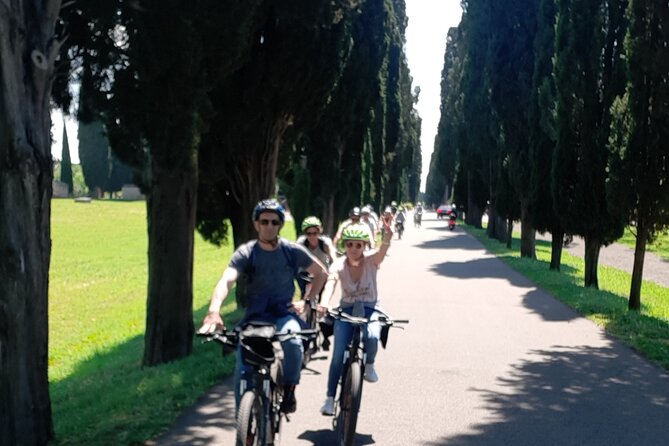
Rome can wear you out. You spend hours moving between famous sights, crossing busy streets, and looking up at buildings while trying not to get clipped by a scooter. This ride gives you a very different view of the city.
The Appian Way, or Via Appia Antica, begins beyond the usual historic-center circuit. The route combines Roman walls, country-like parkland, tombs, ancient villas, aqueducts, and open space. You still see major monuments, but you see them with room around them.
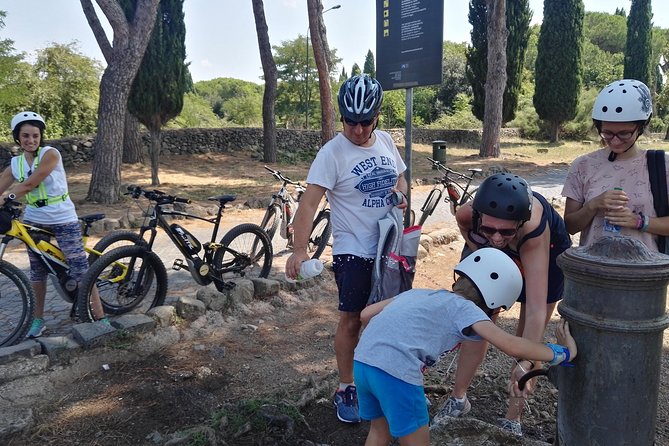
The electric bike matters because the route is long. You can cover far more ground than you could on foot, yet you are not sealed inside a bus or car. You feel the change from city streets to rough Roman paving and park paths.
Do not mistake e-bike for motorbike. The bikes are pedal-assisted, with no throttle. One rider described the pedaling as manageable, but you still need to work, especially over uneven ground and during a four-hour outing.
More Appian Way days out:
- Rome EBike Tour: Appian Way, Catacombs & Roman Aqueducts
★ 5.0 · 1,766 reviews - Rome: Appian Way, Catacombs, & Roman Aqueducts E-bike Tour
★ 4.9 · 1,421 reviews - Rome:Appian Way E-bike Tour with Catacombs, Aqueducts & Food
★ 4.9 · 1,210 reviews
Porta San Sebastiano, where the old road begins
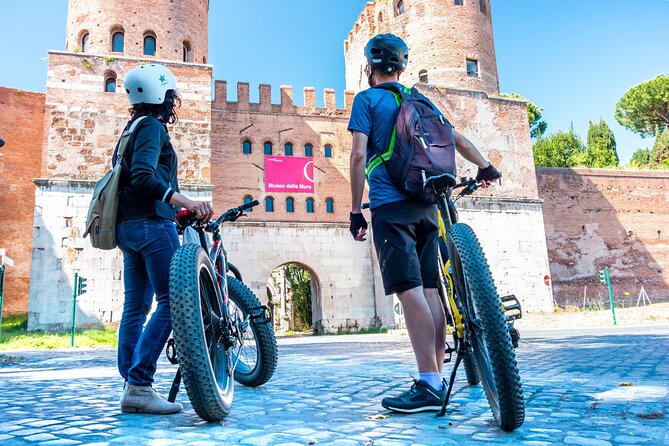
The tour begins at Via dei SS. Quattro, 58, near public transportation. From there, you reach Porta San Sebastiano, one of the main gateways through Rome’s Aurelian Walls.
The gate dates to the wall system built around 275 AD and marks the start of the historic Appian Way. Your guide can point out the medieval graffiti left by pilgrims who passed through over many centuries. That small detail helps you see the road as more than a Roman relic. It remained a working route long after the empire changed.
You spend about 20 minutes here. Admission is included at no extra charge, as it is for the listed stops. The opening city portion is also where you need the most care. About 20 percent of the ride takes place in city traffic, and one rider specifically warned about busy roads and unpredictable Roman drivers.
That does not make the tour a poor choice. It simply means you should be comfortable riding near traffic before you sign up. The private guide can help your group stay together, but this is not a beginner cycling lesson.
Caffarella Park and the Nymphaeum of Egeria
Caffarella Park is where the ride begins to feel like an escape. This large green area forms part of the Appian Way Regional Park, with paths, groves, fields, and remains of ancient structures spread through the open space.
I like this section because it changes your sense of Rome. You are still close to the city, but the setting feels far removed from the streets around the Colosseum and Trevi Fountain. The park also gives children somewhere more appealing than another museum gallery, although the route still requires attention and steady riding.
The next stop is the Nymphaeum of Egeria, a sacred spring tied to the story of Egeria and Numa Pompilius, Rome’s second king. According to the legend, Egeria wept after learning of her beloved’s death, and her tears became the spring.
You get about 20 minutes at each of these stops. That is enough for an explanation and photos, but not enough for a long archaeological study. If you want to read every sign or explore each site at length, the pace may feel brisk.
Aqueduct Park, the visual prize of the ride
Aqueduct Park is likely to be the high point for many people. Ancient water channels cross the broad park in great arches, showing the scale and skill of Roman engineering.
The park was once crossed by the Via Latina, described in the tour information as Rome’s oldest road. It also formed part of the water network that supplied the ancient city. Some aqueduct remains are well preserved, and some channels are still in operation.
This is the kind of place where the e-bike earns its keep. You can ride across a large open area, stop beneath the arches, and take in the long views without spending half the day walking there. One rider who had visited Rome several times said the aqueducts were entirely new to them. That is a useful clue: this route adds something different even if you have already seen Rome’s most famous monuments.
The park is also a strong photo stop. The long lines of stone and the wide open setting make the structures feel much larger than they do in a crowded museum or a city street. Your guide’s explanation gives the ruins a purpose, so you are not only looking at arches but understanding the water system they served.
More bike days around Rome:
- Rome: Top Highlights & Hidden Gems Tour by Cannondale E-Bike
★ 4.9 · 1,760 reviews - Rome City Small Group Bike Tour with quality Cannondale EBike
★ 5.0 · 1,380 reviews - Rome by Night – Ebike Small Group Tour – Food and Wine (Option)
★ 5.0 · 1,275 reviews - Rome: E-Bike Night Tour with Food and Wine Tasting
★ 4.9 · 1,131 reviews
Villa dei Quintili and Santa Maria Nova
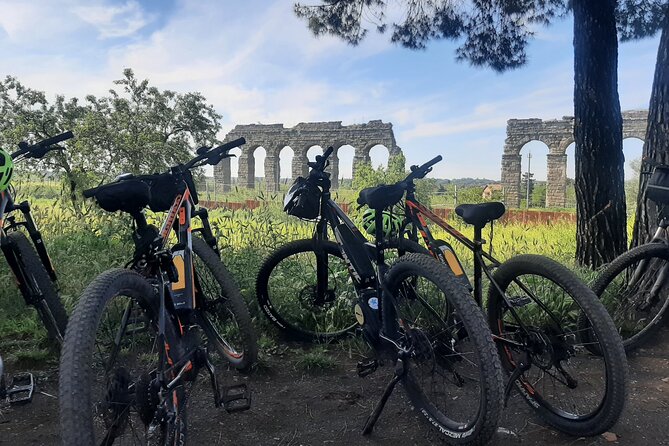
At about the fifth mile of the Appian Way, the route reaches the remains of Villa dei Quintili and Santa Maria Nova. The villa belonged to the brothers Sextus Quintilius Condianus and Maximus Valerius, consuls in the second century AD.
The brothers were killed by Emperor Commodus, who confiscated the property and made it part of the imperial estate. That story gives the villa a sharp political edge. Roman luxury was never just about comfort. Wealth, office, and personal safety could all depend on the emperor’s favor.
The stop is listed at around 20 minutes, so expect an overview rather than a full visit to every ruin. The value here is the setting and the connection between the road, the villa, and imperial power. You get another look at how Roman life extended beyond the city center.
Cecilia Metella’s tomb and the medieval Caetani complex
The Mausoleum of Cecilia Metella is one of the most recognizable monuments along the Appian Way. This large pagan tomb dates to the first century BC and remains one of the best-preserved mausoleums on the road.
The monument later became part of the Castrum Caetani, a medieval fortified complex. You can also see remains of the Caetani family’s medieval residence and the perimeter walls of the church of San Nicola.
This combination is what makes the stop worthwhile. You are not seeing only one period of Rome. A Republican-era tomb, a medieval stronghold, and a church ruin occupy the same setting, showing how later generations reused ancient sites.
The 20-minute stop should give you time to understand the main features and take pictures. If you are especially interested in ancient funerary architecture, you may wish you had longer. Still, the private format helps because you can ask your guide to focus on the parts that matter most to you.
The Circus of Maxentius and a vanished obelisk
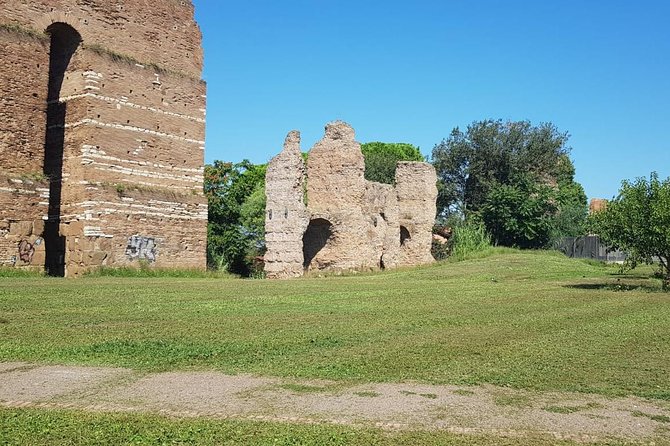
The Circus of Maxentius is described as the best surviving example of a Roman circus. The central spine, or spina, is still visible, helping you picture the long racing track and the spectacle once held here.
The circus originally had an obelisk on its central spine. During the Renaissance, that obelisk was moved to Piazza Navona, where it now forms part of Bernini’s Fountain of the Four Rivers.
That connection is especially useful if Piazza Navona is already on your Rome plans. You may have seen the obelisk in the fountain without knowing where it came from. Here, the tour links a famous central square with the ancient setting that supplied one of its most striking pieces.
Again, the stop lasts about 20 minutes. The site is best appreciated with a guide who can explain how the circus worked, rather than as a quick photo stop. Guides including Nico, who has studied ancient Greek and Latin and holds a degree in ancient history, have been singled out for making this period easier to picture. Guide assignments can change, but the tour’s private setup gives you a good chance to ask for more detail.
Ending at the Baths of Caracalla
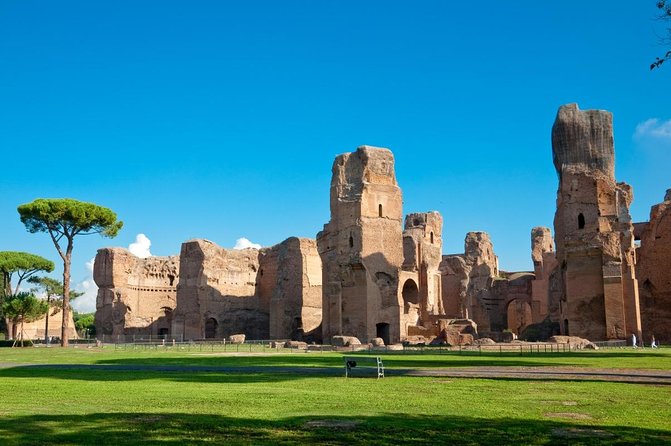
The Baths of Caracalla provide a powerful final stop. Built by Emperor Caracalla, they were for about a century the largest public baths in the Roman world. Much of the structure remains, including the enormous walls and spaces that once held pools, exercise areas, and social rooms.
A branch of the Aqua Marcia supplied water through the Antoninian aqueduct. Small remains of that water system can also be seen near Porta San Sebastiano, linking the beginning and end of the ride.
The baths help round out the day. Earlier stops show roads, tombs, villas, and aqueducts. Here, you see the scale of public life in imperial Rome. These were not simple bathing facilities. They were major public complexes built to serve and impress the population.
The activity ends back at the meeting point. Since the listed duration is about four hours, you should allow the full half-day rather than planning a tight connection immediately afterward.
What the private guide adds
The strongest part of this experience is the guide. A bike can get you from one ruin to another, but the guide turns a long ride into a connected story.
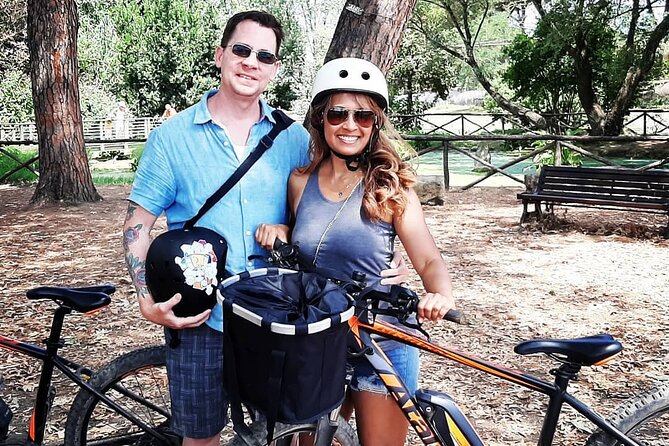
Guides named in the experience include Chris, Alex, Iman, Valerio, Nico, Claudio, Sara, Sarah, and Marco. The most praised traits are patience, flexibility, warmth, and strong knowledge of Roman history. Valerio helped riders with bike and helmet fitting, then adjusted the outing to their needs. Marco was praised for adapting to requests. Claudio was remembered for making the day feel personal, while Sara and Sarah were noted for combining humor with clear historical explanations.
A private tour also helps with family groups and mixed fitness levels. You can ask your guide to explain a monument in more detail, slow down for a child, or keep moving if everyone is eager to ride. The tour is offered in English, and one Japanese-language review noted that a private guide helped make the ride workable even when English or fitness was a concern.
Still, a private guide cannot remove every challenge. You remain responsible for controlling the bike, watching traffic, and handling rough surfaces.
Bikes, children, and physical demands
The tour includes a high-quality e-bike, helmet, mobile phone holder, and handlebar holder. A child seat is available for children up to 25 kilograms.
Children aged 6 to 10 qualify for the child rate only if they are under 143 centimeters tall. The reason given is practical: they use a trailer bike rather than riding a bike alone. Check your child’s height before booking, since age by itself does not determine the discount.
The route is suitable for a family that already cycles comfortably. One family covered the ride with children aged 11, 9, 7, and 5 and found the day highly enjoyable, but the formal conditions specify the child equipment and age range above. Do not assume every child can use the same setup.
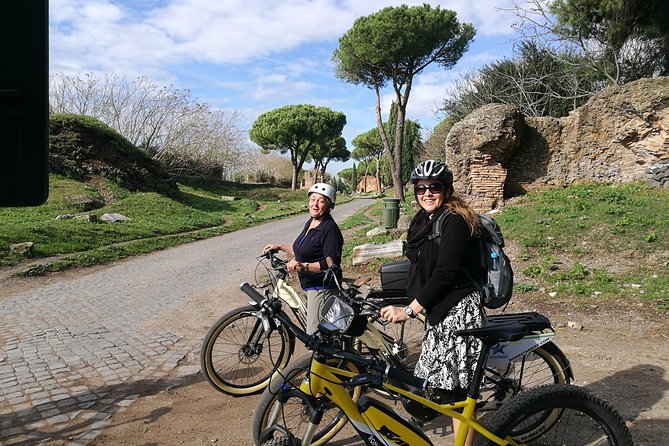
The tour requires moderate physical fitness and good bike skills. You will ride on city streets, cobblestones, and off-road park paths. Hot weather can make the four-hour outing harder, so consider the forecast and your group’s stamina when choosing a start time.
Is $147.54 per person a fair price?
At $147.54 per person, this is not a bargain bike rental. You are paying for a private, guided half-day with a high-quality e-bike, helmet, equipment holders, and child options.
The value improves if you want to see both the Appian Way and the aqueducts in one outing. Reaching these sites independently would require working out transport between several points, then finding your way across roads and park routes. You would also lose the historical thread connecting the monuments.
The price makes less sense if you want a slow archaeological visit at every stop. The tour gives most locations roughly 20 minutes, with the rest of the time spent riding. It is designed for broad coverage and outdoor sightseeing, not a deep visit to one villa or bath complex.
For a couple or small family that likes active touring, the private arrangement is a useful upgrade. You get the flexibility of a group tour without sharing the guide’s attention with strangers.
Who should book this ride?
I would choose this tour if you have already seen some central Rome or want a second side of the city. It is also a good first-day choice for people who enjoy movement, open space, and ruins more than long indoor visits.
Families should consider it seriously, especially if the children are comfortable on bikes. The child seat and trailer-bike option add flexibility, but parents should not treat the e-bike as effortless transport.
You should skip it if busy traffic makes you very nervous, if you cannot ride confidently, or if uneven roads are a serious problem. The tour includes real riding, not just a gentle cruise through a pedestrian park.
Free cancellation is available up to 24 hours before the start time. Changes or cancellations inside that window are not accepted for a refund. The tour is private, conducted in English, and begins and ends at Via dei SS. Quattro, 58.
My verdict on the Ancient Appian Way private bike tour
I would book this for the chance to see Rome’s aqueducts, parks, and ancient road in one well-planned ride. The route gives you major sights such as Cecilia Metella’s tomb, the Circus of Maxentius, and the Baths of Caracalla, but its real pleasure comes from the open spaces between them.
The best guides bring patience and personality to the history, and the private format lets you set the rhythm. Just be honest about your cycling ability. If you can handle traffic, cobblestones, and steady pedaling, this is a memorable way to reach the quieter Roman world beyond the usual center.
FAQ
How long does the Ancient Appian Way bike tour last?
The tour lasts approximately four hours.
How much does the tour cost?
The listed price is $147.54 per person.
Is this a private tour?
Yes. Only your group participates in the activity.
What language is the tour offered in?
The tour is offered in English.
Where does the tour start?
It starts at Via dei SS. Quattro, 58, 00184 Rome, Italy.
Where does the tour end?
The activity ends back at the meeting point.
What equipment is included?
You receive a high-quality e-bike, helmet, mobile phone holder, and handlebar holder.
Are child seats available?
Yes. A child seat is available for a child weighing up to 25 kilograms.
Can children aged 6 to 10 receive a reduced price?
Yes, but the reduction applies only to children under 143 centimeters tall. They use a trailer bike rather than riding a bike alone.
Do I need to be an experienced cyclist?
You must know how to ride a bike well. The tour includes city traffic, cobblestone roads, and off-road paths, and a moderate level of physical fitness is required.
Does the e-bike have a throttle?
No. The bike uses pedal assistance, so you still need to pedal.
How much city traffic is included?
About 20 percent of the ride takes place in city traffic.
Can I cancel for a full refund?
Yes, if you cancel at least 24 hours before the experience start time. Cancellations made less than 24 hours before the start time are not refunded.
Newest reviews from Rome
- ROME:Colosseum & Ancient Rome – private/small group TOUR★ 5.0 · 24 reviews
- Off the Beaten Track in Rome: Rione VI Parione Private Tour★ 5.0 · 24 reviews
- Cinematic Photoshoot in Rome★ 5.0 · 24 reviews
- Rome: Best of Colosseum and Roman Forum Small Group Guided Tour★ 4.5 · 24 reviews
- The Labyrinth of Rome between catacombs and ancient quarries★ 4.5 · 24 reviews
- Vatican and Trionfale Market Tour with Wine and Food Tasting★ 5.0 · 24 reviews
- private tour: Vatican Museums, Sistine Chapel, St. Peter’s Basilica★ 4.5 · 24 reviews
- Colosseum guided tour with Virtual Reality★ 5.0 · 24 reviews
Appian Way Tours, compared.

Rome EBike Tour: Appian Way, Catacombs & Roman Aqueducts
Read our review →
Appian Way, Catacombs, & Roman Aqueducts E-bike Tour
Read our review →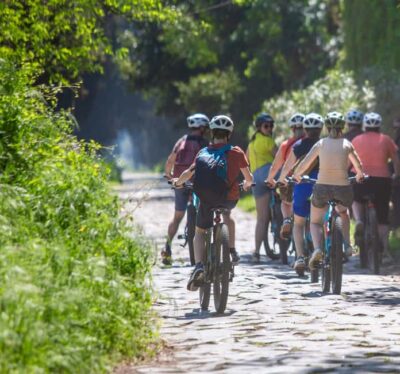
Appian Way E-bike Tour with Catacombs, Aqueducts & Food
Read our review →
Rome Underground: Catacombs Tour, Aqueducts and Appian Way
Read our review →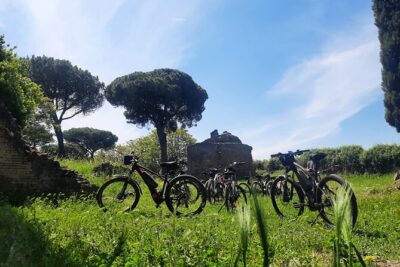
Appian Way Aqueducts Bike Tour (Catacombs & Lunch Option)
Read our review →
Appian Way, Catacombs and Aqueducts Park Tour with Top E-Bike
Read our review →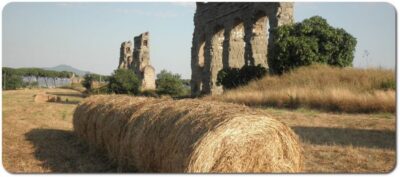
Appian Way E-Bike Tour Catacombs, Aqueducts & Picnic
Read our review →Browse the lists this tour appears in