

Reviewed · CASTEL SANT'ANGELO TOURS
Castel Sant’Angelo Skip-the-Line Entry & Optional Audioguide
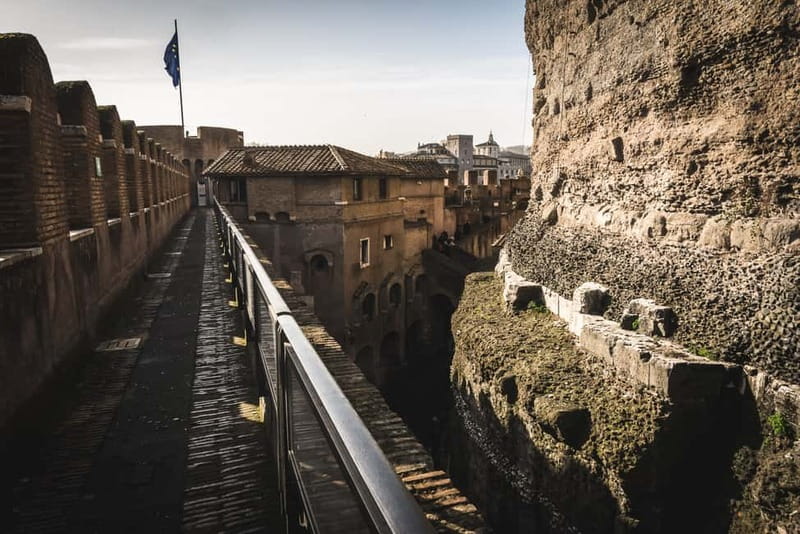
Castel Sant’Angelo packs nearly 2,000 years of Roman history into one unusual building. It began as a grand imperial mausoleum, became a medieval fortress, served the popes, and now works as a museum. The best part is the climb to the terrace, where Rome opens up around you with the Tiber below, Vatican City nearby, and the Bridge of Angels leading toward the riverbank.
I like two things here. First, a skip-the-line ticket can save you from a slow wait at the ticket office, which matters in Rome’s hot summer sun. Second, you explore at your own pace, with an optional audio guide in six languages. The main drawback is physical: stairs are part of the visit, and the experience is not suitable for wheelchair users or people with mobility impairments.
In This Review
- Key points to know before you book
- Why Castel Sant’Angelo is worth your time
- Getting inside with the skip-the-line ticket
- The Roman mausoleum and the spiral route
- Fortress walls, cells, and medieval Rome
- Papal apartments, frescoes, and Baroque decoration
- The rooftop terrace and Rome’s best reward
- Is the optional audio guide worth paying for?
- How much time should you plan?
- Who will get the most from this visit?
- The value of a $15 ticket
- Should you book Castel Sant’Angelo skip-the-line entry?
- FAQ
- What does the Castel Sant’Angelo ticket include?
- Is this a guided tour?
- Which languages are available for the audio guide?
- Do I need headphones?
- What identification do I need?
- How long is the ticket valid?
- Is Castel Sant’Angelo accessible to wheelchair users?
- Can I cancel the booking?
Key points to know before you book
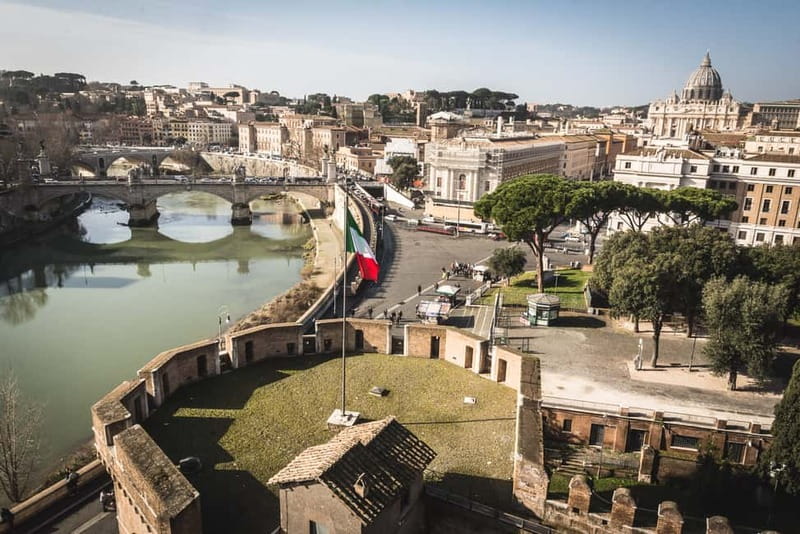
- The terrace is the payoff: Climb to the roof for broad views toward Vatican City, the Tiber River, and Ponte Sant’Angelo.
- One building tells several Roman stories: Follow the change from imperial tomb to fortress, defensive post, and papal residence.
- Skip-the-line means practical savings: You bypass the ticket-office queue, but you still need to arrive at the correct entrance with your ticket and identification.
- The audio guide is optional: Choose English, French, Italian, Chinese, German, or Spanish, and bring your own headphones.
- Allow for stairs and walking: The route passes through five floors, a spiral ramp, cells, rooms, and the terrace.
- The $15 price is strongest for independent visitors: You get entry and, if selected, an audio guide, but not a live guided tour or personal assistance.
Why Castel Sant’Angelo is worth your time

Rome has grander monuments, but few places show so many chapters of the city in one compact visit. Castel Sant’Angelo is not simply a castle with a nice view. Its thick circular form began as the tomb of the emperor Hadrian, then changed purpose as Rome changed around it.
That gives the visit a useful rhythm. You start with the building’s Roman foundation, move through medieval defenses, pass into papal rooms and decorated chambers, and finish above the city. I like this kind of sightseeing because the architecture itself explains the story. You are not only reading about a building’s changes. You are walking through them.
The museum is relatively manageable compared with some of Rome’s enormous sites. One hour may be enough for a brisk visit, while history fans and art lovers can take longer with the audio guide and room displays. The route is easy to follow, though the climb and uneven movement through the fortress can make it tiring.
More Castel Sant'Angelo visits:
- Rome: Castel Sant’Angelo Skip-the-Line Ticket & Audio Guide
★ 4.4 · 3,500 reviews - Rome: Castel Sant’Angelo Skip-the-Line Ticket
★ 4.4 · 3,040 reviews - Rome: Castel Sant’Angelo Skip-the-Line Entry Ticket
★ 4.8 · 2,231 reviews
Getting inside with the skip-the-line ticket
The meeting point is the attraction’s main entrance. You are expected to go directly there, show the emailed ticket, and present a valid passport or identification. Make sure the name on the booking matches the full name on each participant’s identification, since that information is required for verification.
Your ticket is sent to the email used during booking, within 24 hours before the activity. That timing is important. Do not wait until you are standing outside the castle to search through an old inbox. Save the ticket on your phone, keep your phone charged, and check your email before leaving your hotel.
Some bookings include help from a representative outside the entrance. Adrian is one staff member specifically praised for helping visitors set up the audio-guide app. Still, the official information says this is not a guided tour and does not include staff assistance at the entrance, so you should be prepared to manage the basic process yourself.
The skip-the-line benefit is mainly about avoiding the ticket-office queue. That can be valuable when the line is long and the castle is busy. It does not turn the visit into a private entry, and you must still arrive for your selected date and time slot. Late arrivals and no-shows are not accommodated or refunded.
The Roman mausoleum and the spiral route

The first major idea to keep in mind is that Castel Sant’Angelo was built as a monumental tomb. The circular mass was intended to honor an emperor and members of his family, giving the building a solemn beginning before its later military uses.
As you move through the interior, the route leads along a spiral ramp and through five floors. The changing scale is part of the appeal. Some areas feel formal and ceremonial, while others feel more like defensive passages and working spaces.
You will see a chamber of ashes connected with the building’s original role as a mausoleum. The remains and memorial traces here help explain why this was first a place for imperial burial, not a castle in the medieval sense.
Bring comfortable shoes. Even if you plan a quick one-hour visit, the floors, ramp, stairs, and terrace climb involve more walking than the $15 price might suggest at first glance. Carry water, especially in warm weather. One bottle can make the final climb much easier.
Fortress walls, cells, and medieval Rome
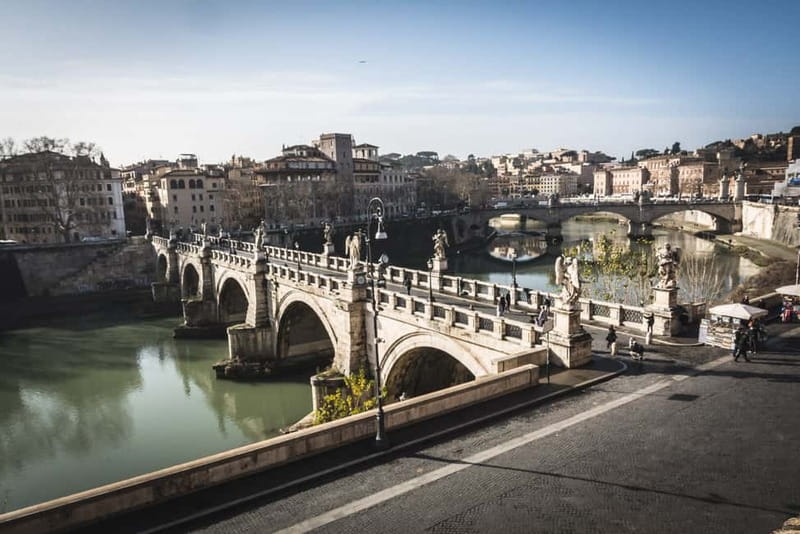
The building’s second life was military. As Rome faced danger and political instability, the old tomb became a fortress. Its heavy walls, elevated position beside the Tiber, and defensive layout made it useful for protection.
This is where the site differs from a standard palace museum. You are moving through a structure designed for security, then seeing how later occupants adapted it. Cells and fortified areas give the visit a harder edge than the painted papal rooms above.
The castle also served as a defensive post against barbarian invasions. That detail helps explain the building’s long survival. It was not preserved only because people admired its ancient design. It remained useful, so each generation altered it instead of tearing it down.
I recommend following the suggested route through the museum rather than wandering randomly. The building has enough passages and rooms that a self-guided visit can become scattered. An audio guide helps connect each section to the larger story, while the printed information and displays are enough for visitors who prefer a shorter visit.
More Rome tours worth comparing
- Vatican Museums & Sistine Chapel Skip-the-Line Entry Ticket
★ 4.4 · 13,838 reviews - Skip-the-Line Group Tour of the Vatican, Sistine Chapel & St. Peter’s Basilica
★ 4.5 · 12,779 reviews - Rome: Vatican Museums & Sistine Chapel Skip-The-Line Ticket
★ 4.2 · 11,708 reviews - Vatican, Sistine Chapel & St. Peter’s Skip-the-Line Tour
★ 4.5 · 7,770 reviews
Papal apartments, frescoes, and Baroque decoration

Higher in the castle, the tone changes. Rooms that served as papal residences bring Renaissance and Baroque art into the military structure. Here you will find frescoes, decorative details, and more refined interiors.
These rooms are valuable because they show how popes used the fortress not only as a defensive refuge but also as a residence. The castle was a place of power, safety, ceremony, and art. Its history is easier to understand when you see those functions side by side.
The frescoes are among the main reasons to choose the audio-guide option. A live guide is not included, so the digital commentary can supply dates, names, and explanations while you move at your own speed. It is available in English, French, Italian, Chinese, German, and Spanish.
The app must be downloaded before the visit. You need a charged smartphone, internet access, and headphones. Headsets are not included. If you are visiting with a group, bring enough headphones for everyone who wants to listen, and set up the app before reaching the entrance.
The rooftop terrace and Rome’s best reward

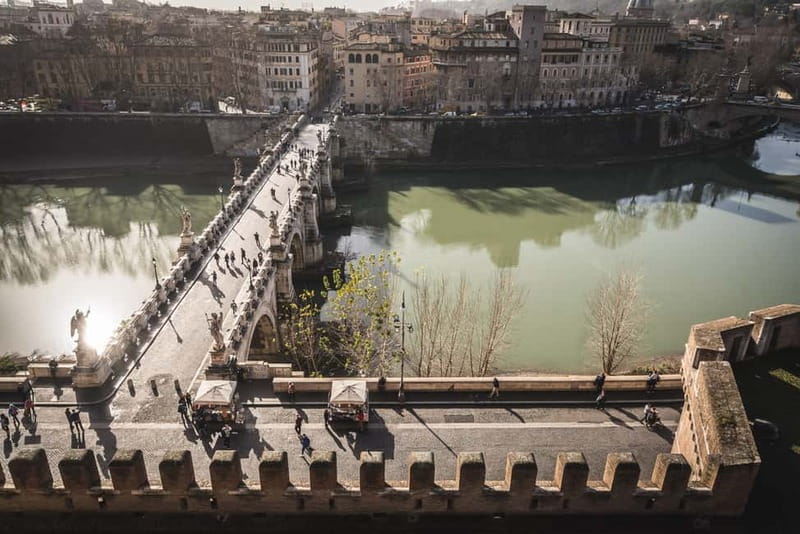
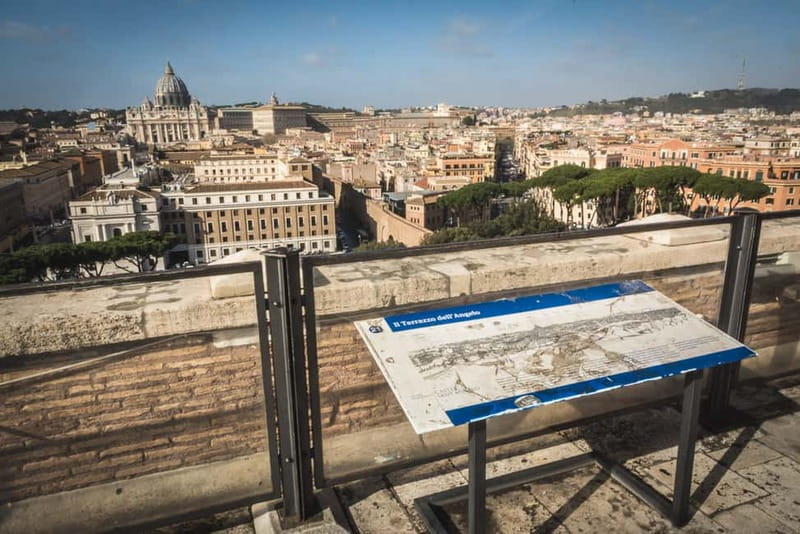
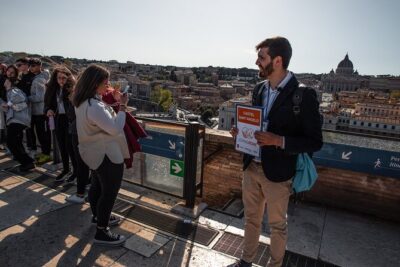
The terrace is the clearest reason to include Castel Sant’Angelo in a Rome itinerary. From above, you can spot Vatican City, the Tiber, and the famous Bridge of Angels. The view gives you a useful sense of how the river, historic center, and Vatican area connect.
This is also a good place to pause. A café or bar on the top level provides a chance to sit with a drink for roughly half an hour, according to the available experience details. Treat it as an optional break rather than a central part of the ticket, since the main value remains the museum and the view.
The terrace is particularly satisfying because you have already walked through the building’s lower and middle levels. The view is not an isolated lookout. You have seen the tomb, fortress, cells, papal rooms, and art before reaching it, so the city below feels connected to the history inside.
There is a price for the panorama. You must climb a series of stairs to reach the top, and the route is not suitable for wheelchair users or people with mobility impairments. If stairs are difficult for you, this is not the right attraction, even if the ticket price looks appealing.
Is the optional audio guide worth paying for?
The basic ticket is best for confident independent visitors who want to see the castle without committing to a long guided program. You can move at your own pace, stop for photographs, and spend extra time in the rooms that interest you.
I would choose the audio guide if this is your first visit or if you want the building’s changing roles explained as you go. Castel Sant’Angelo can look like a collection of attractive rooms unless you understand the order of its Roman, medieval, defensive, and papal phases.
The audio guide also suits families and mixed-interest groups. One person can listen while another studies the frescoes or takes photographs. You are not tied to the pace of a live group, and you can pause or skip sections.
The tradeoff is technical rather than cultural. You need the app, an internet connection, a charged phone, and headphones. If you forget one of those items, the optional upgrade loses much of its value. Visitors who prefer a human guide should note that no guided tour is included.
How much time should you plan?
The ticket is valid for one day, but entry is tied to the selected date and time slot. Plan to arrive early enough to find the main entrance, open your ticket, and complete the identification check without rushing.
A fast visit can take about an hour. That covers the main route, the principal rooms, and the terrace. I would allow more time if you want to listen to the full audio guide, examine the art, or stop at the café.
You also need to think about the rest of your day. The castle sits on the Tiber’s right bank, close to the Vatican area and Ponte Sant’Angelo. Pairing it with nearby sightseeing can make good use of your time, but do not book it so tightly against another timed attraction that a small delay creates stress.
The activity provider offers free cancellation up to 24 hours in advance and a reserve-now, pay-later option. Those terms are useful if your Rome schedule is still shifting. They do not protect you from arriving late, so keep the selected entry time visible in your day plan.
Who will get the most from this visit?
I recommend this experience to people who want history, architecture, and city views in one stop. It is especially suitable for:
- Independent visitors who do not need a live guide
- History fans interested in ancient Rome and the papal era
- Art lovers who want Renaissance and Baroque interiors
- Photographers looking for elevated views of Rome
- Visitors who dislike waiting at ticket offices
- Fans of historical video games and fortress settings
It is less suitable for anyone with limited mobility because of the stairs and walking route. It is also not ideal if you want a fully escorted tour with a guide explaining every room in person.
Large bags and luggage are not allowed, and weapons or sharp objects are prohibited. Bring only what you need for the visit. Comfortable shoes, water, headphones, a charged smartphone, internet access, your digital ticket, and valid identification cover the practical basics.
The value of a $15 ticket
At $15 per person, this is a sensible add-on for a Rome trip if the skip-the-line access saves you a long wait. The price includes entry to a major historic building, the museum route, the terrace, and an audio guide if you select that option.
The value is not only measured by the number of rooms. You get several distinct experiences in one admission: an imperial tomb, military architecture, cells, papal rooms, frescoes, and a rooftop view. That variety makes the ticket stronger than a simple viewpoint admission.
Still, keep your expectations clear. This is not a private tour, a live guided walk, or a package with transport. You are paying for access and, if selected, digital commentary. If you are comfortable exploring alone, that keeps the cost modest. If you need personal help or detailed conversation with a guide, you may prefer another format.
The high overall rating of 4.4 from more than 5,000 submitted ratings fits the practical strengths of the experience: quick entry, easy independent navigation, and a memorable terrace. The main complaints to guard against are not about the castle itself. They are the stairs, the need to locate the correct ticket contact in some cases, and the risk of arriving without the app or required identification.
Should you book Castel Sant’Angelo skip-the-line entry?
Book it if you want a flexible, self-guided visit with a strong payoff at the top. The castle gives you a compact lesson in Rome’s changing power, and the terrace views add something different from the city’s ground-level churches and ruins.
Choose the audio guide if you want context without joining a live group. Choose the basic ticket if you mainly want to explore the rooms, take photographs, and enjoy the view.
I would skip this option only if stairs are a serious problem, you need wheelchair access, or you strongly prefer a personal guide. For everyone else, the $15 admission is a practical way to see one of Rome’s most unusual historic buildings while avoiding the ticket-office wait.
FAQ
What does the Castel Sant’Angelo ticket include?
It includes skip-the-line entry to Castel Sant’Angelo. A digital audio guide is included only if you select that option during booking.
Is this a guided tour?
No. A live guided tour is not included. The optional audio guide lets you explore independently.
Which languages are available for the audio guide?
The audio guide is available in English, French, Italian, Chinese, German, and Spanish.
Do I need headphones?
Yes, headphones are listed among the items to bring. Headsets are not provided.
What identification do I need?
You must present a valid passport or identification during the visit. Provide each participant’s complete name as it appears on their passport when booking.
How long is the ticket valid?
The activity is valid for one day, but tickets are valid only for the selected date and time slot.
Is Castel Sant’Angelo accessible to wheelchair users?
No. The activity is listed as unsuitable for wheelchair users and people with mobility impairments because you must climb stairs to reach the panoramic terrace.
Can I cancel the booking?
You can cancel up to 24 hours in advance for a full refund. Late arrivals and no-shows are not accommodated or refunded.
Newest reviews from Rome
- Rome: Vatican Museums & Sistine Chapel Skip-the-Line Ticket★ 4.4 · 148 reviews
- Shared Shuttle Transfer from Rome to Civitavecchia Port★ 5.0 · 148 reviews
- Rome: Crypts & Catacombs After Hours Tour with Bone Chapel★ 4.6 · 149 reviews
- Ghosts Legends and Mysteries of Rome Walking Tour★ 5.0 · 149 reviews
- Skip the Line: Vatican and Sistine Chapel with Guided Tour★ 4.0 · 149 reviews
- Tivoli: Villa Gregoriana Entrance Ticket★ 4.7 · 150 reviews
- Pizza and Tiramisu Cooking Class in Rome, Piazza Navona★ 5.0 · 150 reviews
- Private Cooking Class in Rome with Chef Andrea Consoli★ 5.0 · 150 reviews
Castel Sant'Angelo Tours, compared.

Castel Sant’Angelo Skip-the-Line Ticket & Audio Guide
Read our review →

Castel Sant’Angelo Skip-the-Line Entry Ticket
Read our review →


Browse the lists this tour appears in