
Reviewed · CASTEL SANT'ANGELO TOURS
Rome: Castel Sant’Angelo Skip-the-Line Ticket & Audio Guide
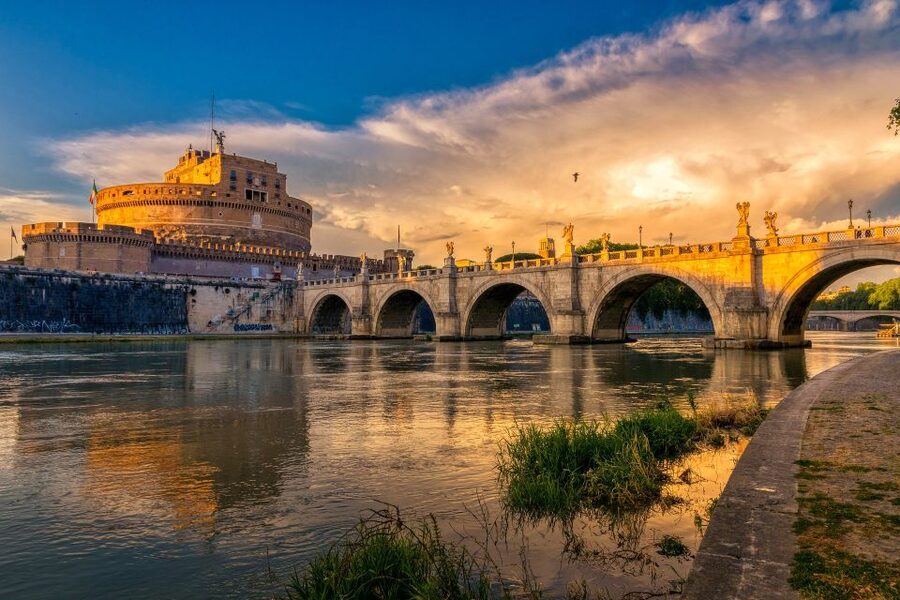
Castel Sant’Angelo is not just another old Roman building. It began as Emperor Hadrian’s enormous tomb, became a fortress, and later served the popes. Inside, you move through several layers of Rome’s past before climbing to a terrace with fine views over the Tiber, St. Peter’s, and Ponte Sant’Angelo.
I like the freedom here. You can use the optional audio guide when you want context, pause it when you want to look around, and move at your own speed. I also like the reserved entry, especially during busy periods when the ticket queue can stretch along the corridor. The main catch is that the experience is not suitable for wheelchair users or people with mobility difficulties, and reaching the best viewpoints means climbing stairs.
In This Review
- Key points to know
- Why Castel Sant’Angelo is worth your Rome time
- Arriving with a reserved entry ticket
- Hadrian’s Mausoleum and the Roman beginning
- From tomb to fortress
- The papal corridors and protected passages
- Climbing to Rome’s panoramic terrace
- How the smartphone audio guide affects the visit
- How much time to allow
- Is the $20 price good value?
- Who should book this experience?
- Practical booking advice before you go
- Should you book Castel Sant’Angelo?
- FAQ
- How much does the Castel Sant’Angelo ticket cost?
- Is the ticket valid all day?
- Where do I collect the ticket?
- Is an audio guide included?
- Which languages are available for the audio guide?
- Do I need to bring headphones?
- What is the last entry time?
- Is the castle accessible to wheelchair users?
Key points to know
- Hadrian’s tomb is the starting point: See the core of the ancient mausoleum, also called Hadrian’s Mole.
- The castle changes character as you climb: Imperial tomb, medieval stronghold, papal refuge, and museum all meet inside.
- The terrace is the payoff: Look across Rome and down toward the angel-lined bridge over the Tiber.
- The audio guide is app-based: Bring your own headphones, a charged smartphone, and enough storage for the download.
- Reserved entry saves time: You receive the ticket by email or WhatsApp and go directly to the entrance at your scheduled time.
- Plan around the stairs: The upper levels and panoramic terrace require physical effort.
Why Castel Sant’Angelo is worth your Rome time
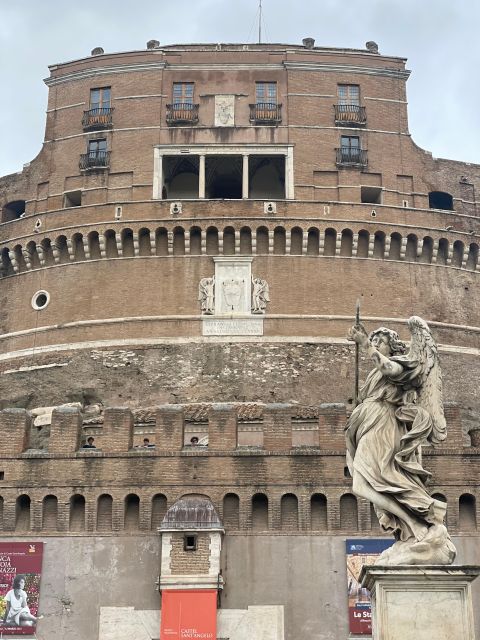
Many first-time visitors pass Castel Sant’Angelo on the way to Vatican City and never go inside. That is a mistake if you enjoy places that show how Rome reused its old buildings. The castle offers more than a single period or a single story.
The round structure began as the Mausoleum of Hadrian in the second century. It was designed as a monumental burial place for the emperor Hadrian and members of his family. Over the centuries, the building gained defensive walls, military functions, papal rooms, and escape routes.
That changing role gives your visit a useful shape. You are not simply looking at a Roman monument from the outside. You are walking through a building that was repeatedly altered to meet the needs of Rome’s rulers.
The visit is self-guided, so you can take your time with the rooms and views. Depending on your pace, allow several hours if you want to read the displays, use the audio guide, stop at the café, and enjoy the upper levels without rushing.
More Castel Sant'Angelo visits:
- Castel Sant’Angelo Skip-the-Line Entry & Optional Audioguide
★ 4.4 · 5,233 reviews - Rome: Castel Sant’Angelo Skip-the-Line Ticket
★ 4.4 · 3,040 reviews - Rome: Castel Sant’Angelo Skip-the-Line Entry Ticket
★ 4.8 · 2,231 reviews
Arriving with a reserved entry ticket

There is no group meeting point for this experience. Your ticket is sent to your email or WhatsApp, normally in the late afternoon on the day before your visit or around 24 hours before entry. Check your messages carefully, then download the audio guide app before you arrive if you selected that option.
The scheduled entry time matters. You must arrive punctually because late entry can be refused without a refund. This is one of the few parts of the visit that does not allow much flexibility, so avoid pairing it with a tight appointment across town.
The reserved ticket is designed to skip the ticket line. That can be useful in warm weather or during a busy morning, when the queue may extend well beyond the entrance. It does not mean you can wander in at any hour. You still need to enter at the time assigned to your ticket.
Bring your passport or identity card, since identification may be required. Large bags, luggage, weapons, sharp objects, and pets are not allowed. Comfortable shoes are a practical choice because the route includes stairs and uneven historic spaces.
Hadrian’s Mausoleum and the Roman beginning
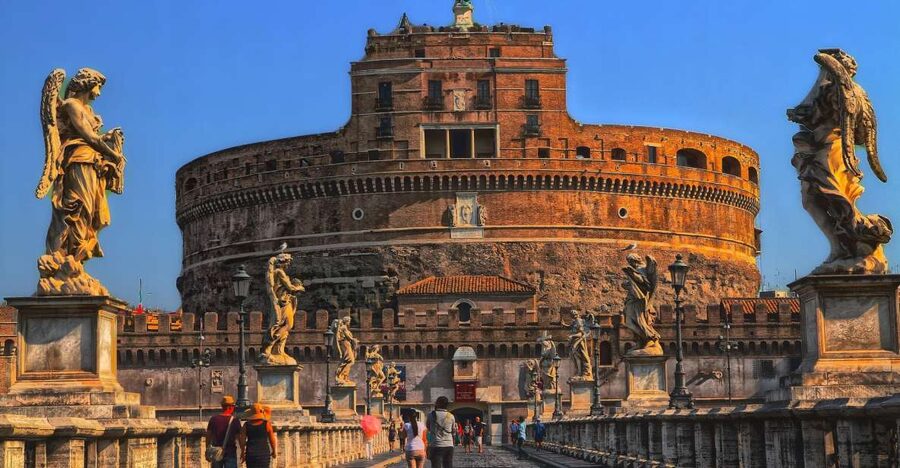
The building’s original purpose is easy to miss if you think of it only as a papal fortress. Castel Sant’Angelo was first built as the Mausoleum of Hadrian, a grand tomb for one of Rome’s most important emperors.
The central burial function gives the castle its solemn core. The massive circular form was meant to project imperial power, not simply to protect soldiers. As you explore, keep that first purpose in mind. The later fortifications and chambers were added around an already imposing Roman structure.
The audio guide can help explain this transition. It is available in English, Italian, French, Spanish, German, and Chinese. The format suits people who prefer to pause, rewind, or skip sections instead of following a guide at a fixed pace.
The app is not a rented headset. You use your own smartphone, and headphones are not included. Download the app before the visit and check that your phone is compatible. It requires about 100 to 150 MB of free storage and works with Android version 5.0 or later and supported iPhones. Older devices, including iPhone 5 and earlier models, some older iPads, iPod Touch 5th generation and earlier, and Windows Phones are not supported.
If you do not choose the audio guide, you can still explore independently. Information panels and directional signs help you follow the route and see the main areas. The tradeoff is simple: the app gives you more historical explanation, while going without it lets you keep your eyes off the screen.
From tomb to fortress
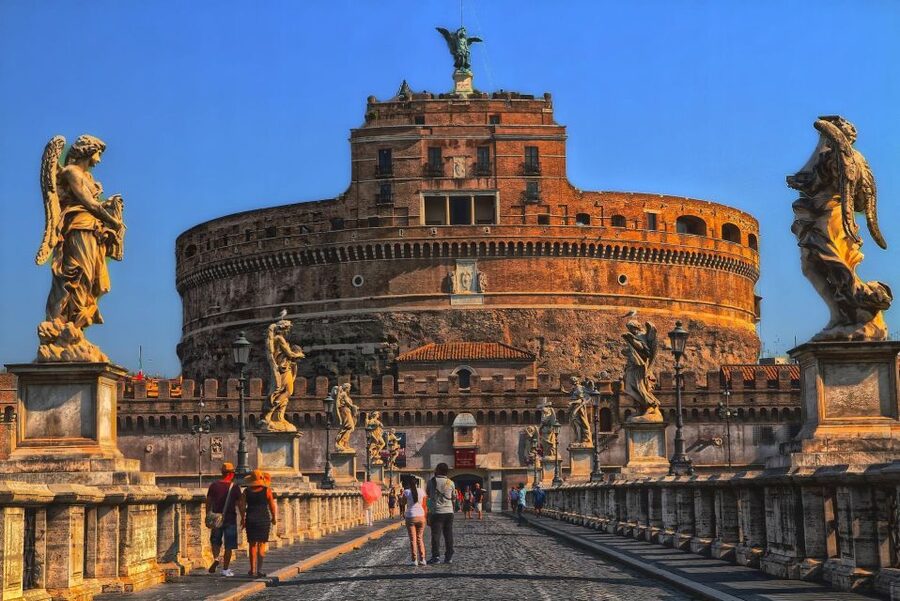
Castel Sant’Angelo makes sense when you see it as a building that adapted to Rome’s changing dangers. The ancient mausoleum was later strengthened and incorporated into the city’s defenses. Its thick walls and elevated position made it useful as a stronghold.
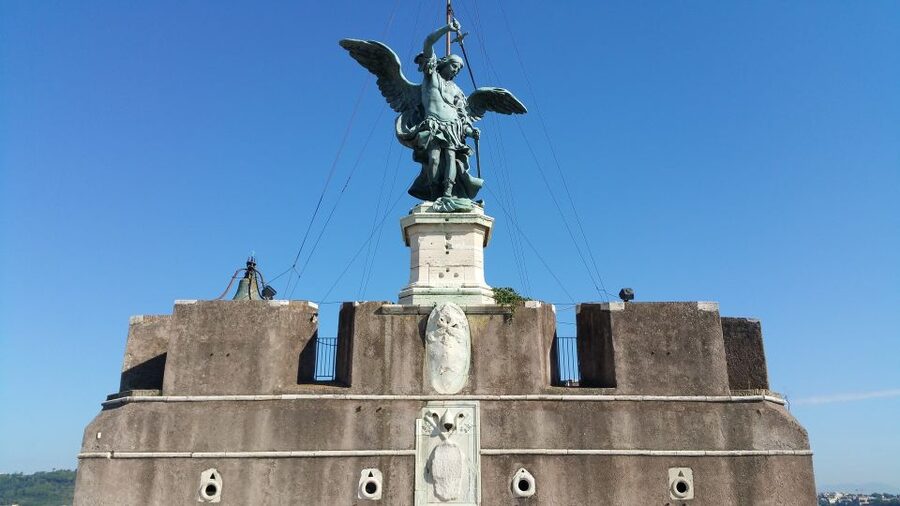
The castle’s name comes from a much later religious story. According to the legend, the Archangel Michael appeared above the mausoleum in 590, sheathing his sword as a sign that the plague had ended. A statue of the archangel crowns the building today, and the story explains why Hadrian’s tomb became known as Castel Sant’Angelo.
This is a good example of Rome’s habit of layering new meaning over old stone. The same building can be an imperial tomb, a military fortress, a papal refuge, and a Christian monument without losing traces of its earlier life.
As you move through the interior, look for the contrast between military spaces and more refined papal areas. The appeal is not only the artwork or architecture by itself. It is seeing how practical defense, political power, religion, and ceremony shared one unusual building.
More Rome tours worth comparing
- Vatican Museums & Sistine Chapel Skip-the-Line Entry Ticket
★ 4.4 · 13,838 reviews - Skip-the-Line Group Tour of the Vatican, Sistine Chapel & St. Peter’s Basilica
★ 4.5 · 12,779 reviews - Rome: Vatican Museums & Sistine Chapel Skip-The-Line Ticket
★ 4.2 · 11,708 reviews - Vatican, Sistine Chapel & St. Peter’s Skip-the-Line Tour
★ 4.5 · 7,770 reviews
The papal corridors and protected passages
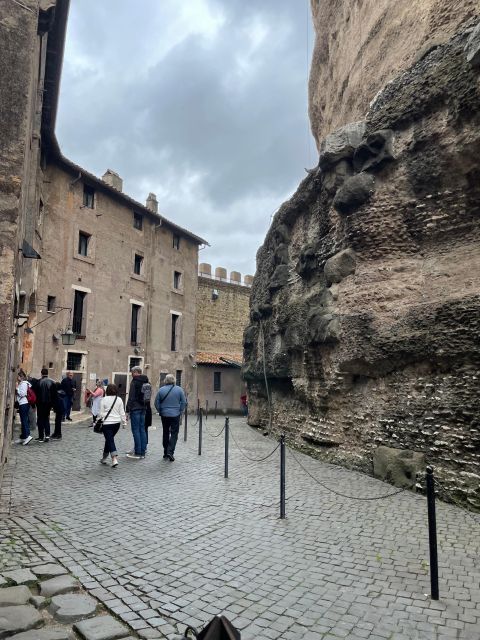
One of the most memorable features connected with Castel Sant’Angelo is its relationship with the Vatican. The castle stands only a short distance from Vatican City and was linked to the papal complex by protected passages.
The papal corridors help explain why this fortress mattered so much. In times of danger, the castle offered a defensible place where the pope could retreat. The building was not an isolated monument. It formed part of the power structure of Rome.
The exact access routes and open areas can change, especially during periods of restoration connected with the Jubilee. Check the updates sent before your visit, since restoration work may alter how you move through the monument.
This is also where the visit rewards patience. The exterior is dramatic, but the interior tells the more complicated story. If you rush only toward the terrace, you will miss much of the reason Castel Sant’Angelo is worth entering.
Climbing to Rome’s panoramic terrace
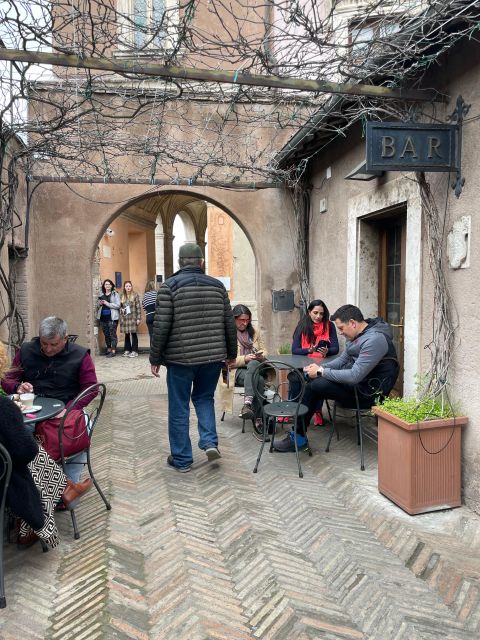
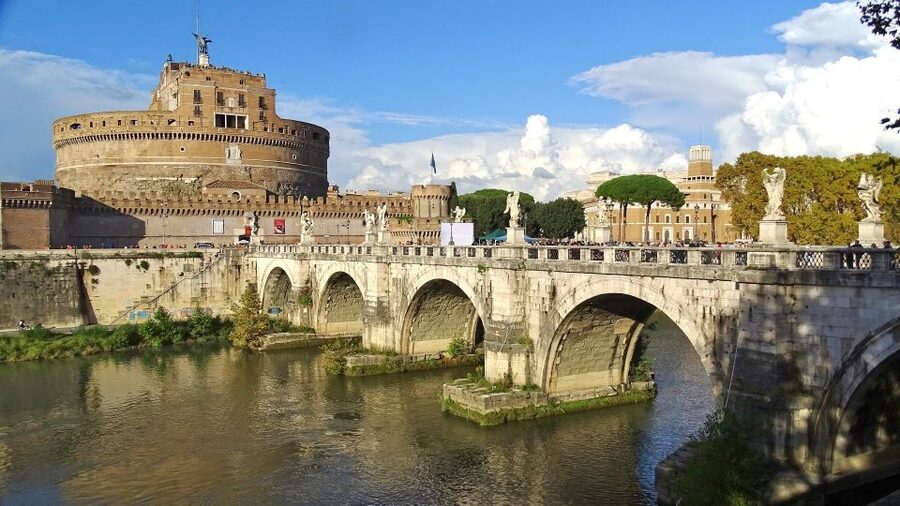
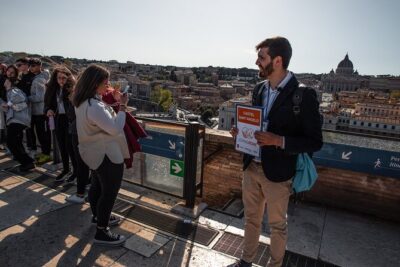
The upper terrace is the clear visual reward. From here, you can look across the River Tiber and take photographs of Ponte Sant’Angelo, also called the Bridge of Angels. The bridge leads toward the castle and creates one of the most recognizable views in this part of Rome.
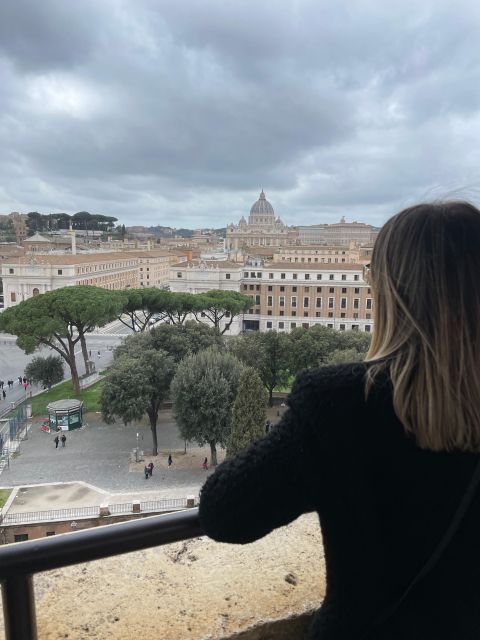
You also get wide views toward the city and the Vatican area. The height gives you a better sense of how the castle fits into Rome’s streets and riverfront. From ground level, its walls feel heavy and enclosed. From above, the building becomes part of the city around it.
There are several levels with views, and the top is reached by stairs. This is not a minor detail. If you have knee, balance, or breathing problems, consider how much climbing you are comfortable doing before booking.
The terrace also has a café where you might stop for a drink or food while looking over the city. Availability and seating can vary, and it may be busy, so treat it as a useful pause rather than a guaranteed quiet table.
For photographs, the terrace is strongest when you take time to look in several directions. The bridge below, the Tiber, Rome’s rooftops, and the Vatican area each offer a different frame. Give yourself a few minutes before moving on.
How the smartphone audio guide affects the visit
The audio guide is a good add-on if you want more than labels but do not want to join a fixed guided group. It lets you stop in front of a room, listen to the relevant section, and continue when ready.
I would choose it if Castel Sant’Angelo is high on your list of historic sites. The building has so many changes of use that a little explanation helps connect the rooms. The app also includes written text, which is useful if you forget headphones or prefer reading.
You need to bring your own headphones. A charged phone is essential, and downloading the content ahead of time is wiser than waiting until you are standing at the entrance. The download needs free space, so check your phone before leaving your hotel.
There is also a strong case for skipping the audio guide. The route is easy enough to explore at your own pace, and information panels fill in many details. If you have already spent the day looking at screens, an independent visit may feel more relaxed.
The audio guide option is especially useful for families or pairs who do not always want to stand together. One person can stop to read while another listens, though you will need to manage your own devices and sound.
How much time to allow
The ticket is valid for one day, but the attraction is entered at a scheduled starting time. The final entry is at 6:30 PM, so do not plan to arrive near closing and expect a leisurely visit.
A quick visit can cover the major rooms and terrace. A longer visit gives you time to read the information, listen to the full audio guide, pause at the café, and enjoy the views from more than one level.
Some people spend around three to four hours here, especially when they use the audio guide and stop often. You may need less time if you are mainly interested in the terrace, but the castle rewards a slower pace.
An early morning slot can help you avoid the heaviest queues and the hottest part of the day. It also leaves room afterward for the nearby Vatican area, although you should not assume that you can enter another timed attraction immediately after this one.
Is the $20 price good value?
The listed price is $20 per person, while the official ticket price is €16. That difference pays for the reserved booking service and, if selected, the smartphone audio guide. The value depends mainly on the date and how much you care about saving time.
In a quiet month, the skip-the-line part may not be essential. One account of a February visit found no queue, making the extra booking convenience less important. During busy periods, however, the benefit is easier to see. Walking past a long ticket line on a hot day can be worth the added cost.
The audio guide is also a personal choice. If you like historical background and want to explore alone, it adds useful structure. If you prefer reading signs or moving quickly, select the ticket without it and save the extra cost.
For a major Rome monument close to the Vatican, $20 is a fair price when the queue is active and you plan to spend several hours inside. It is less compelling if you are visiting in a very quiet period, have limited time, or only want a quick exterior photograph.
Who should book this experience?
I would recommend it to you if you like architecture, Roman history, military buildings, papal history, or city views. It also suits independent visitors who want information without being tied to a guide’s pace.
It is a particularly good choice for anyone who has walked past the castle and wondered what is inside. The interior is more extensive than the exterior suggests, with artwork, architectural details, historic rooms, and several viewpoints.
You should think twice if stairs are difficult for you. The experience is not suitable for wheelchair users or people with mobility impairments, and the panoramic terrace requires climbing.
It may also be a poor fit if you dislike using your phone while sightseeing. The audio guide is optional, but choosing it means downloading an app and managing your battery, storage, and headphones.
Practical booking advice before you go
Check your email and WhatsApp the day before the visit. Download the app in advance, charge your phone, and bring headphones if you selected the audio option.
Allow extra time to reach the entrance. A late arrival may mean denied entry, and the ticket is tied to a scheduled time. Do not count on changing the time once you are already in Rome.
Wear shoes that feel secure on stairs. Carry only a small bag, since large bags and luggage are not allowed. Keep your identification with you.
Because restoration work may affect some monuments and access routes during the Jubilee, read any last-minute messages before setting out. The castle remains worth visiting, but the exact route can change.
Cancellation is free up to 24 hours before the scheduled activity for a full refund. After that point, a late arrival or missed entry may not be refundable.
Should you book Castel Sant’Angelo?
Book it if you want a historic site that connects imperial Rome, medieval defense, papal power, and one of the city’s best river views. The reserved entry is most useful when queues are long, and the optional audio guide gives you a relaxed way to understand the building without joining a group.
I would skip the audio if you prefer to read and wander without a phone. I would also reconsider the visit if stairs are a serious problem. For most people who can manage the climb, though, Castel Sant’Angelo offers more than its famous exterior, and the terrace makes a strong finish.
FAQ
How much does the Castel Sant’Angelo ticket cost?
The listed price is $20 per person. The official ticket price is €16.
Is the ticket valid all day?
The activity is valid for one day, but you must enter at the scheduled time shown for your booking.
Where do I collect the ticket?
You do not need to meet a representative. The ticket is sent to your email or WhatsApp, normally around 24 hours before the visit.
Is an audio guide included?
The smartphone audio guide is included only if you select that option when booking.
Which languages are available for the audio guide?
The audio guide is available in English, Italian, French, Spanish, German, and Chinese.
Do I need to bring headphones?
Yes. Headphones are not included, so bring your own if you choose the audio guide.
What is the last entry time?
The last entry to Castel Sant’Angelo is at 6:30 PM.
Is the castle accessible to wheelchair users?
No. The experience is not suitable for wheelchair users or people with mobility impairments, and stairs are required to reach the panoramic terrace.
More Audio Tours in Rome
- Skip the Line: Vatican & Sistine Chapel Ticket with Audio Guide
★ 4.0 · 3,271 reviews - Rome: Pantheon Priority Entry Ticket & Audio Guide App
★ 4.1 · 3,234 reviews - Rome: Colosseum Experience with Audio Guide and Arena Option
★ 4.2 · 2,200 reviews - Rome: Colosseum, Roman Forum & Palatine Hill Visit + Audio Guide
★ 3.5 · 1,522 reviews
More Self-Guided Tours in Rome
- Rome: Colosseum & Forum with Audio Guide App -Optional Arena
★ 4.2 · 24,770 reviews - Rome: St. Peter’s Basilica & Dome Entry Ticket & Audio Tour
★ 4.2 · 7,537 reviews - Vatican & Sistine Chapel Ticket with Optional Audio Guide
★ 4.1 · 5,405 reviews - Rome: Colosseum, Forum, & Palatine Hill with Audio Guide
★ 4.3 · 4,591 reviews
Newest reviews from Rome
- Rome: Vatican Museums & Sistine Chapel Skip-the-Line Ticket★ 4.4 · 148 reviews
- Shared Shuttle Transfer from Rome to Civitavecchia Port★ 5.0 · 148 reviews
- Rome: Crypts & Catacombs After Hours Tour with Bone Chapel★ 4.6 · 149 reviews
- Ghosts Legends and Mysteries of Rome Walking Tour★ 5.0 · 149 reviews
- Skip the Line: Vatican and Sistine Chapel with Guided Tour★ 4.0 · 149 reviews
- Tivoli: Villa Gregoriana Entrance Ticket★ 4.7 · 150 reviews
- Pizza and Tiramisu Cooking Class in Rome, Piazza Navona★ 5.0 · 150 reviews
- Rome: Borghese Gallery Skip-the-Line Entry and Guided Tour★ 4.7 · 150 reviews
Castel Sant'Angelo Tours, compared.

Castel Sant’Angelo Skip-the-Line Entry & Optional Audioguide
Read our review →

Castel Sant’Angelo Skip-the-Line Entry Ticket
Read our review →


Browse the lists this tour appears in