

Reviewed · CASTEL SANT'ANGELO TOURS
Rome: Castel Sant’ Angelo Ticket and Audio Guide
Castel Sant’Angelo is more than a fortress beside the Tiber. It began as Emperor Hadrian’s cylindrical mausoleum, then took on new roles over the centuries. Inside, you move through grand rooms, defensive spaces, and terraces before reaching some of the finest views in central Rome. The audio guide helps connect those layers without forcing you into a fixed group.
I like the skip-the-line entry, especially when the ticket queue stretches toward an hour. I also like the freedom to stop for the Sala Paolina frescoes, linger over the city views, or move quickly through rooms that interest you less. The main drawback is that this is an app-based tour, not a live explanation, and some people stop using the audio after a while.
In This Review
- Key points to know before you go
- Why Castel Sant’Angelo is worth your Rome time
- Arriving with the skip-the-line ticket
- Downloading the audio guide before entering
- From Hadrian’s mausoleum to papal fortress
- Sala Paolina and the castle’s decorated rooms
- Terraces, Rome views, and the café stop
- How long should you allow?
- Is $31 a fair price?
- Accessibility and the practical limits of an old castle
- Who will enjoy this self-guided visit?
- Tips for making the visit work well
- FAQ
- How much does the Castel Sant’Angelo ticket and audio guide cost?
- Is this a live guided tour?
- Which languages are available for the audio guide?
- What do I need to use the audio guide?
- Can I visit Castel Sant’Angelo at any time during the day?
- Is Castel Sant’Angelo wheelchair accessible?
- Should you book it?
Key points to know before you go

- The fast-track ticket is the main value: Show the barcode at the entrance instead of waiting to buy admission.
- The visit is self-guided: You explore independently with offline narration, text, and maps on your own phone.
- Sala Paolina deserves time: Its well-kept frescoes are among the artistic highlights inside the castle.
- The top views are a major reward: Rome opens up around you from the upper terraces.
- Check the entry time carefully: Some ticket details indicate a timed entry, despite wording that suggests all-day validity.
- Bring a charged phone and headphones: The audio guide needs an Android or iOS device and about 100 to 150 MB of free space.
Why Castel Sant’Angelo is worth your Rome time

Many first-time visitors hurry between the Colosseum, Vatican Museums, and Pantheon. Castel Sant’Angelo offers a different kind of Roman experience. You are not simply looking at one ancient monument. You are walking through a building that changed purpose as Rome changed around it.
The original structure was commissioned as the tomb of Emperor Hadrian. Its round mass still gives the building a powerful shape from outside. Inside, the visit brings together imperial Rome, later military use, papal apartments, art, and high defensive terraces.
That mixture is what I find most rewarding. The building is easy to understand at a glance, but it becomes far more interesting once you notice how one era reused the work of another. The audio guide supplies historical notes and lesser-known anecdotes, giving you a framework as you move through the rooms.
You should not expect the atmosphere of a traditional museum. Castel Sant’Angelo is a large historic structure with stairs, changing levels, thick walls, and varied rooms. Some areas feel formal and decorated. Others feel stark and defensive. The contrast gives the visit its character.
More Castel Sant'Angelo visits:
- Castel Sant’Angelo Skip-the-Line Entry & Optional Audioguide
★ 4.4 · 5,233 reviews - Rome: Castel Sant’Angelo Skip-the-Line Ticket & Audio Guide
★ 4.4 · 3,500 reviews - Rome: Castel Sant’Angelo Skip-the-Line Ticket
★ 4.4 · 3,040 reviews
Arriving with the skip-the-line ticket
Your tour begins and ends at the main entrance of Castel Sant’Angelo. The practical advantage is simple: your admission is arranged before you arrive, so you can show the barcode rather than join the line to purchase a ticket.
That can save real time. One visitor faced a queue of about an hour for people buying tickets, while the prearranged admission allowed direct access. The exact wait will depend on the day, but the value of skipping a ticket-purchase line is clear in a city where sightseeing time is limited.
Keep your ticket ready on your phone. It is also wise to check the entry details as soon as you receive them. There is conflicting information about whether the ticket can be used throughout the day or only during a stated time slot. At least one booking required a correction because the ticket showed a particular entry period. Do not assume that all-day wording means you can arrive whenever you like.
If your schedule is tight, treat the entry time printed on the ticket as important. Contact the provider before your visit if anything looks unclear. That small check can prevent a needless argument at the entrance.
Downloading the audio guide before entering

The audio tour is designed for your own Android or iOS smartphone. You receive the ticket by email, then download the app and tour before reaching the castle. The content includes audio narration, written information, and maps that work offline.
Download it while you have a reliable internet connection. You need about 100 to 150 MB of free storage, so check your phone before leaving your hotel. Also bring headphones and charge your battery fully. A dead phone turns a self-guided audio tour into a plain admission ticket.
The guide is available in English, German, Italian, French, Spanish, and Chinese. That makes it useful for mixed-language groups, and you can listen at your own speed. Pause when a room catches your eye, replay a section, or skip ahead when you are ready to move on.
I like this format for Castel Sant’Angelo because the building rewards a slow look around. A live group tour has its strengths, but you may be asked to follow a fixed route and pace. With the app, you can spend more time on the parts that matter to you.
The tradeoff is personal attention. No guide is there to answer a question, point out a detail you missed, or adjust the explanation for children. The narration also depends on your willingness to keep using the app. Some visitors eventually put the phone away and explore without it.
From Hadrian’s mausoleum to papal fortress
The audio guide begins with the monument’s earliest identity, the Mausoleum of Hadrian. That starting point matters because the building’s shape makes more sense once you know it was planned as an imperial tomb rather than a castle.
Hadrian ruled during the second century and was known for major building projects across the Roman Empire. The mausoleum was designed as a monumental resting place for the emperor and members of his family. Its massive form was meant to be seen and remembered.
Later history changed the building’s function. Castel Sant’Angelo became a fortified structure, and its location beside the river gave it strategic importance. The layers are visible in the way the spaces feel: ceremonial rooms sit near strong defensive elements, and refined decoration shares the building with heavy masonry.
The guide’s historical notes are most useful here. Without some context, you might see a sequence of rooms and stairs without understanding why the building looks so different from one level to the next. The narration turns those changes into a story of reuse, adaptation, and power.
More Rome tours worth comparing
- Rome: Colosseum & Forum with Audio Guide App -Optional Arena
★ 4.2 · 24,770 reviews - Rome: St. Peter’s Basilica & Dome Entry Ticket & Audio Tour
★ 4.2 · 7,537 reviews - Vatican & Sistine Chapel Ticket with Optional Audio Guide
★ 4.1 · 5,405 reviews - Rome: Colosseum, Forum, & Palatine Hill with Audio Guide
★ 4.3 · 4,591 reviews
Sala Paolina and the castle’s decorated rooms
Make time for the Sala Paolina. Its well-maintained frescoes are one of the clearest artistic highlights of the visit, and this is a room where slowing down pays off.
The decoration gives you a break from the bare, fortress-like sections of the building. Look at the walls and ceiling rather than treating the room as a passage to the next terrace. The audio guide can help explain the room’s place within the later history of Castel Sant’Angelo.
This is also where a self-guided visit can work better than a rushed group route. You can stand back, study the painting, and replay the relevant section without holding up anyone else. If you are interested in Renaissance art, the room deserves more than a quick photograph.
At the same time, do not expect every part of the castle to be equally polished or equally ornate. The attraction’s appeal comes from its varied history. The grand rooms are only one part of the experience, and the plain military areas help you understand the building’s defensive role.
Terraces, Rome views, and the café stop
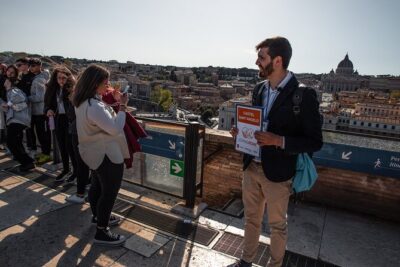
The upper viewpoints are among the strongest reasons to visit. From the terraces, you get broad views across Rome, and the height gives you a useful sense of how the castle relates to the river and surrounding city.
Bring your camera, but do not spend the entire visit looking through it. The views are a chance to pause and get your bearings after moving through enclosed rooms. They also help explain why this site mattered as a defensive position.
A café and bar area provides a place to sit with the view. This is a welcome feature, particularly if you are visiting at an unhurried pace or need a break from stairs and historic interiors. You can use the stop to review the audio notes, rest, and look back over the route.
The café is not a reason to buy the ticket by itself, and you should not plan the visit around a full meal. Think of it as a useful pause within a longer sightseeing stop. The panoramic setting makes it more memorable than an ordinary break.
How long should you allow?

The ticket is valid for one day, but the product information does not give a fixed visit length. Your actual time will depend on how closely you follow the audio guide and how long you spend in the decorated rooms, terraces, and viewpoints.
I would avoid squeezing Castel Sant’Angelo into a narrow gap between two timed attractions. The visit has enough variety to reward a relaxed pace, and the audio guide works best when you are not constantly checking the clock.
A quick visit can cover the major rooms and views. A slower visit lets you listen to more of the narration, study the Sala Paolina frescoes, and take a proper terrace break. One useful advantage of the self-guided format is that you decide when the visit is complete.
If you are planning several major sights in one day, allow extra time for the entrance process, moving through the building, and the possibility that you will want to linger at the top. The castle is not just a single viewpoint with a short walk attached.
Is $31 a fair price?
At $31 per person, this is not the cheapest way to enter a Roman monument. You are paying for admission, the convenience of prearranged entry, and the downloadable audio content.
The value depends mainly on the queue. If the alternative is spending close to an hour waiting to buy a ticket, the fast-track feature can make the price worthwhile. In a packed Rome itinerary, saving that hour may be more valuable than the difference between a standard ticket and this package.
The audio guide adds value if you actually use it. It gives you narration in six languages, plus text and maps that remain available offline. If you prefer to read the walls and explore on your own, or if you usually abandon app tours after a few stops, the package becomes mostly a skip-the-line admission.
A live guide would offer more interaction, but it would also set the pace. The self-guided ticket suits you if you want control and do not need constant commentary. It is less appealing if personal storytelling and questions are central to your idea of a good tour.
There is one important money-saving point. Visitors under 18 qualify for free admission, and visitors with disabilities who are accompanied by someone from the health and social assistance service are also eligible for free entry. EU citizens aged 18 to 25 can qualify for reduced admission. This supplier does not provide those free or reduced tickets, so check the official admission rules before paying for anyone who may qualify.
Accessibility and the practical limits of an old castle

Castel Sant’Angelo is listed as wheelchair accessible, and staff can be helpful. Still, you should not interpret that label as meaning every room and level is easy for every mobility need.
There are many stairs and some sections that may be inaccessible to a person who cannot walk. One family found the visit workable for an elderly mother who could walk a little, but several parts remained out of reach. Ask staff about the route when you arrive and be realistic about what you want to see.
Large bags and luggage are not allowed, so leave suitcases elsewhere. Pets and smoking are also prohibited. These rules are easy to follow, but they matter if you are visiting between hotels or arriving with a full day pack.
The smartphone requirement deserves equal attention. The audio guide does not work with Windows Phones, iPhone 5 or 5C and older models, older iPod Touch and iPad models, or the first-generation iPad Mini. If your device is old, confirm compatibility before booking.
Who will enjoy this self-guided visit?
I recommend this experience most to independent sightseers who want to set their own pace. It works well for adults, couples, families with older children, and anyone who likes moving between art, architecture, military spaces, and city views in one stop.
It is also a good fit if you have limited time in Rome and want to avoid a long ticket line. The barcode entry is simple, and the audio guide gives enough structure to keep the visit from feeling random.
You may prefer a live guide if you want detailed conversation, strong storytelling, or help interpreting every room. You may also prefer ordinary admission if you already have access to a guide app, dislike listening through headphones, or qualify for free or reduced entry.
For wheelchair users and people with limited mobility, contact the attraction or supplier before arrival and ask exactly which route is available. The general accessibility label does not remove the building’s historic stairs and uneven access.
Tips for making the visit work well
- Download the app and audio tour before leaving your accommodation.
- Free 100 to 150 MB of phone storage before downloading.
- Charge your phone and bring headphones.
- Read the ticket carefully for the permitted entry time.
- Keep the barcode easy to open at the entrance.
- Give Sala Paolina more than a passing glance.
- Save time for the upper terraces and panoramic views.
- Use the café as a rest stop, not as the main purpose of the visit.
- Leave large bags and luggage behind.
- If accessibility matters, ask about the route before you begin.
FAQ
How much does the Castel Sant’Angelo ticket and audio guide cost?
The listed price is $31 per person. It includes adult skip-the-line admission and the smartphone audio guide with offline text, narration, and maps.
Is this a live guided tour?
No. This is a self-guided visit using an app on your own smartphone. There is no live guide included.
Which languages are available for the audio guide?
The audio guide is available in English, German, Italian, French, Spanish, and Chinese.
What do I need to use the audio guide?
You need a charged Android smartphone running version 5.0 or later, or a compatible iOS device. Bring headphones and allow about 100 to 150 MB of free space for the download.
Can I visit Castel Sant’Angelo at any time during the day?
The activity is described as valid for one day, but ticket details may show a specific entry time. Check the actual ticket carefully and contact the provider if the permitted time is unclear.
Is Castel Sant’Angelo wheelchair accessible?
The site is listed as wheelchair accessible, but some areas are reached by stairs and may not be accessible to every visitor. Staff can help explain which sections can be reached.
Should you book it?
Book this ticket if saving time at the entrance matters to you and you like exploring without a fixed group. The castle offers far more than a quick photo stop, with Hadrian’s mausoleum, decorated rooms, military spaces, terraces, and sweeping Roman views. The audio guide gives the visit useful shape, especially if you have not studied the site beforehand.
Skip it if you qualify for free or reduced admission and can obtain those tickets directly, or if you know you want a live guide. Also think twice if your phone is not compatible or you are unlikely to use an app.
For most independent visitors, the best reason to buy is the combination of fast entry and freedom to set your own pace. Just confirm the entry time, download everything before you arrive, and leave room in your schedule for the top terrace.
More Audio Tours in Rome
- Skip the Line: Vatican & Sistine Chapel Ticket with Audio Guide
★ 4.0 · 3,271 reviews - Rome: Pantheon Priority Entry Ticket & Audio Guide App
★ 4.1 · 3,234 reviews - Rome: Colosseum Experience with Audio Guide and Arena Option
★ 4.2 · 2,200 reviews - Rome: Colosseum, Roman Forum & Palatine Hill Visit + Audio Guide
★ 3.5 · 1,522 reviews
Newest reviews from Rome
- Rome: Vatican Museums & Sistine Chapel Skip-the-Line Ticket★ 4.4 · 148 reviews
- Shared Shuttle Transfer from Rome to Civitavecchia Port★ 5.0 · 148 reviews
- Rome: Crypts & Catacombs After Hours Tour with Bone Chapel★ 4.6 · 149 reviews
- Ghosts Legends and Mysteries of Rome Walking Tour★ 5.0 · 149 reviews
- Skip the Line: Vatican and Sistine Chapel with Guided Tour★ 4.0 · 149 reviews
- Tivoli: Villa Gregoriana Entrance Ticket★ 4.7 · 150 reviews
- Pizza and Tiramisu Cooking Class in Rome, Piazza Navona★ 5.0 · 150 reviews
- Rome: Borghese Gallery Skip-the-Line Entry and Guided Tour★ 4.7 · 150 reviews
Castel Sant'Angelo Tours, compared.

Castel Sant’Angelo Skip-the-Line Entry & Optional Audioguide
Read our review →
Castel Sant’Angelo Skip-the-Line Ticket & Audio Guide
Read our review →

Castel Sant’Angelo Skip-the-Line Entry Ticket
Read our review →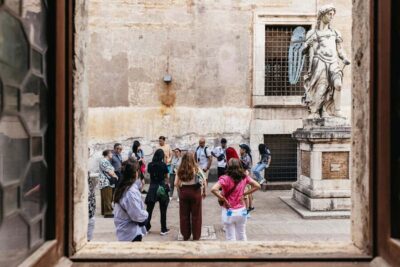


Browse the lists this tour appears in