
Reviewed · CAPITOLINE MUSEUMS TOURS
Percy Jackson and the Olympian Gods Tour at the Capitoline Museums
The clever idea here is to turn Rome’s Capitoline Museums into a Percy Jackson storybook. Instead of asking children to admire unfamiliar marble and bronze in silence, the guide connects Jupiter, Medusa, Hercules, Athena, Ares, and Polyphemus to characters they already know from the novels and films.
I like the private format, since your group gets the guide’s attention rather than trying to keep up with a large crowd. I also like the mix of serious art and playful legend, from the She-Wolf and Constantine to ancient games, calendars, gladiators, and the Boy with Thorn. The main drawback is price: at $249.77 per person, this is a costly museum visit unless your group is large enough to benefit from discounts or you place a high value on a tailored family experience.
In This Review
- Key points to know before you book
- Why Percy Jackson works so well in the Capitoline Museums
- Starting at Piazza del Campidoglio
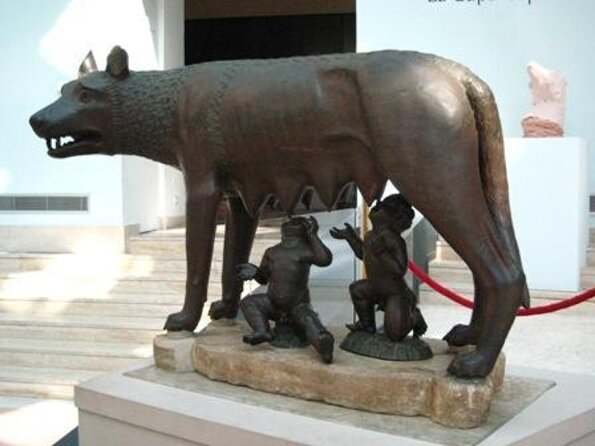
- The She-Wolf and Rome’s origin story
- Gods, heroes, and monsters in stone and bronze
- Constantine, Homer, and the Boy with Thorn
- Ancient games, calendars, and a gladiator’s tomb
- A two-and-a-half-hour pace for different ages
- What the price means for your family
- What the experience does especially well
- Limits to consider before booking
- Who should book this Capitoline Museums tour
- Final call: Is it worth booking?
- FAQ
- Where does the Percy Jackson and the Olympian Gods Tour begin?
- Where does the tour end?
- How long does the tour last?
- Is museum admission included?
- Is this a private tour?
- Is the tour offered in English?
- Can I cancel for a full refund?
Key points to know before you book
- The Capitoline collection becomes a Percy Jackson map, with gods, monsters, heroes, and mythical creatures tied to works of ancient art.
- A private guide keeps children involved, with past guides including Maria, Bruno, Sara, Alex, and Alessandra.
- The 2.5-hour visit covers much more than mythology, including Roman games, calendars, a gladiator tomb, and famous philosophers.
- It suits a wide age range, from young children to teenagers who already know Rick Riordan’s stories.
- You meet at Piazza del Campidoglio, and the tour finishes back at the same point.
- Food, drinks, and hotel pickup are not included, so plan those parts yourself.
Why Percy Jackson works so well in the Capitoline Museums
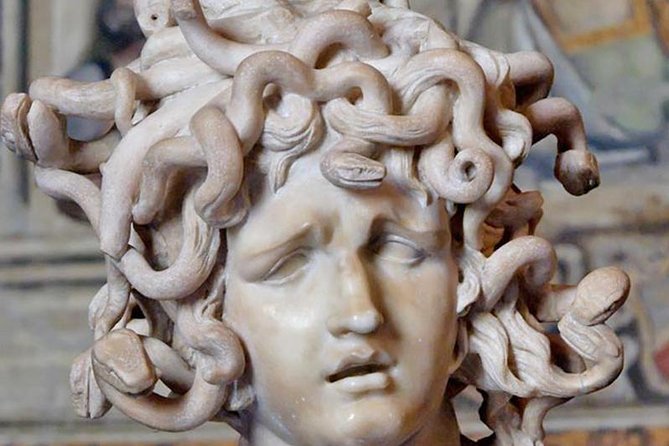
The Percy Jackson books give children a useful doorway into ancient mythology. Rome’s museums can otherwise feel like a long march past names and dates. Jupiter becomes more than a marble god, Medusa becomes more than a frightening head, and Hercules becomes part of a story your child may already understand.
That connection matters. A guide can point to an artwork and explain how Greek myths were adopted, changed, and reused by the Romans. You get a lesson in art, religion, storytelling, and Roman identity without making the visit feel like school.
The tour also avoids treating Greek and Roman mythology as exactly the same thing. Percy’s adventures draw heavily on Greek stories, while the museum is in Rome and filled with Roman versions of familiar gods. That contrast gives the guide plenty to explain. Jupiter and Zeus may share many traits, but their names and roles belong to different traditions.
The strongest feature is the interaction. Maria, Bruno, Sara, Alex, and Alessandra are among the guides who have led this experience, though the guide assigned to your booking can vary. The best version of this tour depends heavily on the guide’s ability to ask questions, tell short stories, and adjust the pace for both children and adults.
More Capitoline Museums visits:
- Rome: Capitoline Museums Experience with Multimedia Video
★ 4.3 · 1,093 reviews - Capitoline Museum Experience with Multimedia Video
★ 4.0 · 98 reviews - Private Tour – Capitoline Museums
★ 5.0 · 90 reviews
Starting at Piazza del Campidoglio
Your meeting point is Piazza del Campidoglio, the grand hilltop square designed around Michelangelo’s plan. The square itself is an excellent prelude to the tour. It gives you a sense that Rome is built in layers, with ancient power, Renaissance design, and modern city life sharing the same hill.
You should arrive ready to enter the museums, since the experience begins at the square and ends there. Hotel pickup is not included. The location is near public transportation, but the tour details do not specify a particular bus, tram, or metro route, so you will need to plan that part based on your hotel.
The activity is private, meaning only your group participates. That is especially useful for families. A guide can spend more time on the topics your children care about, slow down when a sculpture catches their attention, or move past a work that is not holding interest.
Private does not mean completely informal. This is still a museum visit with a planned two-and-a-half-hour duration. You should expect a guided journey through the collection rather than a free-form scavenger hunt.
The She-Wolf and Rome’s origin story
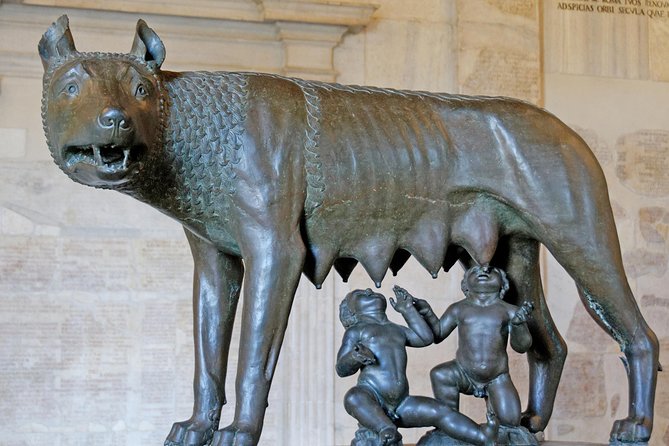
One of the first major works you may encounter is the bronze She-Wolf, the symbol of Rome. Her image is tied to the story of Romulus and Remus, the twin brothers said to have been raised by a wolf before founding Rome.
For children, this is an ideal starting point. It has danger, family conflict, survival, and a legendary creature. The guide can then show how Roman foundation stories differ from the Greek myths familiar from Percy Jackson.
The She-Wolf also helps explain how art can carry political meaning. Rome used stories about its origins to define what made the city special. You are not simply looking at an animal sculpture. You are looking at a symbol that helped Romans explain who they were.
This is where the tour should appeal to adults as much as children. The storytelling has a clear hook for young visitors, but the art and Roman context give parents something substantial to follow.
Gods, heroes, and monsters in stone and bronze
The museum collection includes figures connected with many Percy Jackson characters. Jupiter represents divine power, while Venus, Athena, and Ares bring different parts of the ancient godly world into view. Hercules adds the familiar hero who must face impossible tasks, and Medusa brings the darker side of Greek myth.
Polyphemus, the one-eyed Cyclops, is another memorable connection. You may find that children recognize the creature before they fully understand the ancient source. That recognition gives the guide a chance to explain how old myths continue to appear in modern books and films.
The artwork will not all look like the illustrations in a children’s novel. Some pieces may be busts, fragments, or formal portraits rather than dramatic scenes. That is part of the lesson. Ancient art often communicates power through posture, clothing, hairstyle, symbols, and scale.
A good guide makes those clues visible. Instead of simply saying this is Jupiter, the guide can ask you to notice what identifies him as a god or ruler. That kind of questioning keeps children looking closely rather than waiting for the next story.
More museums and galleries in Rome:
- Vatican: Museums & Sistine Chapel Entrance Ticket
★ 4.5 · 144,003 reviews - Vatican Museums & Sistine Chapel Tour with Optional Basilica
★ 4.3 · 67,413 reviews - Vatican Museums, Sistine Chapel & St Peter’s Basilica Guided Tour
★ 4.5 · 39,149 reviews - Rome: Vatican Museums, Sistine Chapel & Basilica Tour
★ 4.3 · 13,872 reviews
Constantine, Homer, and the Boy with Thorn
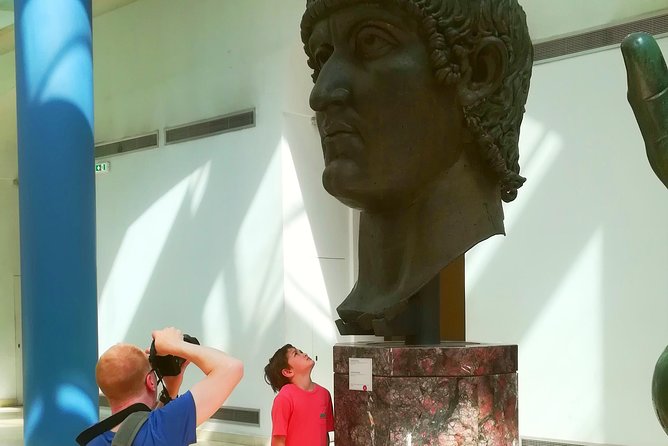
The route includes a portrait of Emperor Constantine, a bust of the poet Homer, and the Boy with Thorn. These works widen the tour beyond the Olympian gods.
Constantine gives you an opening to discuss Roman emperors and the way rulers presented themselves. Homer connects the museum to the epic poems that shaped many Greek myths. The Boy with Thorn is more intimate and human in scale, showing that ancient collections are not only about emperors, gods, and heroic warriors.
For families, this change of mood is helpful. Two and a half hours is a long time for younger children, and a sequence of giant historical figures can become tiring. A small, curious figure such as the Boy with Thorn offers visual variety.
The Homer connection should also appeal to older children and teens. If your child has read Percy Jackson, the guide can place those modern adventures within the much older tradition of epic storytelling. The tour does not require advanced knowledge, but a child who already loves the books will have more connections to make.
Ancient games, calendars, and a gladiator’s tomb
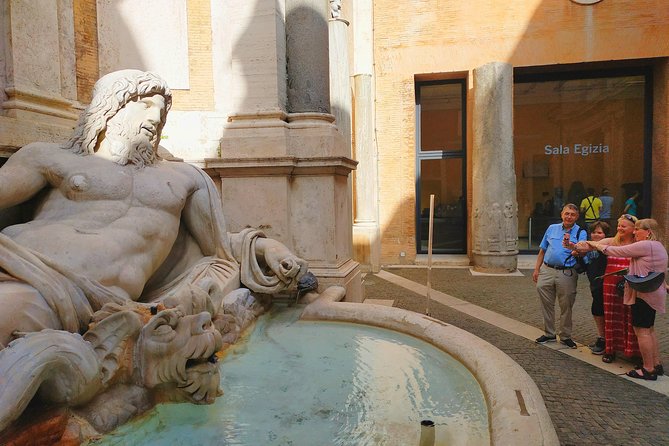
The tour is not limited to gods and monsters. You also learn how ancient Romans played, examine ancient calendars, and see a real gladiator tomb.
These details are valuable because they shift the focus from mythology to ordinary life. A child may remember the monsters first, but the Roman calendar or a gladiator’s burial can make the past feel more real. History becomes something people used, watched, feared, and carried with them, not just a collection of legends.
The gladiator tomb can add a human note to the visit. The stories of heroic combat are often polished by entertainment, while a tomb reminds you that real people lived and died within that world.
The calendar is another useful stop because it shows how Romans organized time. A guide can connect it to the practical side of the ancient city, where religion, politics, and daily routines often overlapped.
These subjects also help parents. If your child is less interested in mythology than expected, the museum still offers games, writing, politics, death, and daily life as alternate points of interest.
A two-and-a-half-hour pace for different ages
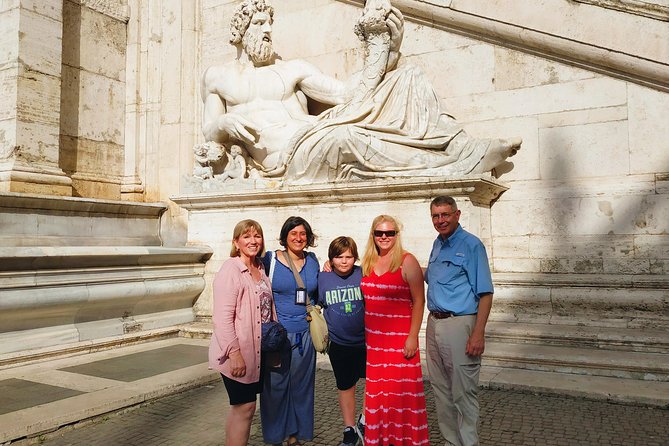
The advertised duration is approximately two hours and 30 minutes. That is enough time to develop a story rather than rush through a few famous objects, but it is also long for a four-year-old.
The experience has worked for families with children as young as four and seven, as well as groups with 10-, 11-, 12-, 13-, 14-, and 17-year-olds. That broad age range is one of its advantages, though you should not expect every child to respond in the same way.
Younger children may focus on monsters, gods, and small gifts or trinkets connected with the tour. Older children may prefer the mythology, the history of Rome, and the chance to correct or expand on what they already know.
If you have several ages in your group, tell the guide what interests each child. The private setting makes this more practical. Maria, for example, has been especially attentive to children who already knew a great deal about the Percy Jackson stories, while other guides have kept younger children involved with questions and playful explanations.
The museum can also feel warm on a hot day. One family found the tour held their children’s attention despite high heat. That is encouraging, but it does not remove the need for water, comfortable shoes, and sensible planning around Rome’s weather. Food and drinks are not included.
What the price means for your family

The listed price is $249.77 per person. That is a serious cost for a 2.5-hour museum visit, particularly for a small family. You are paying for a private activity, a professional guide, museum admission, and a tour shaped around children rather than a standard adult art tour.
The value improves if your group qualifies for a discount or if the cost is shared among several people. The private format can also save you from paying for a generic family experience that fails to interest your children. A child who stays engaged may get more from this museum visit than from a cheaper but less focused tour.
Still, you should compare this price with your own priorities. If your children are not familiar with Percy Jackson or have little interest in myths, a general Rome guide may offer better value. If your family is already planning to visit the Colosseum, Vatican Museums, and Borghese Gallery, this adds a different kind of museum experience, with ancient art explained through stories rather than only chronology.
The tour is booked an average of 34 days ahead, so advance planning makes sense, especially for a particular date. Confirmation arrives at booking. Group discounts are listed, but the exact terms are not provided, so check the price for your party before committing.
What the experience does especially well
The best part is the guide’s ability to make the museum feel approachable. Bruno, Maria, Sara, Alex, and others have been singled out for keeping children involved, but guide assignments are not guaranteed. The experience works when the guide treats the family as an active part of the tour.
The educational value is also stronger than the title might suggest. You learn about Roman and Greek mythology, but also about emperors, philosophers, games, calendars, burial, and famous works of art. Parents can enjoy the content even if they are not looking for a children’s activity.
The private arrangement is another major advantage. Your group does not need to worry about strangers waiting while your child asks a question. You can also tell the guide if your family needs a slower pace or wants to spend more time on a particular character.
The museum setting provides real substance. This is not a costumed character walk or a simple outdoor treasure hunt. The Percy Jackson theme is a way into a major collection of ancient art.
Limits to consider before booking
The tour cannot remove every challenge of a museum visit. Younger children may tire before the end, and children who do not know Percy Jackson may miss some of the intended connections.
The price is the clearest concern. At nearly $250 per person, you need to decide if a private, family-centered guide is worth the premium. The tour includes admission and the guide, but not hotel pickup, food, or drinks.
The description also does not promise costumes, live actors, or a specific set of props. Some children may expect a fully theatrical Percy Jackson adventure. What you are booking is a guided museum tour using the stories as a teaching tool.
You should also remember that children must be accompanied by an adult. Service animals are allowed, most people can participate, and the museum is near public transportation, but the available details do not give a full step-free access description. If that matters to your group, ask the provider before booking.
Who should book this Capitoline Museums tour
I would choose this for a family whose children already enjoy Percy Jackson, Greek gods, monsters, or ancient stories. It is also a good fit for parents who want their children to see serious art without turning the afternoon into a lecture.
It works particularly well for mixed-age groups. A seven-year-old can follow Hercules and Medusa, while a teenager can discuss Homer, Roman religion, and the way modern fiction borrows from ancient sources. Adults get Rome’s art and history, not just a child-focused game.
I would be more cautious if your child is very young, tired easily, or has no interest in mythology. Two and a half hours is a substantial commitment. In that case, a shorter museum visit may be a better choice.
The free cancellation policy gives you some protection. You can cancel at least 24 hours before the start time for a full refund. Changes or cancellations made less than 24 hours before the start time are not accepted, and the times are based on Rome’s local time.
Final call: Is it worth booking?
Book this tour if you want your children to connect with Rome through familiar stories, and if the private guide format matters to you. The strongest reasons are the tailored attention, the range of ages it can serve, and the way it combines major artworks with practical details about ancient Roman life.
Skip it if the price feels too high for a single museum or if your family is not interested in Percy Jackson and classical mythology. For the right group, though, this is a smart way to make the Capitoline Museums feel lively, memorable, and understandable without reducing the art to a simple children’s game.
FAQ
Where does the Percy Jackson and the Olympian Gods Tour begin?
The tour begins at Piazza del Campidoglio, 00186 Roma RM, Italy.
Where does the tour end?
The activity ends back at the meeting point in Piazza del Campidoglio.
How long does the tour last?
The tour lasts approximately 2 hours and 30 minutes.
Is museum admission included?
Yes. Admission to the Capitoline Museums is included.
Is this a private tour?
Yes. Only your group participates in the private tour or activity.
Is the tour offered in English?
Yes. The tour is offered in English.
Can I cancel for a full refund?
Yes, if you cancel at least 24 hours before the experience start time. Cancellations or changes made less than 24 hours before the start time are not accepted for a refund.
Newest reviews from Rome
- ROME:Colosseum & Ancient Rome – private/small group TOUR★ 5.0 · 24 reviews
- Off the Beaten Track in Rome: Rione VI Parione Private Tour★ 5.0 · 24 reviews
- Cinematic Photoshoot in Rome★ 5.0 · 24 reviews
- Rome: Best of Colosseum and Roman Forum Small Group Guided Tour★ 4.5 · 24 reviews
- The Labyrinth of Rome between catacombs and ancient quarries★ 4.5 · 24 reviews
- Vatican and Trionfale Market Tour with Wine and Food Tasting★ 5.0 · 24 reviews
- private tour: Vatican Museums, Sistine Chapel, St. Peter’s Basilica★ 4.5 · 24 reviews
- Colosseum guided tour with Virtual Reality★ 5.0 · 24 reviews
Capitoline Museums Tours, compared.
Capitoline Museums Experience with Multimedia Video
Read our review →
Capitoline Museum Experience with Multimedia Video
Read our review →
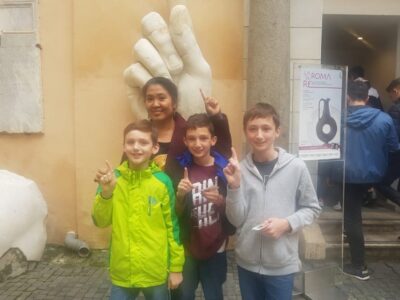


Percy Jackson Tour for Kids at the Capitoline Museums of Rome with Special Guide
Read our review →
Capitoline Museum English Guided Tour & skip the line ticket
Read our review →Browse the lists this tour appears in