
Reviewed · AUDIO TOURS
Pompeii: Entry Ticket w/ Guide and Transfers or Audio Guide
Pompeii is not a museum filled with objects behind glass. It is a city you walk through, with streets, bakeries, villas, public baths, and a forum still laid out beneath Mount Vesuvius. I like the choice between a live guide and an English audio guide, and I like that Rome departures can include round-trip bus or train transport. The main caution is the long travel time from Rome, with some options lasting up to 12 hours.
I also like the chance to see the Forum, amphitheater, Villa of the Mysteries, and the plaster casts of people caught in the eruption. Guide Giuseppe has earned particular praise for making the visit both clear and engaging. Still, this is an outdoor archaeological site with uneven ground, and the experience is not suitable for wheelchair users or people with mobility impairments.
In This Review
- Key points to know before booking
- Why Pompeii feels different from an ordinary ruin
- Choosing between a live guide and an audio guide
- The Forum, where public Pompeii took shape
- The amphitheater and the public side of Roman life
- Villas, frescoes, and the world of the wealthy
- Baths, bakeries, and shops that make daily life visible
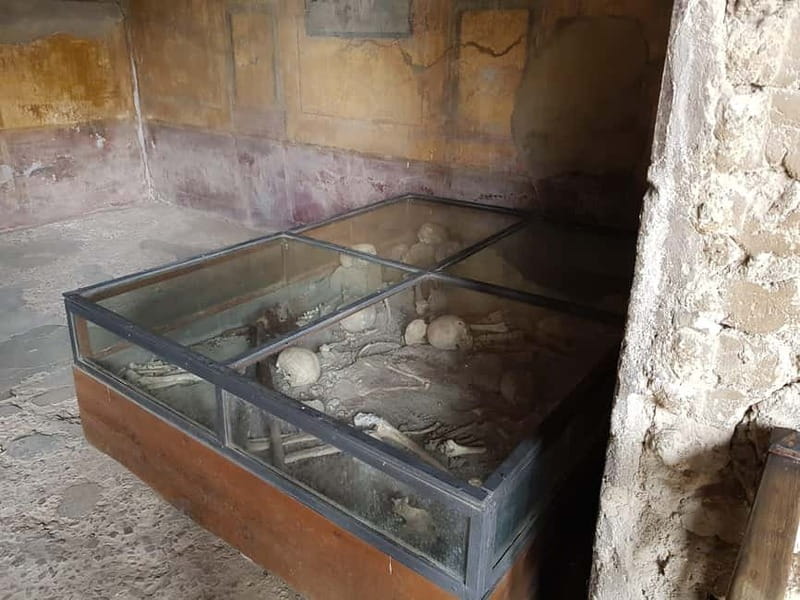
- The plaster casts and the human cost of the eruption
- From Rome: the transport option and the time involved
- How much value do you get for $5.55?
- Who should book this Pompeii experience?
- Practical advice for a smoother visit
- Should you book it?
- FAQ
- Where does the Pompeii activity start?
- Does the experience include entry to Pompeii Archaeological Park?
- Is transportation from Rome included?
- Can I choose between a guide and an audio guide?
- Which languages are available for the host or guide?
- How long does the activity last?
- Is the activity suitable for wheelchair users?
- Can I cancel for a refund?
Key points to know before booking
- Pompeii is a full ancient city, not a single monument: You walk through streets, homes, shops, baths, political spaces, and entertainment buildings.
- Choose your style of visit: A live guide gives structure and context, while the English audio guide lets you set your own pace.
- Rome transport changes the shape of the day: The transport option makes the outing easier to manage, but the complete trip can last up to 12 hours.
- The plaster casts are the emotional center: They make the eruption personal in a way that stone walls alone cannot.
- The price is unusually low: At $5.55 per person, the value is strong if that rate applies to your selected option, but check exactly what transport and guiding it includes.
- Arrive early at the meeting point: The tour will not wait for latecomers, and the meeting location depends on the option you book.
Why Pompeii feels different from an ordinary ruin
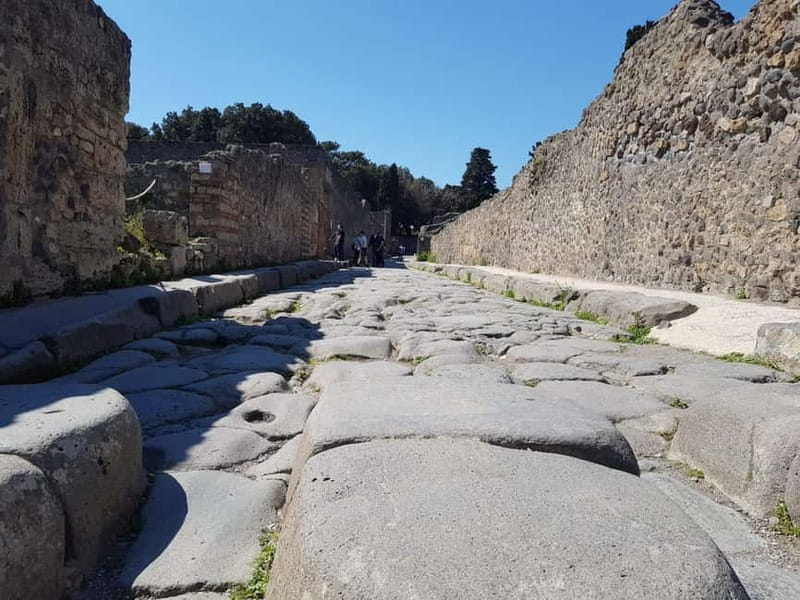
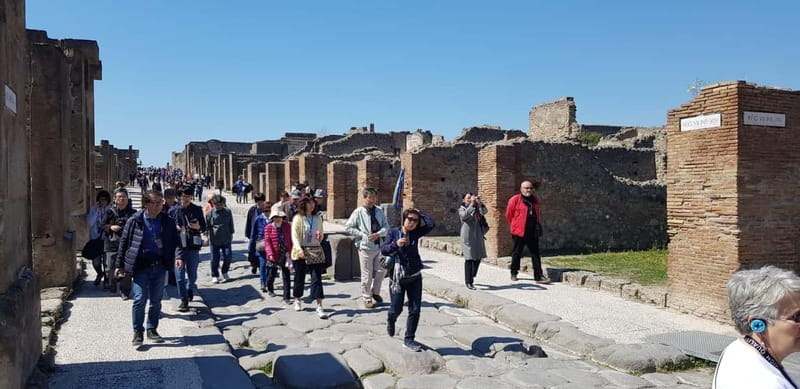
Pompeii gives you an unusual sense of scale. You are not simply looking at a temple facade or a broken column. You can follow an ancient road, pass doorways, peer into homes, and recognize the basic shape of a city that once served thousands of people.
Mount Vesuvius buried Pompeii in 79 AD after a catastrophic eruption. Ash and volcanic material covered much of the city, preserving details that would normally disappear: wall paintings, mosaics, ovens, shop counters, public buildings, and the marks of daily use.
That preservation can make the place feel immediate. You might find yourself studying a faded fresco one minute and looking at a broad stone street the next. The city is damaged, of course, but it is not an empty shell. Its layout still helps you picture how Roman public and private life worked.
I find the best way to approach Pompeii is to expect both grandeur and ordinary details. The Forum matters because it was the civic heart of the city. A bakery matters because it shows how people ate. A villa matters because its rooms and decoration reveal social rank. Together, these pieces create a much clearer picture than a list of dates ever could.
More Rome tours worth comparing
- Rome: Colosseum & Forum with Audio Guide App -Optional Arena
★ 4.2 · 24,770 reviews - Rome: St. Peter’s Basilica & Dome Entry Ticket & Audio Tour
★ 4.2 · 7,537 reviews - Vatican & Sistine Chapel Ticket with Optional Audio Guide
★ 4.1 · 5,405 reviews
Choosing between a live guide and an audio guide
The guided option is the better choice if you want someone to explain what you are seeing as you move through the site. A guide can point out a feature you might otherwise miss, explain how a public building functioned, and connect the eruption to the lives of ordinary residents.
The available host languages are English, French, Spanish, and German. If your option includes a live guide, the quality of the day depends partly on how well that person handles the large amount of material at Pompeii. Giuseppe is one guide specifically praised for being friendly, helpful, and effective at bringing the site to life.
The audio guide option suits you if you prefer independence. You can stop longer at a house that interests you, move on from a crowded space, or keep your visit quieter and more personal. The audio guide is available in English, so this option is less useful if you need another language.
A live guide also helps with orientation. Pompeii can feel confusing because the site contains many streets and buildings, and not every area is open at all times. An audio guide gives you freedom, but you need to pay closer attention to where you are and how much time you have left.
The Forum, where public Pompeii took shape
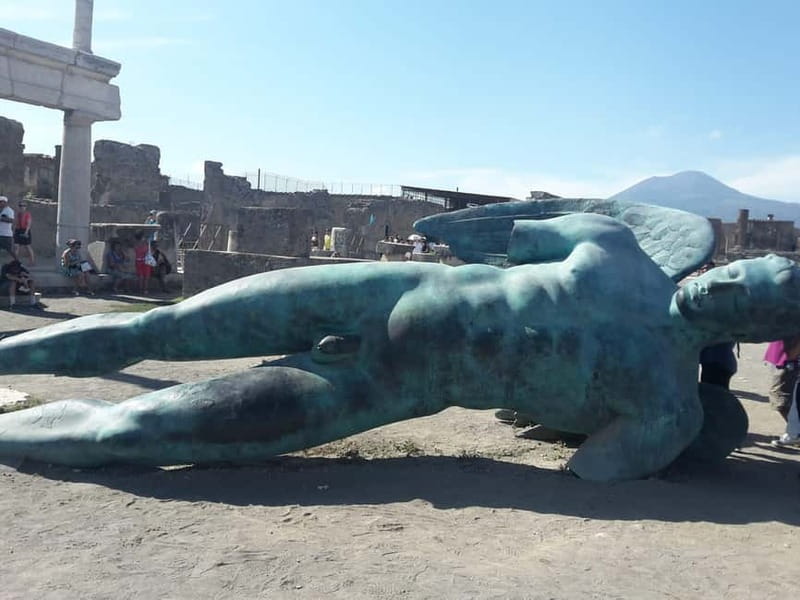
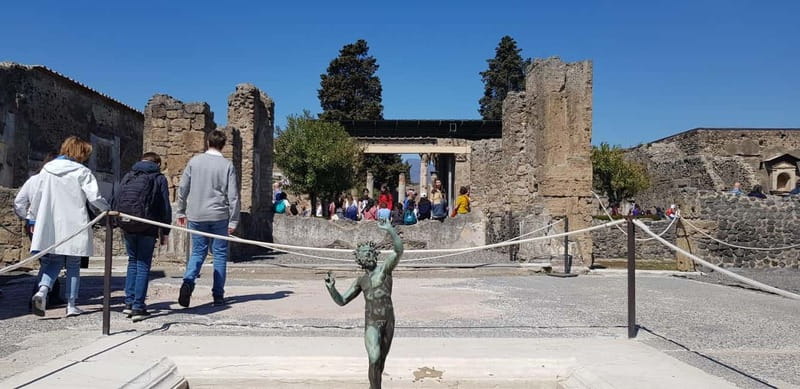
The Forum is one of the essential stops. This was the center of public life, with political, religious, and social roles packed into one broad area. The open space helps you understand how the city was organized around shared civic activity.
Your guide can give the Forum meaning beyond its surviving stones. Look at it as the place where people handled public business, met others, attended ceremonies, and saw the power of local government displayed in architecture.
The Forum is also a useful early stop because it sets up the rest of the visit. After seeing the civic center, you can better understand why homes, shops, temples, and baths were arranged around it and the surrounding streets.
Do not rush through this area simply because it is open and spacious. Pompeii often rewards a slow look. The remains may seem plain at first, but the scale of the buildings and the view toward Vesuvius connect the ruined city to the disaster that ended its life.
The amphitheater and the public side of Roman life
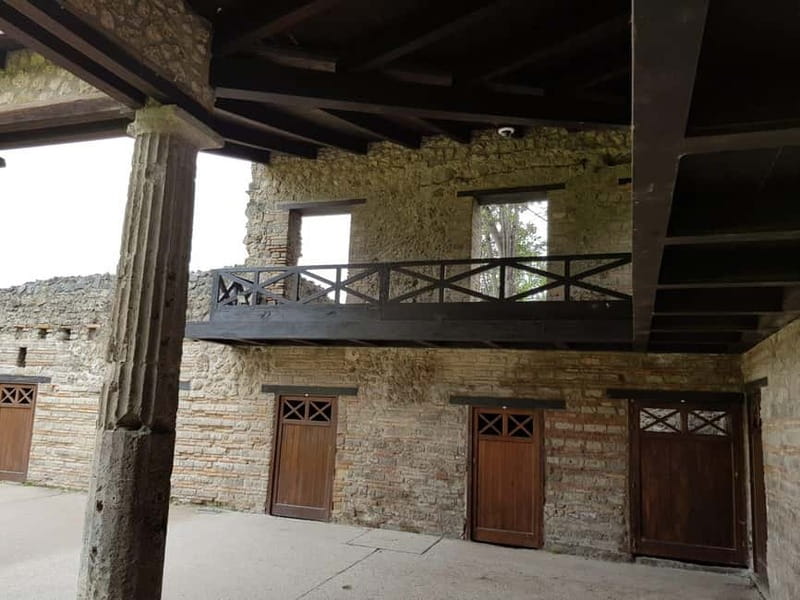
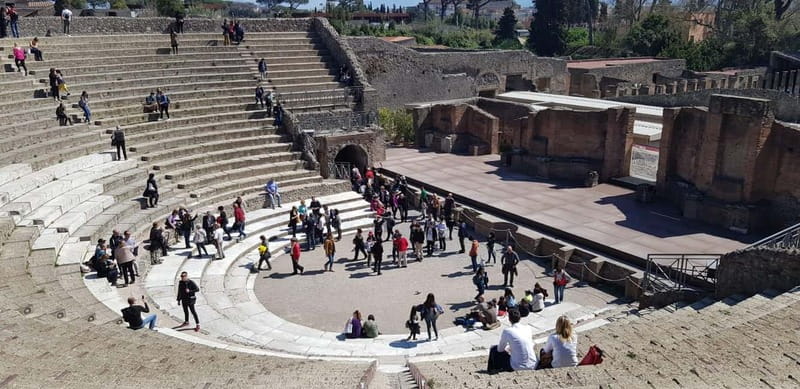
The amphitheater shows a different side of Pompeii. Here, entertainment drew large crowds, and gladiatorial contests formed part of the public culture. The building is a reminder that Roman cities were shaped not only by government and religion, but also by spectacle.
I like this stop because it is easy to picture people entering, finding their places, and reacting to events in the arena. The structure also gives you a sense of how large Pompeii’s population and public life must have been.
The amphitheater is not just an impressive photo stop. It helps balance the more domestic parts of the tour. After looking at bedrooms, gardens, kitchens, and wall paintings, you see a space designed for mass attendance and shared excitement.
Your time here may depend on the route and the specific option you select. The tour promises visits to key landmarks, but the exact order can vary. If the amphitheater is especially important to you, mention it to your guide or confirm its inclusion when checking the details of your booking.
A completely different way to spend the day in Rome:
- Vatican: Museums & Sistine Chapel Entrance Ticket
★ 4.5 · 144,003 reviews - Vatican Museums & Sistine Chapel Tour with Optional Basilica
★ 4.3 · 67,413 reviews - Vatican Museums, Sistine Chapel & St Peter’s Basilica Guided Tour
★ 4.5 · 39,149 reviews - Rome: Colosseum, Palatine Hill and Roman Forum Guided Tour
★ 4.8 · 32,814 reviews
Villas, frescoes, and the world of the wealthy
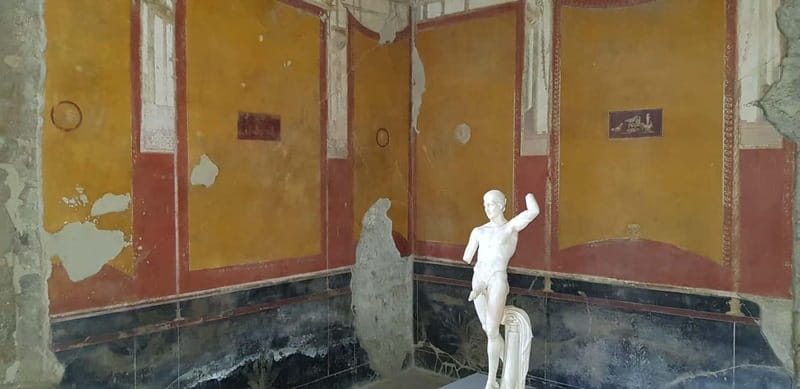
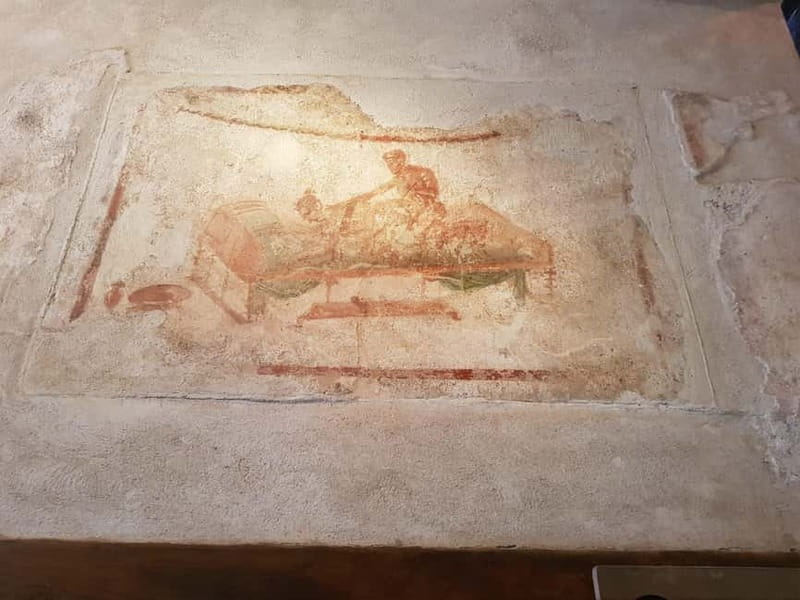
Pompeii’s villas reveal how the city’s wealthier residents lived. The House of the Vettii is especially important for its decorative interiors and the glimpse it gives into elite domestic life. Frescoes and mosaics were not simply decoration. They showed taste, money, education, and social position.
The Villa of the Mysteries adds another layer. Its painted rooms are among the site’s most memorable features, and the villa helps show how private residences could be much more than places to sleep. Homes could include reception rooms, gardens, service areas, and spaces designed to impress visitors.
You may find that the most powerful details are small. A painted wall, a worn threshold, or a room arranged around an open space can tell you how people moved through the house and how they wanted to be seen.
The condition of individual buildings can change, and not every room is guaranteed to be open on every date. Pompeii is an active archaeological park, so closures can happen. A guide is useful here because you can still understand the importance of a building even if part of it is inaccessible.
Baths, bakeries, and shops that make daily life visible
Pompeii becomes especially vivid when you leave the grand monuments and look at practical places. Ancient baths show how washing, exercise, conversation, and social contact could happen in public facilities. Bakeries and shops reveal the working side of the city.
These buildings are valuable because they make Roman life easier to imagine. You can move from the Forum to the places where people bought food, worked, met friends, and managed everyday routines. The city becomes less like an archaeological puzzle and more like a functioning community.
The preserved shop counters and ovens are particularly helpful for younger visitors. Children may not care about a political building, but they can understand a bakery or a shop. That is one reason the experience can work well for families, especially with a guide who can explain the site in a lively way.
The streets themselves deserve attention. Ancient paving, building entrances, and the arrangement of homes and businesses show how people navigated the city. Watch your footing, though. Uneven surfaces are part of the site and can make walking tiring.
The plaster casts and the human cost of the eruption
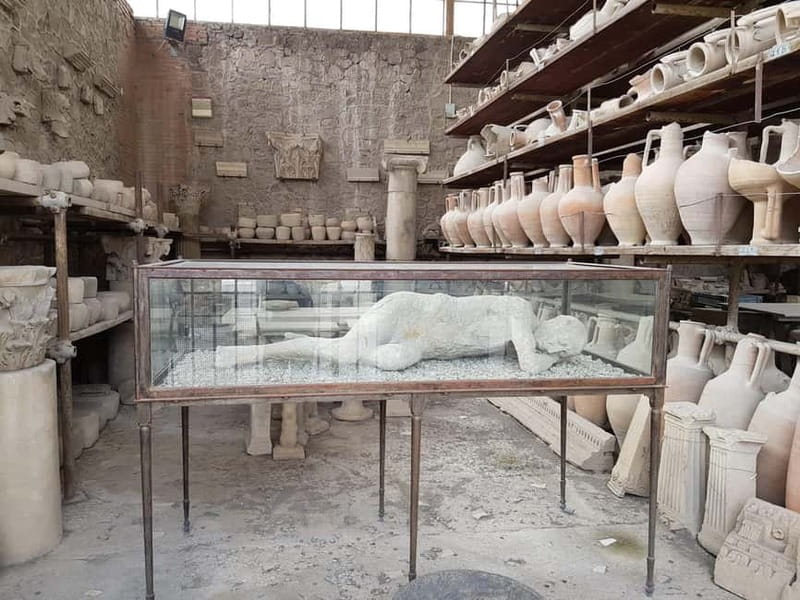
The plaster casts are the most moving part of the visit. They preserve the forms of people who died during the eruption, giving a human shape to an event that can otherwise seem distant.
This stop changes the tone. The Forum and amphitheater show public life, while the villas show status and taste. The casts remind you that Pompeii was also a place where families, workers, and residents faced a sudden disaster.
I recommend taking your time here and treating the display with respect. It is easy to focus on the technical method used to create the casts, but the emotional force comes from remembering that these were people caught in a real catastrophe.
The casts are also one reason a guided visit can be worthwhile. A good explanation can provide context without turning the display into spectacle. You will come away with a more human understanding of Pompeii and the eruption of Vesuvius.
From Rome: the transport option and the time involved
If you select the option with transport from Rome, the day includes bus or train travel through the Italian countryside. This removes some of the planning burden, particularly if you do not want to arrange the route to Pompeii yourself.
The tradeoff is time. Some versions of the activity last up to 12 hours, and the journey from Rome takes a meaningful part of the day. You should think of this as a major day trip, not a quick side visit.
The transport option is a good fit if you want the logistics handled and prefer returning to the same meeting point in Rome. It can also suit solo visitors who want organized transport and a clear structure for the day. The experience has received strong praise for smooth transport and well-managed organization.
Do not assume that every booking includes transport. Some options require you to make your own way directly to Pompeii. Read the selected option carefully, note the exact meeting point, and allow extra time. The meeting location can vary, and late arrivals will not be accommodated.
Food and drinks are not allowed in the vehicle, and large bags or oversize luggage are not permitted. Pack lightly and keep the day simple.
How much value do you get for $5.55?
A listed price of $5.55 per person is remarkably low for entry to Pompeii, especially if your chosen version includes a guide or transport. At that rate, the experience can be one of the best-value cultural outings available from the Rome area.
The important point is to compare the exact option rather than treating the headline price as universal. The activity has several formats: direct entry, entry with a guide, entry with an audio guide, and versions that include round-trip transport from Rome. The price and duration can change with the format.
Even without transport, entry to an archaeological site of this scale gives you access to far more than a single monument. You can spend hours moving among civic buildings, villas, public facilities, shops, and streets. The audio guide can add useful context without the cost of a private tour.
A guided option may be worth paying more for if Pompeii is a major reason for your trip. Without context, it is possible to see a lot of stone and miss how the city functioned. With a strong guide, the buildings connect into a story about work, wealth, entertainment, politics, and sudden loss.
Who should book this Pompeii experience?
I would recommend this outing to first-time visitors who want the main sights explained in a clear order. It also suits solo visitors, couples, families, and anyone who prefers an organized trip rather than handling every transport detail alone.
Families should consider the walking time and uneven ground. The ancient streets and buildings can be fascinating for children, especially the bakery, shops, amphitheater, and vivid stories of daily life. A full Rome to Pompeii day may still be tiring for younger children.
History fans and archaeology enthusiasts will find plenty to hold their attention, particularly in the villas and public buildings. You can also use the free time around the guided portion to look more closely at details that interest you.
This is not a good fit if you need step-free access or use a wheelchair. The activity is specifically not suitable for people with mobility impairments or wheelchair users. You also need to be comfortable walking outdoors in changing weather, since tours run rain or shine unless officials close the monument for safety.
Practical advice for a smoother visit
Check the start time and meeting point immediately after booking. Since the location can differ by option and the tour will not wait for latecomers, this is one detail you should not leave until the morning of the visit.
Wear practical shoes. Pompeii’s old streets are uneven, and the site is large enough that you will spend much of your time on foot. Bring only what you need because large bags and oversize luggage are not allowed.
Plan for changing weather. The tour operates in rain unless the site closes for safety, so a light rain layer can make a difference. You will spend time outdoors, even when visiting enclosed rooms and villas.
If you choose the audio guide, remember that it is offered in English only. If you want explanations in French, Spanish, German, or English from a host, select the live guided option instead.
The cancellation policy gives you useful flexibility: you can cancel up to 24 hours before the activity for a full refund. Reserve now and pay later is also available, which helps if your Rome plans are still shifting.
Should you book it?
Book this Pompeii experience if you want to see the Forum, amphitheater, villas, daily-life buildings, and plaster casts without arranging every part of the visit yourself. The guided option is the best choice for context, while the audio guide is better if you like moving at your own speed.
The Rome transport version is worth considering for convenience, but accept that it can turn into a long day. If you are already near Pompeii, direct entry may make more sense. At the listed $5.55 price, the value is excellent, provided you confirm what your selected option includes.
I would book it for a first visit, a family day out, or a solo excursion where reliable structure matters. I would skip it only if mobility limitations make uneven archaeological ground difficult, or if you want a short, flexible stop rather than a full Pompeii experience.
FAQ
Where does the Pompeii activity start?
The meeting point depends on the option you book. Some versions begin at a meeting point in Rome with transport, while others require you to make your own way directly to Pompeii.
Does the experience include entry to Pompeii Archaeological Park?
Yes, entry to Pompeii Archaeological Park is included.
Is transportation from Rome included?
Round-trip transportation from Rome is included only if you select the transport option. The transport may be by bus or train.
Can I choose between a guide and an audio guide?
Yes. You can select a guided visit or an audio guide option. The audio guide is available in English.
Which languages are available for the host or guide?
The host or guide may be available in English, French, Spanish, or German, depending on the option selected.
How long does the activity last?
The duration ranges from 2 to 12 hours. Check the available starting times and selected option for the exact length.
Is the activity suitable for wheelchair users?
No. The activity is not suitable for wheelchair users or people with mobility impairments.
Can I cancel for a refund?
Yes. You can cancel up to 24 hours in advance for a full refund. Reserve now and pay later is also available.
Newest reviews from Rome
- ROME:Colosseum & Ancient Rome – private/small group TOUR★ 5.0 · 24 reviews
- Off the Beaten Track in Rome: Rione VI Parione Private Tour★ 5.0 · 24 reviews
- Cinematic Photoshoot in Rome★ 5.0 · 24 reviews
- Rome: Best of Colosseum and Roman Forum Small Group Guided Tour★ 4.5 · 24 reviews
- The Labyrinth of Rome between catacombs and ancient quarries★ 4.5 · 24 reviews
- Vatican and Trionfale Market Tour with Wine and Food Tasting★ 5.0 · 24 reviews
- private tour: Vatican Museums, Sistine Chapel, St. Peter’s Basilica★ 4.5 · 24 reviews
- Skip the Line: Vatican Wheelchair Accessible Private Tour★ 5.0 · 24 reviews
Audio Tours, compared.

Colosseum & Forum with Audio Guide App -Optional Arena
Read our review →
St. Peter’s Basilica & Dome Entry Ticket & Audio Tour
Read our review →
Vatican & Sistine Chapel Ticket with Optional Audio Guide
Read our review →
Colosseum, Forum, & Palatine Hill with Audio Guide
Read our review →
Castel Sant’Angelo Skip-the-Line Ticket & Audio Guide
Read our review →
Skip the Line: Vatican & Sistine Chapel Ticket with Audio Guide
Read our review →
Pantheon Priority Entry Ticket & Audio Guide App
Read our review →
Colosseum Experience with Audio Guide and Arena Option
Read our review →Browse the lists this tour appears in